A French Word to Live By
Translate Papa to English
/pa.pa/
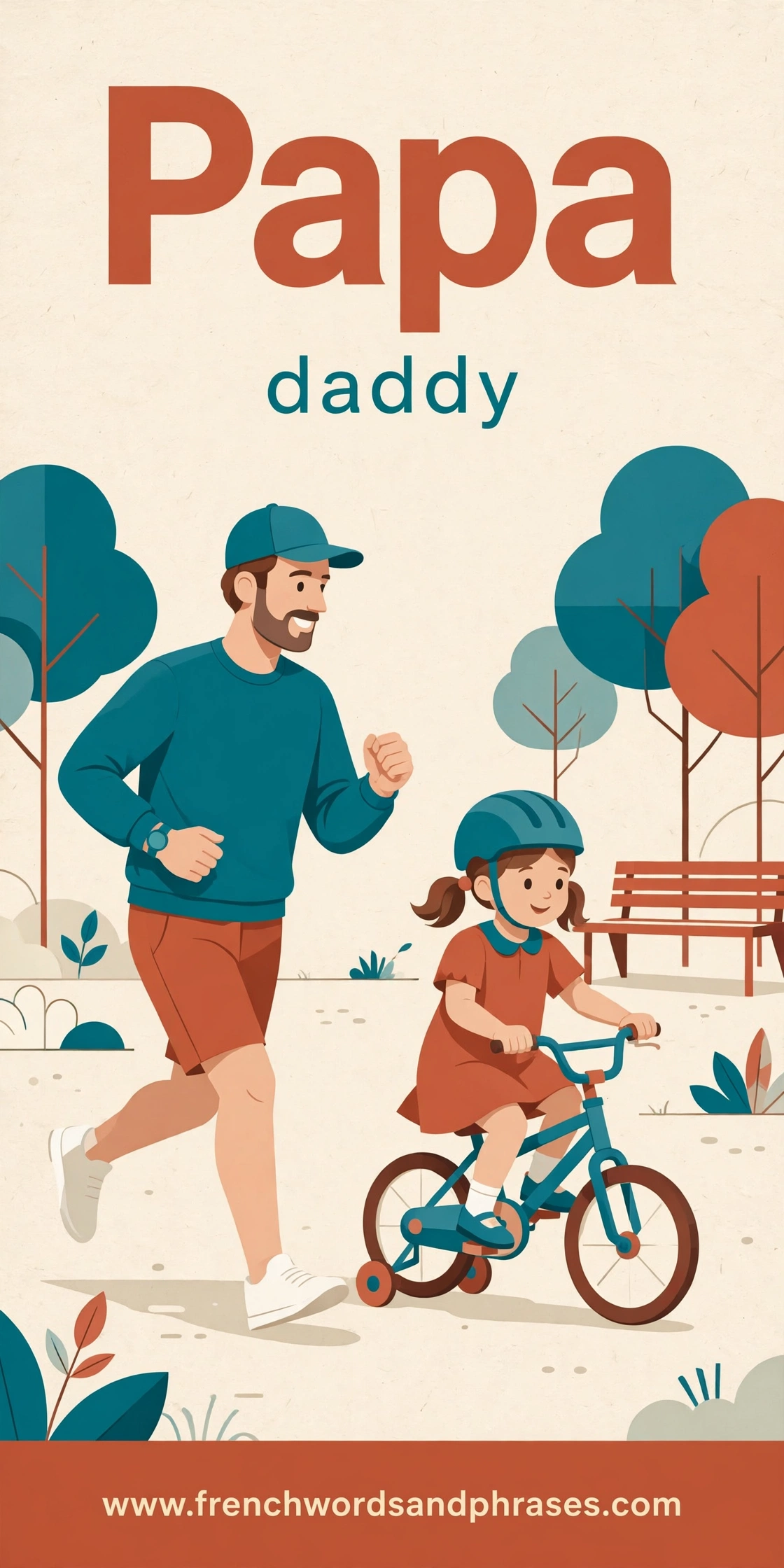
Papa means daddy.
A key in the door at the end of the day, two small feet running down the hall, a story before sleep with the book held wide — in every French home, one voice is answered before all the others: papa.
In this guide, you’ll learn what papa means in English, how to use it with its articles, how to form its plural, and how it appears in everyday French. Explore French examples, English translations, and practice quizzes.
Understanding the French Noun Papa
Papa is a masculine French noun — but, like maman, it is really a family word. Inside the home it is used exactly like a name: you call him papa, you talk to him as papa, and most of the time it carries no article at all.
It means daddy — the warm, everyday word children use for their father, and the word most French adults keep for him all their lives. For talking about a father in a neutral way, French uses un père; papa is the word of the home.
Gender: Masculine
Definite article: None in family use — just papa. (About someone else’s dad: le papa de Marie, Marie’s dad)
Indefinite article: None in family use. Generally: un papa (a dad)
Plural: les papas (the dads)
English equivalents: Daddy; dad.
One important usage detail: because papa works like a name, you do not say le papa for your own father — you simply say papa. The article appears when the word becomes an ordinary noun: un papa formidable (a wonderful dad), le papa de Léo (Léo’s dad). At home it is always papa; père is the neutral word for speaking about a father.
Experience the Word
Papa is more than a word for a father. It is the name of the shoulders you rode on, the voice in the doorway at six o’clock, the reader of the last story of the day.
Imagine a small apartment in the evening: a book open on a child’s bed, a lamp low, and the question every French father knows by heart — Encore un chapitre avant de dormir, papa ?
You have not just named a parent. You have asked for the story one more time.
How to Use Papa in French: Complete Guide
Let’s explore how papa works in French, beginning with its most surprising feature: it usually has no article at all.
Papa and Its Articles
French nouns are almost never used alone — but papa breaks the rule. Inside the family it is used bare, like a first name.
Papa with the Definite Article (Le, Les)
At home there is no article. The article appears only when papa becomes an ordinary noun — for someone else’s dad, or for dads in general.
| Use | French |
|---|---|
| In the family, like a name | papa |
| Someone else’s dad | le papa de Marie |
| Dads in general | les papas |
Example
Le papa de Marie est très drôle.
Marie’s dad is very funny.
Papa with the Indefinite Article (Un, Des)
Speaking generally — not about your own father — papa takes un and des like any other masculine noun.
| Number | French |
|---|---|
| Singular | un papa |
| Plural | des papas |
Example
Un papa attend devant l’école avec une poussette.
A dad is waiting in front of the school with a pushchair.
Talking to Papa
This is where papa lives: called from the stairs, thanked, asked for one more story — always bare, always direct.
| Situation | French |
|---|---|
| Calling him | Papa ! |
| Thanking him | Merci, papa ! |
| Asking for another chapter | Papa, encore un chapitre ! |
| Calling him to the table | Papa, à table ! |
| Saying goodnight | Bonne nuit, papa ! |
Example
Papa, tu viens jouer ?
Dad, are you coming to play?
Quick Quiz 1
How do you call your father when you speak to him at home?
Reveal the answer
Papa !
With no article at all — papa works like a name.
Encore un chapitre avant de dormir, papa ?
One more chapter before sleep, Dad?
The Plural of Papa
Outside the family, papa behaves like a regular masculine noun and simply adds an -s.
| Number | French |
|---|---|
| Singular | un papa |
| Plural | des papas |
Example
Il y a beaucoup de papas à la réunion de l’école.
There are lots of dads at the school meeting.
Papa with Possessive Adjectives (Mon, Ton, Son…)
Possessives agree with the noun, not with the owner — and papa is masculine, so it takes mon, ton, son.
| Owner | French |
|---|---|
| my | mon papa |
| your (tu) | ton papa |
| his / her | son papa |
| our | notre papa |
| your (vous) | votre papa |
| their | leur papa |
Example
C’est mon papa qui conduit, d’habitude.
It’s usually my dad who drives.
Quick Quiz 2
Complete the sentence:
C’est ______ papa qui conduit.
Reveal the answer
mon
C’est mon papa qui conduit.
It’s my dad who’s driving.
Papa with Demonstrative Adjectives (Ce, Ces)
Used to point — mostly about other people’s dads, or dads as a group.
| Number | French |
|---|---|
| Singular | ce papa |
| Plural | ces papas |
Example
Ce papa a trois enfants.
This dad has three children.
Papa with Adjectives
Most French adjectives come after the noun and agree with it — papa is masculine, so: un papa gentil, un papa fatigué.
| Adjective | With Papa |
|---|---|
| gentil (kind) | un papa gentil |
| drôle (funny) | un papa drôle |
| patient (patient) | un papa patient |
| fatigué (tired) | un papa fatigué |
| occupé (busy) | un papa occupé |
| formidable (wonderful) | un papa formidable |
Example
C’est un papa formidable, toujours patient.
He is a wonderful dad, always patient.
Quick Quiz 3
Complete the sentence:
C’est un papa très ______ (funny).
Reveal the answer
drôle
C’est un papa très drôle.
He is a very funny dad. (drôle keeps the same form for masculine and feminine.)
Everyday Expressions with Papa
Papa appears in affectionate expressions every French child grows up hearing.
| Expression | In English |
|---|---|
| un papa poule | a doting dad (literally, a father hen) |
| un papa gâteau | a soft, indulgent dad |
| un jeune papa | a new dad |
| chez papa | at Dad’s house |
| le papa de Marie | Marie’s dad |
Example
C’est un vrai papa poule, toujours avec ses enfants.
He is a real doting dad, always with his children.
Words from the Same Family as Papa
Learn these together and the whole family falls into place.
| French | In English |
|---|---|
| un père | a father (the neutral word) |
| un grand-père | a grandfather |
| la paternité | fatherhood |
| paternel | fatherly, paternal |
| un bébé | a baby |
| la famille | the family |
Example
Mon grand-père est le père de mon papa.
My grandfather is my dad’s father.
Quick Quiz 4
What does un papa gâteau mean?
Reveal the answer
A soft, indulgent dad
C’est un papa gâteau, il ne dit jamais non.
He is a soft touch of a dad, he never says no.
Papa in Everyday French: Real-Life Examples
Now that you know the word, let’s see how papa appears in everyday French.
Example 1 — At bedtime
Encore un chapitre avant de dormir, papa ?
One more chapter before sleep, Dad?
Example 2 — In the garden
Papa, on joue au foot ?
Dad, shall we play football?
Example 3 — Weekend plans
On va chez papa ce week-end.
We’re going to Dad’s this weekend.
Example 4 — In the evening
Papa rentre tard ce soir.
Dad is coming home late tonight.
Example 5 — Saying thank you
Merci, papa, pour le vélo !
Thanks, Dad, for the bike!
Example 6 — Good news
Papa, j’ai réussi mon examen !
Dad, I passed my exam!
Beyond Translation: The Meaning of Papa
English says daddy or dad for the meaning of papa — but the French word is the sound of the front door. It belongs to childhood: the story at bedtime, the shoulders at the parade, the huge figure who fixes bicycles and opens jars.
To say papa is to speak from inside the family.
Like maman, it never really retires — French adults write about leur père but still telephone papa. And French has a soft spot in its heart for him: un papa poule, the father hen, and un papa gâteau, the dad who cannot say no, are portraits painted with affection.
How to Remember the French Noun Papa
Remember it this way: Papa is the home word for father — a masculine noun that behaves like a name and takes no article.
- You call him from the stairs — Papa !, with nothing in front of it.
- You talk about another child’s father — le papa de Marie.
- You describe a dad in general — un papa formidable.
The key idea is at home it is just papa; with an article, it is about someone else’s dad.
Test Your Knowledge of Papa
Let’s see how much you’ve learned. Try answering these questions before revealing the answers.
Question 1
Is papa masculine or feminine?
Reveal the answer
Masculine — un papa, le papa (when an article is used).
Question 2
Which word do you use to call your father at home: père or papa?
Reveal the answer
Papa
Encore un chapitre avant de dormir, papa ?
One more chapter before sleep, Dad?
Question 3
Translate: We’re going to Dad’s this weekend.
Reveal the answer
On va chez papa ce week-end.
Question 4
What does un papa poule mean?
Reveal the answer
A doting dad — literally, a father hen.
Question 5
Complete the sentence:
Encore un chapitre avant de dormir, ______ ?
Reveal the answer
papa
Encore un chapitre avant de dormir, papa ?
One more chapter before sleep, Dad?
Your Final Challenge
Can You Use It?
How would you say this in French?
“Thanks, Dad, for the bike!”
Reveal the answer
Merci, papa, pour le vélo !
Thanks, Dad, for the bike!
A little French. A little curiosity. A richer everyday life.
LEARN FRENCH ONE WORD AT A TIME