A French Word to Live By
Translate Maman to English
/ma.mɑ̃/
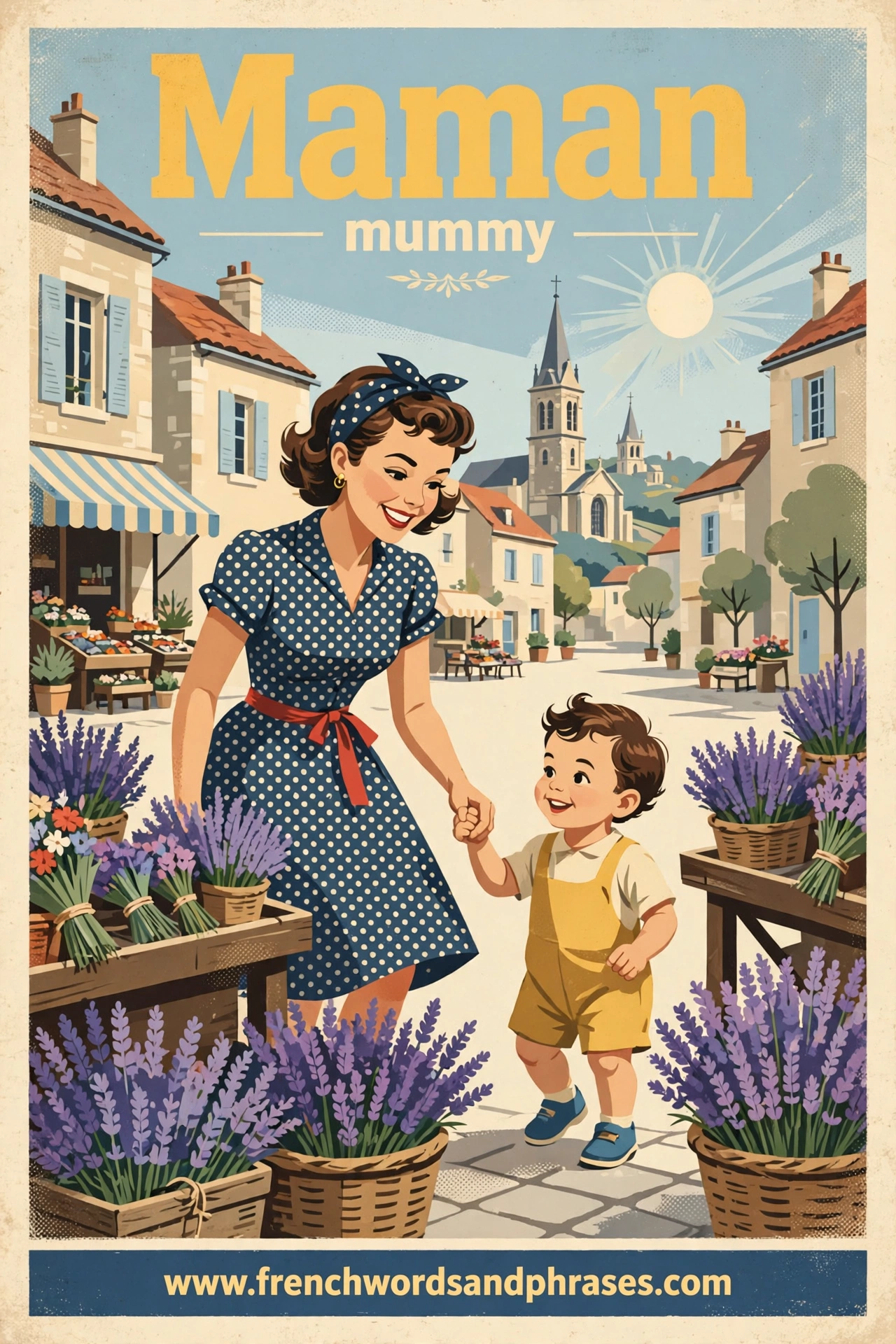
Maman means mummy.
A small voice from the kitchen doorway, a drawing held up with both hands, a call across the garden at dusk — in every French home, one word rises above all the others, and nobody needs an article to say it: maman.
In this guide, you’ll learn what maman means in English, how to use it with its articles, how to form its plural, and how it appears in everyday French. Explore French examples, English translations, and practice quizzes.
Understanding the French Noun Maman
Maman is a feminine French noun — but a noun with a difference. It is a family word, used inside the home exactly like a name: you call her maman, you talk to her as maman, and most of the time it carries no article at all.
It means mummy — the warm, everyday word children use for their mother, and the word most French adults still use for their own mother all their lives. For talking about a mother in a neutral way, French uses une mère; maman is the word of the home, spoken with love.
Gender: Feminine
Definite article: None in family use — just maman. (About someone else’s mum: la maman de Marie, Marie’s mum)
Indefinite article: None in family use. Generally: une maman (a mum)
Plural: les mamans (the mums)
English equivalents: Mummy; mum; mom.
One important usage detail: because maman works like a name, you do not say la maman for your own mother — you simply say maman. The article appears when the word becomes an ordinary noun: une maman formidable (a wonderful mum), la maman de Léo (Léo’s mum). At home it is always maman; mère is the neutral word for speaking about a mother.
Experience the Word
Maman is more than a word for a mother. It is the first word most French children ever say, and for many families it is the last one they would ever give up.
Imagine a hallway just before school: a bag half-zipped, one shoe in a small hand, and a voice calling from the kitchen doorway — Maman, tu as vu mes chaussures rouges ?
You have not just named a parent. You have called home itself.
How to Use Maman in French: Complete Guide
Let’s explore how maman works in French, beginning with its most surprising feature: it usually has no article at all.
Maman and Its Articles
French nouns are almost never used alone — but maman breaks the rule. Inside the family it is used bare, like a first name.
Maman with the Definite Article (La, Les)
At home there is no article. The article appears only when maman becomes an ordinary noun — for someone else’s mum, or for mums in general.
| Use | French |
|---|---|
| In the family, like a name | maman |
| Someone else’s mum | la maman de Marie |
| Mums in general | les mamans |
Example
La maman de Marie est très gentille.
Marie’s mum is very kind.
Maman with the Indefinite Article (Une, Des)
Speaking generally — not about your own mother — maman takes une and des like any other feminine noun.
| Number | French |
|---|---|
| Singular | une maman |
| Plural | des mamans |
Example
Une maman attend devant l’école.
A mum is waiting in front of the school.
Talking to Maman
This is where maman lives: called across a room, thanked, answered, wished goodnight — always bare, always direct.
| Situation | French |
|---|---|
| Calling her | Maman ! |
| Thanking her | Merci, maman ! |
| Agreeing with her | Oui, maman. |
| Wishing her goodnight | Bonne nuit, maman ! |
| Asking her to wait | Attends, maman ! |
Example
Maman, regarde mon dessin !
Mum, look at my drawing!
Quick Quiz 1
How do you call your mother when you speak to her at home?
Reveal the answer
Maman !
With no article at all — maman works like a name.
Maman, tu as vu mes chaussures rouges ?
Mum, have you seen my red shoes?
The Plural of Maman
Outside the family, maman behaves like a regular feminine noun and simply adds an -s.
| Number | French |
|---|---|
| Singular | une maman |
| Plural | des mamans |
Example
Toutes les mamans sont là pour la fête de l’école.
All the mums are here for the school party.
Maman with Possessive Adjectives (Ma, Ta, Sa…)
Possessives agree with the noun, not with the owner — and maman is feminine, so it takes ma, ta, sa.
| Owner | French |
|---|---|
| my | ma maman |
| your (tu) | ta maman |
| his / her | sa maman |
| our | notre maman |
| your (vous) | votre maman |
| their | leur maman |
Example
C’est ma maman, là-bas, avec le chapeau rouge.
That’s my mum, over there, with the red hat.
Quick Quiz 2
Complete the sentence:
C’est ______ maman, pas la tienne !
Reveal the answer
ma
C’est ma maman, pas la tienne !
She’s my mum, not yours!
Maman with Demonstrative Adjectives (Cette, Ces)
Used to point — mostly about other people’s mums, or mums as a group.
| Number | French |
|---|---|
| Singular | cette maman |
| Plural | ces mamans |
Example
Cette maman a trois enfants.
This mum has three children.
Maman with Adjectives
Most French adjectives come after the noun and agree with it — maman is feminine, so: une maman douce, une maman fatiguée.
| Adjective | With Maman |
|---|---|
| gentille (kind) | une maman gentille |
| douce (gentle) | une maman douce |
| patiente (patient) | une maman patiente |
| fatiguée (tired) | une maman fatiguée |
| occupée (busy) | une maman occupée |
| formidable (wonderful) | une maman formidable |
Example
C’est une maman formidable, toujours patiente.
She is a wonderful mum, always patient.
Quick Quiz 3
Complete the sentence:
C’est une maman très ______ (gentle).
Reveal the answer
douce
C’est une maman très douce.
She is a very gentle mum. (The adjective agrees with maman, feminine.)
Everyday Expressions with Maman
Maman appears in warm, familiar expressions — and in one famous comparison.
| Expression | In English |
|---|---|
| une maman poule | a mother hen (a very protective mum) |
| chez maman | at Mum’s house |
| la maman de Marie | Marie’s mum |
| Maman, à table ! | Mum, dinner’s ready! |
Example
C’est une vraie maman poule, elle s’inquiète pour tout.
She is a real mother hen, she worries about everything.
Words from the Same Family as Maman
Learn these together and the whole family falls into place.
| French | In English |
|---|---|
| une mère | a mother (the neutral word) |
| une grand-mère | a grandmother |
| la maternité | motherhood |
| maternel / maternelle | motherly, maternal |
| un bébé | a baby |
| la famille | the family |
Example
Ma grand-mère est la mère de ma maman.
My grandmother is my mum’s mother.
Quick Quiz 4
What does une maman poule mean?
Reveal the answer
A mother hen
C’est une vraie maman poule.
She is a real mother hen — a very protective mum.
Maman in Everyday French: Real-Life Examples
Now that you know the word, let’s see how maman appears in everyday French.
Example 1 — Before school
Maman, tu as vu mes chaussures rouges ?
Mum, have you seen my red shoes?
Example 2 — Showing a drawing
Maman, regarde mon dessin !
Mum, look at my drawing!
Example 3 — Sunday plans
On va chez maman dimanche.
We’re going to Mum’s on Sunday.
Example 4 — Mum arriving
Maman arrive à six heures.
Mum is arriving at six o’clock.
Example 5 — Saying thank you
Merci, maman, c’est délicieux !
Thanks, Mum, it’s delicious!
Example 6 — At bedtime
Bonne nuit, maman, je t’aime !
Goodnight, Mum, I love you!
Beyond Translation: The Meaning of Maman
English says mummy or mum for the meaning of maman — but the French word carries a whole childhood inside it. It is among the first words a French baby says, and unusually, it never quite retires: French adults introduce their mother as ma mère, but at the front door, at the table, on the telephone, she is still maman.
To say maman is to speak from inside the family.
It evokes the kitchen, the school gate, the voice that answers. And it explains its tender cousin, une maman poule — the mother hen who hovers, watches and worries: in France, that is not an insult. It is almost a compliment.
How to Remember the French Noun Maman
Remember it this way: Maman is the home word for mother — a feminine noun that behaves like a name and takes no article.
- You call her across the kitchen — Maman !, with nothing in front of it.
- You talk about another child’s mother — la maman de Marie.
- You describe a mum in general — une maman formidable.
The key idea is at home it is just maman; with an article, it is about someone else’s mum.
Test Your Knowledge of Maman
Let’s see how much you’ve learned. Try answering these questions before revealing the answers.
Question 1
Is maman masculine or feminine?
Reveal the answer
Feminine — une maman, la maman (when an article is used).
Question 2
Which word do you use to call your mother at home: mère or maman?
Reveal the answer
Maman
Maman, tu as vu mes chaussures rouges ?
Mum, have you seen my red shoes?
Question 3
Translate: We’re going to Mum’s on Sunday.
Reveal the answer
On va chez maman dimanche.
Question 4
What does une maman poule mean?
Reveal the answer
A mother hen — a very protective mum.
Question 5
Complete the sentence:
______, tu as vu mes chaussures rouges ?
Reveal the answer
Maman
Maman, tu as vu mes chaussures rouges ?
Mum, have you seen my red shoes?
Your Final Challenge
Can You Use It?
How would you say this in French?
“Goodnight, Mum, I love you!”
Reveal the answer
Bonne nuit, maman, je t’aime !
Goodnight, Mum, I love you!
A little French. A little curiosity. A richer everyday life.
LEARN FRENCH ONE WORD AT A TIME