A French Word to Live By
Translate Train to English
/tʁɛ̃/
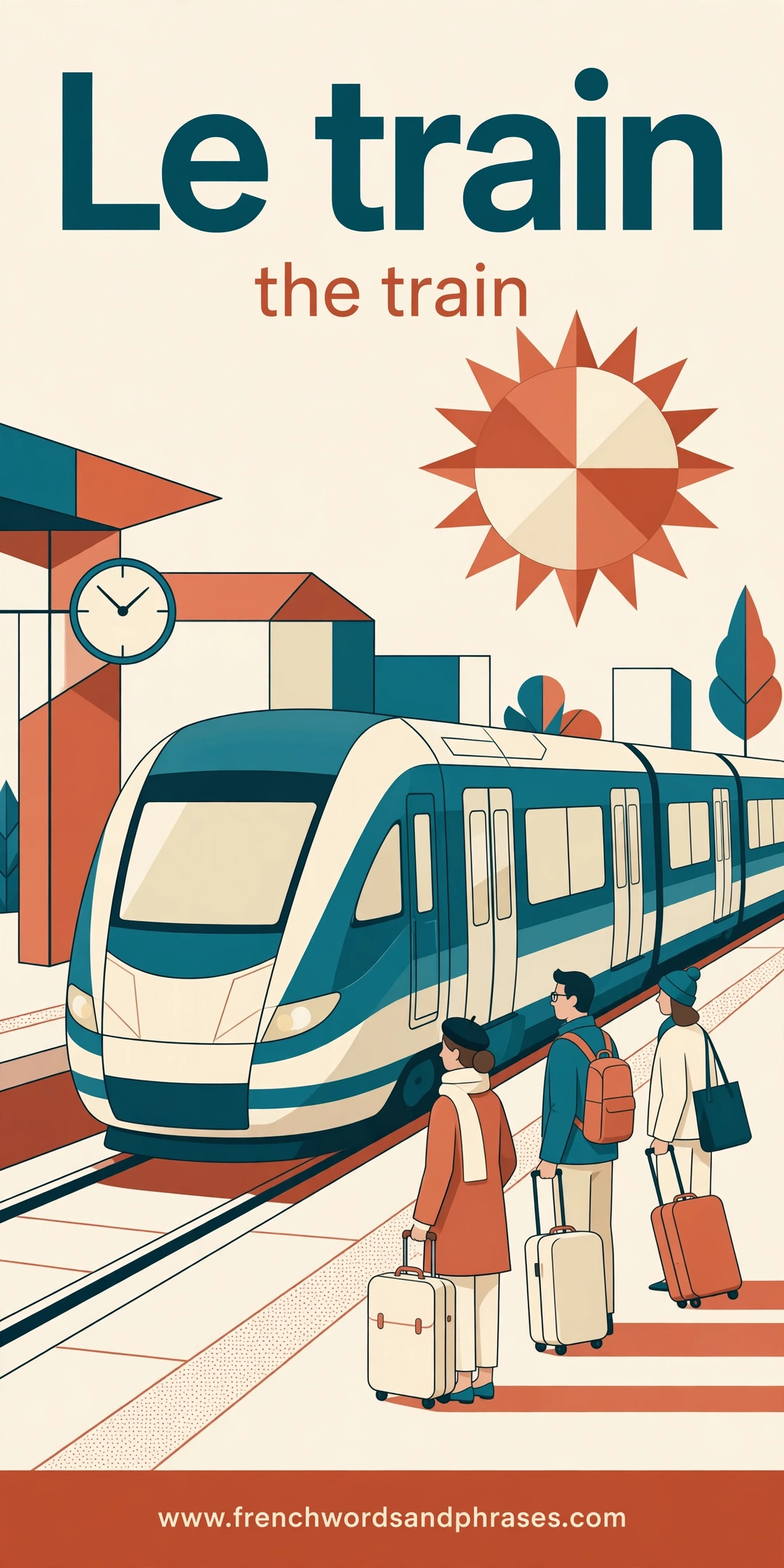
Le train means the train.
Mist on the platform, a whistle far away, and two hundred tonnes of patience rolling slowly out of the dark. Suitcases thump, doors sigh shut — that is le train.
In this guide, you’ll learn what train means in English, how to use it with its articles, how to form its plural, and how it appears in everyday French. Explore French examples, English translations, and practice quizzes.
Understanding the French Noun Train
Train is a masculine French noun. Like every French noun, it has a gender, and it is learned together with its article: le train.
It means the train — the machine itself, and the journey that comes with it: prendre le train, to take the train. France is a country of trains, from the slow local line to the TGV that crosses the country in two hours. Hidden inside the word is also one of the most useful constructions in French: être en train de faire quelque chose, to be in the middle of doing something.
Gender: Masculine
Definite article: le — le train (the train)
Indefinite article: un — un train (a train)
Plural: les trains (the trains)
English equivalents: The train; a train.
One expression must be learned with this noun before all others: en train de plus an infinitive means in the middle of doing. Je suis en train de manger — I am eating, right now. Despite the spelling, it has nothing to do with the railway: it is the picture of an action under way, like a train already moving.
Experience the Word
Train is more than transport. It is the journey slowed to human speed: landscapes unrolling like a film, strangers sharing a table, time itself taking a seat by the window.
Imagine the night train south, the compartment dark, the rails singing below, and the Mediterranean waiting quietly at the end of sleep.
You have not just travelled. You have watched a country go by.
How to Use Train in French: Complete Guide
Let’s explore how train works in French, beginning with its articles.
Train with the Definite Article (Le, Les)
Used for a particular train both speakers know — the 7:40, the one at platform four — or for trains in general.
| Number | French |
|---|---|
| Singular | le train |
| Plural | les trains |
Example
Le train arrive avec dix minutes de retard.
The train is arriving ten minutes late.
Train with the Indefinite Article (Un, Des)
Used when the train is unnamed, or simply one among others.
| Number | French |
|---|---|
| Singular | un train |
| Plural | des trains |
Example
Il y a un train pour Paris toutes les heures.
There is a train to Paris every hour.
Kinds of Train (TGV, Direct, de Nuit…)
From the TGV to the little regional line, French names its trains by what they do.
| Type | French |
|---|---|
| a high-speed train | un train à grande vitesse (un TGV) |
| a direct train | un train direct |
| a night train | un train de nuit |
| a local train | un train régional |
Example
Nous prenons le train de nuit pour Rome.
We are taking the night train to Rome.
Quick Quiz 1
How do you say a night train in French?
Reveal the answer
un train de nuit
Le train de nuit arrive à Rome à sept heures.
The night train arrives in Rome at seven o’clock.
The Plural of Train
Train adds a simple -s in the plural — a letter you see but do not hear.
| Number | French |
|---|---|
| Singular | le train |
| Plural | les trains |
Example
Les trains partent de la gare de Lyon.
The trains leave from the Gare de Lyon.
Train with Possessive Adjectives (Mon, Ton, Son…)
Possessives agree with the noun, not with the owner — and train is masculine, so it takes mon, ton, son.
| Owner | French |
|---|---|
| my | mon train |
| your (tu) | ton train |
| his / her | son train |
| our | notre train |
| your (vous) | votre train |
| their | leur train |
Example
Mon train part dans vingt minutes.
My train leaves in twenty minutes.
Quick Quiz 2
Complete the sentence:
Le train pour ______ part à 7:40.
Reveal the answer
Nantes
Le train pour Nantes part à 7:40.
The train to Nantes leaves at 7:40.
Train with Demonstrative Adjectives (Ce, Ces)
Used to point: this train here, those trains there.
| Number | French |
|---|---|
| Singular | ce train |
| Plural | ces trains |
Example
Ce train va directement à Bordeaux.
This train goes straight to Bordeaux.
Train with Adjectives
Most adjectives follow the noun — un train lent — but premier and dernier, first and last, go in front of it.
| Adjective | With Train |
|---|---|
| direct (direct) | un train direct |
| rapide (fast) | un train rapide |
| lent (slow) | un train lent |
| premier (first) | le premier train |
| dernier (last) | le dernier train |
| plein (full, crowded) | un train plein |
Example
Le dernier train part à minuit.
The last train leaves at midnight.
Quick Quiz 3
What does je suis en train de lire mean?
Reveal the answer
I am in the middle of reading — I am reading right now.
Chut, elle est en train de dormir.
Shh, she is in the middle of sleeping.
Everyday Expressions with Train
Train pulls some of the most useful expressions in French — including one that never goes near a station.
| Expression | In English |
|---|---|
| prendre le train | to take the train |
| manquer le train | to miss the train |
| être en train de + infinitive | to be in the middle of doing something |
| à bord du train | on board the train |
| le train de vie | one’s lifestyle, standard of living |
| un train d’enfer | a hectic pace (a hell of a pace) |
Example
Vite, nous allons manquer le train!
Quick, we are going to miss the train!
Words from the Same Family as Train
Learn these together and the whole station falls into place.
| French | In English |
|---|---|
| la gare | the station |
| un billet | a ticket |
| le quai | the platform |
| un voyageur / une voyageuse | a passenger, a traveller |
| un retard | a delay |
| la voie | the track, the platform line |
Example
Le train part de la voie quatre.
The train leaves from track four.
Quick Quiz 4
What does la gare mean?
Reveal the answer
The station — where every train story begins.
Nous arrivons à la gare à huit heures.
We arrive at the station at eight o’clock.
Train in Everyday French: Real-Life Examples
Now that you know the word, let’s see how train appears in everyday French.
Example 1 — At the station
Le train pour Nantes part à 7:40.
The train to Nantes leaves at 7:40.
Example 2 — Tomorrow morning
Nous prenons le train de sept heures demain.
We are taking the seven o’clock train tomorrow.
Example 3 — Running late
Le train est entré en gare avec un quart d’heure de retard.
The train pulled into the station fifteen minutes late.
Example 4 — On board
Elle lit un roman dans le train.
She is reading a novel on the train.
Example 5 — Watching them pass
Les enfants adorent regarder les trains passer.
The children love watching the trains go by.
Example 6 — An expression in real life
Je suis en train de préparer le dîner.
I am in the middle of preparing dinner.
Beyond Translation: The Meaning of Train
France is the country of the train: the little local line, the great glass gares of Paris, the TGV that made Lyon feel like a suburb of the capital.
And the word hides a second life.
Être en train de — to be in the middle of doing — has nothing to do with railways, yet it is built from this very noun. Master train, and you can both catch the 7:40 to Nantes and say exactly what you are doing right now.
How to Remember the French Noun Train
Remember it this way: Train is the 7:40 to Nantes — and, hidden inside it, the way to say in the middle of doing.
- On the platform at dawn — le train pour Nantes.
- Running along the platform — ne manque pas ton train!
- Right now, at this very moment — je suis en train de lire.
The key idea is le train to Nantes — and en train de for right now.
Test Your Knowledge of Train
Let’s see how much you’ve learned. Try answering these questions before revealing the answers.
Question 1
Is train masculine or feminine?
Reveal the answer
Masculine — le train.
Question 2
How do you say to miss the train in French?
Reveal the answer
manquer le train
Question 3
Translate: The train to Nantes leaves at 7:40.
Reveal the answer
Le train pour Nantes part à 7:40.
Question 4
What does je suis en train de manger mean?
Reveal the answer
I am eating — right now, in the middle of it.
Question 5
Complete the sentence:
Nous allons ______ le train si nous ne partons pas.
Reveal the answer
manquer
Nous allons manquer le train si nous ne partons pas.
We will miss the train if we do not leave.
Your Final Challenge
Can You Use It?
How would you say this in French?
“I am in the middle of reading on the train.”
Reveal the answer
Je suis en train de lire dans le train.
I am in the middle of reading on the train.
A little French. A little curiosity. A richer everyday life.
LEARN FRENCH ONE WORD AT A TIME