A French Word to Live By
Translate Avoir mal to English
/a.vwaʁ mal/
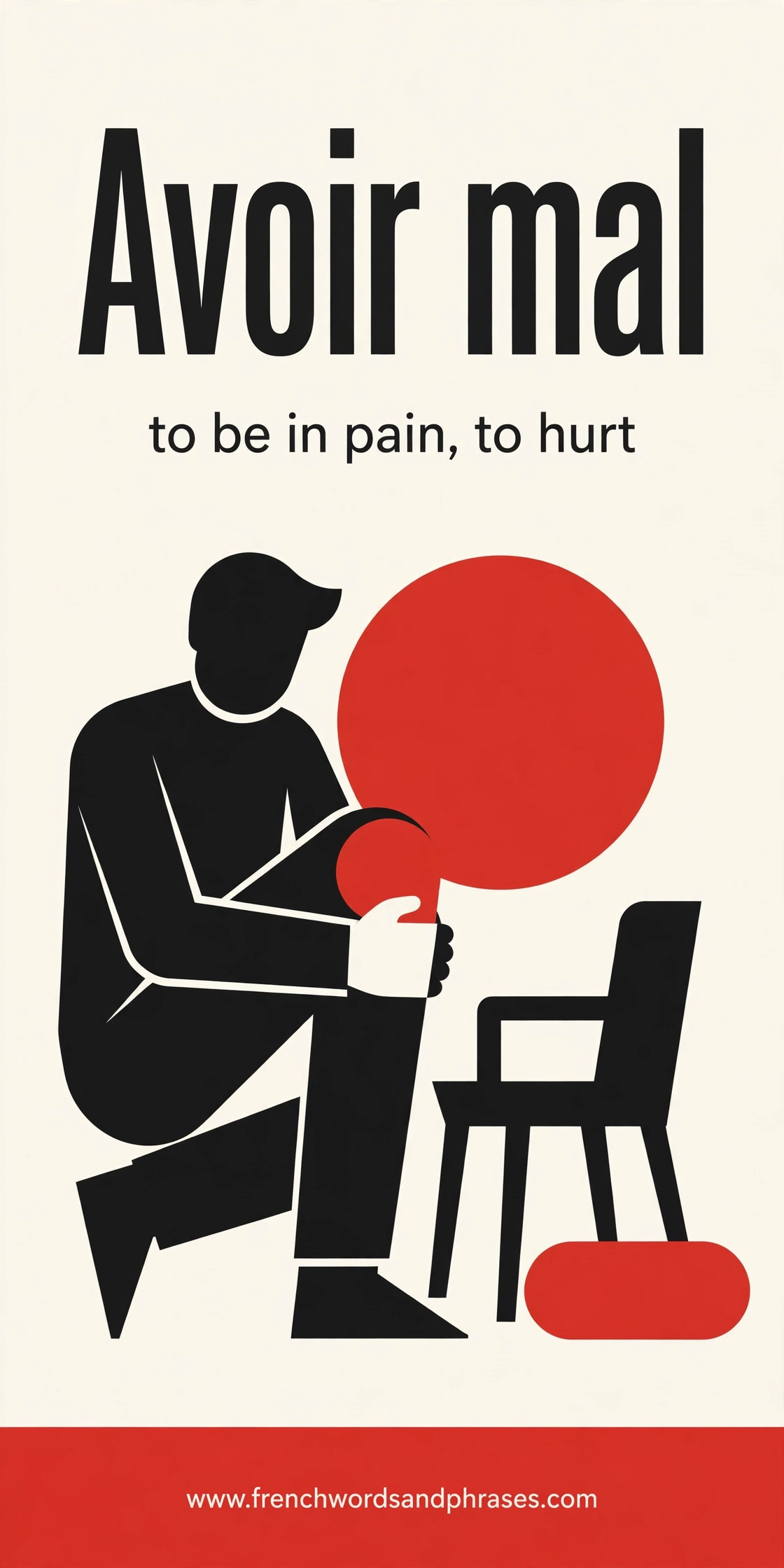
Avoir mal means to hurt, to be in pain — to have a pain somewhere.
The child points at her knee, the grandmother at her back, the runner at his ankle — and all three say the same two words: « J’ai mal. » Avoir mal, to hurt, is how French gives pain an address: you have it, and you say exactly where.
Let’s explore how avoir mal works in French, beginning with the whole phrase on one card.
Understanding the French Phrase Avoir mal
Avoir mal is a French verbal phrase built from avoir (to have — a verb that has its own page on this site) and mal, pain, ache. Word for word it is « to have pain ». The pain is located with à: avoir mal à la tête, au dos, aux dents. Where English says my head hurts — the body part doing the hurting — French says j’ai mal à la tête: I have pain at the head. The sufferer owns the pain; the body part only gives the address.
It means to hurt, to be in pain: j’ai mal au dos, my back hurts; tu as mal où ?, where does it hurt? — the first question of every French doctor and mother. It grades from the twinge to the cry: avoir un peu mal, to hurt a little, avoir très mal, to be in a lot of pain, avoir mal partout, to ache all over. And it stays for pain only: for illness itself, French switches to être malade or tomber malade.
Type: Verbal phrase — pain and its location (avoir + mal + à)
Answers the question: Tu as mal où ? — Where does it hurt?
The construction: avoir mal à + body part: au dos, à la tête, aux dents
Its boundary: Pain only — for illness, French says être malade
One important usage detail: the à contracts as always — à + le = au (j’ai mal au ventre), à + les = aux (j’ai mal aux pieds), à + la stays (j’ai mal à la gorge), and before a vowel it is à l’ (j’ai mal à l’oreille). Never say « je suis mal » for pain — that means I am unwell or badly placed; the pain phrase is avoir mal, with avoir.
Experience the Word
Avoir mal is the first medical French anyone learns, usually aged four, knee scraped, in a playground: two words and a pointing finger, and the whole problem is communicated.
Imagine the doctor’s waiting room on a Monday morning — a row of patients, each holding their pain in a different place: au dos, à la tête, aux dents. The doctor’s question travels down the row like a key fitting every lock: « Vous avez mal où ? »
English makes the body part the actor — my back hurts. French keeps the person at the centre: I have pain, and here is its address.
How to Use Avoir mal in French: Complete Guide
Let’s explore how avoir mal works in French, beginning with the whole phrase on one card.
Avoir mal at a Glance
The Whole Phrase on One Card
Meaning, picture, construction and boundary — avoir mal in four lines.
| Point | Avoir mal |
|---|---|
| What it really means | to hurt, to be in pain — to have a pain |
| Word for word | to have pain — the sufferer owns it, the body gives the address |
| The construction | avoir mal à + body part: au, à la, aux, à l’ |
| Its boundary | pain only — illness is être malade |
Example
J’ai mal au dos depuis hier.
My back has been hurting since yesterday.
Word by Word: Building the Phrase
Three pieces — the verb of having, the pain, and the little word that gives the address.
| Word | Literal meaning | Its job in the phrase |
|---|---|---|
| avoir | to have | the owner: the person has the pain |
| mal | pain, ache | the thing had — masculine noun, plural maux |
| à (+ le/les) | at, in | the address: au ventre, aux dents, à la tête |
Example
Elle a mal aux dents depuis deux jours.
She has had toothache for two days.
Quick Quiz 1
How do you ask a child where it hurts — tu as mal où ? or tu es mal où ?
Reveal the answer
Tu as mal où ? — pain is avoir mal, with avoir.
Tu as mal où, mon petit ?
Where does it hurt, little one?
The Addresses of Pain: Avoir mal à…
The phrase travels the whole body — watch au, à la, aux and à l’ do their work.
| Address | Example |
|---|---|
| the head | avoir mal à la tête — to have a headache |
| the back | avoir mal au dos — to have backache |
| the teeth | avoir mal aux dents — to have toothache |
| the stomach | avoir mal au ventre — to have stomach ache |
| the ear | avoir mal à l’oreille — to have earache |
Example
Après le repas, il a mal au ventre.
After the meal, his stomach hurts.
The Phrase in Its Tenses: Pain in Every Season
Avoir conjugates as usual; mal never changes — the pain is the same word in every tense.
| Form | French | In English |
|---|---|---|
| Present | j’ai mal au dos | my back hurts |
| Passé composé | elle a eu mal toute la nuit | she was in pain all night |
| Imparfait | il avait mal aux jambes | his legs used to hurt |
| Future | tu auras mal demain | you will be sore tomorrow |
| With quantity | j’ai très mal / un peu mal | I am in a lot of pain / a little pain |
Example
Demain, tu auras mal aux jambes après la course.
Tomorrow, your legs will hurt after the run.
Quick Quiz 2
Complete it: j’ai mal ______ dents (aux / à la)
Reveal the answer
aux — à + les = aux, for the plural dents.
J’ai mal aux dents.
I have toothache.
Everyday Expressions: Building on the Pain
Avoir mal slots into these frames — each one ready to use as it stands.
| Frame | In English |
|---|---|
| avoir mal à la tête | to have a headache |
| avoir mal partout | to ache all over |
| avoir très mal | to be in a lot of pain |
| faire mal | to hurt (someone) — ça fait mal, that hurts |
| se faire mal | to hurt oneself — je me suis fait mal au genou |
Example
Attention, tu vas te faire mal !
Careful, you’re going to hurt yourself!
Close Cousins: The Other Ways to Suffer
French divides suffering carefully — pain, illness, and the hurting of others.
| Expression | The difference |
|---|---|
| être malade | to be ill — illness, not a located pain |
| tomber malade | to fall ill — the moment sickness begins |
| souffrir | to suffer — stronger, longer, more formal |
| faire mal à quelqu’un | to hurt someone (physically or morally) |
| avoir de la fièvre | to have a fever — the temperature cousin |
Example
Il n’est pas malade, il a seulement mal au dos.
He is not ill, his back just hurts.
Quick Quiz 3
Which cousin means « to be ill » rather than « to be in pain » — avoir mal or être malade?
Reveal the answer
Être malade — avoir mal locates a pain; être malade names the illness.
Elle est malade et elle a mal à la gorge.
She is ill and her throat hurts.
Avoir mal and Its Neighbours
The suffering shelf around the phrase — pains, aches and their plurals.
| French | In English |
|---|---|
| le mal de tête | the headache (the noun phrase) |
| les maux de dents | toothaches — mal becomes maux in the plural |
| la douleur | pain — the stronger, more formal word |
| faire mal | to hurt — ça fait mal ! |
| sans mal | without difficulty — the other life of mal |
Example
Ça fait mal, mais ce n’est qu’un petit mal.
That hurts, but it is only a small pain.
Watch Out: The Traps Around Avoir mal
The traps: être for avoir, the forgotten contractions, and pain confused with illness.
| Trap | The truth |
|---|---|
| « je suis mal » for pain | say j’ai mal — je suis mal means I feel unwell or I am badly placed |
| « mal à le dos » | à + le contracts: mal au dos; à + les: mal aux dents |
| avoir mal for illness | a virus is not avoir mal — you are malade, and the sore throat is avoir mal à la gorge |
| mal everywhere | mal is also the adverb badly and the noun evil — context decides: le mal du pays, homesickness |
Example
Il a mal au ventre, mais il n’est pas malade.
His stomach hurts, but he is not ill.
Quick Quiz 4
How do you say ‘my legs hurt’ with avoir mal?
Reveal the answer
j’ai mal aux jambes
À + les = aux, and the pain belongs to the speaker: j’ai mal.
Après la course, j’ai mal aux jambes. — After the run, my legs hurt.
Avoir mal in Everyday French: Real-Life Examples
Now that you know the word, let’s see how avoir mal appears in everyday French.
Example 1 — The child
Tu as mal où ? Montre-moi.
Where does it hurt? Show me.
Example 2 — The back
J’ai mal au dos depuis ce matin.
My back has been hurting since this morning.
Example 3 — The dentist
Elle a mal aux dents, elle appelle le dentiste.
She has toothache, she is calling the dentist.
Example 4 — After sport
Demain, tu auras mal partout !
Tomorrow, you will ache all over!
Example 5 — The cry
Aïe ! Ça fait mal !
Ow! That hurts!
Example 6 — Better
Je n’ai plus mal, c’est fini.
It doesn’t hurt any more, it’s over.
Beyond Translation: The Meaning of Avoir mal
Avoir mal is built on one of the oldest bargains in French: mal, from Latin malum, is pain, harm and evil in a single word — le mal is evil, un mal is a pain, and mal as an adverb is badly. The phrase avoir mal keeps the oldest, physical end of that family: the body reporting damage. French’s genius is the address system — à la tête, au dos, aux dents — a pain is not real until it has a location, and the doctor’s first question, vous avez mal où ?, is the phrase turned into a diagnosis. Between avoir mal (the pain), être malade (the illness) and faire mal (hurting another), French maps suffering with a surveyor’s care.
Avoir mal is the phrase of the pointing finger — pain, owned and located.
Learn the contractions with it — au, aux, à la, à l’ — and you can describe any ache in France.
How to Remember the French Phrase Avoir mal
Remember it this way: Avoir mal is to hurt — avoir, not être, and the body part follows with à: au, à la, aux, à l’.
- The verb — avoir: j’ai mal, never « je suis mal » for a pain.
- The addresses — mal au dos, mal à la tête, mal aux dents, mal à l’oreille.
- The boundary — pain is avoir mal; illness is être malade.
The key idea is avoir mal à + body part = to hurt; au/aux/à la/à l’ give the address.
Test Your Knowledge of Avoir mal
Let’s see how much you’ve learned. Try answering these questions before revealing the answers.
Question 1
What does avoir mal mean?
Reveal the answer
To hurt, to be in pain — to have a pain somewhere.
Question 2
How do you say my back hurts?
Reveal the answer
J’ai mal au dos.
Question 3
Translate: Where does it hurt?
Reveal the answer
Tu as mal où ? (to a child) — Vous avez mal où ? (to an adult).
Question 4
Complete the sentence:
Elle a mal ______ gorge.
Reveal the answer
à la
Elle a mal à la gorge.
Her throat hurts.
Question 5
What is the difference between avoir mal and être malade?
Reveal the answer
Avoir mal locates a pain (au dos, à la tête); être malade names an illness.
Your Final Challenge
Can You Use It?
How would you say this in French?
“My back has been hurting since yesterday.”
Reveal the answer
J’ai mal au dos depuis hier.
My back has been hurting since yesterday.
A little French. A little curiosity. A richer everyday life.
LEARN FRENCH ONE WORD AT A TIME