A French Word to Live By
Translate Aspirine to English
/as.pi.ʁin/
L’aspirine means the aspirin.
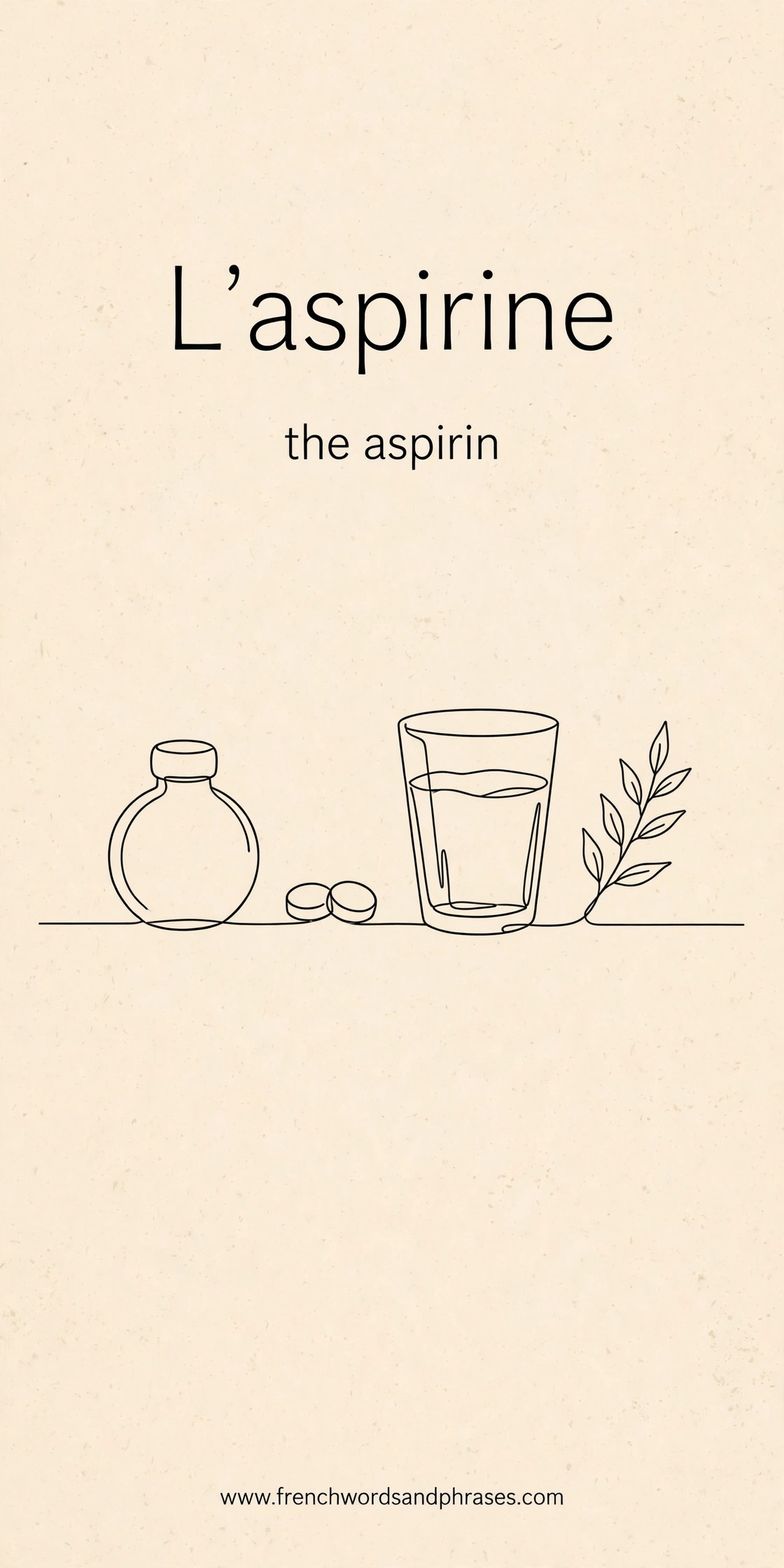
A small white tablet dissolving in a glass of water beside the bed: l’aspirine, the aspirin — the world’s most famous medicine, asked for by name in every French pharmacy for over a century.
In this guide, you’ll learn what aspirine means in English, how to use it with its articles, how to form its plural, and how it appears in everyday French. Explore French examples, English translations, and practice quizzes.
Understanding the French Noun Aspirine
Aspirine is a feminine French noun, learned with its article: l’aspirine, une aspirine — the article hides in the apostrophe before the vowel. The name began as a trademark (Bayer, 1899, built from the plant name spirée) and became, in French as in English, the ordinary word for the tablet itself: un cachet d’aspirine, an aspirin tablet.
It means aspirin — the painkiller for headaches, fevers and small pains: prendre une aspirine, to take an aspirin, un cachet d’aspirine, an aspirin tablet, une aspirine effervescente, a fizzy, soluble aspirin — the French favourite, watched dissolving in the glass. At the pharmacy you ask plainly: vous avez de l’aspirine ? Its modern shelf-companion is le paracétamol, and the pharmacist will ask which you prefer.
Gender: Feminine — l’aspirine
Definite article: l’ — l’aspirine (the aspirin)
Indefinite article: une — une aspirine (an aspirin)
Plural: les aspirines — regular, with a simple -s
The tablet: un cachet d’aspirine — an aspirin tablet
The French favourite: l’aspirine effervescente — the fizzy, soluble kind
English equivalents: The aspirin.
You take aspirin with prendre: prendre une aspirine, prendre un cachet d’aspirine. For the substance in general, French uses the partitive — il me faut de l’aspirine, I need some aspirin. And note the pharmacy ritual: in France, l’aspirine lives behind the counter of the pharmacie, and the word to ask with is simply its name.
Experience the Word
Aspirine is the little white circle of hope at the bottom of every handbag, drawer and travel bag in France.
Imagine the traveller in the night train, head pounding, asking the stranger opposite: « Vous n’auriez pas une aspirine ? » — and the stranger, of course, has one, because everyone in France travels with aspirine the way they travel with a ticket.
You have not just named a tablet. You have named the household remedy itself — l’aspirine, first aid in a word.
How to Use Aspirine in French: Complete Guide
Let’s explore how aspirine works in French, beginning with its articles — l’aspirine, une aspirine, un cachet d’aspirine.
Aspirine with the Definite Article (L’, Les)
Used for the specific aspirin — the one in the drawer, the one that works.
| Form | French |
|---|---|
| Feminine singular | l’aspirine |
| Plural | les aspirines |
Example
L’aspirine est dans l’armoire de la salle de bains.
The aspirin is in the bathroom cabinet.
Aspirine with the Indefinite Article (Une, Des)
Used for an aspirin in general — one tablet, asked for by name.
| Form | French |
|---|---|
| Feminine singular | une aspirine |
| Plural | des aspirines |
Example
Je vais prendre une aspirine et me coucher.
I’m going to take an aspirin and go to bed.
Forms of Aspirine (Cachet, Effervescente…)
French names its aspirin by form — the tablet, the fizzy glass, the box.
| Form | French |
|---|---|
| an aspirin tablet | un cachet d’aspirine |
| a soluble aspirin | une aspirine effervescente |
| a box of aspirin | une boîte d’aspirine |
| to take an aspirin | prendre une aspirine |
| some aspirin | de l’aspirine |
Example
Elle dissout son aspirine dans un verre d’eau.
She dissolves her aspirin in a glass of water.
Quick Quiz 1
Complete the sentence:
______ aspirine agit en vingt minutes. (the)
Reveal the answer
L’
L’aspirine agit en vingt minutes.
The aspirin works in twenty minutes — aspirine is feminine and begins with a vowel, so l’.
The Plural of Aspirine
Aspirine takes a regular plural in -s — the box holds twenty of them.
| Number | French |
|---|---|
| Singular | l’aspirine |
| Plural | les aspirines |
Example
Les aspirines sont rangées dans la boîte rouge.
The aspirins are kept in the red box.
Aspirine with Possessive Adjectives (Mon, Ton, Son…)
Possessives agree with the noun: aspirine is feminine, but before a vowel the possessive takes the masculine-looking form — mon aspirine.
| Owner | French |
|---|---|
| my | mon aspirine |
| your (tu) | ton aspirine |
| his / her | son aspirine |
| our | notre aspirine |
| your (vous) | votre aspirine |
| their | leur aspirine |
Example
Il garde son aspirine dans sa poche.
He keeps his aspirin in his pocket.
Quick Quiz 2
Complete the sentence:
Elle prend ______ aspirine avec un verre d’eau. (her)
Reveal the answer
son
Elle prend son aspirine avec un verre d’eau.
She takes her aspirin with a glass of water — son, because aspirine begins with a vowel.
Aspirine with Demonstrative Adjectives (Cette, Ces)
Used to point: cette aspirine, this aspirin — the fizzy one, not the plain one.
| Form | French |
|---|---|
| Feminine singular | cette aspirine |
| Plural | ces aspirines |
Example
Cette aspirine se dissout dans l’eau.
This aspirin dissolves in water.
Aspirine with Adjectives
Adjectives agree with aspirine — feminine singular: une aspirine effervescente, une aspirine forte.
| Adjective | With Aspirine |
|---|---|
| effervescente (fizzy, soluble) | une aspirine effervescente |
| forte (strong) | une aspirine forte |
| ordinaire (ordinary) | une aspirine ordinaire |
| en cachet (in tablet form) | une aspirine en cachet |
| pour enfants (for children) | une aspirine pour enfants |
Example
Je préfère une aspirine effervescente.
I prefer a soluble aspirin.
Quick Quiz 3
Complete the sentence:
C’est une aspirine ______, elle se dissout. (fizzy)
Reveal the answer
effervescente
C’est une aspirine effervescente, elle se dissout.
It is a fizzy aspirin, it dissolves — effervescente, feminine, to agree with aspirine.
Everyday Expressions with Aspirine
Headaches, pharmacies and handbags — the aspirine phrases of daily life.
| Expression | In English |
|---|---|
| prendre une aspirine | to take an aspirin |
| un cachet d’aspirine | an aspirin tablet |
| vous avez de l’aspirine ? | do you have any aspirin? |
| l’armoire à pharmacie | the medicine cabinet |
| le paracétamol | paracetamol — the shelf companion |
Example
Vous avez de l’aspirine, s’il vous plaît ?
Do you have any aspirin, please?
Words from the Same Family as Aspirine
Remedies and pains — the words that travel with aspirine.
| French | In English |
|---|---|
| le cachet | the tablet |
| le médicament | the medicine |
| la pharmacie | the pharmacy |
| le mal de tête | the headache |
| avaler | to swallow (the verb) |
Example
Le médicament se prend avec de l’eau.
The medicine is taken with water.
Quick Quiz 4
What is un cachet d’aspirine?
Reveal the answer
An aspirin tablet — one single tablet of aspirin.
Prends un cachet d’aspirine et repose-toi.
Take an aspirin tablet and rest.
Aspirine in Everyday French: Real-Life Examples
Now that you know the word, let’s see how aspirine appears in everyday French.
Example 1 — The headache
J’ai mal à la tête, je prends une aspirine.
I have a headache, I’m taking an aspirin.
Example 2 — At the pharmacy
Vous avez de l’aspirine, s’il vous plaît ?
Do you have any aspirin, please?
Example 3 — The fizzy kind
Elle préfère l’aspirine effervescente.
She prefers the soluble aspirin.
Example 4 — In the bag
Je garde toujours une aspirine dans mon sac.
I always keep an aspirin in my bag.
Example 5 — The fever
Une aspirine fait tomber la fièvre.
An aspirin brings the fever down.
Example 6 — Advice
Prends une aspirine et un verre d’eau.
Take an aspirin and a glass of water.
Beyond Translation: The Meaning of Aspirine
Aspirine is one of the rare words that is the same in almost every language on earth — a trademark that escaped and became a common noun, in French with a feminine article pinned to it: l’aspirine. France adopted it into its most intimate geography, the armoire à pharmacie, the bathroom cabinet where every household keeps its small army against pain. The effervescent tablet in its glass of water is a particularly French ceremony — part medicine, part pause, the fizz buying you a minute of rest before the remedy even starts.
To say aspirine is to open the medicine cabinet of the whole world — in French.
It evokes the night-time headache, the kind pharmacist, and the small white tablet dissolving like a promise.
How to Remember the French Noun Aspirine
Remember it this way: Aspirine is the aspirin — feminine with a hidden article: l’aspirine, taken with prendre, often as un cachet d’aspirine.
- Always feminine — l’aspirine, une aspirine; the la hides in the apostrophe.
- The tablet phrase — un cachet d’aspirine, an aspirin tablet; prendre une aspirine, to take one.
- The French favourite — l’aspirine effervescente, the fizzy one in the glass.
The key idea is l’aspirine — the aspirin, feminine; un cachet d’aspirine = an aspirin tablet.
Test Your Knowledge of Aspirine
Let’s see how much you’ve learned. Try answering these questions before revealing the answers.
Question 1
Is aspirine masculine or feminine?
Reveal the answer
Feminine — l’aspirine, une aspirine.
Question 2
How do you say to take an aspirin?
Reveal the answer
Prendre une aspirine.
Question 3
Translate: Do you have any aspirin, please?
Reveal the answer
Vous avez de l’aspirine, s’il vous plaît ?
Question 4
What is une aspirine effervescente?
Reveal the answer
A soluble, fizzy aspirin — the kind that dissolves in a glass of water.
Question 5
Complete the sentence:
______ aspirines sont dans la boîte rouge. (the)
Reveal the answer
Les
Les aspirines sont dans la boîte rouge.
The aspirins are in the red box.
Your Final Challenge
Can You Use It?
How would you say this in French?
“I’m going to take an aspirin and go to bed.”
Reveal the answer
Je vais prendre une aspirine et me coucher.
I’m going to take an aspirin and go to bed.
A little French. A little curiosity. A richer everyday life.
LEARN FRENCH ONE WORD AT A TIME