A French Word to Live By
Translate Mal de tête to English
/mal də tɛt/
Le mal de tête means the headache.
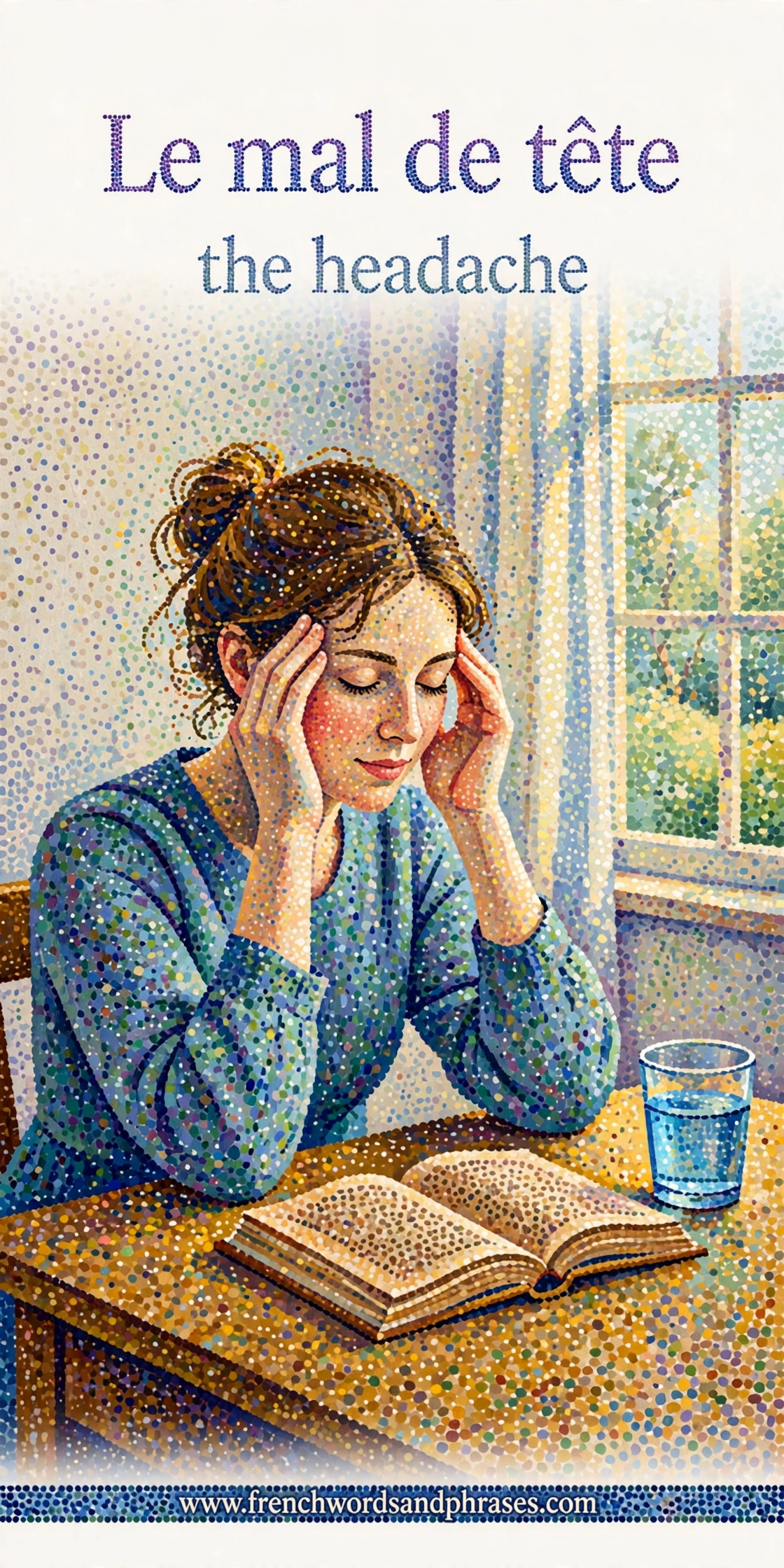
The lights too bright, the room too loud, a hand pressed to the forehead: le mal de tête, the headache — literally « the pain of head », French’s plain, honest name for the most common pain in the world.
In this guide, you’ll learn what mal de tête means in English, how to use it with its articles, how to form its plural, and how it appears in everyday French. Explore French examples, English translations, and practice quizzes.
Understanding the French Noun Mal de tête
Mal de tête is a masculine French noun phrase, learned with its article: le mal de tête, un mal de tête. It is built from mal, pain or ache — the same mal as in avoir mal, to hurt — and tête, the head. The gender comes from mal, which is masculine: the phrase means, word for word, head-pain.
It means a headache: avoir mal à la tête, to have a headache — the everyday way to say it — and un mal de tête for the thing itself: j’ai un mal de tête terrible, I have a terrible headache. French grades them: un léger mal de tête, a slight headache, un mal de tête carabiné, a splitting headache, and at the top of the scale la migraine, the migraine. The cure shelf is fixed too: un cachet d’aspirine, an aspirin tablet, prendre l’air, to get some fresh air.
Gender: Masculine — le mal de tête
Definite article: le — le mal de tête (the headache)
Indefinite article: un — un mal de tête (a headache)
Plural: les maux de tête — careful: mal becomes maux in the plural
Built from: mal (pain, ache) + de + tête (head) — head-pain
The everyday phrase: avoir mal à la tête — to have a headache
English equivalents: The headache.
Two ways to carry a headache in French: the state — j’ai mal à la tête, my head hurts, with mal à la — and the object — j’ai un mal de tête, I have a headache. The first is what you say at the pharmacy; the second is what you announce at the door. And never write « mals de tête »: the plural of mal is maux, as in les maux de tête, les maux de dents.
Experience the Word
Mal de tête is pain with an address: not suffering in general, but this exact ache, behind the eyes, that makes the whole world too bright.
Imagine the student after six hours of revision, the letters swimming on the page — un mal de tête. She closes the book, opens the window, and the cool evening air does what the aspirin had not yet done.
You have not just named a pain. You have named the head’s protest — le mal de tête, the ache that asks for darkness and quiet.
How to Use Mal de tête in French: Complete Guide
Let’s explore how mal de tête works in French, beginning with its articles — le mal de tête, un mal de tête, avoir mal à la tête.
Mal de tête with the Definite Article (Le, Les)
Used for a specific headache — the one from last night, the one that won’t leave.
| Form | French |
|---|---|
| Masculine singular | le mal de tête |
| Plural | les maux de tête |
Example
Le mal de tête vient de la fatigue.
The headache comes from tiredness.
Mal de tête with the Indefinite Article (Un, Des)
Used for a headache in general — announced at doors and pharmacies everywhere.
| Form | French |
|---|---|
| Masculine singular | un mal de tête |
| Plural | des maux de tête |
Example
J’ai un mal de tête terrible ce matin.
I have a terrible headache this morning.
Grades of Mal de tête (Léger, Carabiné, Migraine…)
French grades its headaches from the slight to the splitting.
| Grade | French |
|---|---|
| a slight headache | un léger mal de tête |
| a terrible headache | un mal de tête terrible |
| a splitting headache | un mal de tête carabiné |
| a migraine | une migraine |
| to have a headache | avoir mal à la tête |
Example
Après l’écran, j’ai souvent mal à la tête.
After the screen, I often have a headache.
Quick Quiz 1
Complete the sentence:
______ mal de tête m’empêche de travailler. (the)
Reveal the answer
Le
Le mal de tête m’empêche de travailler.
The headache is stopping me from working — mal is masculine, so le.
The Plural of Mal de tête
Mal changes in the plural: maux — les maux de tête, like les maux de dents.
| Number | French |
|---|---|
| Singular | le mal de tête |
| Plural | les maux de tête |
Example
Les maux de tête fréquents demandent un avis médical.
Frequent headaches need a doctor’s opinion.
Mal de tête with Possessive Adjectives (Mon, Ton, Son…)
Possessives agree with the noun: mal is masculine, so mon, ton, son in the singular.
| Owner | French |
|---|---|
| my | mon mal de tête |
| your (tu) | ton mal de tête |
| his / her | son mal de tête |
| our | notre mal de tête |
| your (vous) | votre mal de tête |
| their | leur mal de tête |
Example
Mon mal de tête passe avec un café.
My headache goes away with a coffee.
Quick Quiz 2
Complete the sentence:
Il attribue ______ mal de tête au bruit. (his)
Reveal the answer
son
Il attribue son mal de tête au bruit.
He blames his headache on the noise — son, because mal is masculine.
Mal de tête with Demonstrative Adjectives (Ce, Ces)
Used to point: ce mal de tête, this headache — the famous one from the wedding wine.
| Form | French |
|---|---|
| Masculine singular | ce mal de tête |
| Plural | ces maux de tête |
Example
Ce mal de tête dure depuis hier soir.
This headache has lasted since last night.
Mal de tête with Adjectives
Adjectives agree with mal — masculine singular: un mal de tête terrible, un léger mal de tête.
| Adjective | With Mal de tête |
|---|---|
| léger (slight) | un léger mal de tête |
| terrible (terrible) | un mal de tête terrible |
| carabiné (splitting, informal) | un mal de tête carabiné |
| fréquent (frequent) | des maux de tête fréquents |
| matinal (morning) | un mal de tête matinal |
Example
Un léger mal de tête ne m’arrêtera pas.
A slight headache will not stop me.
Quick Quiz 3
Complete the sentence:
C’est un mal de tête ______, je vais me coucher. (terrible)
Reveal the answer
terrible
C’est un mal de tête terrible, je vais me coucher.
It is a terrible headache, I’m going to bed — terrible has the same form for masculine and feminine.
Everyday Expressions with Mal de tête
Pharmacies, offices and quiet rooms — the mal de tête phrases of daily life.
| Expression | In English |
|---|---|
| avoir mal à la tête | to have a headache (the everyday way) |
| un mal de tête carabiné | a splitting headache |
| prendre un cachet | to take a tablet (for it) |
| donner mal à la tête | to give someone a headache (noise, problems) |
| un casse-tête | a puzzle — literally a head-breaker |
Example
Ce bruit me donne mal à la tête.
This noise is giving me a headache.
Words from the Same Family as Mal de tête
Pains and their addresses — the words that travel with mal de tête.
| French | In English |
|---|---|
| la tête | the head |
| avoir mal | to hurt, to be in pain (the phrase) |
| le mal de dents | toothache |
| la migraine | the migraine |
| l’aspirine | the aspirin |
Example
Après le mal de tête, un cachet d’aspirine et du repos.
After the headache, an aspirin tablet and some rest.
Quick Quiz 4
What is un mal de tête carabiné?
Reveal the answer
A splitting headache — the strongest grade, in informal French.
Après la fête, un mal de tête carabiné !
After the party, a splitting headache!
Mal de tête in Everyday French: Real-Life Examples
Now that you know the word, let’s see how mal de tête appears in everyday French.
Example 1 — In the morning
Je me réveille avec un mal de tête.
I wake up with a headache.
Example 2 — At the pharmacy
J’ai mal à la tête, vous avez de l’aspirine ?
I have a headache, do you have any aspirin?
Example 3 — At work
Ce bruit me donne mal à la tête.
This noise is giving me a headache.
Example 4 — The cure
Un cachet et un verre d’eau, ça va passer.
A tablet and a glass of water, it will pass.
Example 5 — Splitting
Un mal de tête carabiné, je rentre me coucher.
A splitting headache, I’m going home to bed.
Example 6 — Gone
Le mal de tête est passé après la sieste.
The headache went away after the nap.
Beyond Translation: The Meaning of Mal de tête
Mal de tête is French at its most practical: where English built one opaque word, headache, French simply describes — the pain, of the head. The pattern runs through the whole body: mal de dents, mal de gorge, mal au dos, a pain with its address written on it. And the family keeps a joker: un casse-tête, a head-breaker, is a puzzle — the headache you choose for pleasure. Between the mal de tête you suffer and the casse-tête you solve sits the whole French attitude to the head: respect it, and it will work for you.
To say mal de tête is to give your pain its address — and then, with luck, to evict it.
It evokes the darkened room, the cool cloth on the forehead, and the first painless cup of coffee afterwards.
How to Remember the French Noun Mal de tête
Remember it this way: Mal de tête is the headache — masculine, built from mal (pain) + tête (head), and its plural changes mal to maux.
- Always masculine — le mal de tête, un mal de tête, mon mal de tête.
- The plural trap — les maux de tête: mal becomes maux, never « mals ».
- The everyday phrase — avoir mal à la tête, to have a headache.
The key idea is le mal de tête — the headache, masculine; plural les maux de tête.
Test Your Knowledge of Mal de tête
Let’s see how much you’ve learned. Try answering these questions before revealing the answers.
Question 1
Is mal de tête masculine or feminine?
Reveal the answer
Masculine — le mal de tête, un mal de tête.
Question 2
How do you say to have a headache (the everyday way)?
Reveal the answer
Avoir mal à la tête.
Question 3
Translate: I have a terrible headache this morning.
Reveal the answer
J’ai un mal de tête terrible ce matin.
Question 4
What is the plural of mal de tête?
Reveal the answer
Les maux de tête — mal becomes maux in the plural.
Question 5
Complete the sentence:
______ maux de tête fréquents demandent un médecin. (the)
Reveal the answer
Les
Les maux de tête fréquents demandent un médecin.
Frequent headaches need a doctor.
Your Final Challenge
Can You Use It?
How would you say this in French?
“I have a terrible headache this morning.”
Reveal the answer
J’ai un mal de tête terrible ce matin.
I have a terrible headache this morning.
A little French. A little curiosity. A richer everyday life.
LEARN FRENCH ONE WORD AT A TIME