A French Word to Live By
Translate Vacances to English
/va.kɑ̃s/
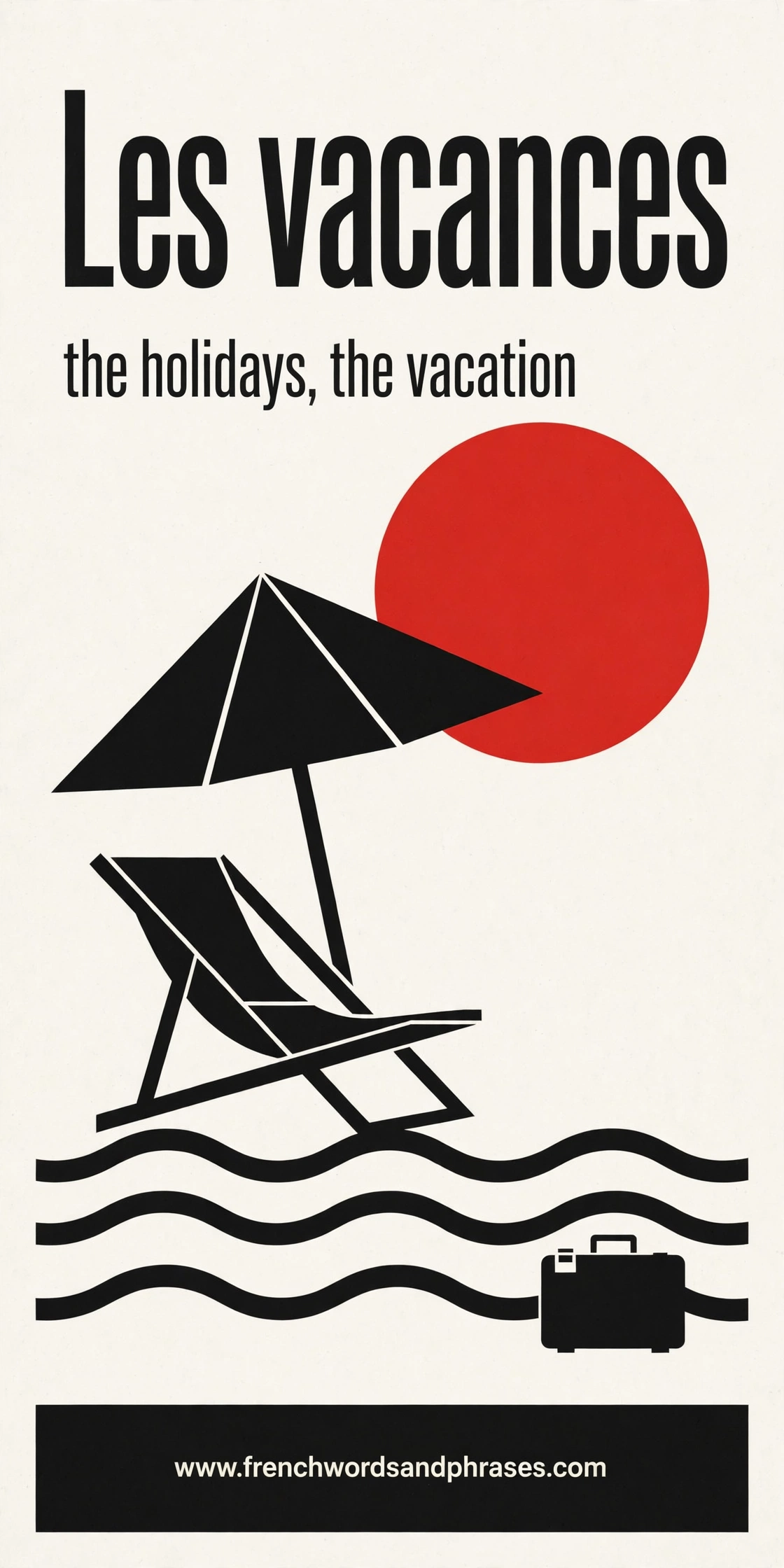
Les vacances means the holidays, the vacation.
The last school bell of June, the factory gates closing for August, a whole country turning towards the sea: les vacances, the holidays — the word French lives for, and a word that only exists in the plural, as if one single day of it could never be enough.
In this guide, you’ll learn what vacances means in English, how to use it with its articles, how to form its plural, and how it appears in everyday French. Explore French examples, English translations, and practice quizzes.
Understanding the French Noun Vacances
Vacances is a feminine French noun that lives in the plural: les vacances, des vacances. There is no everyday singular — une vacance exists only in law and administration, for an empty post or position. The word comes from the Latin vacare, to be empty, free: the vacances are the empty space in the year, deliberately left unfilled by work and school.
It means the holidays, the vacation — the period away from work or school: les vacances d’été, the summer holidays, les grandes vacances, the long summer break, être en vacances, to be on holiday, partir en vacances, to go away on holiday. France organises its year around them: les vacances de Noël, de février, de Pâques, and above all les grandes vacances of July and August, when the country famously slows to a stroll.
Gender: Feminine plural — les vacances
Definite article: les — les vacances (the holidays)
Indefinite article: des — des vacances (holidays, a holiday)
Plural: les vacances — the word lives in the plural; no everyday singular
The long break: les grandes vacances — the summer holidays (July–August)
The key phrases: être en vacances (to be on holiday), partir en vacances (to go on holiday)
English equivalents: The holidays, the vacation.
The holidays take plural verbs and plural agreements everywhere: les vacances sont finies, the holidays are over — sont, not est. You are en vacances (no article) and you leave en vacances: partir en vacances. And a single day off is not une vacance: it is un jour de congé or un jour férié.
Experience the Word
Vacances is the plural France dreams in: not a day, not a weekend, but weeks of it — the word itself refuses to be small.
Imagine the last Friday of July in Paris: suitcases on the pavement, cars loaded to the roof, and a whole city saying the same shining sentence — on part en vacances. By Monday, the sea towns are full and the capital belongs to the swallows.
You have not just named time off. You have named the year’s great reward — les vacances, the holidays, always in the plural because one is never enough.
How to Use Vacances in French: Complete Guide
Let’s explore how vacances works in French, beginning with its articles — les vacances, des vacances, être en vacances.
Vacances with the Definite Article (Les)
The holidays are always plural — the article is les, and the verb agrees in the plural.
| Form | French |
|---|---|
| Plural | les vacances |
| The summer holidays | les vacances d’été |
| The long summer break | les grandes vacances |
Example
Les vacances commencent la semaine prochaine.
The holidays start next week.
Vacances with the Indefinite Article (Des)
Des vacances — holidays as a stretch of time you take, spend or dream of.
| Form | French |
|---|---|
| Plural | des vacances |
| Some real holidays | de vraies vacances |
| Short holidays | de petites vacances |
Example
Il faut prendre des vacances cette année.
You must take a holiday this year.
The Vacances of the French Year (Été, Noël, Pâques…)
France names its holidays by season and feast — the school calendar is built on them.
| Holiday | French |
|---|---|
| the summer holidays | les vacances d’été |
| the Christmas holidays | les vacances de Noël |
| the Easter holidays | les vacances de Pâques |
| the February holidays | les vacances de février |
| the school holidays | les vacances scolaires |
Example
Pendant les vacances de Noël, la famille se réunit.
During the Christmas holidays, the family gets together.
Quick Quiz 1
Complete the sentence:
______ vacances sont finies, on retourne au travail. (the)
Reveal the answer
Les
Les vacances sont finies, on retourne au travail.
The holidays are over, back to work — vacances is always plural, so les, and the verb is plural too.
The Plural of Vacances
Vacances is already the plural — the singular vacance survives only in legal French, for a vacant post.
| Number | French |
|---|---|
| Singular | les vacances |
| Plural | les vacances |
Example
De bonnes vacances demandent un peu d’organisation.
A good holiday takes a little organising.
Vacances with Possessive Adjectives (Mes, Tes, Ses…)
Possessives agree with the plural noun: mes, tes, ses — and leurs for their.
| Owner | French |
|---|---|
| my | mes vacances |
| your (tu) | tes vacances |
| his / her | ses vacances |
| our | nos vacances |
| your (vous) | vos vacances |
| their | leurs vacances |
Example
Mes vacances commencent vendredi soir.
My holidays start on Friday evening.
Quick Quiz 2
Complete the sentence:
Ils racontent ______ vacances à tout le monde. (their)
Reveal the answer
leurs
Ils racontent leurs vacances à tout le monde.
They tell everyone about their holidays — leurs, for the plural vacances.
Vacances with Demonstrative Adjectives (Ces)
Used to point: ces vacances, these holidays — this year’s, the unforgettable ones.
| Form | French |
|---|---|
| Plural | ces vacances |
| These holidays-ci | ces vacances-ci |
Example
Ces vacances resteront dans nos mémoires.
These holidays will stay in our memories.
Vacances with Adjectives
Adjectives agree with vacances — feminine plural: de grandes vacances, des vacances inoubliables.
| Adjective | With Vacances |
|---|---|
| grandes (long, the summer break) | les grandes vacances |
| inoubliables (unforgettable) | des vacances inoubliables |
| courtes (short) | de courtes vacances |
| scolaires (school) | les vacances scolaires |
| bien méritées (well earned) | des vacances bien méritées |
Example
Les grandes vacances durent deux mois.
The long summer holidays last two months.
Quick Quiz 3
Complete the sentence:
Ce sont des vacances bien ______. (well earned)
Reveal the answer
méritées
Ce sont des vacances bien méritées.
They are well-earned holidays — méritées, feminine plural, to agree with vacances.
Everyday Expressions with Vacances
Leaving, being away, coming back — the vacances phrases of the French year.
| Expression | In English |
|---|---|
| être en vacances | to be on holiday |
| partir en vacances | to go away on holiday |
| les grandes vacances | the long summer holidays |
| prendre des vacances | to take a holiday |
| bonnes vacances ! | have a good holiday! |
Example
Le bureau est fermé : tout le monde est en vacances.
The office is closed: everyone is on holiday.
Words from the Same Family as Vacances
Rest and empty calendars — the words that travel with vacances.
| French | In English |
|---|---|
| le congé | leave, time off — un jour de congé, a day off |
| le jour férié | the public holiday (a single day) |
| se reposer | to rest (the verb) |
| la rentrée | the return to school and work after the holidays |
| le vacancier | the holidaymaker |
Example
Après les vacances, c’est la rentrée pour tout le monde.
After the holidays, it’s back to school and work for everyone.
Quick Quiz 4
What are les grandes vacances?
Reveal the answer
The long summer holidays — the great break of July and August.
Pendant les grandes vacances, Paris se vide.
During the long summer holidays, Paris empties.
Vacances in Everyday French: Real-Life Examples
Now that you know the word, let’s see how vacances appears in everyday French.
Example 1 — At work
Je suis en vacances la semaine prochaine.
I am on holiday next week.
Example 2 — Leaving
Nous partons en vacances demain matin.
We are going on holiday tomorrow morning.
Example 3 — At school
Les vacances d’été durent deux mois.
The summer holidays last two months.
Example 4 — Wishing well
Bonnes vacances, reposez-vous bien !
Have a good holiday, get plenty of rest!
Example 5 — Coming back
Les vacances sont finies, hélas.
The holidays are over, alas.
Example 6 — Planning
Où passez-vous vos vacances cette année ?
Where are you spending your holidays this year?
Beyond Translation: The Meaning of Vacances
France did not merely adopt holidays; it legislated joy. In 1936 the congés payés — paid holidays — gave every worker two weeks by law, and the first trains of vacanciers rolled to the sea with bicycles and accordions. The word itself kept the shape of that revolution: plural, generous, collective. Les grandes vacances still empty the cities every July, the autoroutes still jam on the same Saturdays, and la rentrée — the return — is a national season of its own. A language that makes its holiday word plural-only is a language that takes rest seriously.
To say vacances is to close the diary and open the map.
It evokes loaded cars, closed shutters, seaside light — and the whole country exhaling at once.
How to Remember the French Noun Vacances
Remember it this way: Vacances lives in the plural — les vacances, plural verbs, plural agreements, and no everyday singular at all.
- Always plural — les vacances sont…, never « la vacance est » in everyday French.
- The two key phrases — être en vacances, to be on holiday; partir en vacances, to go on holiday.
- The great break — les grandes vacances, the long summer holidays.
The key idea is les vacances — the holidays, feminine plural only; les grandes vacances = the summer break.
Test Your Knowledge of Vacances
Let’s see how much you’ve learned. Try answering these questions before revealing the answers.
Question 1
Is vacances singular or plural?
Reveal the answer
Plural — always: les vacances, with plural verbs and agreements.
Question 2
How do you say to be on holiday?
Reveal the answer
Être en vacances.
Question 3
Translate: We are going on holiday tomorrow morning.
Reveal the answer
Nous partons en vacances demain matin.
Question 4
What are les grandes vacances?
Reveal the answer
The long summer holidays — the July–August break.
Question 5
Complete the sentence:
______ vacances commencent vendredi. (my)
Reveal the answer
Mes
Mes vacances commencent vendredi.
My holidays start on Friday.
Your Final Challenge
Can You Use It?
How would you say this in French?
“We are going on holiday tomorrow morning.”
Reveal the answer
Nous partons en vacances demain matin.
We are going on holiday tomorrow morning.
A little French. A little curiosity. A richer everyday life.
LEARN FRENCH ONE WORD AT A TIME