A French Word to Live By
Translate Carte postale to English
/kaʁt pɔs.tal/
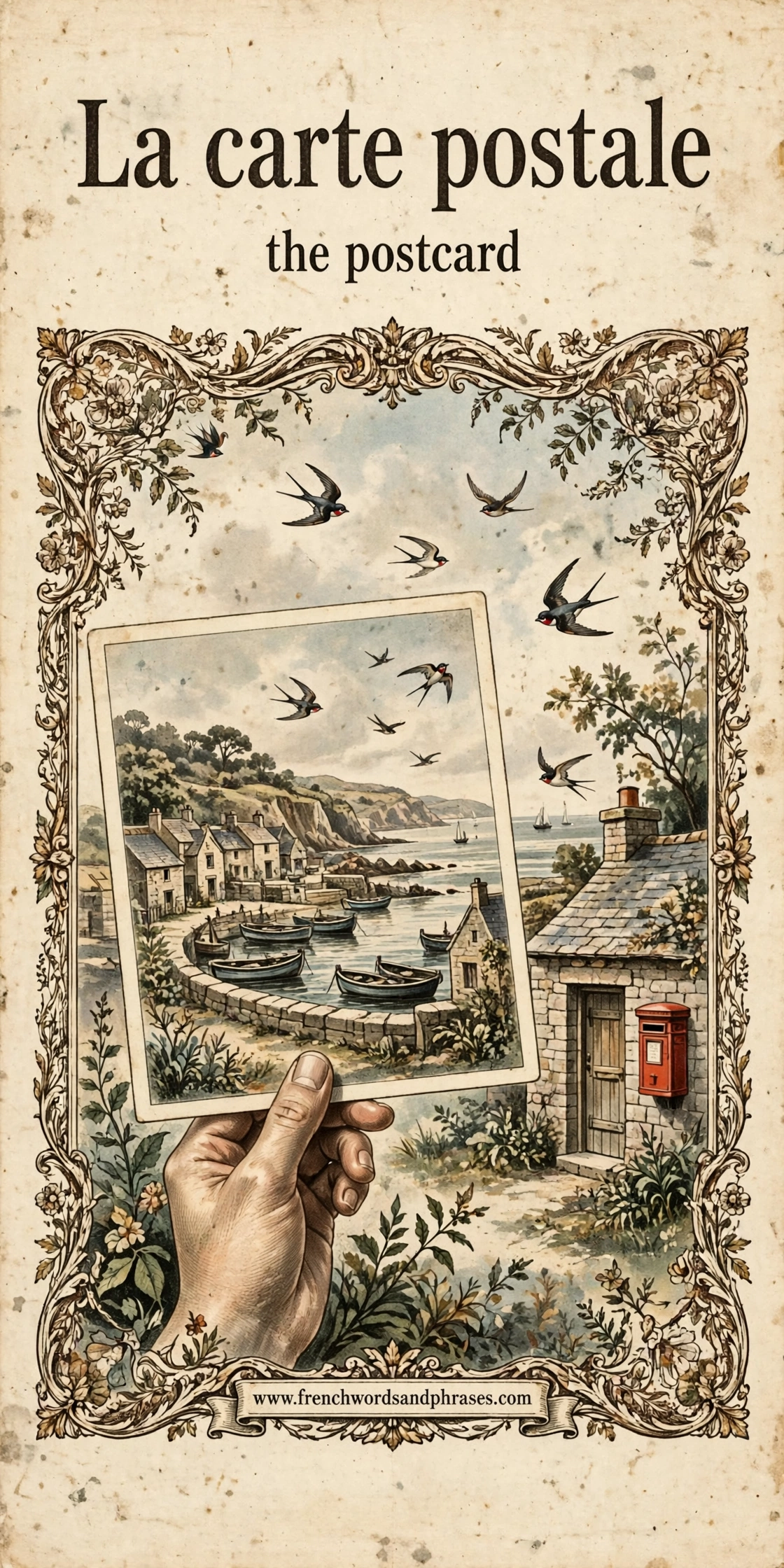
La carte postale means the postcard.
A sunny square, a café table, and a small rectangle of cardboard carrying a beach, a stamp and ten words home: la carte postale, the postcard — the holiday’s little ambassador, sent with love and arriving, traditionally, after you do.
In this guide, you’ll learn what carte postale means in English, how to use it with its articles, how to form its plural, and how it appears in everyday French. Explore French examples, English translations, and practice quizzes.
Understanding the French Noun Carte postale
Carte postale is a feminine French noun phrase, learned with its article: la carte postale, une carte postale. It is built from carte, a card, and the adjective postale, postal — the card that travels by post, with the picture on one side and your handwriting on the other. Carte is feminine, so the whole phrase is feminine.
It means a postcard: envoyer une carte postale, to send a postcard, une carte postale de Venise, a postcard from Venice, écrire une carte postale, to write a postcard. The picture side gave French an image of perfect, slightly unreal beauty: un paysage de carte postale, a picture-postcard landscape. All it needs to travel is un timbre, a stamp, and une boîte aux lettres, a postbox.
Gender: Feminine — la carte postale
Definite article: la — la carte postale (the postcard)
Indefinite article: une — une carte postale (a postcard)
Plural: les cartes postales — both words take the -s
Built from: carte (card) + postale (postal) — the card that goes by post
The image it left: un paysage de carte postale — a picture-postcard landscape
English equivalents: The postcard.
Mind the plural: both halves grow — des cartes postales, never « des carte postale ». You send a postcard à someone and de somewhere: je t’envoie une carte postale de Bretagne, I’m sending you a postcard from Brittany. The verb of its journey is poster — poster une carte, to post a card.
Experience the Word
Carte postale is the slowest, warmest message in the world: chosen by hand, written by hand, and carried across a continent for the price of a stamp.
Imagine the grandmother in a seaside shop, turning the rack slowly — the harbour, the lighthouse, the sunset — choosing the exact view her grandson will pin above his desk, then writing, in her careful hand: « Tout va bien. Je t’embrasse. »
You have not just named a card. You have named the holiday itself, folded small — la carte postale, proof that you were there and thought of them.
How to Use Carte postale in French: Complete Guide
Let’s explore how carte postale works in French, beginning with its articles — la carte postale, une carte postale, des cartes postales.
Carte postale with the Definite Article (La, Les)
Used for a specific postcard — the one with the lighthouse, the one that just arrived.
| Form | French |
|---|---|
| Feminine singular | la carte postale |
| Plural | les cartes postales |
Example
La carte postale est arrivée ce matin.
The postcard arrived this morning.
Carte postale with the Indefinite Article (Une, Des)
Used for a postcard in general — any card from the rack by the till.
| Form | French |
|---|---|
| Feminine singular | une carte postale |
| Plural | des cartes postales |
Example
Je vais acheter une carte postale pour ma sœur.
I’m going to buy a postcard for my sister.
Carte postale on Its Journey (Écrire, Envoyer, Recevoir…)
A postcard is written, stamped, sent and received — French follows it at every step.
| Step | French |
|---|---|
| to write a postcard | écrire une carte postale |
| to send a postcard | envoyer une carte postale |
| to receive a postcard | recevoir une carte postale |
| a stamp | un timbre |
| a picture-postcard landscape | un paysage de carte postale |
Example
Elle envoie une carte postale à ses parents.
She is sending a postcard to her parents.
Quick Quiz 1
Complete the sentence:
______ carte postale montre le vieux port. (the)
Reveal the answer
La
La carte postale montre le vieux port.
The postcard shows the old harbour — carte postale is feminine, so la.
The Plural of Carte postale
Both words take the -s: cartes postales — a rack full of them.
| Number | French |
|---|---|
| Singular | la carte postale |
| Plural | les cartes postales |
Example
Les cartes postales tournent sur le présentoir.
The postcards turn on the rack.
Carte postale with Possessive Adjectives (Ma, Ta, Sa…)
Possessives agree with the noun: carte postale is feminine, so ma, ta, sa in the singular.
| Owner | French |
|---|---|
| my | ma carte postale |
| your (tu) | ta carte postale |
| his / her | sa carte postale |
| our | notre carte postale |
| your (vous) | votre carte postale |
| their | leur carte postale |
Example
Ma carte postale est partie hier.
My postcard went off yesterday.
Quick Quiz 2
Complete the sentence:
Il a reçu ______ carte postale de Venise. (his)
Reveal the answer
sa
Il a reçu sa carte postale de Venise.
He received his postcard from Venice — sa, because carte postale is feminine.
Carte postale with Demonstrative Adjectives (Cette, Ces)
Used to point: cette carte postale, this postcard — the one with the sunset.
| Form | French |
|---|---|
| Feminine singular | cette carte postale |
| Plural | ces cartes postales |
Example
Cette carte postale date de 1960.
This postcard dates from 1960.
Carte postale with Adjectives
Adjectives agree with carte — feminine singular: une belle carte postale, une carte postale ancienne.
| Adjective | With Carte postale |
|---|---|
| belle (beautiful) | une belle carte postale |
| ancienne (old) | une carte postale ancienne |
| en couleur (in colour) | une carte postale en couleur |
| illustrée (illustrated) | une carte postale illustrée |
| vierge (blank) | une carte postale vierge |
Example
Il collectionne les cartes postales anciennes.
He collects old postcards.
Quick Quiz 3
Complete the sentence:
C’est une ______ carte postale du village. (beautiful)
Reveal the answer
belle
C’est une belle carte postale du village.
It is a beautiful postcard of the village — belle, feminine, to agree with carte.
Everyday Expressions with Carte postale
Shops, stamps and mantelpieces — the carte postale phrases of the holiday.
| Expression | In English |
|---|---|
| envoyer une carte postale | to send a postcard |
| un paysage de carte postale | a picture-postcard landscape |
| un timbre | a stamp |
| la boîte aux lettres | the postbox |
| un présentoir de cartes postales | a postcard rack |
Example
Ce village est un vrai paysage de carte postale.
This village is a real picture-postcard landscape.
Words from the Same Family as Carte postale
Cards and the post — the words that travel with carte postale.
| French | In English |
|---|---|
| la carte | the card — also the map and the menu |
| la lettre | the letter |
| le timbre | the stamp |
| poster | to post, to mail (the verb) |
| le facteur | the postman |
Example
Le facteur apporte les cartes postales le matin.
The postman brings the postcards in the morning.
Quick Quiz 4
What is un paysage de carte postale?
Reveal the answer
A picture-postcard landscape — a view so pretty it looks printed.
De la terrasse, on voit un paysage de carte postale.
From the terrace, you can see a picture-postcard landscape.
Carte postale in Everyday French: Real-Life Examples
Now that you know the word, let’s see how carte postale appears in everyday French.
Example 1 — In the shop
Je choisis une carte postale avec le phare.
I choose a postcard with the lighthouse.
Example 2 — Writing
Elle écrit sa carte postale au café.
She writes her postcard at the café.
Example 3 — The stamp
Il faut un timbre pour la carte postale.
You need a stamp for the postcard.
Example 4 — Arriving home
La carte postale est arrivée après nous !
The postcard arrived after we did!
Example 5 — Collecting
Mon grand-père garde toutes ses cartes postales.
My grandfather keeps all his postcards.
Example 6 — The view
Quel paysage de carte postale !
What a picture-postcard landscape!
Beyond Translation: The Meaning of Carte postale
The postcard was the text message of 1900: cheap, quick, and read by the postman, the concierge and the whole family before it reached you — which is why its messages stayed cheerful and short. France covered its villages with racks of them, and the phrase paysage de carte postale entered the language as the measure of a perfect view. Phones have nearly killed the habit, and that is exactly why receiving one now feels like a small ceremony: somebody stopped, chose, wrote, stamped — for you.
To say carte postale is to send a piece of the holiday through the post, at walking pace.
It evokes the turning rack, the careful handwriting and the card propped on the mantelpiece for a month.
How to Remember the French Noun Carte postale
Remember it this way: Carte postale is the postcard — feminine, and both words take the -s in the plural: des cartes postales.
- Always feminine — la carte postale, une carte postale, ma carte postale.
- The double plural — des cartes postales, both halves take -s.
- The pretty phrase — un paysage de carte postale, a picture-postcard landscape.
The key idea is la carte postale — the postcard, feminine; plural: les cartes postales.
Test Your Knowledge of Carte postale
Let’s see how much you’ve learned. Try answering these questions before revealing the answers.
Question 1
Is carte postale masculine or feminine?
Reveal the answer
Feminine — la carte postale, une carte postale.
Question 2
How do you say to send a postcard?
Reveal the answer
Envoyer une carte postale.
Question 3
Translate: The postcard arrived this morning.
Reveal the answer
La carte postale est arrivée ce matin.
Question 4
How does the plural of carte postale work?
Reveal the answer
Both words take -s — des cartes postales.
Question 5
Complete the sentence:
______ cartes postales sont sur la table. (the)
Reveal the answer
Les
Les cartes postales sont sur la table.
The postcards are on the table.
Your Final Challenge
Can You Use It?
How would you say this in French?
“I’m going to buy a postcard for my sister.”
Reveal the answer
Je vais acheter une carte postale pour ma sœur.
I’m going to buy a postcard for my sister.
A little French. A little curiosity. A richer everyday life.
LEARN FRENCH ONE WORD AT A TIME