A French Word to Live By
Translate Camping to English
/kɑ̃.piŋ/
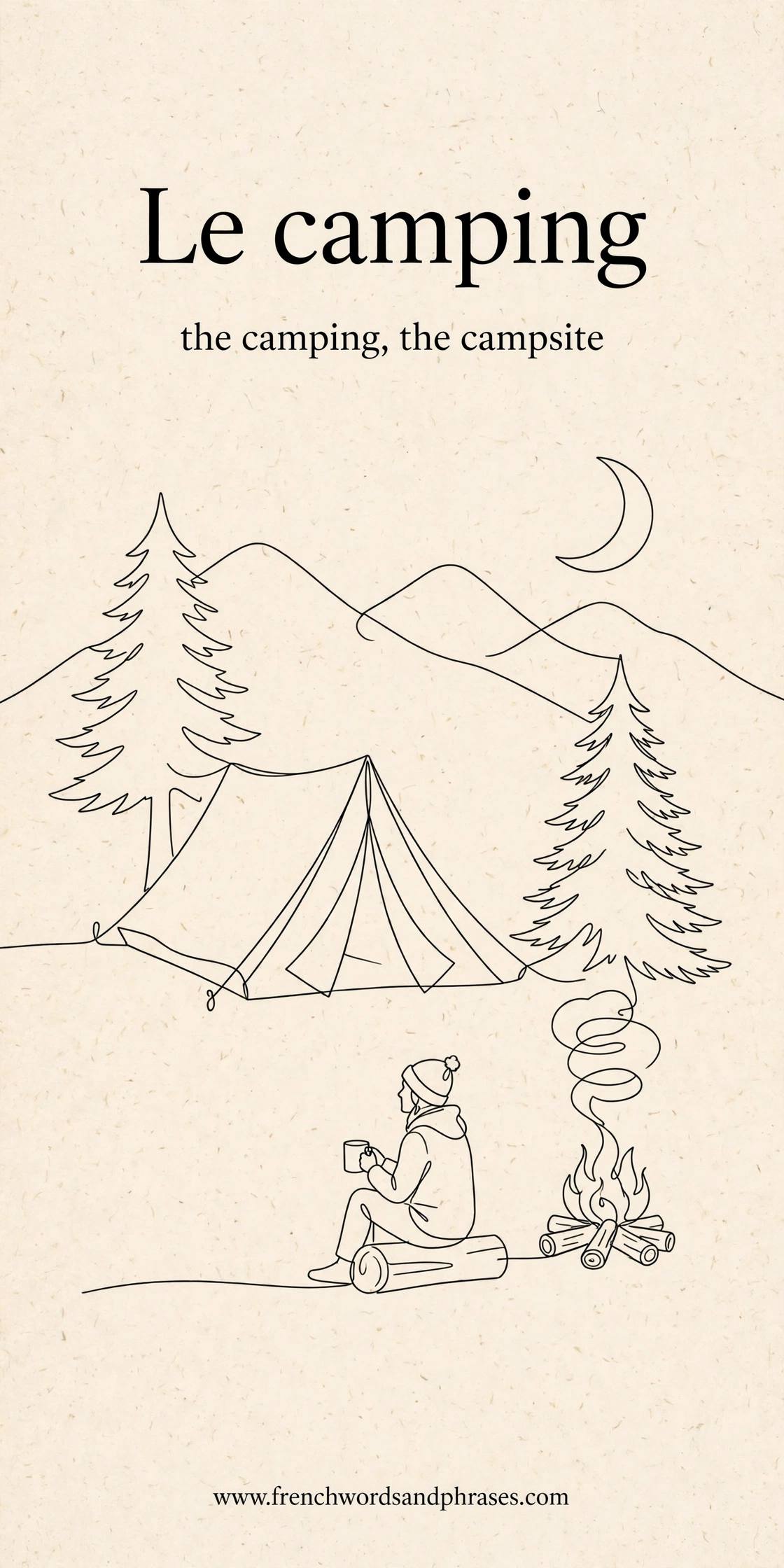
Le camping means the camping, the campsite.
A tent under the pines, a kettle on a small stove, and the whole of the outdoors for a garden: le camping — in French the word names both the activity of sleeping under canvas and the campsite itself, the field with its numbered pitches.
In this guide, you’ll learn what camping means in English, how to use it with its articles, how to form its plural, and how it appears in everyday French. Explore French examples, English translations, and practice quizzes.
Understanding the French Noun Camping
Camping is a masculine French noun, learned with its article: le camping, un camping. It is borrowed from English camping, but French made it do double duty: faire du camping is the activity, to go camping, and un camping is the place, a campsite with its showers, its shop and its boules pitch. English splits the two; French keeps one word for both.
It means camping and the campsite: partir en camping, to go off camping, un camping au bord de la mer, a campsite by the sea, le camping sauvage, wild camping — pitching your tent outside an official site, which French law restricts in many places. The person is un campeur, a camper, and the equipment has its own shelf: une tente, a tent, un sac de couchage, a sleeping bag, un réchaud, a camping stove.
Gender: Masculine — le camping
Definite article: le — le camping (the campsite)
Indefinite article: un — un camping (a campsite)
Plural: les campings — regular, with a simple -s
The activity: faire du camping — to go camping
The person: un campeur, une campeuse — a camper
English equivalents: The camping, the campsite.
Keep the two jobs apart with their little words: the activity takes faire du — nous faisons du camping, we go camping — while the place takes an ordinary article: le camping est complet, the campsite is full. And for the vehicle, French says un camping-car — a motorhome, literally a camping-coach.
Experience the Word
Camping is the French summer in its simplest form: a tent, a field, a river nearby, and dinner cooked outside as the light goes.
Imagine the family arriving at the camping in the Dordogne, the children already barefoot, the tent going up in the practised chaos of the first evening — and by nine o’clock, apéritif in hand, the parents are happier than in any hotel.
You have not just named a holiday. You have named freedom with a tent peg — le camping, the great French outdoors.
How to Use Camping in French: Complete Guide
Let’s explore how camping works in French, beginning with its articles — le camping, un camping, faire du camping.
Camping with the Definite Article (Le, Les)
Used for a specific campsite — the one by the river, the one with the pool.
| Form | French |
|---|---|
| Masculine singular | le camping |
| Plural | les campings |
Example
Le camping ouvre au mois d’avril.
The campsite opens in April.
Camping with the Indefinite Article (Un, Des)
Used for a campsite in general — any field with pitches and a shower block.
| Form | French |
|---|---|
| Masculine singular | un camping |
| Plural | des campings |
Example
Il y a un camping près du lac.
There is a campsite near the lake.
Kinds of Camping (Sauvage, À la ferme…)
French names its camping by style — wild, on the farm, or with all the comforts.
| Kind | French |
|---|---|
| wild camping | le camping sauvage |
| farm camping | le camping à la ferme |
| a seaside campsite | un camping au bord de la mer |
| a motorhome | un camping-car |
| a campsite pitch | un emplacement de camping |
Example
Le camping sauvage est interdit dans le parc.
Wild camping is forbidden in the park.
Quick Quiz 1
Complete the sentence:
______ camping est complet en août. (the)
Reveal the answer
Le
Le camping est complet en août.
The campsite is full in August — camping is masculine, so le.
The Plural of Camping
Camping takes a regular plural in -s — the coast is lined with them.
| Number | French |
|---|---|
| Singular | le camping |
| Plural | les campings |
Example
Les campings de la côte sont pleins en été.
The campsites on the coast are full in summer.
Camping with Possessive Adjectives (Mon, Ton, Son…)
Possessives agree with the noun: camping is masculine, so mon, ton, son in the singular.
| Owner | French |
|---|---|
| my | mon camping |
| your (tu) | ton camping |
| his / her | son camping |
| our | notre camping |
| your (vous) | votre camping |
| their | leur camping |
Example
Notre camping préféré se trouve en Bretagne.
Our favourite campsite is in Brittany.
Quick Quiz 2
Complete the sentence:
Il retourne chaque année dans ______ camping. (his)
Reveal the answer
son
Il retourne chaque année dans son camping.
He goes back to his campsite every year — son, because camping is masculine.
Camping with Demonstrative Adjectives (Ce, Ces)
Used to point: ce camping, this campsite — the one with the view.
| Form | French |
|---|---|
| Masculine singular | ce camping |
| Plural | ces campings |
Example
Ce camping a une piscine et un restaurant.
This campsite has a pool and a restaurant.
Camping with Adjectives
Adjectives agree with camping — masculine singular: un camping calme, un camping familial.
| Adjective | With Camping |
|---|---|
| calme (quiet) | un camping calme |
| familial (family) | un camping familial |
| sauvage (wild) | le camping sauvage |
| municipal (municipal) | un camping municipal |
| petit (small) | un petit camping |
Example
Nous cherchons un camping calme, loin de la route.
We are looking for a quiet campsite, away from the road.
Quick Quiz 3
Complete the sentence:
C’est un camping très ______. (quiet)
Reveal the answer
calme
C’est un camping très calme.
It is a very quiet campsite — calme has the same form for masculine and feminine.
Everyday Expressions with Camping
Tents, pitches and motorhomes — the camping phrases of the French summer.
| Expression | In English |
|---|---|
| faire du camping | to go camping (the activity) |
| un camping-car | a motorhome |
| le camping sauvage | wild camping |
| un emplacement | a pitch (on a campsite) |
| monter la tente | to pitch the tent |
Example
Cet été, nous faisons du camping en montagne.
This summer, we are going camping in the mountains.
Words from the Same Family as Camping
Under canvas — the words that travel with camping.
| French | In English |
|---|---|
| la tente | the tent |
| le campeur | the camper |
| camper | to camp (the verb) |
| le sac de couchage | the sleeping bag |
| le réchaud | the camping stove |
Example
Le campeur monte sa tente près de la rivière.
The camper pitches his tent near the river.
Quick Quiz 4
What is un camping-car?
Reveal the answer
A motorhome — the camping vehicle you sleep in, literally a camping-coach.
Ils voyagent en camping-car depuis dix ans.
They have been travelling by motorhome for ten years.
Camping in Everyday French: Real-Life Examples
Now that you know the word, let’s see how camping appears in everyday French.
Example 1 — Summer plans
Nous faisons du camping au mois de juillet.
We are going camping in July.
Example 2 — Booking
Le camping demande une réservation en été.
The campsite requires a booking in summer.
Example 3 — The tent
On monte la tente avant la nuit.
We pitch the tent before dark.
Example 4 — Wild camping
Le camping sauvage est interdit ici.
Wild camping is forbidden here.
Example 5 — The motorhome
Leur camping-car est garé près de la plage.
Their motorhome is parked near the beach.
Example 6 — The camper
Un bon campeur laisse l’endroit propre.
A good camper leaves the place clean.
Beyond Translation: The Meaning of Camping
Camping is an English word that France adopted and then out-organised. No country in Europe has more campsites: thousands of them, starred and rated like hotels, with bread delivered in the morning and boules at six. The French genius was to keep the tent and add civilisation — le camping in France can mean a Michelin-starred restaurant beside the pitches. And the language kept the souvenir of the borrowing: un camping is a place, faire du camping is the pleasure, and un camping-car is the vehicle — one English word, three French jobs.
To say camping in French is to pitch your tent in a country that turned camping into an art.
It evokes pine shade, river water, and dinner outside as the swallows turn in the evening air.
How to Remember the French Noun Camping
Remember it this way: Camping does two jobs in French: faire du camping is the activity, un camping is the campsite itself.
- Always masculine — le camping, un camping, mon camping.
- The activity phrase — faire du camping, to go camping.
- The vehicle — un camping-car, a motorhome.
The key idea is le camping — the campsite; faire du camping = to go camping.
Test Your Knowledge of Camping
Let’s see how much you’ve learned. Try answering these questions before revealing the answers.
Question 1
Is camping masculine or feminine?
Reveal the answer
Masculine — le camping, un camping.
Question 2
How do you say to go camping (the activity)?
Reveal the answer
Faire du camping.
Question 3
Translate: There is a campsite near the lake.
Reveal the answer
Il y a un camping près du lac.
Question 4
What is le camping sauvage?
Reveal the answer
Wild camping — pitching a tent outside an official campsite.
Question 5
Complete the sentence:
______ campings de la côte sont pleins. (the)
Reveal the answer
Les
Les campings de la côte sont pleins.
The campsites on the coast are full.
Your Final Challenge
Can You Use It?
How would you say this in French?
“This summer, we are going camping in the mountains.”
Reveal the answer
Cet été, nous faisons du camping en montagne.
This summer, we are going camping in the mountains.
A little French. A little curiosity. A richer everyday life.
LEARN FRENCH ONE WORD AT A TIME