A French Word to Live By
Translate Maison to English
/mɛ.zɔ̃/
La maison means a house.
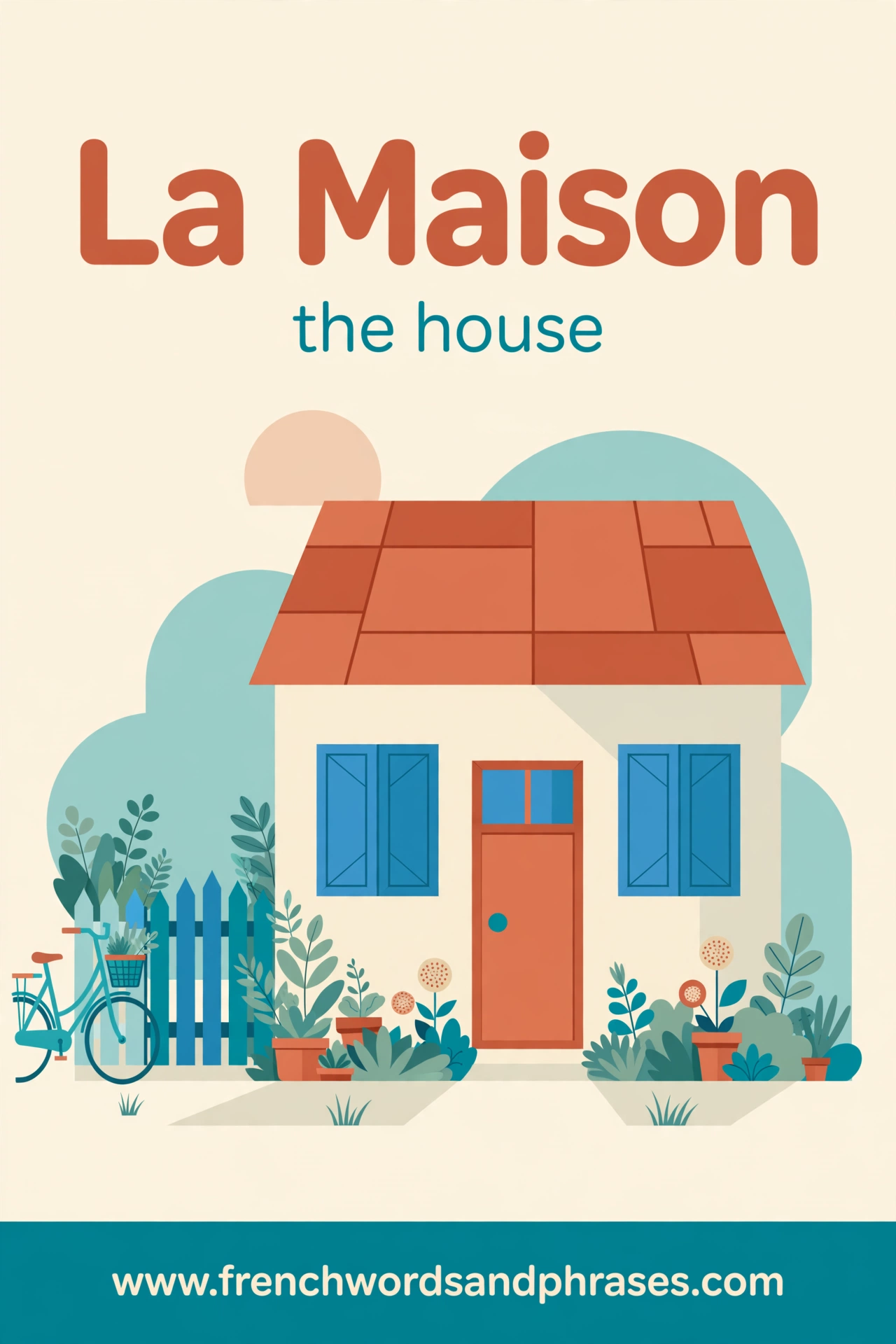
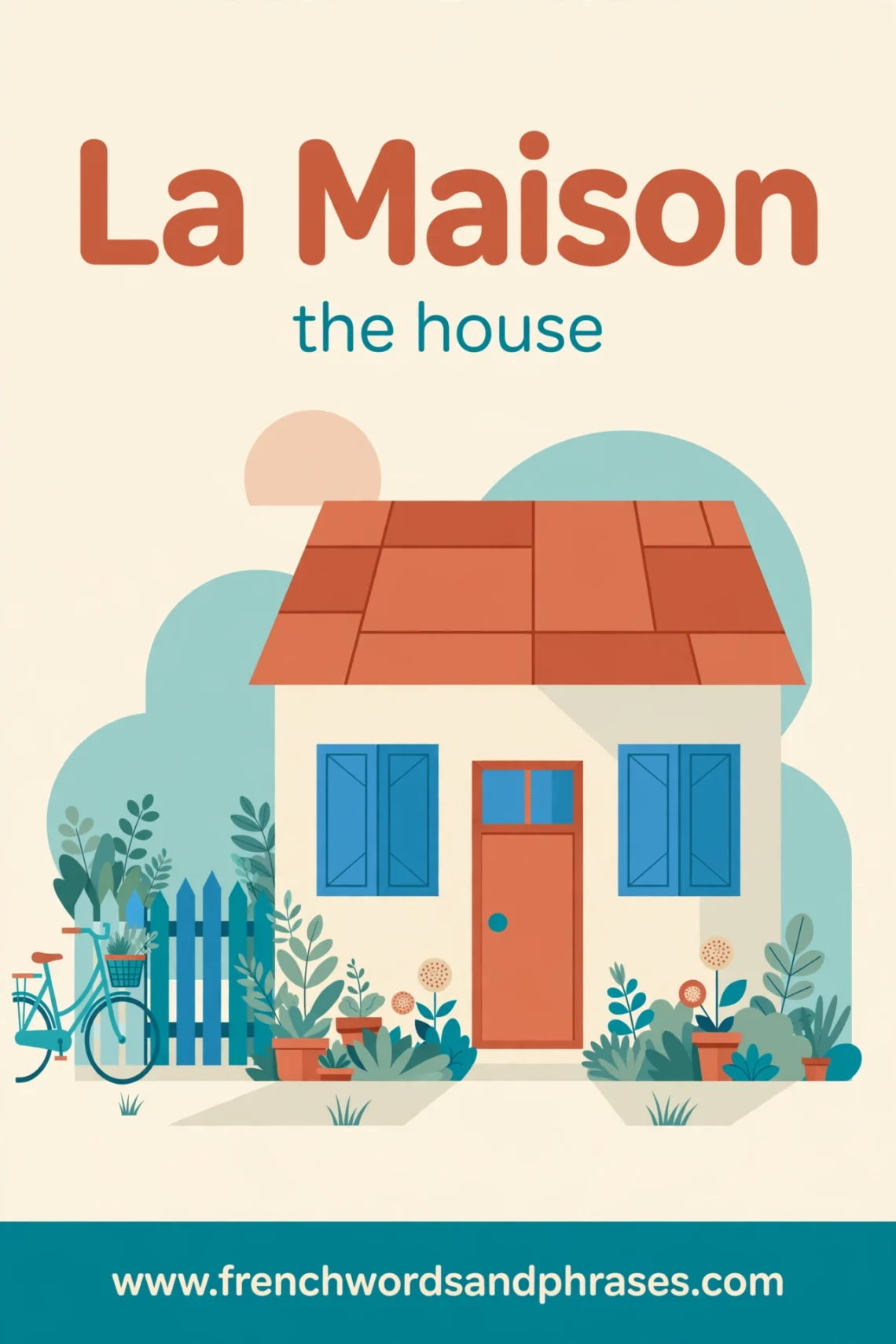
Blue shutters, a garden gate, smoke rising from the chimney on a cold evening — and behind the door, light, warmth and dinner. That is la maison.
In this guide, you’ll learn what maison means in English, how to use it with its articles, how to form its plural, and how it appears in everyday French. Explore French examples, English translations, and practice quizzes.
Understanding the French Noun Maison
Maison is a feminine French noun. Like every French noun, it has a gender, and it is learned together with its article: la maison.
It means a house — the building a family lives in, with its roof, its rooms and its garden. But maison reaches further than bricks: in the phrase à la maison, it becomes the English word home.
Gender: Feminine
Definite article: la — la maison (the house)
Indefinite article: une — une maison (a house)
Plural: les maisons (the houses)
English equivalents: A house; home (in à la maison).
One important usage detail: à la maison means at home, or simply home — not at the house. Je reste à la maison ce soir is I am staying at home tonight, and rentrer à la maison is to go home, wherever home is.
Experience the Word
Maison is more than walls and a roof. It is the smell of soup from the kitchen, shoes by the door, and the one place where you are completely yourself.
Imagine the evening return: the gate, the path, the key in the lock, and the whole day gently closing behind you.
You have not just bought a building. You have come home.
How to Use Maison in French: Complete Guide
Let’s explore how maison works in French, beginning with its articles.
Maison and Its Articles
French nouns are almost never used alone. The small word in front of the noun — the article — does a great deal of work.
Maison with the Definite Article (La, Les)
Used for a particular house both speakers know about, or for the house as a place in general.
| Number | French |
|---|---|
| Singular | la maison |
| Plural | les maisons |
Example
La maison est au bout de la rue.
The house is at the end of the street.
Maison with the Indefinite Article (Une, Des)
Used to introduce a house for the first time: one house, or some houses.
| Number | French |
|---|---|
| Singular | une maison |
| Plural | des maisons |
Example
Nous cherchons une maison avec trois chambres.
We are looking for a house with three bedrooms.
Maison with Numbers and Quantities
Maison is a count noun — you count houses one by one, so instead of a partitive article, French uses numbers and quantity words.
| Quantity | French |
|---|---|
| deux (two) | deux maisons |
| trois (three) | trois maisons |
| plusieurs (several) | plusieurs maisons |
| beaucoup de (a lot of) | beaucoup de maisons |
| toutes les (all the) | toutes les maisons |
| chaque (each) | chaque maison |
Example
Toutes les maisons du village sont blanches.
All the houses in the village are white.
Quick Quiz 1
How do you say the houses in French?
Reveal the answer
les maisons
Les maisons du village sont blanches.
The houses in the village are white.
The Plural of Maison
Like most French nouns, maison simply adds an -s in the plural — a letter you see but do not hear.
| Number | French |
|---|---|
| Singular | la maison |
| Plural | les maisons |
Example
Les maisons anciennes ont beaucoup de charme.
Old houses have a lot of charm.
Maison with Possessive Adjectives (Ma, Ta, Sa…)
Possessives agree with the noun, not with the owner — and maison is feminine, so it takes ma, ta, sa in the singular.
| Owner | French |
|---|---|
| my | ma maison |
| your (tu) | ta maison |
| his / her | sa maison |
| our | notre maison |
| your (vous) | votre maison |
| their | leur maison |
Example
Leur maison est grande et ancienne.
Their house is big and old.
Quick Quiz 2
Complete the sentence:
______ maison est bleue. (my)
Reveal the answer
Ma
Ma maison est bleue.
My house is blue.
Maison with Demonstrative Adjectives (Cette, Ces)
Used to point: this house here, those houses there. Feminine singular takes cette.
| Number | French |
|---|---|
| Singular | cette maison |
| Plural | ces maisons |
Example
Cette maison a un grand jardin.
This house has a big garden.
Maison with Adjectives
Adjectives agree with the noun, so they take feminine forms with maison. Short, common adjectives like grande and petite come before the noun; colours like bleue come after it.
| Adjective | With Maison |
|---|---|
| grande (big) | la grande maison |
| petite (small) | la petite maison |
| bleue (blue) | la maison bleue |
| blanche (white) | la maison blanche |
| ancienne (old) | la maison ancienne |
| moderne (modern) | la maison moderne |
Example
Ils ont acheté une grande maison moderne.
They bought a big modern house.
Quick Quiz 3
Complete the sentence:
La maison ______ est à vendre. (blue)
Reveal the answer
bleue
La maison bleue est à vendre.
The blue house is for sale. (Bleue is feminine and comes after the noun.)
Everyday Expressions with Maison
Maison is at the centre of the phrases of home life — staying in, going home and food made from scratch.
| Expression | In English |
|---|---|
| à la maison | at home, home |
| rentrer à la maison | to go home |
| rester à la maison | to stay at home |
| une maison de campagne | a country house |
| fait maison | homemade |
| la maison d’en face | the house opposite |
Example
Ce soir, je reste à la maison.
Tonight, I am staying at home.
Words from the Same Family as Maison
Learn these together and the whole house falls into place, room by room.
| French | In English |
|---|---|
| la porte | the door |
| la fenêtre | the window |
| la chambre | the bedroom |
| la cuisine | the kitchen |
| le toit | the roof |
| le jardin | the garden |
Example
Le toit de la maison est rouge.
The roof of the house is red.
Quick Quiz 4
What does rentrer à la maison mean?
Reveal the answer
To go home
Nous rentrons à la maison à pied.
We go home on foot.
Maison in Everyday French: Real-Life Examples
Now that you know the word, let’s see how maison appears in everyday French.
Example 1 — A blue house
La maison bleue est celle de mes grands-parents.
The blue house is my grandparents’ house.
Example 2 — Staying in
Ce soir, je reste à la maison.
Tonight, I am staying at home.
Example 3 — A big old house
Leur maison est grande et ancienne.
Their house is big and old.
Example 4 — Going home
Nous rentrons à la maison à pied.
We go home on foot.
Example 5 — In the village
Les maisons du village sont blanches.
The houses in the village are white.
Example 6 — In the country
Sa maison de campagne est près de la mer.
Her country house is near the sea.
Beyond Translation: The Meaning of Maison
English needs two words, house and home, where French manages with one: maison. The building and the feeling live in the same word, and the phrase à la maison gathers up everything English means by home.
To say maison is to say where you belong.
It evokes shutters and soup, the family table, the house opposite, and even pride on a restaurant menu — fait maison, made here, made properly, made at home.
How to Remember the French Noun Maison
Remember it this way: Maison is the house, feminine — and with à la, it becomes home itself.
- You describe where you live — tu habites une maison ancienne.
- You stay in for the evening — tu restes à la maison.
- You head back after a long day — tu rentres à la maison.
The key idea is la maison for the house, à la maison for at home.
Test Your Knowledge of Maison
Let’s see how much you’ve learned. Try answering these questions before revealing the answers.
Question 1
Is maison masculine or feminine?
Reveal the answer
Feminine — la maison.
Question 2
How do you say at home in French?
Reveal the answer
À la maison.
Question 3
Translate: They bought a house near the sea.
Reveal the answer
Ils ont acheté une maison près de la mer.
Question 4
What does fait maison mean on a menu?
Reveal the answer
Homemade.
Question 5
Complete the sentence:
Ce soir, je reste ______.
Reveal the answer
à la maison
Ce soir, je reste à la maison.
Tonight, I am staying at home.
Your Final Challenge
Can You Use It?
How would you say this in French?
“Tonight, I am staying at home.”
Reveal the answer
Ce soir, je reste à la maison.
Tonight, I am staying at home.
A little French. A little curiosity. A richer everyday life.
LEARN FRENCH ONE WORD AT A TIME