
A French Word to Live By
Translate Route to English
/ʁut/
La route means a road.
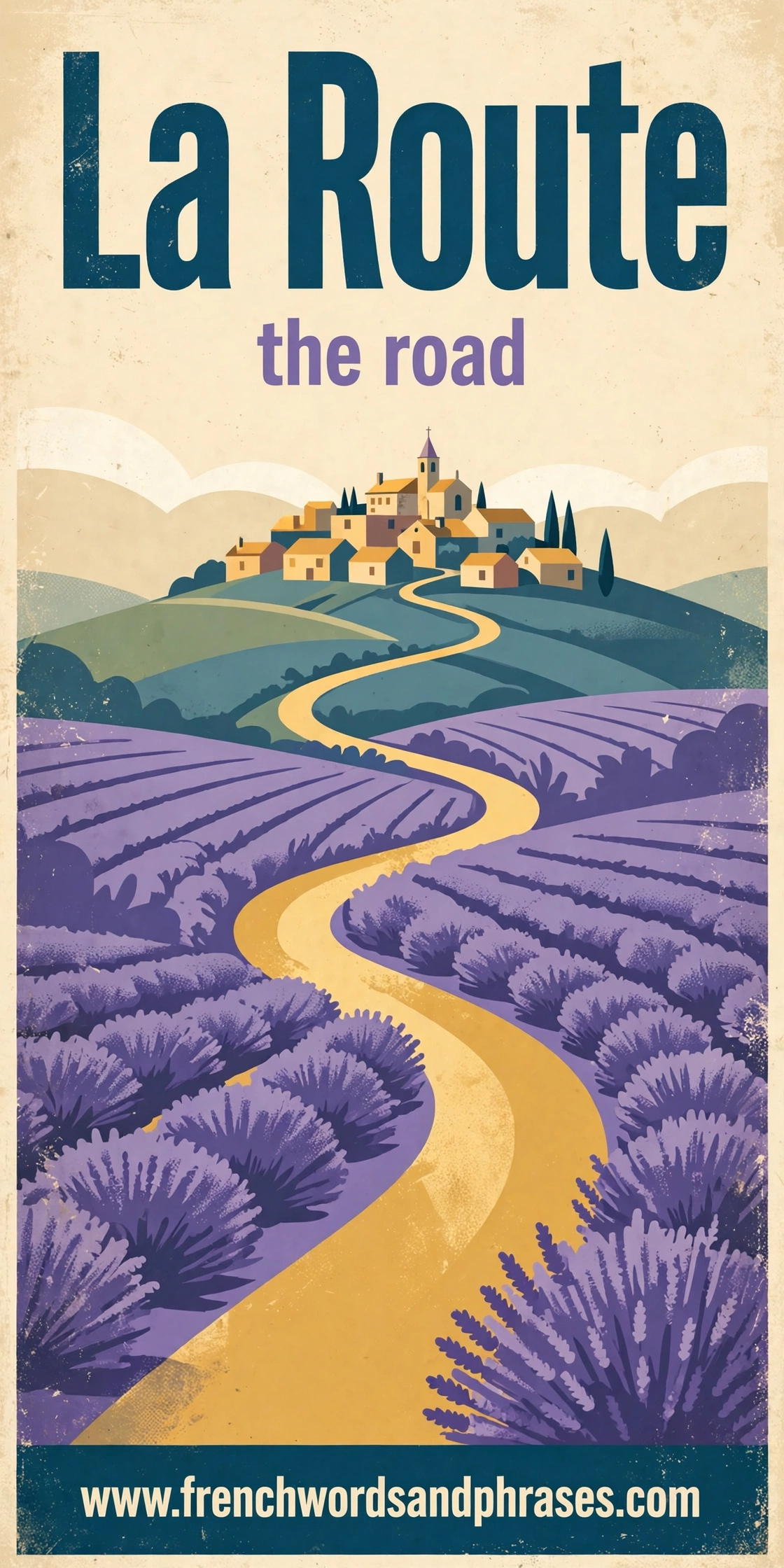
The town falls behind in the mirror, the fields open on both sides, and a long white line pulls you towards the horizon — that is la route.
In this guide, you’ll learn what route means in English, how to use it with its articles, how to form its plural, and how it appears in everyday French. Explore French examples, English translations, and practice quizzes.
Understanding the French Noun Route
Route is a feminine French noun. Like every French noun, it has a gender, and it is learned together with its article: la route.
It means a road — not a street in a town, but the road that travels: between villages, across the countryside, towards the sea. It is the word of journeys, of prendre la route, to set off, and of the joyful cry En route !
Gender: Feminine
Definite article: la — la route (the road)
Indefinite article: une — une route (a road)
Plural: les routes (the roads)
English equivalents: A road.
One important usage detail: keep route and rue apart. A rue stays inside a town, lined with houses and shops; a route leaves town and crosses open country. If you are giving a street address, you want rue; if you are driving to the next village, you want route.
Experience the Word
Route is more than asphalt. It is departure itself: the full tank, the map on the passenger seat, the promise that somewhere ahead there is a different sky.
Imagine the road at dawn in August — empty, golden, the whole of France asleep on either side, and the sea still three hours away.
You have not just named a way through the fields. You have named the journey.
How to Use Route in French: Complete Guide
Let’s explore how route works in French, beginning with its articles.
Route and Its Articles
French nouns are almost never used alone. The small word in front of the noun — the article — does a great deal of work.
Route with the Definite Article (La, Les)
Used for a particular road both speakers know about, or for the road as a place in general.
| Number | French |
|---|---|
| Singular | la route |
| Plural | les routes |
Example
La route est longue entre les deux villages.
The road is long between the two villages.
Route with the Indefinite Article (Une, Des)
Used to introduce a road for the first time: one road, or some roads.
| Number | French |
|---|---|
| Singular | une route |
| Plural | des routes |
Example
C’est une route de campagne, étroite et belle.
It is a country road, narrow and beautiful.
Route with Numbers and Quantities
Route is a count noun — you count roads one by one, so instead of a partitive article, French uses numbers and quantity words.
| Quantity | French |
|---|---|
| deux (two) | deux routes |
| trois (three) | trois routes |
| plusieurs (several) | plusieurs routes |
| toutes les (all the) | toutes les routes |
| chaque (each) | chaque route |
| quelle (which) | quelle route |
Example
Quelle route prend-on pour aller à la mer ?
Which road do we take to go to the sea?
Quick Quiz 1
How do you say two roads in French?
Reveal the answer
deux routes
Deux routes mènent au village.
Two roads lead to the village.
The Plural of Route
Like most French nouns, route simply adds an -s in the plural — a letter you see but do not hear.
| Number | French |
|---|---|
| Singular | la route |
| Plural | les routes |
Example
Les routes de campagne sont étroites.
Country roads are narrow.
Route with Possessive Adjectives (Ma, Ta, Sa…)
Possessives agree with the noun, not with the owner — and route is feminine, so it takes ma, ta, sa in the singular.
| Owner | French |
|---|---|
| my | ma route |
| your (tu) | ta route |
| his / her | sa route |
| our | notre route |
| your (vous) | votre route |
| their | leur route |
Example
Notre route passe par les montagnes.
Our road goes through the mountains.
Quick Quiz 2
Complete the sentence:
______ route est dangereuse la nuit. (our)
Reveal the answer
Notre
Notre route est dangereuse la nuit.
Our road is dangerous at night.
Route with Demonstrative Adjectives (Cette, Ces)
Used to point: this road here, those roads there. Feminine singular takes cette.
| Number | French |
|---|---|
| Singular | cette route |
| Plural | ces routes |
Example
Cette route traverse la forêt.
This road goes through the forest.
Route with Adjectives
Adjectives agree with the noun, so they take feminine forms with route. Most come after the noun: la route dangereuse, la route étroite.
| Adjective | With Route |
|---|---|
| dangereuse (dangerous) | la route dangereuse |
| longue (long) | la route longue |
| étroite (narrow) | la route étroite |
| mauvaise (bad) | la mauvaise route |
| droite (straight) | la route droite |
| belle (beautiful) | la belle route |
Example
Ils ont pris la mauvaise route.
They took the wrong road.
Quick Quiz 3
Complete the sentence:
C’est une route ______ (dangerous).
Reveal the answer
dangereuse
C’est une route dangereuse.
It is a dangerous road. (Dangereuse is feminine and comes after the noun.)
Everyday Expressions with Route
Route is the word of departures — some of the most joyful phrases in French live here.
| Expression | In English |
|---|---|
| en route ! | let’s go! / on our way! |
| prendre la route | to set off, to hit the road |
| bonne route ! | have a good journey! |
| faire de la route | to cover a lot of miles |
| une route de campagne | a country road |
| la sécurité routière | road safety |
Example
En route pour les vacances !
On our way to the holidays!
Words from the Same Family as Route
Learn these together and the whole journey falls into place.
| French | In English |
|---|---|
| l’autoroute | the motorway (highway) |
| le chemin | the path, the way |
| la circulation | the traffic |
| le panneau | the road sign |
| le virage | the bend |
| le kilomètre | the kilometre |
Example
Attention, il y a un virage dangereux sur cette route.
Careful, there is a dangerous bend on this road.
Quick Quiz 4
What does en route ! mean?
Reveal the answer
Let’s go! / On our way!
En route pour les vacances !
On our way to the holidays!
Route in Everyday French: Real-Life Examples
Now that you know the word, let’s see how route appears in everyday French.
Example 1 — A warning
Attention, cette route est fermée en hiver.
Careful, this road is closed in winter.
Example 2 — Between villages
La route entre les deux villages est longue.
The road between the two villages is long.
Example 3 — Setting off
En route pour les vacances !
On our way to the holidays!
Example 4 — An early start
Nous prenons la route tôt le matin.
We set off early in the morning.
Example 5 — In the countryside
Les routes de campagne sont étroites.
Country roads are narrow.
Example 6 — A traveller’s wish
Bonne route !
Have a good journey!
Beyond Translation: The Meaning of Route
English says road for the meaning of route — but the French word smells of summer. It is the Nationale 7 of the old holiday songs, the plane trees, the picnic at the side of the road, France unfolding one village at a time.
To say route is to say France in motion.
It evokes departures before dawn, the cry of En route ! at the front door, and the simple blessing offered to every traveller: Bonne route !
How to Remember the French Noun Route
Remember it this way: Route is the road between places, feminine — the journey word, not the town street.
- You leave town and cross the fields — c’est la route.
- You set off early — tu prends la route tôt.
- You wish a friend well — bonne route !
The key idea is la route for the open road, la rue for the street in town.
Test Your Knowledge of Route
Let’s see how much you’ve learned. Try answering these questions before revealing the answers.
Question 1
Is route masculine or feminine?
Reveal the answer
Feminine — la route.
Question 2
How do you say this road in French?
Reveal the answer
Cette route.
Question 3
Translate: We set off early in the morning.
Reveal the answer
Nous prenons la route tôt le matin.
Question 4
What does bonne route ! mean?
Reveal the answer
Have a good journey!
Question 5
Complete the sentence:
Nous suivons cette ______ jusqu’au village.
Reveal the answer
route
Nous suivons cette route jusqu’au village.
We follow this road to the village.
Your Final Challenge
Can You Use It?
How would you say this in French?
“We set off early in the morning.”
Reveal the answer
Nous prenons la route tôt le matin.
We set off early in the morning.
A little French. A little curiosity. A richer everyday life.
LEARN FRENCH ONE WORD AT A TIME




