A French Word to Live By
Translate Passage piétons to English
/pa.saʒ pje.tɔ̃/
Le passage piétons means the pedestrian crossing.
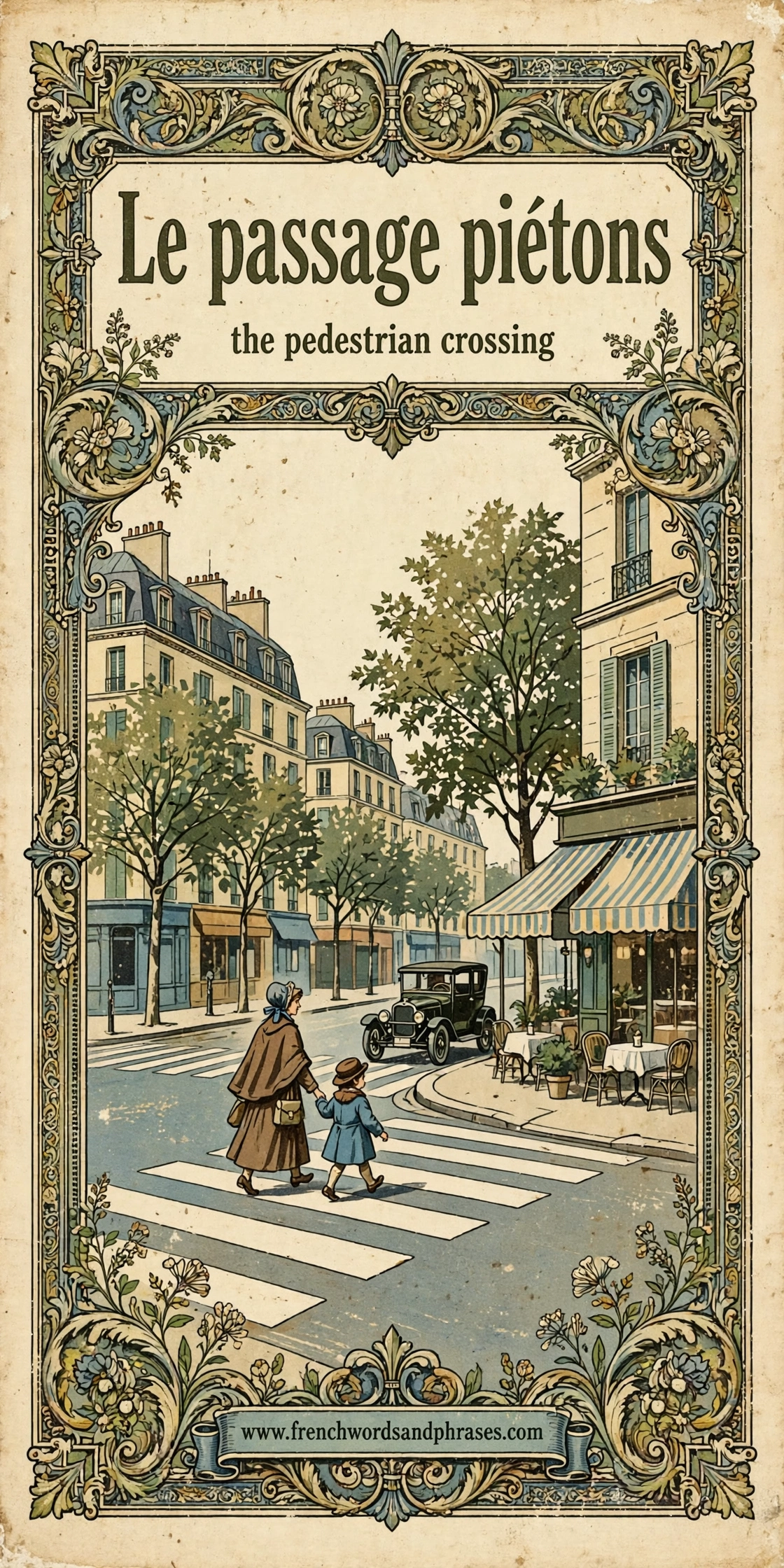
White stripes painted across the black road, a small crowd waiting for the green man, then the whole pavement stepping out together: le passage piétons, the pedestrian crossing — the walker’s treaty with the traffic, signed in zebra stripes.
In this guide, you’ll learn what passage piétons means in English, how to use it with its articles, how to form its plural, and how it appears in everyday French. Explore French examples, English translations, and practice quizzes.
Understanding the French Noun Passage piétons
Passage piétons is a masculine French noun phrase, learned with its article: le passage piétons, un passage piétons. Its head word is passage, a crossing or passing-place, and piétons — the pedestrians, from pied, the foot — stays in the plural inside the phrase, frozen: it is the crossing OF pedestrians. You will also see it written passage piéton and, in everyday speech, le passage clouté, the studded crossing, after its old metal studs.
It means a pedestrian crossing, a crosswalk — the marked place where people on foot cross the road: traverser au passage piétons, to cross at the pedestrian crossing, attendre au passage piétons, to wait at the crossing. French traffic law protects it fiercely: drivers must stop for a pedestrian engaged on the passage, and pedestrians, in town, must use it when one is near. The stripes themselves are les bandes blanches, and the little green walker who gives the signal is le bonhomme vert.
Gender: Masculine — le passage piétons
Definite article: le — le passage piétons (the pedestrian crossing)
Indefinite article: un — un passage piétons (a pedestrian crossing)
Plural: les passages piétons — the -s goes on passage; piétons is already plural
Spelling note: piétons stays plural inside the name — the crossing of the pedestrians
Everyday cousin: le passage clouté — the studded crossing, the older name
English equivalents: The pedestrian crossing, the crosswalk.
The verb is traverser, and the place is fixed: traverser au passage piétons, never in the middle of the road — traverser n’importe où is what the agent de police scolds. Children learn the liturgy early: regarder à gauche, à droite, et encore à gauche, then wait for le bonhomme vert. Drivers, for their part, learn the other half: céder le passage aux piétons, give way to pedestrians.
Experience the Word
Passage piétons is democracy painted on asphalt: for thirty seconds, the smallest person on foot outranks the biggest lorry in the road.
Imagine the school corner at eight-thirty — the agent’s whistle, the white stripes filling with small boots, the whole traffic holding its breath until the pavement is reached.
You have not just named road paint. You have named the walker’s right of way — le passage piétons, the pedestrian crossing, the street’s safe bridge.
How to Use Passage piétons in French: Complete Guide
Let’s explore how passage piétons works in French, beginning with its articles — le passage piétons, un passage piétons, traverser au passage.
Passage piétons with the Definite Article (Le, Les)
Used for a specific crossing — the one by the school, the one at the lights.
| Form | French |
|---|---|
| Masculine singular | le passage piétons |
| Plural | les passages piétons |
Example
Le passage piétons se trouve devant l’école.
The pedestrian crossing is in front of the school.
Passage piétons with the Indefinite Article (Un, Des)
Used for a crossing in general — any striped bridge across the traffic.
| Form | French |
|---|---|
| Masculine singular | un passage piétons |
| Plural | des passages piétons |
Example
Il faudrait un passage piétons dans cette rue dangereuse.
There should be a pedestrian crossing in this dangerous street.
Passage piétons in Action (Traverser, Attendre, Céder…)
The crossing lives through its verbs — waiting, crossing, and giving way to it.
| Action | French |
|---|---|
| to cross at the crossing | traverser au passage piétons |
| to wait at the crossing | attendre au passage piétons |
| to give way to pedestrians | céder le passage aux piétons |
| the white stripes | les bandes blanches |
| the green man | le bonhomme vert |
Example
Les enfants attendent le bonhomme vert au passage piétons.
The children wait for the green man at the pedestrian crossing.
Quick Quiz 1
Complete the sentence:
______ passage piétons est juste au coin de la rue. (the)
Reveal the answer
Le
Le passage piétons est juste au coin de la rue.
The pedestrian crossing is just at the street corner — passage is masculine, so le.
The Plural of Passage piétons
The head noun takes the -s: les passages piétons — piétons, already plural, never changes.
| Number | French |
|---|---|
| Singular | le passage piétons |
| Plural | les passages piétons |
Example
La ville repeint les passages piétons près des écoles.
The town is repainting the pedestrian crossings near the schools.
Passage piétons with Possessive Adjectives (Notre, Votre…)
A street speaks of its crossing: notre passage piétons — possessives agree with passage, masculine singular.
| Owner | French |
|---|---|
| our | notre passage piétons |
| your (vous) | votre passage piétons |
| their | leur passage piétons |
| the school’s | le passage piétons de l’école |
| the neighbourhood’s | le passage piétons du quartier |
Example
Notre passage piétons est protégé par un agent le matin.
Our pedestrian crossing is guarded by an officer in the morning.
Quick Quiz 2
Complete the sentence:
Traverse toujours ______ passage piétons. (at the — use au)
Reveal the answer
au
Traverse toujours au passage piétons.
Always cross at the pedestrian crossing — au, à + le, because passage is masculine.
Passage piétons with Demonstrative Adjectives (Ce, Ces)
Used to point: ce passage piétons, this crossing — this safe one, not the busy corner.
| Form | French |
|---|---|
| Masculine singular | ce passage piétons |
| Plural | ces passages piétons |
Example
Ce passage piétons est dangereux le soir.
This pedestrian crossing is dangerous in the evening.
Passage piétons with Adjectives
Adjectives agree with passage — masculine singular: un passage piétons sûr, un nouveau passage.
| Adjective | With Passage piétons |
|---|---|
| sûr (safe) | un passage piétons sûr |
| dangereux (dangerous) | un passage piétons dangereux |
| nouveau (new) | un nouveau passage piétons |
| protégé (guarded) | un passage piétons protégé |
| clouté (studded, the old name) | un passage clouté |
Example
Un passage piétons sûr protège les enfants du quartier.
A safe pedestrian crossing protects the neighbourhood’s children.
Quick Quiz 3
Complete the sentence:
La mairie a installé un passage piétons ______. (new)
Reveal the answer
nouveau
La mairie a installé un passage piétons nouveau.
The town hall has installed a new pedestrian crossing — nouveau, masculine, to agree with passage.
Everyday Expressions with Passage piétons
Stripes, signals and school corners — the passage piétons phrases of daily life.
| Expression | In English |
|---|---|
| traverser au passage piétons | to cross at the pedestrian crossing |
| le passage clouté | the studded crossing — the older everyday name |
| le bonhomme vert | the green man on the signal |
| les bandes blanches | the white stripes |
| céder le passage | to give way |
Example
Regarde le bonhomme vert avant de traverser au passage piétons.
Look for the green man before crossing at the pedestrian crossing.
Words from the Same Family as Passage piétons
Walking and crossing — the words that travel with passage piétons.
| French | In English |
|---|---|
| un piéton | a pedestrian — the person inside the name |
| traverser | to cross (the verb) |
| le trottoir | the pavement, the sidewalk |
| un feu rouge | a red light, traffic lights |
| le carrefour | the intersection the crossing serves |
Example
Le piéton attend sur le trottoir, près du feu rouge.
The pedestrian waits on the pavement, near the traffic light.
Quick Quiz 4
What is le passage clouté?
Reveal the answer
The older name for the pedestrian crossing — after the metal studs that marked it before paint.
Traverse au passage clouté, pas au milieu de la rue.
Cross at the crossing, not in the middle of the road.
Passage piétons in Everyday French: Real-Life Examples
Now that you know the word, let’s see how passage piétons appears in everyday French.
Example 1 — Teaching
On traverse au passage piétons, jamais au milieu.
You cross at the pedestrian crossing, never in the middle.
Example 2 — Waiting
Les piétons attendent le bonhomme vert.
The pedestrians are waiting for the green man.
Example 3 — Driving
La voiture s’arrête au passage piétons.
The car stops at the pedestrian crossing.
Example 4 — School
Le passage piétons de l’école est repeint en jaune.
The school’s pedestrian crossing is repainted in yellow.
Example 5 — Asking
Pardon, où est le passage piétons le plus proche ?
Excuse me, where is the nearest pedestrian crossing?
Example 6 — Safety
Un passage piétons sûr change tout un quartier.
A safe pedestrian crossing changes a whole neighbourhood.
Beyond Translation: The Meaning of Passage piétons
The passage piétons began as iron: rows of metal studs — clous — hammered into the road, which is why grandparents still call it le passage clouté. Paint replaced the studs, the bonhomme vert replaced the agent’s whistle, but the idea stayed the same and rather beautiful: a treaty zone where horsepower yields to foot-power, renewed every thirty seconds at every corner. French law guards it accordingly, and French childhood is drilled in its liturgy before almost any other civic lesson.
To say passage piétons is to claim the walker’s share of the road.
It evokes white stripes, waiting crowds and the green man’s small permission — the street, shared.
How to Remember the French Noun Passage piétons
Remember it this way: Passage piétons is the pedestrian crossing — masculine: le passage piétons, plural les passages piétons, and you traverser au passage.
- Always masculine — le passage piétons, un passage piétons, ce passage piétons.
- The plural — the -s goes on passage only: les passages piétons.
- The old name — le passage clouté, the studded crossing.
The key idea is le passage piétons — the pedestrian crossing, masculine; older name passage clouté.
Test Your Knowledge of Passage piétons
Let’s see how much you’ve learned. Try answering these questions before revealing the answers.
Question 1
Is passage piétons masculine or feminine?
Reveal the answer
Masculine — le passage piétons, un passage piétons.
Question 2
How is the plural written?
Reveal the answer
Les passages piétons — the -s goes on passage; piétons is already plural.
Question 3
Translate: Always cross at the pedestrian crossing.
Reveal the answer
Traverse toujours au passage piétons.
Question 4
What is le bonhomme vert?
Reveal the answer
The green man — the walking figure on the crossing signal.
Question 5
Complete the sentence:
______ passages piétons de la ville sont repeints. (the)
Reveal the answer
Les
Les passages piétons de la ville sont repeints.
The town’s pedestrian crossings are repainted.
Your Final Challenge
Can You Use It?
How would you say this in French?
“The children wait for the green man at the pedestrian crossing.”
Reveal the answer
Les enfants attendent le bonhomme vert au passage piétons.
The children wait for the green man at the pedestrian crossing.
A little French. A little curiosity. A richer everyday life.
LEARN FRENCH ONE WORD AT A TIME