A French Word to Live By
Translate Russie to English
/ʁy.si/
La Russie means Russia.
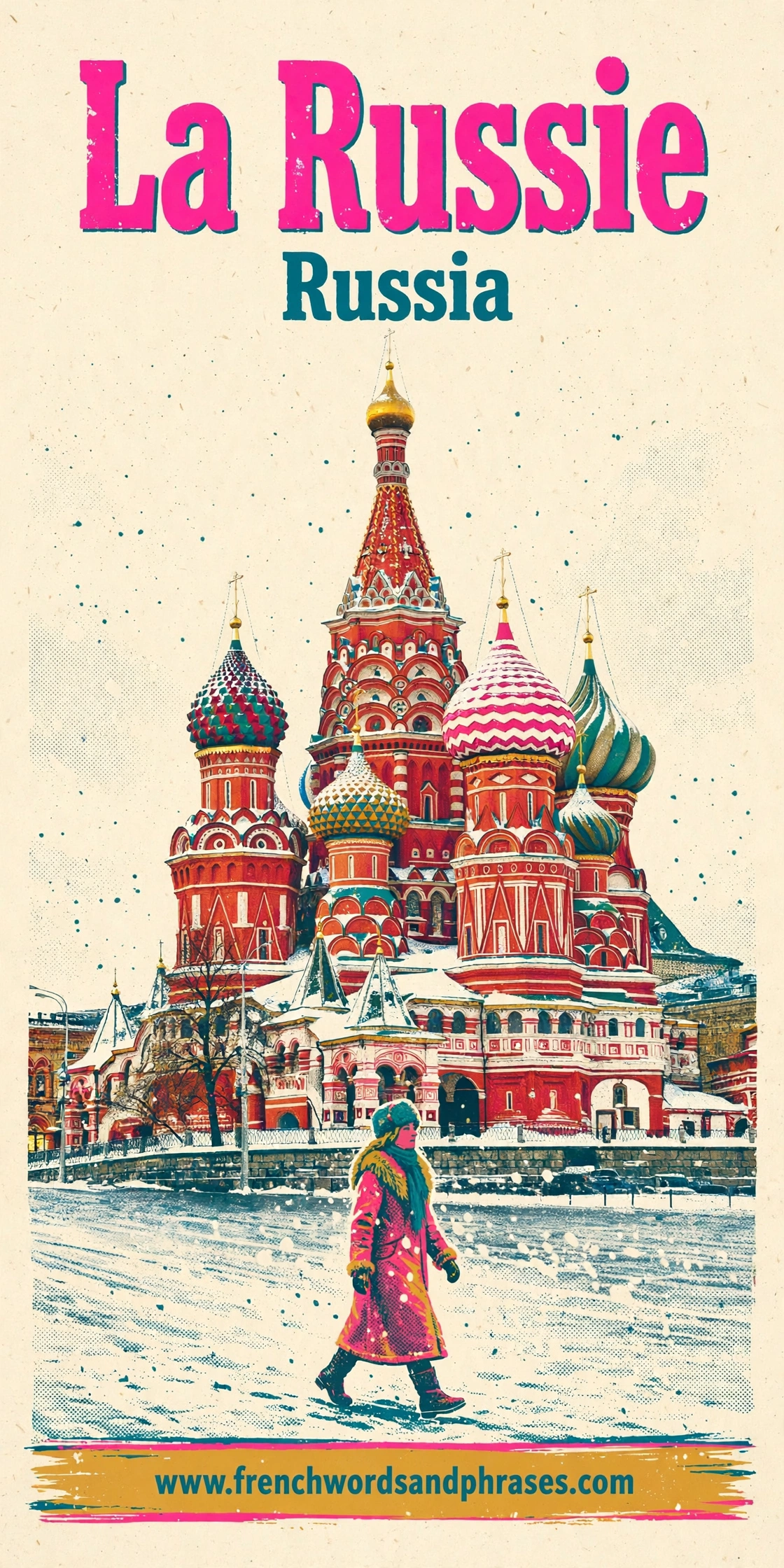
Eleven time zones, onion domes and winters that swallow armies: la Russie, Russia — the largest country on Earth, stretching from the Baltic to the Pacific in one unbroken sweep of forest, steppe and snow.
In this guide, you’ll learn what Russie means in English, how to use it with its articles, how to form its plural, and how it appears in everyday French. Explore French examples, English translations, and practice quizzes.
Understanding the French Noun Russie
Russie is a feminine proper noun, learned with its article: la Russie. Countries ending in -e are feminine, and Russie follows the rule — en Russie for in/to, de Russie for from. The name comes from the Rus’, the medieval people and state from which Russia, Ukraine and Belarus all descend.
It means Russia — the largest country in the world, spanning eastern Europe and all of northern Asia, with Moscou, Moscow, as its capital. Its people are les Russes — one form for men and women alike, un Russe, une Russe — and its language is le russe, written in the Cyrillic alphabet, l’alphabet cyrillique. France and Russia have been allies, enemies and fascinated admirers by turns; French was once the language of the Russian court, and Russian words — tsar, cosaque, steppe — season French in return.
Gender: Feminine — la Russie
Definite article: la — la Russie (Russia)
Saying in / to: en — en Russie
Saying from: de — venir de Russie
Capital: Moscou
The people: les Russes — un Russe, une Russe
English equivalents: Russia.
Russie behaves like France: en Russie, de Russie, and la Russie as subject or object. The people are a gift to learners: Russe does not change for the feminine — un Russe, une Russe, les Russes — only the article moves. The language, le russe, uses another alphabet, which French names with respect: le cyrillique.
Experience the Word
Russie is the country that defeats maps: you can fly for nine hours inside it, cross eleven time zones, and still land in la Russie.
Imagine the Trans-Siberian at dawn — birch forest without end, a village of wooden houses in the snow, tea in a metal holder in the dining car — la Russie passing the window for a week.
You have not just named a country. You have named immensity itself — la Russie, Russia, the giant of the north.
How to Use Russie in French: Complete Guide
Let’s explore how Russie works in French, beginning with its article and prepositions — la Russie, en Russie, de Russie.
Russie with the Definite Article (La)
As subject or object, Russie keeps her article: la Russie.
| Form | French |
|---|---|
| The country | la Russie |
| The east of Russia | l’est de la Russie |
| All of Russia | toute la Russie |
Example
La Russie est le plus grand pays du monde.
Russia is the largest country in the world.
Saying In, To and From: En Russie, De Russie
Feminine countries take en for in/to and de for from — the article disappears after both.
| Meaning | French |
|---|---|
| in Russia, to Russia | en Russie |
| from Russia | de Russie |
| across Russia | dans toute la Russie |
| to the capital | à Moscou |
Example
Il a voyagé en Russie l’hiver dernier.
He travelled to Russia last winter.
The People of Russia: Les Russes
The inhabitants are easy: Russe keeps one form for men and women — only the article changes.
| Person | French |
|---|---|
| a Russian man | un Russe |
| a Russian woman | une Russe |
| Russian men / the Russians | les Russes |
| Russian women | les Russes |
Example
Les Russes aiment le thé très chaud.
Russians love very hot tea.
Quick Quiz 1
Complete the sentence:
Il a voyagé ______ Russie l’hiver dernier. (to)
Reveal the answer
en
Il a voyagé en Russie l’hiver dernier.
He travelled to Russia last winter — feminine countries take en, with no article.
The Language and the Adjective: Russe
Russe is the language of Tolstoy — and an adjective that, like the people, keeps one form for both genders in the singular.
| Use | French |
|---|---|
| the language | le russe |
| masculine adjective | un hiver russe |
| feminine adjective | une âme russe |
| to speak Russian | parler russe |
Example
Le russe s’écrit en alphabet cyrillique.
Russian is written in the Cyrillic alphabet.
Russie at a Glance
The facts every beginner meets first — capital, currency, language.
| Point | Russie |
|---|---|
| Capital | Moscou |
| Currency | le rouble |
| Language | le russe |
| Alphabet | l’alphabet cyrillique |
| Famous train | le Transsibérien |
Example
Moscou est la capitale de la Russie.
Moscow is the capital of Russia.
Quick Quiz 2
What is the capital of Russia?
Reveal the answer
Moscou
Moscou est la capitale de la Russie.
Moscow is the capital of Russia.
Russie and Its Neighbours
Russia touches Europe and Asia at once — and borders more countries than any learner can list.
| Direction | French |
|---|---|
| to the west | l’Europe — la Finlande, la Pologne |
| to the south | la Chine |
| to the east | l’océan Pacifique |
| inside | la Sibérie — Siberia, the immense east |
Example
La Chine est au sud de la Russie.
China is south of Russia.
Russie with Adjectives
Adjectives agree with Russie — feminine singular: la Russie entière, the whole of Russia.
| Adjective | With Russie |
|---|---|
| entière (whole) | la Russie entière |
| grande (great) | la grande Russie |
| froide (cold) | la Russie froide du nord |
| ancienne (old) | la vieille Russie des tsars |
Example
La Russie entière regarde la neige tomber.
The whole of Russia watches the snow fall.
Quick Quiz 3
Complete the sentence:
C’est une femme ______, de Moscou. (Russian)
Reveal the answer
russe
C’est une femme russe, de Moscou.
She is a Russian woman from Moscow — russe keeps the same form for the feminine.
Everyday Expressions with Russie
Steppes, tsars and long trains — the Russie phrases of daily life.
| Expression | In English |
|---|---|
| en Russie | in Russia |
| de Russie | from Russia; Russian (of origin) |
| la steppe | the steppe — the great grass plain |
| un tsar | a tsar — the old emperor of Russia |
| les poupées russes | Russian dolls — the nesting matryoshkas |
Example
Les poupées russes sont célèbres dans le monde entier.
Russian dolls are famous all over the world.
Words from the Same Family as Russie
Russians and Russian — the words that travel with Russie.
| French | In English |
|---|---|
| russe | Russian — the language and the adjective |
| un Russe | a Russian man |
| la Sibérie | Siberia |
| le tsar | the tsar |
| cyrillique | Cyrillic — the alphabet of Russian |
Example
La Sibérie est la partie immense de la Russie en Asie.
Siberia is the immense Asian part of Russia.
Quick Quiz 4
What are les poupées russes?
Reveal the answer
Russian dolls — the painted wooden dolls that nest inside each other.
Les poupées russes s’ouvrent les unes après les autres.
Russian dolls open one after another.
Russie in Everyday French: Real-Life Examples
Now that you know the word, let’s see how Russie appears in everyday French.
Example 1 — Travel
Il a voyagé en Russie l’hiver dernier.
He travelled to Russia last winter.
Example 2 — Language
Elle apprend le russe à l’université.
She is learning Russian at university.
Example 3 — Geography
La Russie est le plus grand pays du monde.
Russia is the largest country in the world.
Example 4 — Winter
En Russie, l’hiver est long et froid.
In Russia, winter is long and cold.
Example 5 — Trains
Le Transsibérien traverse toute la Russie.
The Trans-Siberian crosses the whole of Russia.
Example 6 — Tea
Les Russes boivent du thé toute la journée.
Russians drink tea all day long.
Beyond Translation: The Meaning of Russie
Russie defeated the two greatest conquerors of Europe — Napoleon and Hitler both marched in and were marched out by distance and winter, which French remembers in the phrase le général Hiver, General Winter. Yet the cultural love affair is just as famous: in the nineteenth century, the Russian aristocracy spoke French at home, Tolstoy wrote pages of War and Peace in it, and Paris later welcomed the Ballets Russes like a revelation. Two languages, two empires of snow and salons, forever translating each other.
To say Russie is to measure the world in time zones.
It evokes the Trans-Siberian at dawn, onion domes in snow and tea that never cools — Russia, the immense north.
How to Remember the French Noun Russie
Remember it this way: Russie is feminine: la Russie — en Russie and de Russie, with no article, for in and from.
- Feminine with her article — la Russie as subject: la Russie est immense.
- The prepositions — en Russie (in, to), de Russie (from).
- The people — un Russe, une Russe: the word never changes, only the article.
The key idea is la Russie — Russia, feminine; en Russie, de Russie.
Test Your Knowledge of Russie
Let’s see how much you’ve learned. Try answering these questions before revealing the answers.
Question 1
Is Russie masculine or feminine in French?
Reveal the answer
Feminine — la Russie.
Question 2
How do you say in Russia?
Reveal the answer
En Russie — feminine countries take en, without the article.
Question 3
Translate: Russia is the largest country in the world.
Reveal the answer
La Russie est le plus grand pays du monde.
Question 4
How do you say a Russian woman?
Reveal the answer
Une Russe — Russe keeps one form; the article carries the gender.
Question 5
Complete the sentence:
______ Russie s’étend sur deux continents. (the)
Reveal the answer
La
La Russie s’étend sur deux continents.
Russia stretches across two continents.
Your Final Challenge
Can You Use It?
How would you say this in French?
“He travelled to Russia last winter.”
Reveal the answer
Il a voyagé en Russie l’hiver dernier.
He travelled to Russia last winter.
A little French. A little curiosity. A richer everyday life.
LEARN FRENCH ONE WORD AT A TIME