A French Word to Live By
Translate France to English
/fʁɑ̃s/
La France means France.
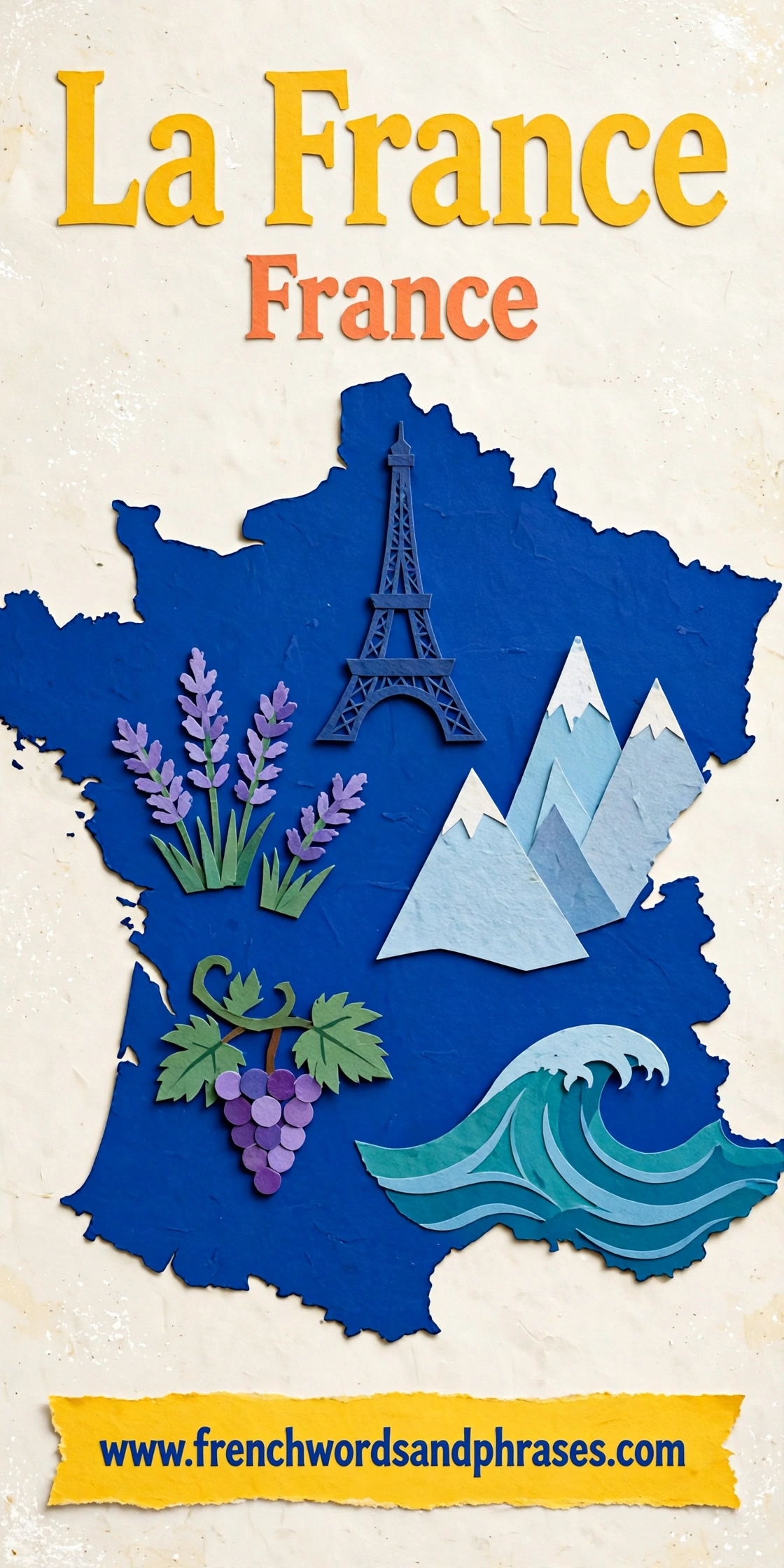
The hexagon on the map, the country this whole site is about: la France, France — baguettes and TGVs, villages and vineyards, and the language you are learning, spoken from Lille to Marseille and far beyond the sea.
In this guide, you’ll learn what France means in English, how to use it with its articles, how to form its plural, and how it appears in everyday French. Explore French examples, English translations, and practice quizzes.
Understanding the French Noun France
France is a feminine proper noun, learned with its article: la France. Almost all French country names carry an article, and France keeps hers in most sentences: la France est grande. The name comes from the Franks, the Germanic people who gave the country — and the French — their name. After the prepositions en and de, the article steps aside: en France, in France, de France, from France.
It means France — the country in Western Europe shaped, its schoolchildren learn, like a hexagon: l’Hexagone is its famous nickname. Its capital is Paris, its language le français, its people les Français and les Françaises. France also reaches beyond Europe: la France d’outre-mer, overseas France, from Guadeloupe to New Caledonia. To live there is vivre en France; to cross it, traverser la France.
Gender: Feminine — la France
Definite article: la — la France (France)
Saying in / to: en — en France, vivre en France
Saying from: de — venir de France
Capital: Paris
The people: les Français, les Françaises — a Frenchman, a Frenchwoman
English equivalents: France.
The preposition is the whole game with countries: feminine countries take en — en France — and give back with de: le vin de France. The article returns whenever France is a subject or object: la France a gagné, France won. Its nickname l’Hexagone works the same way: dans l’Hexagone, within mainland France.
Experience the Word
France is not just a place on this site — it is the source of every word on it, the country whose language fills these pages.
Imagine the school map on the classroom wall, the familiar six-sided shape in the middle of Europe, coloured in by generations of children who learn to call it mon pays — or, for the learner abroad, le pays de la langue que j’apprends.
You have not just named a country. You have named the home of French itself — la France, France, the Hexagon.
How to Use France in French: Complete Guide
Let’s explore how France works in French, beginning with its article and prepositions — la France, en France, de France.
France with the Definite Article (La)
As subject or object, France keeps her article: la France.
| Form | French |
|---|---|
| The country | la France |
| Mainland France (nickname) | l’Hexagone |
| Overseas France | la France d’outre-mer |
Example
La France est un grand pays d’Europe.
France is a large country in Europe.
Saying In, To and From: En France, De France
Feminine countries take en for in/to and de for from — the article disappears after both.
| Meaning | French |
|---|---|
| in France, to France | en France |
| from France | de France |
| all over France | dans toute la France |
| to the capital | à Paris |
Example
Nous vivons en France depuis dix ans.
We have lived in France for ten years.
The People of France: Les Français
The inhabitants take a capital letter — and the same word français, small f, names the language and the adjective.
| Person | French |
|---|---|
| a Frenchman | un Français |
| a Frenchwoman | une Française |
| French men / the French | les Français |
| French women | les Françaises |
Example
Les Français aiment le pain frais.
The French love fresh bread.
Quick Quiz 1
Complete the sentence:
Elle habite ______ France, près de Lyon. (in)
Reveal the answer
en
Elle habite en France, près de Lyon.
She lives in France, near Lyon — feminine countries take en, with no article.
The Language and the Adjective: Français
One word, three jobs: français is the language, the adjective, and — capitalised — the person.
| Use | French |
|---|---|
| the language | le français |
| masculine adjective | un vin français |
| feminine adjective | une ville française |
| to speak French | parler français |
Example
Le français est la langue de la France.
French is the language of France.
France at a Glance
The facts every beginner meets first — capital, currency, language.
| Point | France |
|---|---|
| Capital | Paris |
| Currency | l’euro |
| Language | le français |
| Nickname | l’Hexagone — for its six-sided shape |
| Motto | Liberté, Égalité, Fraternité |
Example
Paris est la capitale de la France.
Paris is the capital of France.
Quick Quiz 2
What is the capital of France?
Reveal the answer
Paris
Paris est la capitale de la France.
Paris is the capital of France.
France and Its Neighbours
The Hexagon touches eight countries — a geography lesson in one table.
| Direction | French |
|---|---|
| to the north | la Belgique |
| to the east | l’Allemagne, la Suisse, l’Italie |
| to the south | l’Espagne |
| to the west | l’océan Atlantique |
| across the Channel | l’Angleterre |
Example
La France a une frontière avec l’Espagne.
France has a border with Spain.
France with Adjectives
Adjectives agree with France — feminine singular: la France entière, the whole of France.
| Adjective | With France |
|---|---|
| entière (whole) | la France entière |
| belle (beautiful) | la belle France |
| rurale (rural) | la France rurale |
| profonde (deep, rural heartland) | la France profonde |
| métropolitaine (mainland) | la France métropolitaine |
Example
La France entière regarde le match ce soir.
The whole of France is watching the match tonight.
Quick Quiz 3
Complete the sentence:
La France ______ regarde la finale. (whole)
Reveal the answer
entière
La France entière regarde la finale.
The whole of France is watching the final — entière, feminine, to agree with France.
Everyday Expressions with France
Hexagons, holidays and home — the France phrases of daily life.
| Expression | In English |
|---|---|
| en France | in France |
| à la française | in the French way, French-style |
| la France profonde | deep rural France |
| Vive la France ! | Long live France! |
| un tour de France | a tour of France; also the famous cycle race |
Example
Ce jardin est à la française, avec des allées droites.
This garden is French-style, with straight paths.
Words from the Same Family as France
French and Frenchness — the words that travel with France.
| French | In English |
|---|---|
| français | French — the language and the adjective |
| un Français | a Frenchman |
| francophone | French-speaking |
| la francophonie | the French-speaking world |
| franco- | Franco- — franco-allemand, Franco-German |
Example
Le Canada fait partie de la francophonie.
Canada is part of the French-speaking world.
Quick Quiz 4
What does à la française mean?
Reveal the answer
In the French way, French-style — done as the French do it.
Un dîner à la française commence par un apéritif.
A French-style dinner begins with an aperitif.
France in Everyday French: Real-Life Examples
Now that you know the word, let’s see how France appears in everyday French.
Example 1 — Living there
Nous habitons en France depuis deux ans.
We have been living in France for two years.
Example 2 — Travelling
Cet été, nous traversons la France en train.
This summer, we’re crossing France by train.
Example 3 — Geography
La France a la forme d’un hexagone.
France is shaped like a hexagon.
Example 4 — Football
La France a gagné le match hier soir.
France won the match last night.
Example 5 — Wine
Ce vin vient de France.
This wine comes from France.
Example 6 — A toast
Vive la France !
Long live France!
Beyond Translation: The Meaning of France
France named itself after the Franks, and schoolchildren ever since have learned their country as a shape: l’Hexagone, six sides drawn by seas and mountains. The word carries more than the map — France d’outre-mer reaches across every ocean, and the French language, le français, is spoken on five continents, which is why this site exists at all. Few countries are so thoroughly identified with their language: to learn French is, in the French imagination, to visit France wherever you are.
To say France is to name the homeland of the language itself.
It evokes the classroom map, the village bakery and the train window — the Hexagon, from the Channel to the Pyrenees.
How to Remember the French Noun France
Remember it this way: France is feminine: la France — but en France and de France, with no article, for in and from.
- Feminine with her article — la France as subject: la France est grande.
- The prepositions — en France (in, to), de France (from), never “à la France”.
- The nickname — l’Hexagone, for the country’s six-sided shape.
The key idea is la France — France, feminine; en France, de France.
Test Your Knowledge of France
Let’s see how much you’ve learned. Try answering these questions before revealing the answers.
Question 1
Is France masculine or feminine in French?
Reveal the answer
Feminine — la France.
Question 2
How do you say in France?
Reveal the answer
En France — feminine countries take en, without the article.
Question 3
Translate: We live in France.
Reveal the answer
Nous vivons en France.
Question 4
What is l’Hexagone?
Reveal the answer
France’s nickname — mainland France, named for its six-sided shape.
Question 5
Complete the sentence:
______ France est un pays d’Europe. (the)
Reveal the answer
La
La France est un pays d’Europe.
France is a country in Europe.
Your Final Challenge
Can You Use It?
How would you say this in French?
“We have lived in France for ten years.”
Reveal the answer
Nous vivons en France depuis dix ans.
We have lived in France for ten years.
A little French. A little curiosity. A richer everyday life.
LEARN FRENCH ONE WORD AT A TIME