A French Word to Live By
Translate Semaine to English
/sə.mɛn/
La semaine means a week.
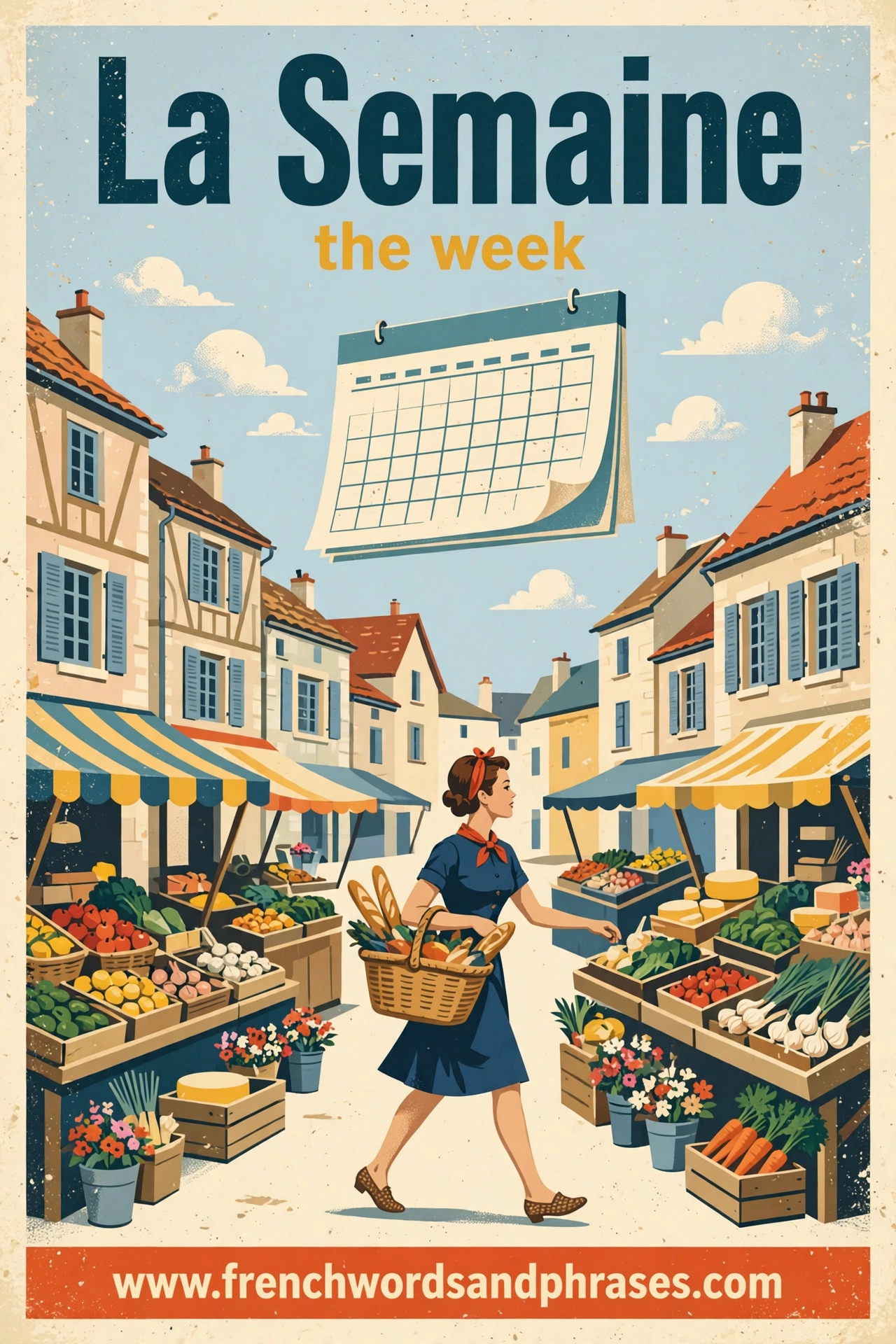
Seven squares on the kitchen calendar, seven mornings, seven evenings. Monday’s market list, Friday’s relief, Sunday’s long lunch — the whole of life, measured out in sevens: that is la semaine.
In this guide, you’ll learn what semaine means in English, how to use it with its articles, how to form its plural, and how it appears in everyday French. Explore French examples, English translations, and practice quizzes.
Understanding the French Noun Semaine
Semaine is a feminine French noun. Like every French noun, it has a gender, and it is learned together with its article: la semaine.
It means a week — the seven days from Monday to Sunday, and the rhythm they give to work, school and rest. French counts life in weeks: holidays last deux semaines, deadlines fall la semaine prochaine, and habits are the things you do chaque semaine.
Gender: Feminine
Definite article: la — la semaine (the week)
Indefinite article: une — une semaine (a week)
Plural: les semaines (the weeks)
English equivalents: A week.
One important usage detail: French keeps the definite article where English drops it, for last and next. La semaine dernière is last week and la semaine prochaine is next week — the la is never dropped. But with a number, the article disappears completely: je pars deux semaines, I am leaving for two weeks.
Experience the Word
Semaine is more than seven days. It is the shape of ordinary life: the working days in the middle, and the weekend like a small festival waiting at the end.
Imagine the calendar on the kitchen wall — appointments, birthdays, the dentist on Thursday, the train on Saturday — a whole life arranged in seven columns.
You have not just counted days. You have given your time a shape.
How to Use Semaine in French: Complete Guide
Let’s explore how semaine works in French, beginning with its articles.
Semaine and Its Articles
French nouns are almost never used alone. The small word in front of the noun — the article — does a great deal of work.
Semaine with the Definite Article (La, Les)
Used when both speakers know which week is meant — and always for last week and next week.
| Number | French |
|---|---|
| Singular | la semaine |
| Plural | les semaines |
Example
La semaine commence le lundi en France.
The week begins on Monday in France.
Semaine with the Indefinite Article (Une, Des)
Used to introduce a week for the first time: one week, or some weeks.
| Number | French |
|---|---|
| Singular | une semaine |
| Plural | des semaines |
Example
Je pars une semaine à la mer.
I am going to the seaside for a week.
Semaine with Numbers and Quantities
Semaine is a count noun — you count weeks one by one, so instead of a partitive article, French uses numbers and quantity words.
| Quantity | French |
|---|---|
| deux (two) | deux semaines |
| trois (three) | trois semaines |
| plusieurs (several) | plusieurs semaines |
| quelques (a few) | quelques semaines |
| toutes les (every) | toutes les semaines |
| chaque (each) | chaque semaine |
Example
Nous avons passé trois semaines à la mer.
We spent three weeks by the sea.
Quick Quiz 1
How do you say two weeks in French?
Reveal the answer
deux semaines
Je pars deux semaines en voyage.
I am going away for two weeks.
The Plural of Semaine
Like most French nouns, semaine simply adds an -s in the plural — a letter you see but do not hear.
| Number | French |
|---|---|
| Singular | la semaine |
| Plural | les semaines |
Example
Les semaines passent très vite en vacances.
The weeks fly by on holiday.
Semaine with Possessive Adjectives (Ma, Ta, Sa…)
Possessives agree with the noun, not with the owner — and semaine is feminine, so it takes ma, ta, sa in the singular.
| Owner | French |
|---|---|
| my | ma semaine |
| your (tu) | ta semaine |
| his / her | sa semaine |
| our | notre semaine |
| your (vous) | votre semaine |
| their | leur semaine |
Example
Ma semaine a été très chargée.
My week was very busy.
Quick Quiz 2
Complete the sentence:
______ semaine a été très chargée. (my)
Reveal the answer
Ma
Ma semaine a été très chargée.
My week was very busy.
Semaine with Demonstrative Adjectives (Cette, Ces)
Used to point: this week here, those weeks there. Feminine singular takes cette.
| Number | French |
|---|---|
| Singular | cette semaine |
| Plural | ces semaines |
Example
Cette semaine, je travaille de nuit.
This week, I am working nights.
Semaine with Adjectives
Adjectives agree with the noun, so they take feminine forms with semaine. With time words, they come after the noun: la semaine prochaine, la semaine dernière.
| Adjective | With Semaine |
|---|---|
| prochaine (next) | la semaine prochaine |
| dernière (last) | la semaine dernière |
| longue (long) | une longue semaine |
| courte (short) | une courte semaine |
| chargée (busy) | une semaine chargée |
| pleine (full) | une semaine pleine |
Example
La semaine prochaine, nous partons en vacances.
Next week, we are going on holiday.
Quick Quiz 3
Complete the sentence:
C’est une semaine ______ (busy).
Reveal the answer
chargée
C’est une semaine chargée.
It is a busy week. (Chargée is feminine and comes after the noun.)
Everyday Expressions with Semaine
Semaine organises the French calendar — last week, next week, and everything in between.
| Expression | In English |
|---|---|
| la semaine prochaine | next week |
| la semaine dernière | last week |
| en semaine | during the week, on weekdays |
| toute la semaine | all week long |
| la semaine de travail | the working week |
| la semaine sainte | Holy Week |
Example
En semaine, les trains sont pleins.
On weekdays, the trains are full.
Words from the Same Family as Semaine
Learn these together and the whole calendar falls into place.
| French | In English |
|---|---|
| un jour | a day |
| un mois | a month |
| une année | a year |
| le week-end | the weekend |
| le calendrier | the calendar |
| hebdomadaire | weekly |
Example
Note la date dans ton calendrier.
Write the date in your calendar.
Quick Quiz 4
What does en semaine mean?
Reveal the answer
During the week — on weekdays
En semaine, je travaille ; le week-end, je me repose.
During the week, I work; at the weekend, I rest.
Semaine in Everyday French: Real-Life Examples
Now that you know the word, let’s see how semaine appears in everyday French.
Example 1 — Going away
Elles partent deux semaines en Italie, quelle chance !
They’re off to Italy for two weeks — lucky them!
Example 2 — At work
Je travaille cinq jours par semaine.
I work five days a week.
Example 3 — Making plans
On se voit la semaine prochaine ?
Shall we meet next week?
Example 4 — Looking back
La semaine dernière, il a beaucoup plu.
Last week, it rained a lot.
Example 5 — Every week
Chaque semaine, elle téléphone à sa mère.
Every week, she phones her mother.
Example 6 — All week long
Il a plu toute la semaine.
It rained all week.
Beyond Translation: The Meaning of Semaine
English says week for the meaning of semaine — but the French word begins on Monday and thinks in sevens, with the weekend borrowed from English as le week-end, a welcome guest at the end of the French week.
To say semaine is to say the rhythm of life.
It evokes the school timetable, the two weeks by the sea in August, and the question everyone asks on Monday morning: tu as passé une bonne semaine ?
How to Remember the French Noun Semaine
Remember it this way: Semaine is the week, feminine — seven days counted from Monday, with la semaine prochaine for next week.
- You plan a trip — tu pars deux semaines en voyage.
- You look ahead — on se voit la semaine prochaine.
- You repeat a habit — tu fais du sport chaque semaine.
The key idea is la semaine for the week, chaque semaine for every week.
Test Your Knowledge of Semaine
Let’s see how much you’ve learned. Try answering these questions before revealing the answers.
Question 1
Is semaine masculine or feminine?
Reveal the answer
Feminine — la semaine.
Question 2
How do you say next week in French?
Reveal the answer
La semaine prochaine.
Question 3
Translate: I work five days a week.
Reveal the answer
Je travaille cinq jours par semaine.
Question 4
What does en semaine mean?
Reveal the answer
During the week — on weekdays.
Question 5
Complete the sentence:
On se voit la semaine ______. (next)
Reveal the answer
prochaine
On se voit la semaine prochaine.
See you next week.
Your Final Challenge
Can You Use It?
How would you say this in French?
“We’re going to the seaside for three weeks.”
Reveal the answer
Nous partons trois semaines au bord de la mer.
We’re going to the seaside for three weeks.
A little French. A little curiosity. A richer everyday life.
LEARN FRENCH ONE WORD AT A TIME