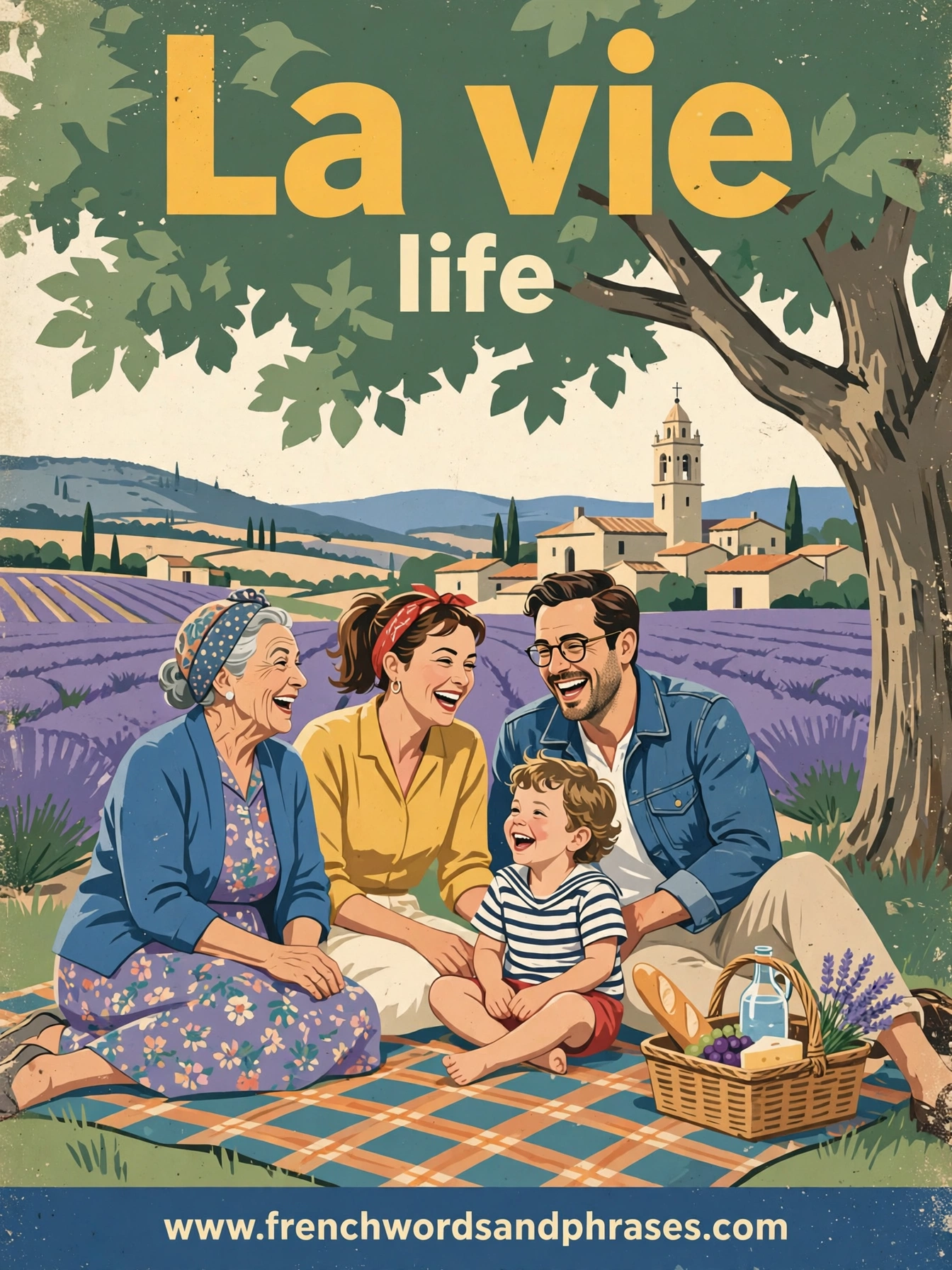
A French Word to Live By
Translate Vie to English
/vi/
La vie means life.
A christening in the morning, a wedding in the afternoon, the same church bell for both, and a grandmother on the steps saying the word that holds them together: la vie.
In this guide, you’ll learn what vie means in English, how to use it with its articles, how to form its plural, and how it appears in everyday French. Explore French examples, English translations, and practice quizzes.
Understanding the French Noun Vie
Vie is a feminine French noun. Like every French noun, it has a gender, and it is learned together with its article: la vie.
It means life — the whole of it, from first breath to last, and also the way it is lived day by day: la vie quotidienne, everyday life. It is one of the most sung, quoted and toasted words in the language, and the toast to it is heard at every French table: à la vie! — to life!
Gender: Feminine
Definite article: la — la vie (life, the life); les vies (lives)
Indefinite article: une — une vie (a life)
Plural: les vies (lives)
English equivalents: Life; a lifetime.
One important detail: en vie means alive, with no article at all — il est en vie, he is alive. And where English says my whole life, French says toute ma vie, with the word for whole in front of the possessive.
Experience the Word
Vie is more than the years between two dates. It is the texture of the days themselves: the morning bread, the work, the loves, the small luck of an ordinary Tuesday.
Imagine the old fisherman mending his nets and telling you, without sadness, that the sea gave him everything: c’est ma vie — that is my life — and the harbour behind him agrees.
You have not just counted birthdays. You have named the whole adventure, from the first cry to the last story.
How to Use Vie in French: Complete Guide
Let’s explore how vie works in French, beginning with its articles.
Vie and Its Articles
French nouns are almost never used alone. The small word in front of the noun — the article — does a great deal of work.
Vie with the Definite Article (La, Les)
Used for life in general — the great subject itself — or for a particular life both speakers know.
| Number | French |
|---|---|
| Singular | la vie |
| Plural | les vies |
Example
La vie est belle en été.
Life is beautiful in summer.
Vie with the Indefinite Article (Une, Des)
Used when one single life is told as a story — a life can be counted when it is narrated.
| Number | French |
|---|---|
| Singular | une vie |
| Plural | des vies |
Example
Il a eu une vie extraordinaire.
He had an extraordinary life.
Vie with De (Plein de Vie, Mode de Vie)
Vie builds its commonest phrases with de: fullness, ways of living, and the price of it all.
| Meaning | French |
|---|---|
| full of life | plein de vie |
| a way of life | un mode de vie |
| quality of life | la qualité de vie |
| the cost of living | le coût de la vie |
| a sign of life | un signe de vie |
Example
Cette vieille dame est pleine de vie.
This old lady is full of life.
Quick Quiz 1
Complete the sentence:
______ vie est belle en été. (the)
Reveal the answer
La
La vie est belle en été.
Life is beautiful in summer.
The Plural of Vie
Vie adds a simple -s in the plural — the plural belongs to novels and biographies, where lives are told side by side.
| Number | French |
|---|---|
| Singular | la vie |
| Plural | les vies |
Example
Le roman raconte les vies de trois sœurs.
The novel tells the lives of three sisters.
Vie with Possessive Adjectives (Ma, Ta, Sa…)
Possessives agree with the noun, not with the owner — and vie is feminine, so it takes ma, ta, sa.
| Owner | French |
|---|---|
| my | ma vie |
| your (tu) | ta vie |
| his / her | sa vie |
| our | notre vie |
| your (vous) | votre vie |
| their | leur vie |
Example
Ma vie a changé ce jour-là.
My life changed that day.
Quick Quiz 2
Complete the sentence:
______ vie a changé ce jour-là. (my)
Reveal the answer
Ma
Ma vie a changé ce jour-là.
My life changed that day.
Vie with Demonstrative Adjectives (Cette, Ces)
Used to point: this life here — usually with a sigh of contentment or of refusal.
| Number | French |
|---|---|
| Singular | cette vie |
| Plural | ces vies |
Example
Cette vie lui convient parfaitement.
This life suits her perfectly.
Vie with Adjectives
Most French adjectives come after the noun — la vie quotidienne, la vie privée — while belle, the favourite, comes before it.
| Adjective | With Vie |
|---|---|
| belle (beautiful) | la belle vie |
| quotidienne (everyday) | la vie quotidienne |
| privée (private) | la vie privée |
| longue (long) | une longue vie |
| dure (hard) | une vie dure |
| nouvelle (new) | une nouvelle vie |
Example
Ils mènent une vie dure mais libre.
They lead a hard but free life.
Quick Quiz 3
Complete the sentence:
Ils commencent une ______ vie à la campagne. (new)
Reveal the answer
nouvelle
Ils commencent une nouvelle vie à la campagne.
They are starting a new life in the countryside. (Nouvelle comes before the noun.)
Everyday Expressions with Vie
Vie owns the vocabulary of earning, surviving and starting again — and of the everyday itself.
| Expression | In English |
|---|---|
| la vie de famille | family life |
| en vie | alive |
| la vie est belle | life is beautiful |
| gagner sa vie | to earn one’s living |
| refaire sa vie | to rebuild one’s life, to start over |
| la vie de tous les jours | everyday life |
Example
Après son divorce, elle a refait sa vie.
After her divorce, she rebuilt her life.
Words from the Same Family as Vie
Learn these together and you can follow a French life from its first day to its stories.
| French | In English |
|---|---|
| vivre | to live |
| vivant | alive, living |
| naître | to be born |
| la naissance | birth |
| la mort | death |
| un souvenir | a memory |
Example
Il est né ici et il a vécu ici toute sa vie.
He was born here and lived here all his life.
Quick Quiz 4
What does en vie mean?
Reveal the answer
Alive
Le chat est encore en vie.
The cat is still alive.
Vie in Everyday French: Real-Life Examples
Now that you know the word, let’s see how vie appears in everyday French.
Example 1 — A toast to life
À la vie, mes amis!
To life, my friends!
Example 2 — Everyday life
La vie quotidienne est plus calme à la campagne.
Everyday life is calmer in the countryside.
Example 3 — A new start
Ils refont leur vie dans un petit village.
They are rebuilding their life in a small village.
Example 4 — Earning a living
Elle gagne sa vie comme professeure.
She earns her living as a teacher.
Example 5 — Good news
Le petit chat est toujours en vie.
The little cat is still alive.
Example 6 — An expression in real life
La vie est belle quand le soleil brille.
Life is beautiful when the sun shines.
Beyond Translation: The Meaning of Vie
English says life for the meaning of vie — but the French word is toasted, sung and lived out loud. French divides it with affection: la vie quotidienne for the ordinary days, la belle vie for the good ones, toute une vie for the whole long story.
To say la vie is to hold the whole journey in two syllables.
It evokes the toast at a wedding, the first morning of a new job in a new town, and a fisherman who would not trade his harbour for any palace on Earth.
How to Remember the French Noun Vie
Remember it this way: Vie is feminine — la vie — and the toast to it is à la vie!
- You raise your glass — à la vie!
- You speak of your own — toute ma vie.
- You celebrate a survivor — il est en vie.
The key idea is la vie for life, en vie for alive.
Test Your Knowledge of Vie
Let’s see how much you’ve learned. Try answering these questions before revealing the answers.
Question 1
Is vie masculine or feminine?
Reveal the answer
Feminine — la vie.
Question 2
How do you say everyday life in French?
Reveal the answer
La vie quotidienne.
Question 3
Translate: My life changed that day.
Reveal the answer
Ma vie a changé ce jour-là.
Question 4
What does gagner sa vie mean?
Reveal the answer
To earn one’s living.
Question 5
Complete the sentence:
Elle gagne ______ vie comme professeure. (her)
Reveal the answer
sa
Elle gagne sa vie comme professeure.
She earns her living as a teacher.
Your Final Challenge
Can You Use It?
How would you say this in French?
“They are starting a new life in the countryside.”
Reveal the answer
Ils commencent une nouvelle vie à la campagne.
They are starting a new life in the countryside.
A little French. A little curiosity. A richer everyday life.
LEARN FRENCH ONE WORD AT A TIME