
A French Word to Live By
Translate Ça va to English
/sa va/
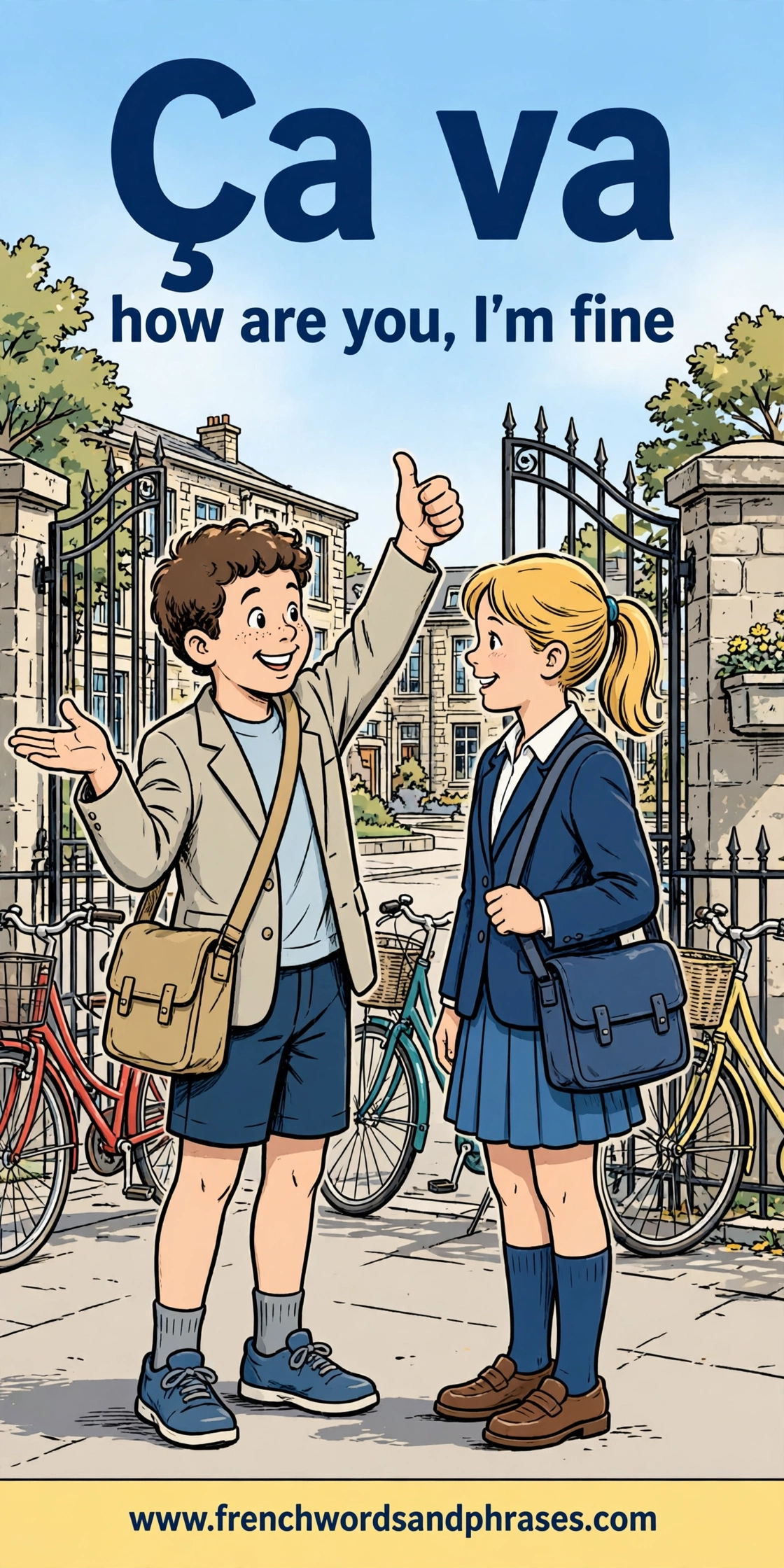
Ça va means how are you, I’m fine.
A colleague passes in the corridor, neither of you slows down, and the whole conversation happens at walking pace: « Ça va ? — Ça va, et toi ? — Ça va. » Ça va is the most useful small phrase in French: question and answer in the same two words — how’s it going, and it’s going fine.
Let’s explore how ça va works in French, beginning with the whole phrase on one card.
Understanding the French Phrase Ça va
Ça va is a French set phrase built from ça (that, it) and va (goes, from aller, to go): literally « it goes ». With a rising tone it is the everyday question — how are you, how’s it going; with a falling tone it is the answer — I’m fine, it’s going well. It belongs to the familiar, daily register: friends, colleagues, family — the vous world more often asks comment allez-vous.
It means how are you and I’m fine, and a dozen neighbours besides: ça va bien, I’m well; ça va mal, things are bad; ça ne va pas, something’s wrong; ça va aller, it’ll be all right. The little phrase is a whole dashboard of French wellbeing, read at a glance. As a pure greeting it is lighter than comment vas-tu — a nod in word form between people who meet every day.
Type: Set phrase — question and answer in the same two words
Answers the need: Daily check-ins between familiars: how goes it / it goes well
Register: Familiar and everyday — friends, colleagues, family
Strength: Light as a nod — but it can carry the truth when it must
One important usage detail: the tone is the grammar. « Ça va ? » rising asks; « Ça va. » falling answers. The full polite exchange runs: Ça va ? — Ça va bien, merci, et toi ? — Ça va. Do not aim ça va at a formal first meeting or an official: comment allez-vous is the dressed form. And ça va has a second life as reassurance: t’inquiète pas, ça va — don’t worry, it’s fine.
Experience the Word
Ça va is the pulse-check of French daily life — two syllables taken at every meeting, like a hand briefly on a wrist.
Imagine the office kitchen at nine: coffees in hand, the phrase passes round the room — ça va ? ça va… ça va ? ça va — a little flock of questions and answers, and by the time the cups are full, everyone has been seen, greeted, and quietly taken the measure of everyone’s morning.
You have not exchanged information. You have exchanged presence — the smallest proof that the tribe is well.
How to Use Ça va in French: Complete Guide
Let’s explore how ça va works in French, beginning with the whole phrase on one card.
Ça va at a Glance
The Whole Phrase on One Card
Real meaning, literal picture, English twin and register — ça va in five lines.
| Point | Ça va |
|---|---|
| What it really means | how’s it going (rising) / I’m fine (falling) |
| Word for word | it goes (ça + va, from aller) |
| English equivalent | how are you; I’m fine; it’s OK |
| Register | familiar, everyday — the corridor and the kitchen |
| Use it for | daily greetings, quick check-ins, small reassurances |
Example
Ça va ? — Ça va bien, merci, et toi ?
How are you? — I’m well, thank you, and you?
Word by Word: Building the Phrase
Two pieces — a pointing word and a going verb, doing the work of a whole conversation.
| Word | Literal meaning | Its job in the phrase |
|---|---|---|
| ça | that, it | the pointer: life, things, the situation in general |
| va | goes (from aller, to go) | the motion: how it is going, how it moves |
| ça va | it goes | question rising, answer falling — tone is the grammar |
Example
Ça va, ne t’inquiète pas pour moi.
I’m fine, don’t worry about me.
Quick Quiz 1
How can the same two words be both the question and the answer?
Reveal the answer
By tone — rising, ça va ? asks; falling, ça va. answers.
Ça va ? — Ça va.
How are you? — I’m fine.
When You Say It: The Daily Moments
Ça va fires at every familiar meeting — corridors, kitchens, school gates, screens.
| Situation | Example |
|---|---|
| Passing a colleague | ça va ? — Ça va, et toi ? |
| Meeting a friend | salut, ça va ? |
| Checking on a child | ça va, mon petit ? |
| Reassuring | t’inquiète pas, ça va |
| Something wrong | ça ne va pas, je suis malade |
Example
Salut, Paul, ça va ce matin ?
Hi, Paul, how are you this morning?
Make It Yours: Ça va in Its Frames
The phrase grades itself — bien, mal, mieux — a whole scale in a few words.
| Form | French | In English |
|---|---|---|
| The question | ça va ? | how are you? how’s it going? |
| The answer | ça va | I’m fine |
| Well | ça va bien | I’m well |
| Badly | ça va mal | things are bad |
| Getting better | ça va mieux | I’m better, it’s improving |
| It’ll be fine | ça va aller | it’ll be all right |
Example
Ça va mieux aujourd’hui, merci.
I’m better today, thank you.
Quick Quiz 2
Complete the exchange: Ça va ? — ______ , merci, et toi ?
Reveal the answer
Ça va bien — the fuller answer, with the question handed back.
Ça va ? — Ça va bien, merci, et toi ?
How are you? — I’m well, thank you, and you?
Everyday Expressions with Ça va
Ça va slots into these frames — each one ready to use as it stands.
| Frame | In English |
|---|---|
| ça va ? | how are you? how’s it going? |
| ça va bien | I’m well, things are good |
| ça ne va pas | something’s wrong, I’m not well |
| ça va aller | it’ll be all right |
| comment ça va ? | how are things going? — the fuller question |
Example
Ne t’inquiète pas, ça va aller.
Don’t worry, it’ll be all right.
Close Cousins: The Other Check-ins
French checks on you at several temperatures — ça va is the daily one.
| Expression | The difference |
|---|---|
| ça va ? | how’s it going — light, daily, familiar |
| comment vas-tu ? | how are you — fuller, warmer, still tu |
| comment allez-vous ? | how are you — the polite, vous form |
| quoi de neuf ? | what’s new — asks for events, not state |
| la forme ? | in good shape? — brisk and cheerful |
Example
Entre collègues, ça va ; chez le médecin, comment allez-vous.
Between colleagues, ça va; at the doctor’s, comment allez-vous.
Quick Quiz 3
A friend whispers « ça ne va pas ». What has she told you?
Reveal the answer
That something is wrong — she’s not well, or things are bad; the negation turns the dashboard red.
Ça ne va pas, je suis malade.
I’m not well, I’m ill.
Ça va and Its Neighbours
The words around the phrase — going, wellbeing, and the reassurance family.
| French | In English |
|---|---|
| aller | to go — and, for people, to be (health): je vais bien |
| bien | well |
| mieux | better |
| la santé | health |
| t’inquiète pas | don’t worry (tu form) |
Example
Tu vas bien ? — Oui, je vais bien.
Are you well? — Yes, I’m well.
Watch Out: The Traps Around Ça va
The traps: the familiar phrase at a formal door, and the question that wants a real answer.
| Trap | The truth |
|---|---|
| Ça va to an official | too familiar for first formal meetings — comment allez-vous |
| Forgetting et toi ? | the exchange expects the return: ça va bien, et toi ? |
| The flat answer to a real enquiry | from a close friend, ça va ? may be a true question — answer truly |
| Ça va as goodbye | it is not a farewell; pair it with salut or au revoir |
Example
Ça va ? — Ça va. Salut, à demain.
How are you? — Fine. Bye, see you tomorrow.
Quick Quiz 4
You had a bad night and a friend asks « Ça va ? » Give the honest answer.
Reveal the answer
Ça va mal, je suis fatigué
The phrase grades the truth as easily as the courtesy.
Ça va mal, je suis fatigué. — Things are bad, I’m tired.
Ça va in Everyday French: Real-Life Examples
Now that you know the word, let’s see how ça va appears in everyday French.
Example 1 — In the corridor
Ça va ? — Ça va, et toi ?
How are you? — Fine, and you?
Example 2 — Meeting a friend
Salut, ça va ? Ça fait longtemps.
Hi, how are you? It’s been a while.
Example 3 — A parent checks
Ça va, mon petit, tu as bien dormi ?
How are you, my little one, did you sleep well?
Example 4 — Reassurance
Ne t’inquiète pas, ça va, je suis là.
Don’t worry, it’s fine, I’m here.
Example 5 — Honest answer
Ça ne va pas trop, je suis malade.
I’m not too well, I’m ill.
Example 6 — Recovery
Ça va mieux, merci, presque guéri.
I’m better, thank you, nearly recovered.
Beyond Translation: The Meaning of Ça va
Ça va may be the hardest-working phrase in spoken French: greeting, question, answer, reassurance and diagnosis in two syllables. Its engine is the verb aller, which French uses for health itself — je vais bien, I am well, literally I go well — a very old idea that to be alive is to be moving, and to be well is to move well. The phrase’s genius is its scale: add bien, mal, mieux, pas, and the same two words report a whole inner weather, from storm to sunshine.
Ça va is French wellbeing in miniature — the journey, asked and answered in one breath.
Learn it whole: ça va ?, ça va, ça va bien, ça ne va pas, ça va aller — five forms, and you can meet any morning in France.
How to Remember the French Phrase Ça va
Remember it this way: Ça va is ça plus va — it goes: rising for the question, falling for the answer, graded by bien, mal and mieux.
- You let the tone work — ça va ? monte, ça va descend : la mélodie fait la grammaire.
- You hand it back — ça va bien, merci, et toi ? : l’échange complet.
- You grade it honestly — ça va mal, ça ne va pas, ça va aller : toute la météo en deux mots.
The key idea is ça va = how are you / I’m fine; ça + va (aller), it goes.
Test Your Knowledge of Ça va
Let’s see how much you’ve learned. Try answering these questions before revealing the answers.
Question 1
What does ça va mean?
Reveal the answer
How are you (rising) — I’m fine (falling): question and answer in the same two words.
Question 2
How do you say I’m well, thank you, and you?
Reveal the answer
Ça va bien, merci, et toi ?
Question 3
Translate: Don’t worry, it’ll be all right.
Reveal the answer
Ne t’inquiète pas, ça va aller.
Question 4
Complete the exchange:
Ça va ? — ______ mieux, merci.
Reveal the answer
Ça va
Ça va ? — Ça va mieux, merci.
How are you? — I’m better, thank you.
Question 5
What does ça ne va pas mean?
Reveal the answer
Something’s wrong / I’m not well — the negative form reports trouble.
Your Final Challenge
Can You Use It?
How would you say this in French?
“How are you? — I’m well, thank you, and you?”
Reveal the answer
Ça va ? — Ça va bien, merci, et toi ?
How are you? — I’m well, thank you, and you?
A little French. A little curiosity. A richer everyday life.
LEARN FRENCH ONE WORD AT A TIME




