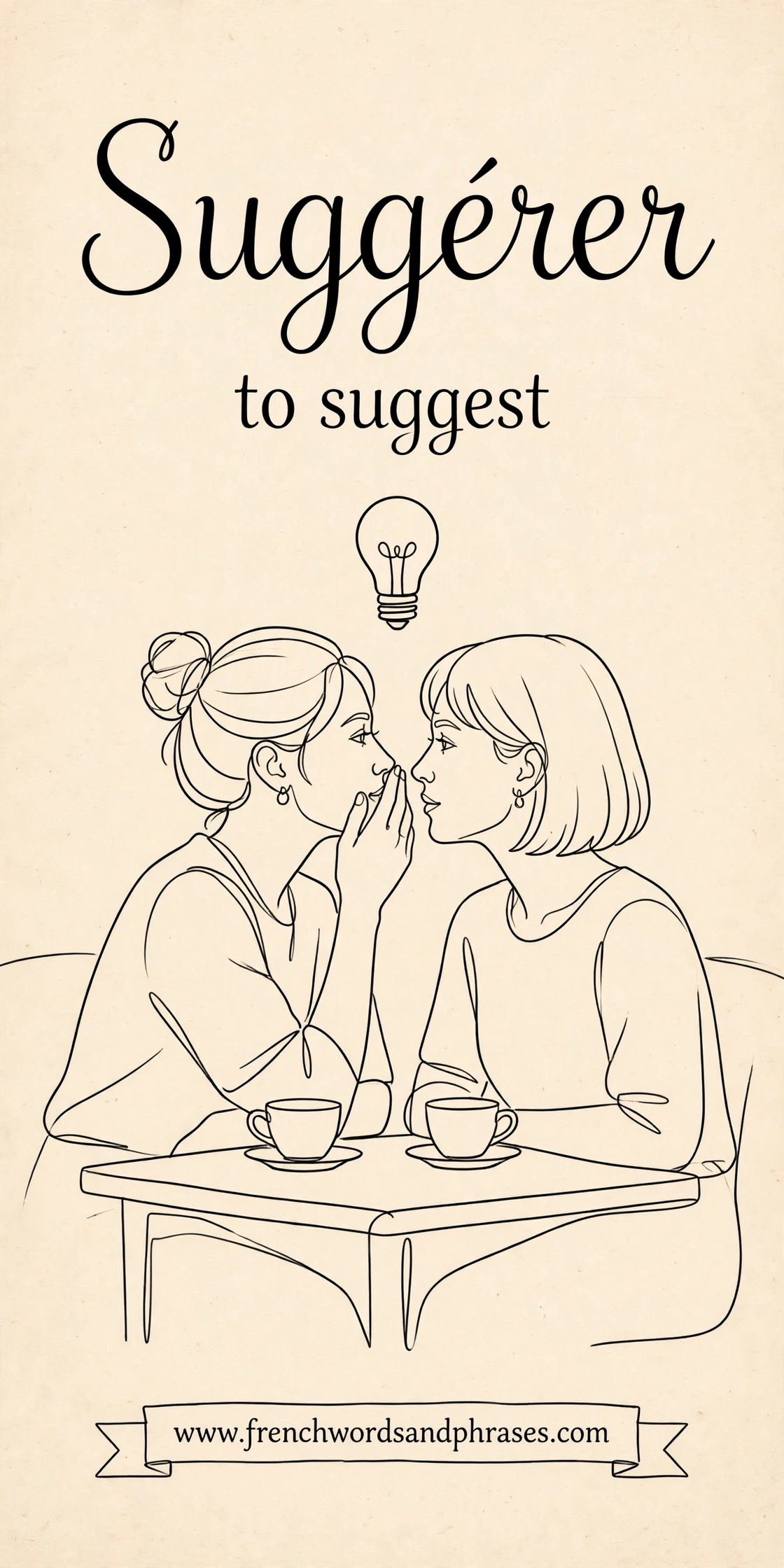
A French Word to Live By
How to Conjugate Suggérer in French
/syɡ.ʒe.ʁe/
Suggérer means to suggest — to put an idea gently on the table without imposing it: a plan, a name, a solution, offered for others to take or leave.
A hand half-raised in a meeting, a name dropped into conversation as if by accident, a dish the waiter mentions with a small smile — suggérer is the verb of the light touch: it proposes, it never pushes.
In this guide, you’ll learn how to conjugate suggérer in all the major French tenses and moods. Explore complete conjugation tables, French examples, English translations, and practice quizzes.
Understanding the French Verb Suggérer
Suggérer is a regular French verb belonging to the first group of verbs, those ending in-er.
It means to suggest. Suggérer works two ways: proposing something (suggérer un restaurant, suggérer de partir tôt) and implying something (ce silence suggère un désaccord — that silence suggests disagreement). When what follows is a clause, French uses the subjunctive for a proposal — je suggère qu’il vienne — and the indicative for an implication: cela suggère qu’il est fatigué.
Verb classification: First group (-er)
Auxiliary verb: Avoir
Past participle: suggéré
Present participle: suggérant
English equivalents: To suggest, to propose, to imply; suggérer une idée — to suggest an idea; suggérer que + subjunctive — to suggest that…; je suggère que nous partions — I suggest we leave; cela suggère que… — that suggests that….
One important detail: suggérer is an espérer-type verb — the é of the stem opens to è in the present singular and third plural, in the subjunctive singular and third plural, and in the tu imperative: je suggère, tu suggères, il suggère, ils suggèrent. But the future and conditional keep é: je suggérerai, je suggérerais, never with è. The é also survives where the ending is sounded: nous suggérons, vous suggérez, and in the past participle suggéré.
Experience the Word
Suggérer is the verb of tact — the idea offered with an open hand, never forced into anyone’s fist.
Imagine the old professor at the end of the seminar. She never orders, never corrects head-on. « Je suggère, » she says, « que vous relisiez la page vingt. » The students go home and reread page twenty — because a suggestion from her weighs more than an order from anyone else.
Nothing was commanded. But the idea was suggested — suggérée — and it did its work quietly.
How to Conjugate Suggérer: Complete French Conjugation Guide
Let’s explore every major conjugation of suggérer, beginning with the indicative mood.
How to Conjugate Suggérer in the Indicative Mood
The indicative mood is used to express facts, observations, actions, and events.
How to Conjugate Suggérer in the Present Tense (Présent)
Used for actions happening now, habitual actions, and general truths.
| Subject | Conjugation |
|---|---|
| je | suggère |
| tu | suggères |
| il / elle | suggère |
| nous | suggérons |
| vous | suggérez |
| ils / elles | suggèrent |
Example
Je suggère un petit restaurant près de la gare.
I suggest a small restaurant near the station.
Quick Quiz 1
Complete the sentence:
Nous ______ une solution simple.
Reveal the answer
suggérons
Nous suggérons une solution simple.
We suggest a simple solution — the nous form keeps é.
How to Conjugate Suggérer in the Passé Composé
Used for completed actions in the past. Suggérer takes the auxiliary verb avoir.
| Subject | Conjugation |
|---|---|
| j’ | ai suggéré |
| tu | as suggéré |
| il / elle | a suggéré |
| nous | avons suggéré |
| vous | avez suggéré |
| ils / elles | ont suggéré |
Example
Elle a suggéré de reporter la réunion à demain.
She suggested postponing the meeting until tomorrow.
How to Conjugate Suggérer in the Imparfait (Imperfect Tense)
Used for habitual past actions, descriptions, and ongoing situations in the past.
| Subject | Conjugation |
|---|---|
| je | suggérais |
| tu | suggérais |
| il / elle | suggérait |
| nous | suggérions |
| vous | suggériez |
| ils / elles | suggéraient |
Example
Il suggérait toujours les meilleurs vins de la carte.
He always used to suggest the best wines on the menu.
Quick Quiz 2
Choose the correct form:
Tomorrow, I will suggest another route.
Demain, je ______ un autre itinéraire. (suggérerai / suggèrerai)
Reveal the answer
suggérerai
Demain, je suggérerai un autre itinéraire.
The future keeps the é of the stem.
How to Conjugate Suggérer in the Plus-que-parfait
Used to describe an action that had already been completed before another past event.
| Subject | Conjugation |
|---|---|
| j’ | avais suggéré |
| tu | avais suggéré |
| il / elle | avait suggéré |
| nous | avions suggéré |
| vous | aviez suggéré |
| ils / elles | avaient suggéré |
Example
Nous avions suggéré cette solution dès le début.
We had suggested this solution right from the start.
How to Conjugate Suggérer in the Passé Simple
Primarily used in formal writing, literature, and historical narratives. It is rarely used in everyday conversation.
| Subject | Conjugation |
|---|---|
| je | suggérai |
| tu | suggéras |
| il / elle | suggéra |
| nous | suggérâmes |
| vous | suggérâtes |
| ils / elles | suggérèrent |
Example
Le guide suggéra une visite du vieux quartier.
The guide suggested a visit to the old quarter.
How to Conjugate Suggérer in the Passé Antérieur
A literary tense used to express an action completed immediately before another past action, generally in the passé simple.
| Subject | Conjugation |
|---|---|
| j’ | eus suggéré |
| tu | eus suggéré |
| il / elle | eut suggéré |
| nous | eûmes suggéré |
| vous | eûtes suggéré |
| ils / elles | eurent suggéré |
Example
Quand elle eut suggéré le nom du coupable, un silence tomba.
When she had suggested the culprit’s name, a silence fell.
How to Conjugate Suggérer in the Future Tense (Futur Simple)
Used to describe actions that will take place in the future.
| Subject | Conjugation |
|---|---|
| je | suggérerai |
| tu | suggéreras |
| il / elle | suggérera |
| nous | suggérerons |
| vous | suggérerez |
| ils / elles | suggéreront |
Example
Demain, je suggérerai un autre itinéraire.
Tomorrow, I will suggest another route.
How to Conjugate Suggérer in the Futur Antérieur (Future Perfect)
Used for an action that will have been completed before a particular point in the future.
| Subject | Conjugation |
|---|---|
| j’ | aurai suggéré |
| tu | auras suggéré |
| il / elle | aura suggéré |
| nous | aurons suggéré |
| vous | aurez suggéré |
| ils / elles | auront suggéré |
Example
D’ici vendredi, ils auront suggéré trois candidats.
By Friday, they will have suggested three candidates.
How to Conjugate Suggérer in the Near Future (Futur Proche)
Used to describe something that is going to happen soon. Formed with aller + infinitive.
| Subject | Conjugation |
|---|---|
| je | vais suggérer |
| tu | vas suggérer |
| il / elle | va suggérer |
| nous | allons suggérer |
| vous | allez suggérer |
| ils / elles | vont suggérer |
Example
Je vais suggérer une pause, tout le monde est fatigué.
I am going to suggest a break, everyone is tired.
How to Conjugate Suggérer in the Conditional Mood
The conditional mood expresses what would happen under certain circumstances. It is also frequently used to make polite requests or express wishes.
How to Conjugate Suggérer in the Present Conditional
| Subject | Conjugation |
|---|---|
| je | suggérerais |
| tu | suggérerais |
| il / elle | suggérerait |
| nous | suggérerions |
| vous | suggéreriez |
| ils / elles | suggéreraient |
Example
À ta place, je suggérerais un menu plus simple.
In your place, I would suggest a simpler menu.
How to Conjugate Suggérer in the Past Conditional
| Subject | Conjugation |
|---|---|
| j’ | aurais suggéré |
| tu | aurais suggéré |
| il / elle | aurait suggéré |
| nous | aurions suggéré |
| vous | auriez suggéré |
| ils / elles | auraient suggéré |
Example
Tu aurais suggéré la même chose à ma place.
You would have suggested the same thing in my place.
Suggérer in the Literary Past Conditional Form
This less common literary form uses the imperfect subjunctive of avoir.
| Subject | Conjugation |
|---|---|
| j’ | eusse suggéré |
| tu | eusses suggéré |
| il / elle | eût suggéré |
| nous | eussions suggéré |
| vous | eussiez suggéré |
| ils / elles | eussent suggéré |
Example
Elle eût suggéré la prudence, si on l’avait écoutée.
She would have suggested caution, if anyone had listened to her.
How to Conjugate Suggérer in the Subjunctive Mood
The subjunctive is used to express wishes, emotions, doubts, necessity, and uncertainty. It frequently follows expressions such as il faut que (it is necessary that) or bien que (although).
How to Conjugate Suggérer in the Present Subjunctive
| Subject | Conjugation |
|---|---|
| que je | suggère |
| que tu | suggères |
| qu’il / qu’elle | suggère |
| que nous | suggérions |
| que vous | suggériez |
| qu’ils / qu’elles | suggèrent |
Example
Il faut que tu suggères une date pour la visite.
You need to suggest a date for the visit.
Quick Quiz 3
Complete the sentence using the subjunctive:
Je suggère qu’il ______ avec nous.
Reveal the answer
vienne
Je suggère qu’il vienne avec nous.
A proposal after suggérer que takes the subjunctive.
How to Conjugate Suggérer in the Imperfect Subjunctive
A literary tense, rarely encountered in modern spoken French.
| Subject | Conjugation |
|---|---|
| que je | suggérasse |
| que tu | suggérasses |
| qu’il / qu’elle | suggérât |
| que nous | suggérassions |
| que vous | suggérassiez |
| qu’ils / qu’elles | suggérassent |
Example
Je souhaitais qu’il suggérât un autre candidat.
I wished he would suggest another candidate.
How to Conjugate Suggérer in the Pluperfect Subjunctive
A literary construction used to express an action completed before another past action.
| Subject | Conjugation |
|---|---|
| que j’ | eusse suggéré |
| que tu | eusses suggéré |
| qu’il / qu’elle | eût suggéré |
| que nous | eussions suggéré |
| que vous | eussiez suggéré |
| qu’ils / qu’elles | eussent suggéré |
Example
On s’étonnait qu’elle eût suggéré un tel plan.
People were surprised she had suggested such a plan.
How to Conjugate Suggérer in the Past Subjunctive
| Subject | Conjugation |
|---|---|
| que j’ | aie suggéré |
| que tu | aies suggéré |
| qu’il / qu’elle | ait suggéré |
| que nous | ayons suggéré |
| que vous | ayez suggéré |
| qu’ils / qu’elles | aient suggéré |
Example
Je suis content que vous ayez suggéré cette idée.
I am glad you suggested this idea.
How to Conjugate Suggérer in the Imperative
The imperative is used to give commands, instructions, invitations, or suggestions. Subject pronouns are omitted.
How to Conjugate Suggérer in the Present Imperative
| Person | Conjugation |
|---|---|
| (tu) | suggère |
| (nous) | suggérons |
| (vous) | suggérez |
Example
Suggère un film pour ce soir !
Suggest a film for tonight!
Quick Quiz 4
How would you say Suggest a film (tu form)?
Reveal the answer
Suggère un film !
French Participles of Suggérer
Participles are verb forms that can be used in compound tenses and other grammatical constructions.
Present Participle of Suggérer
suggérant
En suggérant ce détour, elle nous a fait gagner une heure.
By suggesting this detour, she saved us an hour.
Past Participle of Suggérer
suggéré
Suggérée par un ami, cette adresse est devenue notre préférée.
Suggested by a friend, this place became our favourite.
Suggérer in Everyday French: Real-Life Examples
Now that you know the conjugations, let’s see how suggérer appears in everyday French.
Example 1 — Present
Je suggère une pause café.
I suggest a coffee break.
Example 2 — Passé composé
Elle a suggéré un excellent restaurant.
She suggested an excellent restaurant.
Example 3 — Imparfait
Il suggérait toujours de bonnes idées.
He always used to suggest good ideas.
Example 4 — Future
Je suggérerai ton nom au directeur.
I will suggest your name to the director.
Example 5 — Conditional
Je suggérerais de partir plus tôt.
I would suggest leaving earlier.
Example 6 — Imperative
Suggère quelque chose de simple !
Suggest something simple!
Beyond Translation: The Meaning of Suggérer
Suggérer comes from the Latin suggerere — sub, under, plus gerere, to carry: to carry something in underneath, to slip it in from below. The image is still alive in the French word: a suggestion is not placed on the table with a bang, it is slid quietly under the conversation until everyone discovers it is already there.
To suggest is to lead without pushing.
That is why French manners love the verb: je suggère que… softens any advice, and ce que cela suggère lets a speaker imply a conclusion while keeping clean hands.
How to Remember the French Verb Suggérer
Remember it this way: Suggérer is about the professor’s quiet je suggère — an idea slid under the conversation.
- Espérer-type spelling: je suggère with è in the present, but je suggérerai with é in the future.
- A proposal takes the subjunctive: je suggère qu’il vienne; an implication takes the indicative: cela suggère qu’il est fatigué.
- Regular -er endings everywhere else: nous suggérons, past participle suggéré.
The key idea is the professor’s quiet je suggère — an idea slid under the conversation.
Test Your Knowledge of Suggérer
Let’s see how much you’ve learned. Try answering these questions before revealing the answers.
Question 1
Why does je suggère have a grave accent but je suggérerai an acute one?
Reveal the answer
The espérer-type rule — é becomes è in the present and subjunctive stems, but the future and conditional keep é: je suggérerai.
Question 2
How do you say I suggest a small restaurant near the station in French?
Reveal the answer
Je suggère un petit restaurant près de la gare.
Question 3
Translate: She suggested postponing the meeting.
Reveal the answer
Elle a suggéré de reporter la réunion.
Question 4
What is the past participle of suggérer?
Reveal the answer
Suggéré.
Question 5
Complete the sentence:
Il faut que tu ______ une date pour la visite.
Reveal the answer
suggères
Il faut que tu suggères une date pour la visite.
You need to suggest a date for the visit — the subjunctive singular takes è.
Your Final Challenge
Can You Use It?
How would you say this in French?
I suggest we reread page twenty before tomorrow.
Reveal the answer
Je suggère que nous relisions la page vingt avant demain.
I suggest we reread page twenty before tomorrow.
A little French. A little curiosity. A richer everyday life.
LEARN FRENCH ONE WORD AT A TIME