
A French Word to Live By
Translate Plan to English
/plɑ̃/
Le plan means the plan, the map.
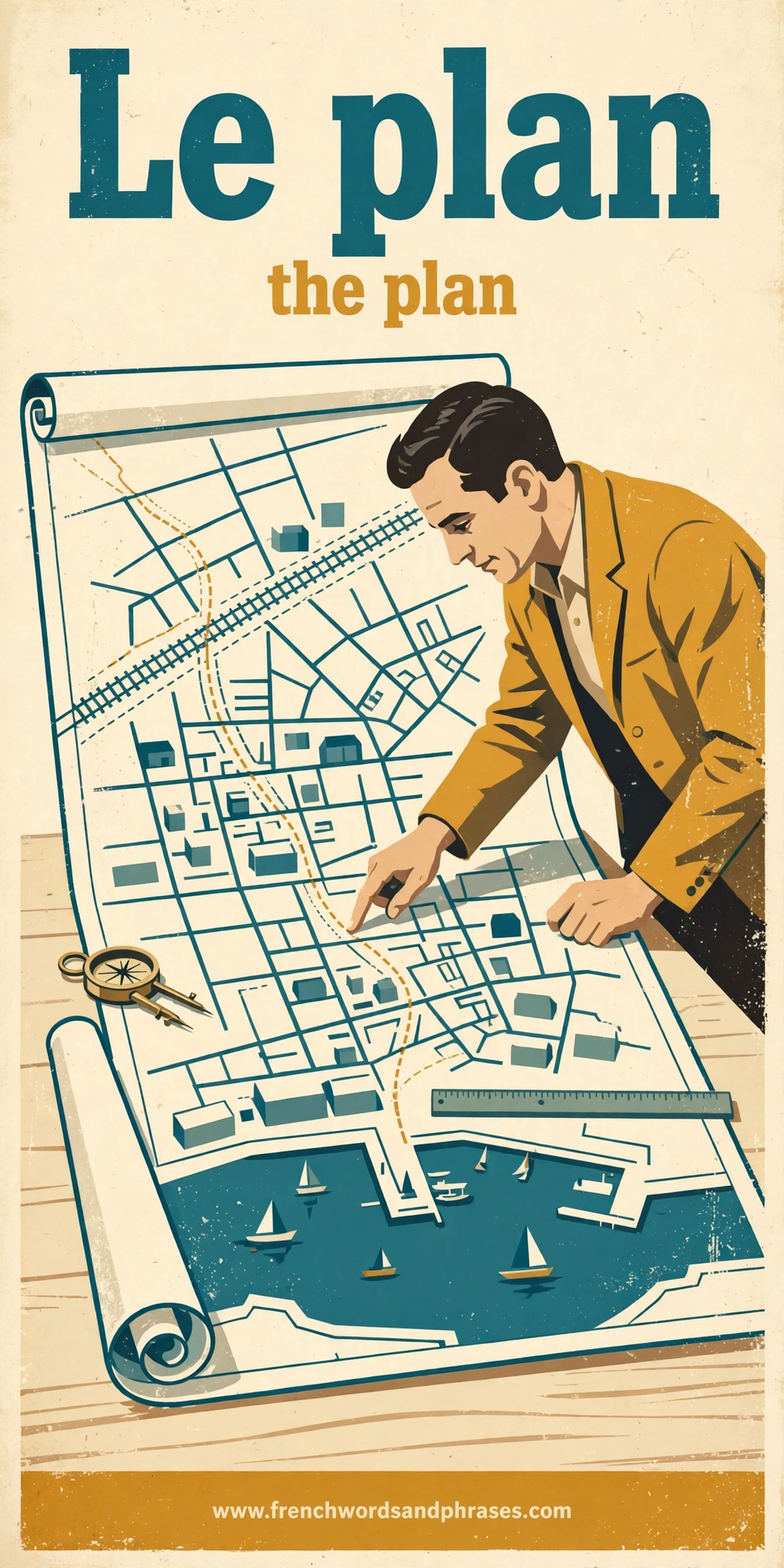
A sheet unrolled on the table, streets shrunk to lines; a list of steps whispered before the door opens: le plan, the plan and the map — one word for the drawing of a city and the drawing-up of a scheme.
In this guide, you’ll learn what plan means in English, how to use it with its articles, how to form its plural, and how it appears in everyday French. Explore French examples, English translations, and practice quizzes.
Understanding the French Noun Plan
Plan is a masculine French noun, learned with its article: le plan, un plan. It comes from the Latin planus, flat — a plan is first a flat drawing, the ground seen from above, and only then the flat, clear arrangement of what one means to do.
It has two great lives, both about seeing the whole at once. First, a map or diagram drawn to scale: le plan de la ville, the map of the town, le plan du métro, the metro map, le plan d’une maison, the floor plan of a house. Second, a scheme of action: un plan de voyage, a travel plan, suivre le plan, to follow the plan, un plan B, a plan B. Cinema borrowed it for the shot — un gros plan, a close-up — and painters for depth: au premier plan, in the foreground.
Gender: Masculine — le plan
Definite article: le — le plan (the plan, the map)
Indefinite article: un — un plan (a plan, a map)
Plural: les plans — regular, with a simple -s
Spelling note: from Latin planus, flat — the flat drawing comes first
Two lives: a drawn map or floor plan; a scheme of action
English equivalents: The plan; the map; the floor plan; a shot (cinema).
For a street map, French says un plan where English might reach for map — une carte is the larger-scale geographical map, un plan the town or building drawn close. A good everyday test: you unfold un plan de ville in a street, you hang une carte de France in a classroom. And a plan that fails leaves you en plan: laisser quelqu’un en plan, to leave someone stranded.
Experience the Word
Plan is the word for the whole seen from above — the town become paper, the future become a list.
Imagine the tourist at the station exit, plan de la ville in hand, turning it twice before the streets agree with the paper. Across town, at the same minute, a bride and her mother unfold a different plan — tables, flowers, timings — and the wedding, too, becomes a drawing before it becomes a day.
You have not just named a sheet of paper. You have named foresight itself — le plan, the whole, visible at a glance.
How to Use Plan in French: Complete Guide
Let’s explore how plan works in French, beginning with its articles — le plan, un plan, suivre le plan.
Plan with the Definite Article (Le, Les)
Used for a specific plan or map — the one on the table, the one everyone agreed.
| Form | French |
|---|---|
| Masculine singular | le plan |
| Plural | les plans |
Example
Le plan de la ville est affiché à la gare.
The town map is posted at the station.
Plan with the Indefinite Article (Un, Des)
Used for a plan in general — any scheme, any drawing of a whole.
| Form | French |
|---|---|
| Masculine singular | un plan |
| Plural | des plans |
Example
Tu as un plan pour le week-end ?
Do you have a plan for the weekend?
The Drawn Plans (Ville, Métro, Maison…)
The drawing life of plan: towns, buildings and underground lines, shrunk to fit a sheet.
| Drawing | French |
|---|---|
| a town map | un plan de ville |
| the metro map | le plan du métro |
| a floor plan | le plan d’une maison |
| a street map (detailed) | un plan des rues |
| a seating plan | un plan de table |
Example
Le plan du métro de Paris est célèbre dans le monde entier.
The Paris metro map is famous all over the world.
Quick Quiz 1
Complete the sentence:
______ plan du métro est dans le guide. (the)
Reveal the answer
Le
Le plan du métro est dans le guide.
The metro map is in the guidebook — plan is masculine, so le.
The Plural of Plan
Plan takes a regular plural in -s — architects and generals both live among plans.
| Number | French |
|---|---|
| Singular | le plan |
| Plural | les plans |
Example
Les plans de la nouvelle école sont sur le bureau de l’architecte.
The plans for the new school are on the architect’s desk.
Plan with Possessive Adjectives (Mon, Ton, Son…)
Possessives agree with the noun: plan is masculine, so mon, ton, son in the singular.
| Owner | French |
|---|---|
| my | mon plan |
| your (tu) | ton plan |
| his / her | son plan |
| our | notre plan |
| your (vous) | votre plan |
| their | leur plan |
Example
Mon plan est simple : partir tôt et éviter les embouteillages.
My plan is simple: leave early and avoid the traffic jams.
Quick Quiz 2
Complete the sentence:
Elle a changé ______ plan au dernier moment. (her)
Reveal the answer
son
Elle a changé son plan au dernier moment.
She changed her plan at the last moment — son, because plan is masculine.
Plan with Demonstrative Adjectives (Ce, Ces)
Used to point: ce plan, this plan — this map, this famous scheme.
| Form | French |
|---|---|
| Masculine singular | ce plan |
| Plural | ces plans |
Example
Ce plan de ville date de 1950, les rues ont changé.
This town map dates from 1950, the streets have changed.
Plan with Adjectives
Adjectives agree with plan — masculine singular: un bon plan, un plan détaillé.
| Adjective | With Plan |
|---|---|
| bon (good) | un bon plan |
| détaillé (detailed) | un plan détaillé |
| simple (simple) | un plan simple |
| nouveau (new) | un nouveau plan |
| secret (secret) | un plan secret |
Example
Un bon plan vaut mieux qu’une longue discussion.
A good plan is worth more than a long discussion.
Quick Quiz 3
Complete the sentence:
C’est un plan très ______, chaque rue y est dessinée. (detailed)
Reveal the answer
détaillé
C’est un plan très détaillé, chaque rue y est dessinée.
It is a very detailed map, every street is drawn on it.
Everyday Expressions with Plan
Maps, schemes and cinema — the plan phrases of daily life.
| Expression | In English |
|---|---|
| suivre le plan | to follow the plan |
| un plan B | a plan B |
| au premier plan | in the foreground; in the forefront |
| un gros plan | a close-up (cinema, photo) |
| laisser en plan | to leave stranded, to abandon mid-way |
Example
Le film commence par un gros plan sur les mains du pianiste.
The film opens with a close-up of the pianist’s hands.
Words from the Same Family as Plan
Drawings and intentions — the words that travel with plan.
| French | In English |
|---|---|
| une carte | a map (geographical, larger scale) |
| un projet | a project, a plan in the making |
| planifier | to plan (the verb) |
| un dessin | a drawing |
| un itinéraire | a route, an itinerary |
Example
Planifie ton itinéraire avec le plan de la ville.
Plan your route with the town map.
Quick Quiz 4
What is un gros plan?
Reveal the answer
A close-up — the cinema and photo shot that fills the frame with a face or an object.
Le gros plan sur la lettre révèle un secret.
The close-up of the letter reveals a secret.
Plan in Everyday French: Real-Life Examples
Now that you know the word, let’s see how plan appears in everyday French.
Example 1 — At the station
Le plan de la ville est gratuit à l’office de tourisme.
The town map is free at the tourist office.
Example 2 — The weekend
Mon plan pour samedi : marché le matin, sieste après.
My plan for Saturday: market in the morning, nap after.
Example 3 — At the cinema
Le gros plan sur son visage dit tout.
The close-up on her face says everything.
Example 4 — Building
L’architecte présente les plans de la maison.
The architect presents the plans of the house.
Example 5 — Plan B
S’il pleut, le plan B, c’est le musée.
If it rains, plan B is the museum.
Example 6 — Foreground
Au premier plan de la photo, on voit les enfants.
In the foreground of the photo, you can see the children.
Beyond Translation: The Meaning of Plan
Plan is the flattest word in French and one of the most ambitious: from Latin planus, flat, it first flattened the world into drawings — towns, houses, battlefields — and then flattened the future the same way, into steps that fit on one page. The cinema took it for the size of a shot, painting for the layers of depth, and everyday speech for the stranded friend: laissé en plan, left flat.
To say plan is to hold the whole at arm’s length and read it at a glance.
It evokes the unrolled map, the architect’s blue lines and the whispered scheme before the door opens — everything French draws before it does.
How to Remember the French Noun Plan
Remember it this way: Plan is two words in one — the drawn map and the scheme of action: le plan, masculine, from planus, flat.
- Always masculine — le plan, un plan, mon plan.
- The two lives — le plan de la ville (the map) and suivre le plan (the scheme).
- Plan or carte? — un plan for the town close-up, une carte for the country at large.
The key idea is le plan — the plan and the map, masculine; un gros plan is a close-up.
Test Your Knowledge of Plan
Let’s see how much you’ve learned. Try answering these questions before revealing the answers.
Question 1
Is plan masculine or feminine?
Reveal the answer
Masculine — le plan, un plan.
Question 2
How do you say the metro map in French?
Reveal the answer
Le plan du métro.
Question 3
Translate: Follow the plan.
Reveal the answer
Suivez le plan.
Question 4
What is the difference between un plan and une carte?
Reveal the answer
Un plan is a close-scale drawing — a town, a building; une carte is the geographical map of a region or country.
Question 5
Complete the sentence:
______ plans de la maison sont chez l’architecte. (the)
Reveal the answer
Les
Les plans de la maison sont chez l’architecte.
The plans of the house are at the architect’s.
Your Final Challenge
Can You Use It?
How would you say this in French?
“My plan is simple: leave early and avoid the traffic jams.”
Reveal the answer
Mon plan est simple : partir tôt et éviter les embouteillages.
My plan is simple: leave early and avoid the traffic jams.
A little French. A little curiosity. A richer everyday life.
LEARN FRENCH ONE WORD AT A TIME




