A French Word to Live By
Translate Manière to English
/ma.njɛʁ/
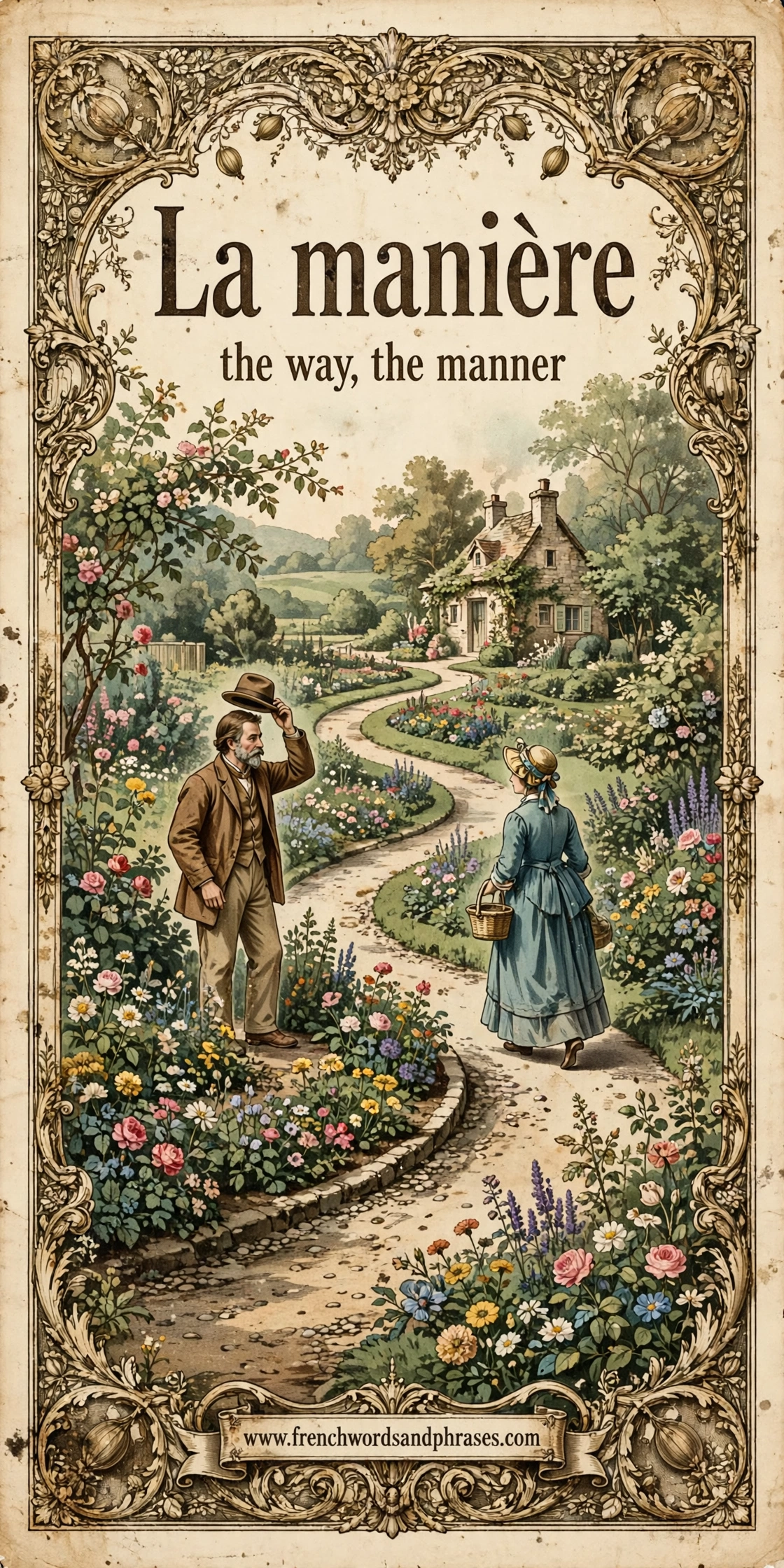
La manière means the way, the manner.
Two cooks peel the same potatoes in the same kitchen. One is fast and rough, the other slow and neat as a jeweller. « Chacun a sa manière », shrugs the chef — everyone has their own way. Manière is the noun of how: the personal style with which a thing gets done.
In this guide, you’ll learn what manière means in English, how to use it with its articles, how to form its plural, and how it appears in everyday French. Explore French examples, English translations, and practice quizzes.
Understanding the French Noun Manière
Manière is a feminine French noun, learned with its article: la manière, une manière. It comes from the Latin manus, the hand — the manière was first the way a hand holds a tool, and it still carries that touch of craft: a manière is a way of doing that bears someone’s mark.
It means the way, the manner — how something is done: la manière de parler, the way of speaking, de cette manière, in this way. In the plural, les manières becomes manners themselves — les bonnes manières, good manners, the polite way of behaving at table and in company. And the fixed phrase de toute manière means in any case, anyway.
Gender: Feminine — la manière
Definite article: la — la manière (the way)
Indefinite article: une — une manière (a way)
Plural: les manières — good manners, when the word is about behaviour
Key phrase: de toute manière — in any case, anyway
Close neighbour: la façon — the everyday twin: la façon de faire, the way of doing
English equivalents: The way, the manner.
You build with manière using de: la manière de faire, the way of doing, la manière dont il parle, the way he speaks — dont, not que, when manière is pulled out of its clause. And mind the plural: une manière is a way of doing one thing; les manières, plural, is how a person behaves — il a de drôles de manières, he has strange manners.
Experience the Word
Manière is the signature inside an action — two people do the same job, and the manière tells you who did it.
Imagine the old tailor measuring a jacket: no ruler slapped down, but a ribbon floated, a chalk line drawn in one breath. Thirty years of manière live in that gesture, and the apprentice watches the hands, not the cloth.
You have not just named a method. You have named the personal touch that no instruction sheet can copy — la manière, the way someone does things.
How to Use Manière in French: Complete Guide
Let’s explore how manière works in French, beginning with its articles — la manière, une manière, de toute manière.
Manière with the Definite Article (La, Les)
Used for the specific way — the one this person, this house, this recipe has.
| Form | French |
|---|---|
| Feminine singular | la manière |
| Plural | les manières |
Example
La manière dont il explique est très claire.
The way he explains is very clear.
Manière with the Indefinite Article (Une, Des)
Used for a way in general — one method among others.
| Form | French |
|---|---|
| Feminine singular | une manière |
| Plural | des manières |
Example
C’est une manière simple de retenir les verbes.
It is a simple way of remembering the verbs.
Manière with De: The Way of Doing
Manière almost always travels with de — the way of doing, of speaking, of being.
| Frame | French |
|---|---|
| the way of doing | la manière de faire |
| the way of speaking | la manière de parler |
| in this way | de cette manière |
| in another way | d’une autre manière |
| in any case | de toute manière |
Example
La manière de faire de ma grand-mère est la meilleure.
My grandmother’s way of doing it is the best.
Quick Quiz 1
Complete the sentence:
______ manière dont elle chante est douce. (the)
Reveal the answer
La
La manière dont elle chante est douce.
The way she sings is gentle — manière is feminine, so la.
The Plural of Manière
The plural changes the word’s world: les manières is behaviour — the manners a person shows the world.
| Number | French |
|---|---|
| Singular | la manière |
| Plural | les manières |
Example
Les bonnes manières s’apprennent à la maison.
Good manners are learned at home.
Manière with Possessive Adjectives (Ma, Ta, Sa…)
Possessives agree with the noun: manière is feminine, so ma, ta, sa in the singular.
| Owner | French |
|---|---|
| my | ma manière |
| your (tu) | ta manière |
| his / her | sa manière |
| our | notre manière |
| your (vous) | votre manière |
| their | leur manière |
Example
Laisse-moi faire à ma manière.
Let me do it my way.
Quick Quiz 2
Complete the sentence:
Chacun travaille à ______ manière. (his / her own way)
Reveal the answer
sa
Chacun travaille à sa manière.
Everyone works in their own way — sa, because manière is feminine.
Manière with Demonstrative Adjectives (Cette, Ces)
Used to point: cette manière, this way — usually the one being demonstrated.
| Form | French |
|---|---|
| Feminine singular | cette manière |
| Plural | ces manières |
Example
Cette manière de couper le pain est dangereuse.
This way of cutting bread is dangerous.
Manière with Adjectives
Adjectives agree with manière — feminine singular: une manière douce, une drôle de manière.
| Adjective | With Manière |
|---|---|
| douce (gentle) | une manière douce |
| simple (simple) | une manière simple |
| drôle (strange, funny) | une drôle de manière |
| bonne (good) | la bonne manière |
| mauvaise (bad) | une mauvaise manière |
Example
Il a une drôle de manière de poser les questions.
He has a strange way of asking questions.
Quick Quiz 3
Complete the sentence:
C’est une ______ manière de commencer la journée. (good)
Reveal the answer
bonne
C’est une bonne manière de commencer la journée.
It is a good way to start the day — bonne, feminine, to agree with manière.
Everyday Expressions with Manière
Kitchens, classrooms and arguments — the manière phrases of daily life.
| Expression | In English |
|---|---|
| de toute manière | in any case, anyway |
| à ma manière | in my way, my own way |
| de cette manière | in this way |
| les bonnes manières | good manners |
| une manière de dire | a way of speaking, a figure of speech |
Example
De toute manière, nous partirons demain matin.
In any case, we will leave tomorrow morning.
Words from the Same Family as Manière
Hands and habits — the words that travel with manière.
| French | In English |
|---|---|
| la façon | the way — the everyday twin of manière |
| la main | the hand — the Latin root of manière |
| maniéré | mannered, affected — too much manière |
| le manuel | the manual — a book for the hands |
| se comporter | to behave — where les manières come from |
Example
Sa façon de rire est connue dans tout le village.
Her way of laughing is known throughout the village.
Quick Quiz 4
What does de toute manière mean?
Reveal the answer
In any case, anyway — the phrase that closes an argument.
De toute manière, c’est décidé.
In any case, it is decided.
Manière in Everyday French: Real-Life Examples
Now that you know the word, let’s see how manière appears in everyday French.
Example 1 — In the kitchen
Elle coupe les oignons à sa manière.
She chops the onions her own way.
Example 2 — At school
La manière dont le professeur explique est très claire.
The way the teacher explains is very clear.
Example 3 — Manners
Cet enfant a de très bonnes manières.
This child has very good manners.
Example 4 — Anyway
De toute manière, il est trop tard pour changer.
In any case, it is too late to change.
Example 5 — A method
Montre-moi ta manière de plier les serviettes.
Show me your way of folding the napkins.
Example 6 — Behaviour
Je n’aime pas ses manières avec les invités.
I do not like his manners with the guests.
Beyond Translation: The Meaning of Manière
Manière began in the hand: Latin manus. A manière was the grip, the touch, the trained movement of a craftsman — and French never let the word forget it. That is why manière is warmer than méthode: a method can be printed in a book, but a manière lives in a person’s hands and habits.
To say manière is to say that how a thing is done is part of what is done.
It evokes grandmothers’ kitchens, tailors’ chalk lines and the small ceremonies of politeness — les bonnes manières — by which French daily life still sets great store.
How to Remember the French Noun Manière
Remember it this way: Manière is the way of doing — feminine: la manière, built with de, and its plural means manners.
- Always feminine — la manière, une manière, ma manière.
- The building frame — la manière de faire, la manière dont il parle.
- The plural surprise — les manières are manners: les bonnes manières, good manners.
The key idea is la manière — the way, feminine; la manière de faire; les manières = manners; de toute manière = anyway.
Test Your Knowledge of Manière
Let’s see how much you’ve learned. Try answering these questions before revealing the answers.
Question 1
Is manière masculine or feminine?
Reveal the answer
Feminine — la manière, une manière.
Question 2
How do you say « in any case, anyway »?
Reveal the answer
De toute manière.
Question 3
Translate: Everyone has their own way.
Reveal the answer
Chacun a sa manière.
Question 4
What do les manières (plural) usually mean?
Reveal the answer
Manners — behaviour: les bonnes manières, good manners.
Question 5
Complete the sentence:
La manière ______ il parle est calme. (the way he speaks)
Reveal the answer
dont
La manière dont il parle est calme.
The way he speaks is calm.
Your Final Challenge
Can You Use It?
How would you say this in French?
“Let me do it my way.”
Reveal the answer
Laisse-moi faire à ma manière.
Let me do it my way.
A little French. A little curiosity. A richer everyday life.
LEARN FRENCH ONE WORD AT A TIME