A French Word to Live By
Translate Juste to English
/ʒyst/
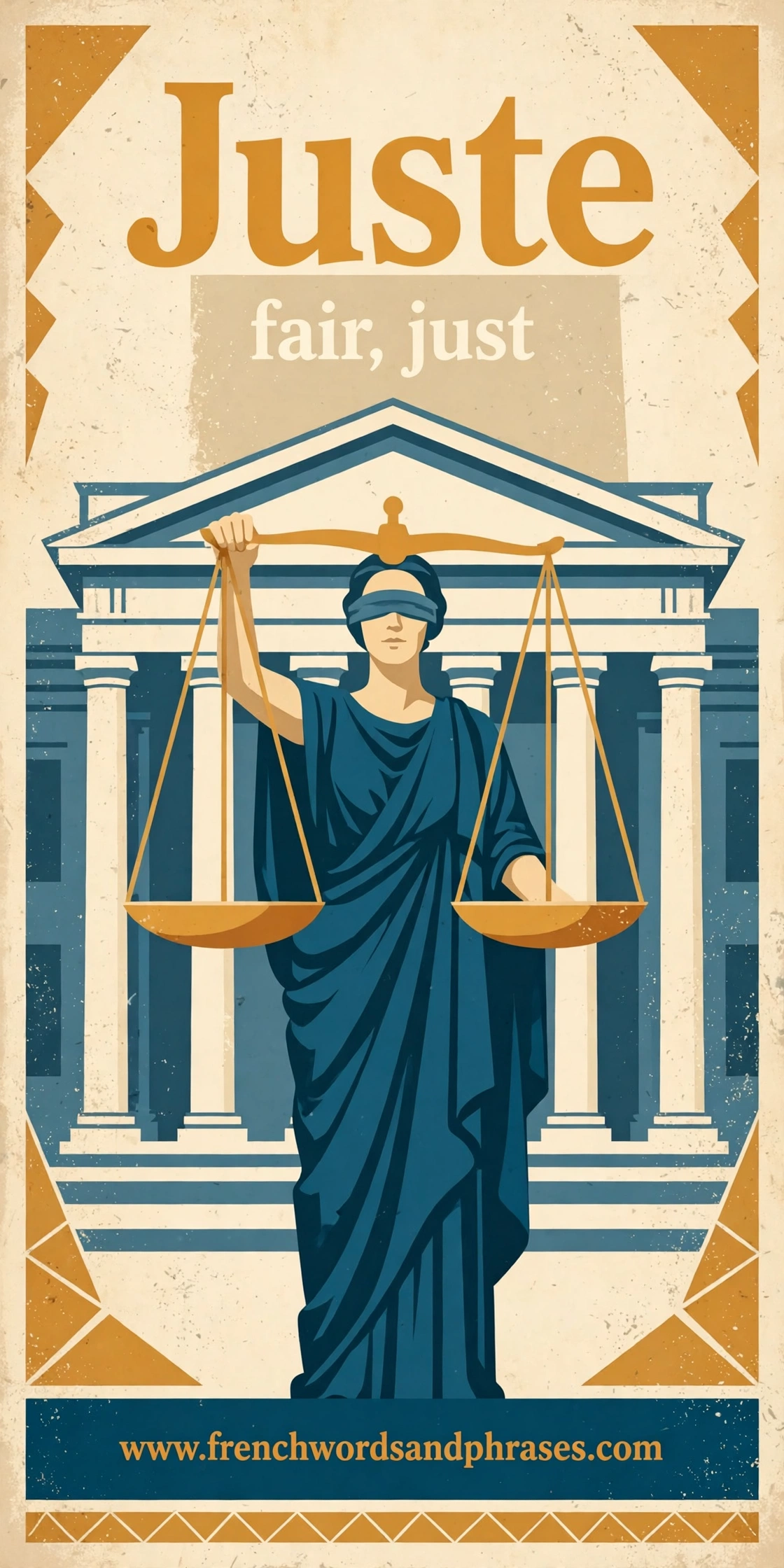
Juste means fair, just; exact, right.
A judge weighing two stories in silence; a child dividing a cake into two perfectly equal halves, tongue between her teeth; a key turning in exactly the right lock. « C’est juste ! » — that’s right! Juste is the adjective of the exact fit: fair in judgement, right in answer, precise in measure.
In this guide, you’ll learn what juste means in English, why it never changes for the feminine, where it stands in the sentence, and how its two families — fairness and exactness — divide its work. Explore French examples, English translations, and practice quizzes.
Understanding the French Adjective Juste
Juste is a French adjective of fairness and exactness. It already ends in -e, so it is invariable in gender: un homme juste, une décision juste. Only the plural changes: justes. Before the noun it often means only, mere (une juste remarque can be a fair remark after the noun, or a mere remark before it); after the noun it means fair or right. It is also an adverb: chanter juste, to sing in tune; tomber juste, to be exactly right.
It means fair, just — un juge juste, a fair judge; une loi juste, a just law — and right, exact: la réponse juste, the right answer; l’heure juste, the exact time; un mot juste, an apt word. Between the two families stands its everyday cheer: c’est juste, that’s right, that’s correct — the words every teacher loves to say.
Type: Adjective — fairness and exactness; also an adverb
Answers the question: Comment est-ce ? — How is it? (Answer: fair, or exactly right)
Changes form: Invariable in gender — juste for him and for her; plural justes
English equivalents: Fair, just; right, correct, exact.
One important usage detail: position changes the shade. After the noun, juste means fair or right — une décision juste, a fair decision. Before it, juste often shrinks to ‘only, mere’ — un juste regard can be a mere glance. And as an adverb it never changes at all: elle chante juste, she sings in tune.
Experience the Word
Juste is the adjective of the balance and the bullseye — fairness and accuracy sharing one small word.
Imagine the market scale at dawn: the fishmonger adds one last small fish, the needle settles exactly on the kilo, and both women nod — « c’est juste ». Fair weight, exact measure, nobody cheated: the whole morality of the market in two words.
You have not just said ‘correct’. You have said the thing fits — the judgement, the answer, the weight.
How to Use Juste in French: Complete Guide
Let’s explore how juste works in French, beginning with the whole word on one card.
Juste at a Glance
Before the details, here is the whole word on one card.
The Whole Word on One Card
Meaning, type, position and forms — juste in four lines.
| Point | Juste |
|---|---|
| Meaning | fair, just — and right, exact |
| Type | adjective of fairness and exactness |
| Usual position | after the noun for fair/right — une réponse juste |
| Form | juste for both genders — justes in the plural |
Example
C’est la réponse juste.
That is the right answer.
The Four Forms of Juste
Juste already ends in -e, so masculine and feminine are identical; only the plural adds an s.
| Form | Juste | Example |
|---|---|---|
| Masculine singular | juste | un juge juste — a fair judge |
| Feminine singular | juste | une loi juste — a just law |
| Masculine plural | justes | des juges justes — fair judges |
| Feminine plural | justes | des lois justes — just laws |
Example
Des décisions justes calment tout le monde.
Fair decisions calm everyone.
Quick Quiz 1
What is the feminine of juste?
Reveal the answer
juste
Une réponse juste — the word already ends in -e, so nothing changes.
A right answer.
The Feminine of Juste: The Same Word
Like all adjectives ending in -e, juste keeps one form for both genders.
| Situation | Example |
|---|---|
| Masculine | un prix juste — a fair price |
| Feminine | une part juste — a fair share |
| Why | adjectives ending in -e do not change for the feminine |
| The plural | add s — des prix justes, des parts justes |
Example
Elle demande une part juste du gâteau.
She asks for a fair share of the cake.
Where Juste Goes: Position Changes the Shade
After the noun, juste means fair or right; before it, it often shrinks to only, mere — and as an adverb it stands after the verb.
| Pattern | Example |
|---|---|
| After the noun (fair) | une décision juste — a fair decision |
| After the noun (right) | la réponse juste — the right answer |
| Before the noun (mere) | un juste sourire — a mere smile |
| As an adverb | chanter juste — to sing in tune |
Example
Il a trouvé le mot juste au bon moment.
He found the right word at the right moment.
Quick Quiz 2
How do you say ‘the right answer’ — la juste réponse or la réponse juste?
Reveal the answer
la réponse juste
For right and fair, juste follows the noun.
The right answer.
More Juste: Comparing with Juste
For fairness, juste compares with plus and le plus; for exactness, French prefers tout à fait or parfaitement.
| Degree | Example |
|---|---|
| As fair as | aussi juste que — aussi juste que son père |
| Fairer | plus juste — plus juste que la première loi |
| Less fair | moins juste — moins juste qu’avant |
| The fairest (masc.) | le plus juste — le juge le plus juste |
| The fairest (fem.) | la plus juste — la décision la plus juste |
Example
C’est la solution la plus juste pour tous.
It is the fairest solution for everyone.
Everyday Expressions with Juste
Right answers, exact times and narrow escapes — juste in the phrases of the day.
| Expression | In English |
|---|---|
| c’est juste | that’s right, that’s correct |
| juste à temps | just in time |
| juste avant / juste après | just before / just after |
| l’heure juste | the exact time |
| de justesse | narrowly, by a hair |
| au juste | exactly, precisely (au juste, combien ?) |
Example
Le train est arrivé juste à temps.
The train arrived just in time.
Quick Quiz 3
What does juste à temps mean?
Reveal the answer
Just in time
Elle est arrivée juste à temps pour le train.
She arrived just in time for the train.
Juste and Its Neighbours
The fairness shelf: fair, exact, true — and their opposites.
| French | In English |
|---|---|
| juste | fair, just; right, exact |
| équitable | equitable, fair (formal) |
| exact | exact, precise |
| vrai | true |
| injuste | unfair, unjust — the opposite |
| faux | wrong, false — the opposite for answers |
Example
Une réponse vraie mais pas tout à fait juste.
A true answer, but not quite the right one.
Watch Out: The Traps Around Juste
The traps: English ‘just’ sneaking in, and juste confused with seulement.
| Trap | The truth |
|---|---|
| using juste for every English ‘just’ | ‘I just arrived’ is je viens d’arriver; juste is fair/exact, or only in set frames |
| forgetting the plural s | the plural is justes: des réponses justes |
| confusing juste and justement | justement is an adverb: precisely, just — justement, je voulais te voir |
| placing juste before the noun for ‘right’ | the right answer is la réponse juste — after the noun |
Example
Justement, ta réponse est juste.
Precisely — your answer is right.
Quick Quiz 4
How do you say ‘that’s right!’?
Reveal the answer
C’est juste !
Bravo, c’est juste !
Well done, that’s right!
Juste in Everyday French: Real-Life Examples
Now that you know the word, let’s see how juste appears in everyday French.
Example 1 — In class
C’est juste, bravo !
That’s right, well done!
Example 2 — Fairness
Le partage doit être juste pour tous.
The sharing must be fair for everyone.
Example 3 — Time
Il est juste à l’heure.
He is exactly on time.
Example 4 — Music
Elle chante juste, sans effort.
She sings in tune, effortlessly.
Example 5 — A narrow escape
Il a gagné de justesse.
He won by a hair.
Example 6 — The right word
Tu as dit le mot juste.
You said the right word.
Beyond Translation: The Meaning of Juste
Juste is the meeting point of the courtroom and the classroom: the same word applauds the fair judge and the correct answer, as if French believed that truth and fairness were one virtue wearing two coats. Its adverb life is just as honourable — viser juste, to aim true; tomber juste, to land exactly right.
Juste is the click of the key in the right lock.
And its near-escape noun, la justesse, gave French a beloved compliment for precision of mind: la justesse d’esprit, exactness of thought.
How to Remember the French Adjective Juste
Remember it this way: Juste is fair and right — invariable in gender, plural justes, and it follows the noun for both its great senses.
- You judge with it — un juge juste, a fair judge.
- You answer with it — la réponse juste, the right answer.
- You arrive with it — juste à temps, just in time.
The key idea is juste means fair, just and right, exact; invariable in gender, plural justes; c’est juste = that’s right.
Test Your Knowledge of Juste
Let’s see how much you’ve learned. Try answering these questions before revealing the answers.
Question 1
What does juste mean?
Reveal the answer
Fair, just — and right, exact: un juge juste, la réponse juste.
Question 2
What is the feminine of juste?
Reveal the answer
Juste — unchanged: une loi juste.
Question 3
Translate: That’s right!
Reveal the answer
C’est juste !
Question 4
What is the opposite of juste?
Reveal the answer
Injuste for fairness (unfair) and faux for answers (wrong).
Question 5
Complete the sentence:
Des réponses ______ méritent dix sur dix. (right, plural)
Reveal the answer
justes
Des réponses justes méritent dix sur dix.
Right answers deserve ten out of ten.
Your Final Challenge
Can You Use It?
How would you say this in French?
“That’s right, well done!”
Reveal the answer
C’est juste, bravo !
That’s right, well done!
A little French. A little curiosity. A richer everyday life.
LEARN FRENCH ONE WORD AT A TIME