A French Word to Live By
Translate Salade to English
/sa.lad/
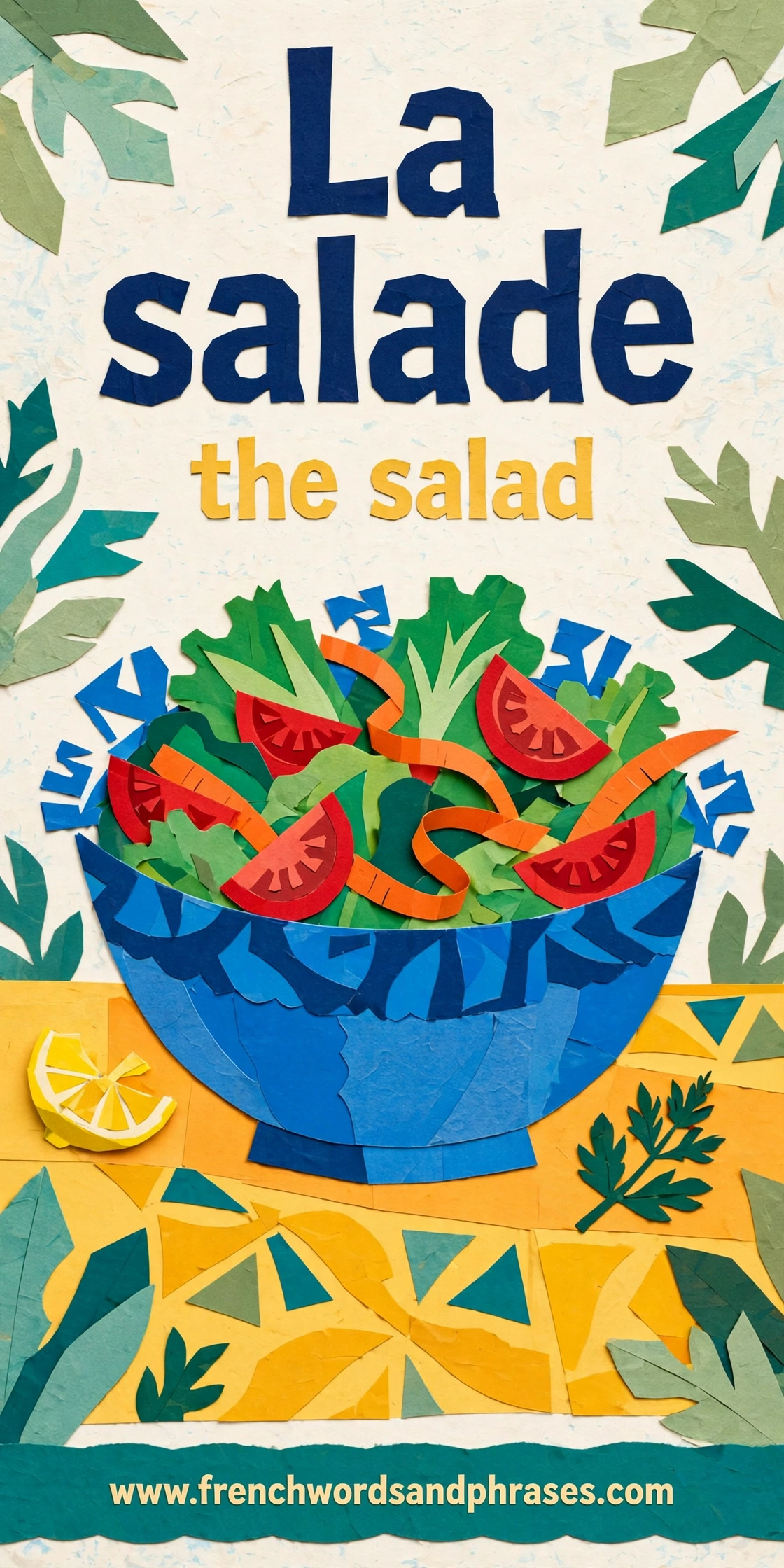
La salade means the salad.
Crisp leaves, a sharp vinaigrette, and the bowl passed hand to hand around the table: la salade, the salad — in France not a side dish but a course of its own, arriving after the main plate like a cool breeze through the meal.
In this guide, you’ll learn what salade means in English, how to use it with its articles, how to form its plural, and how it appears in everyday French. Explore French examples, English translations, and practice quizzes.
Understanding the French Noun Salade
Salade is a feminine French noun, learned with its article: la salade, une salade. It comes from the Italian insalata, salted greens — herbs dressed with salt, oil and vinegar, as the Romans already liked them. One word does double duty in French: une salade is both the dish in the bowl and the lettuce it is made from.
It means salad — first the plant, a lettuce: acheter une salade at the market is to buy a head of lettuce. Then the dish: une salade verte, a green salad, une salade composée, a mixed salad with eggs, cheese or tuna, une salade de fruits, a fruit salad, une salade de tomates. You prepare it with assaisonner la salade, to dress the salad — in France, always at the last minute, in the bowl, with vinaigrette. And in familiar French, raconter des salades means to spin tall tales — this site has the idiom as its own page.
Gender: Feminine — la salade
Definite article: la — la salade (the salad)
Indefinite article: une — une salade (a salad, or a lettuce)
Plural: les salades — regular, with a simple -s
Spelling note: from Italian insalata, salted greens — the salt is in the name
Double life: the dish in the bowl, and the lettuce itself: une salade = a head of lettuce
English equivalents: The salad, the lettuce.
At the market, une salade is a lettuce; at the table, it is the dressed dish — context decides. The dressing is not optional vocabulary: la vinaigrette is what a French salade wears, and assaisonner is the verb for putting it on. For the figurative sense — a muddle, a tall story — French says raconter des salades, to tell salads, and quelle salade ! for a fine mess.
Experience the Word
Salade is the pause in the middle of the French meal: the plates change, the conversation breathes, and the green bowl goes round.
Imagine the market stall in June — rows of lettuces like green roses, the vendor wrapping your salade in newspaper while the vinaigrette is still only an idea in your kitchen.
You have not just named a dish. You have named freshness itself — la salade, the salad, crisp, salted and shared.
How to Use Salade in French: Complete Guide
Let’s explore how salade works in French, beginning with its articles — la salade, une salade, assaisonner la salade.
Salade with the Definite Article (La, Les)
Used for a specific salad — the one in the bowl, the one on the menu.
| Form | French |
|---|---|
| Feminine singular | la salade |
| Plural | les salades |
Example
La salade est prête, passez à table.
The salad is ready, come to the table.
Salade with the Indefinite Article (Une, Des)
Used for a salad in general — remember, une salade can also be one whole lettuce.
| Form | French |
|---|---|
| Feminine singular | une salade |
| Plural | des salades |
Example
J’ai acheté une salade et des tomates au marché.
I bought a lettuce and some tomatoes at the market.
Salade with the Partitive (De la salade…)
Served by the bowlful, salad takes the partitive: some salad, a little salad, no salad at all.
| Quantity | French |
|---|---|
| some salad | de la salade |
| a lot of salad | beaucoup de salade |
| a bowl of salad | un bol de salade |
| a plate of salad | une assiette de salade |
| no salad (after negation) | pas de salade |
Example
Tu veux encore de la salade ?
Do you want some more salad?
Quick Quiz 1
Complete the sentence:
______ salade verte arrive après le plat principal. (the)
Reveal the answer
La
La salade verte arrive après le plat principal.
The green salad comes after the main course — salade is feminine, so la.
The Plural of Salade
Salade takes a regular plural in -s — lettuces at the market, salads on the menu.
| Number | French |
|---|---|
| Singular | la salade |
| Plural | les salades |
Example
Les salades du marché sont fraîches ce matin.
The lettuces at the market are fresh this morning.
Salade with Possessive Adjectives (Ma, Ta, Sa…)
Possessives agree with the noun: salade is feminine, so ma, ta, sa in the singular.
| Owner | French |
|---|---|
| my | ma salade |
| your (tu) | ta salade |
| his / her | sa salade |
| our | notre salade |
| your (vous) | votre salade |
| their | leur salade |
Example
Il prépare sa salade avec une vinaigrette à la moutarde.
He makes his salad with a mustard vinaigrette.
Quick Quiz 2
Complete the sentence:
Elle assaisonne ______ salade au dernier moment. (her)
Reveal the answer
sa
Elle assaisonne sa salade au dernier moment.
She dresses her salad at the last moment — sa, because salade is feminine.
Salade with Demonstrative Adjectives (Cette, Ces)
Used to point: cette salade, this salad — this lettuce, this bowl.
| Form | French |
|---|---|
| Feminine singular | cette salade |
| Plural | ces salades |
Example
Cette salade est croquante et bien fraîche.
This lettuce is crisp and really fresh.
Salade with Adjectives
Adjectives agree with salade — feminine singular: une salade verte, une salade fraîche.
| Adjective | With Salade |
|---|---|
| verte (green) | une salade verte |
| fraîche (fresh) | une salade fraîche |
| composée (mixed) | une salade composée |
| croquante (crisp) | une salade croquante |
| assaisonnée (dressed) | une salade assaisonnée |
Example
Une salade composée suffit pour le déjeuner.
A mixed salad is enough for lunch.
Quick Quiz 3
Complete the sentence:
J’adore la salade ______ avec des œufs et du fromage. (mixed)
Reveal the answer
composée
J’adore la salade composée avec des œufs et du fromage.
I love mixed salad with eggs and cheese — composée, feminine, to agree with salade.
Everyday Expressions with Salade
Markets, menus and tall tales — the salade phrases of daily life.
| Expression | In English |
|---|---|
| une salade verte | a green salad |
| une salade de fruits | a fruit salad |
| assaisonner la salade | to dress the salad |
| la vinaigrette | the vinaigrette, the dressing |
| raconter des salades | to spin tall tales (familiar) |
Example
Ne l’écoute pas, il raconte des salades.
Don’t listen to him, he’s spinning tall tales.
Words from the Same Family as Salade
Greens and dressings — the words that travel with salade.
| French | In English |
|---|---|
| la laitue | the lettuce (the plant, precise word) |
| la vinaigrette | the vinaigrette |
| le sel | the salt — the root of the word |
| l’huile d’olive | the olive oil |
| assaisonner | to season, to dress (the verb) |
Example
La laitue et la salade poussent côte à côte au potager.
Lettuce and salad greens grow side by side in the vegetable garden.
Quick Quiz 4
What does raconter des salades mean?
Reveal the answer
To spin tall tales — to tell stories nobody should believe.
Il raconte des salades pour impressionner ses amis.
He spins tall tales to impress his friends.
Salade in Everyday French: Real-Life Examples
Now that you know the word, let’s see how salade appears in everyday French.
Example 1 — At the market
Je prends une salade, s’il vous plaît.
I’ll take a lettuce, please.
Example 2 — In the kitchen
Assaisonne la salade juste avant de servir.
Dress the salad just before serving.
Example 3 — On the menu
Une salade composée et une soupe, merci.
A mixed salad and a soup, please.
Example 4 — Dessert
La salade de fruits est fraîche et légère.
The fruit salad is fresh and light.
Example 5 — The garden
Les salades poussent vite cette année.
The lettuces are growing fast this year.
Example 6 — Tall tales
Arrête de raconter des salades !
Stop spinning tall tales!
Beyond Translation: The Meaning of Salade
Salade keeps its recipe in its name: from Latin sal, salt, through Italian insalata — greens that have been salted. The Romans dressed leaves with salt, oil and vinegar two thousand years before the word reached France, and the French meal still honours the ritual: the salade arrives as its own course, the bowl tossed at the table, never before its moment. And because a tossed bowl is a cheerful muddle, salade drifted into slang — a mix-up, a mess, a story too jumbled to believe: raconter des salades.
To say salade is to taste salt, oil and green leaves at once.
It evokes the market stall, the family bowl going round, and the tall tale told over it — freshness with a wink.
How to Remember the French Noun Salade
Remember it this way: Salade is the salad — and the lettuce itself: la salade, une salade at the market, de la salade in the bowl.
- Always feminine — la salade, une salade, ma salade.
- Two lives — une salade is a lettuce at the market, a dressed salad at the table.
- The idiom — raconter des salades, to spin tall tales.
The key idea is la salade — the salad, feminine; une salade = a lettuce too.
Test Your Knowledge of Salade
Let’s see how much you’ve learned. Try answering these questions before revealing the answers.
Question 1
Is salade masculine or feminine?
Reveal the answer
Feminine — la salade, une salade.
Question 2
At the market, what is une salade?
Reveal the answer
A lettuce — a whole head of lettuce; the dressed dish takes the same word.
Question 3
Translate: Dress the salad just before serving.
Reveal the answer
Assaisonne la salade juste avant de servir.
Question 4
How do you ask for some more salad?
Reveal the answer
De la salade — the partitive: Tu veux encore de la salade ?
Question 5
Complete the sentence:
______ salade de fruits est sur la table. (the)
Reveal the answer
La
La salade de fruits est sur la table.
The fruit salad is on the table.
Your Final Challenge
Can You Use It?
How would you say this in French?
“Dress the salad just before serving.”
Reveal the answer
Assaisonne la salade juste avant de servir.
Dress the salad just before serving.
A little French. A little curiosity. A richer everyday life.
LEARN FRENCH ONE WORD AT A TIME