
A French Word to Live By
How to Conjugate Carburer in French
/kaʁ.by.ʁe/
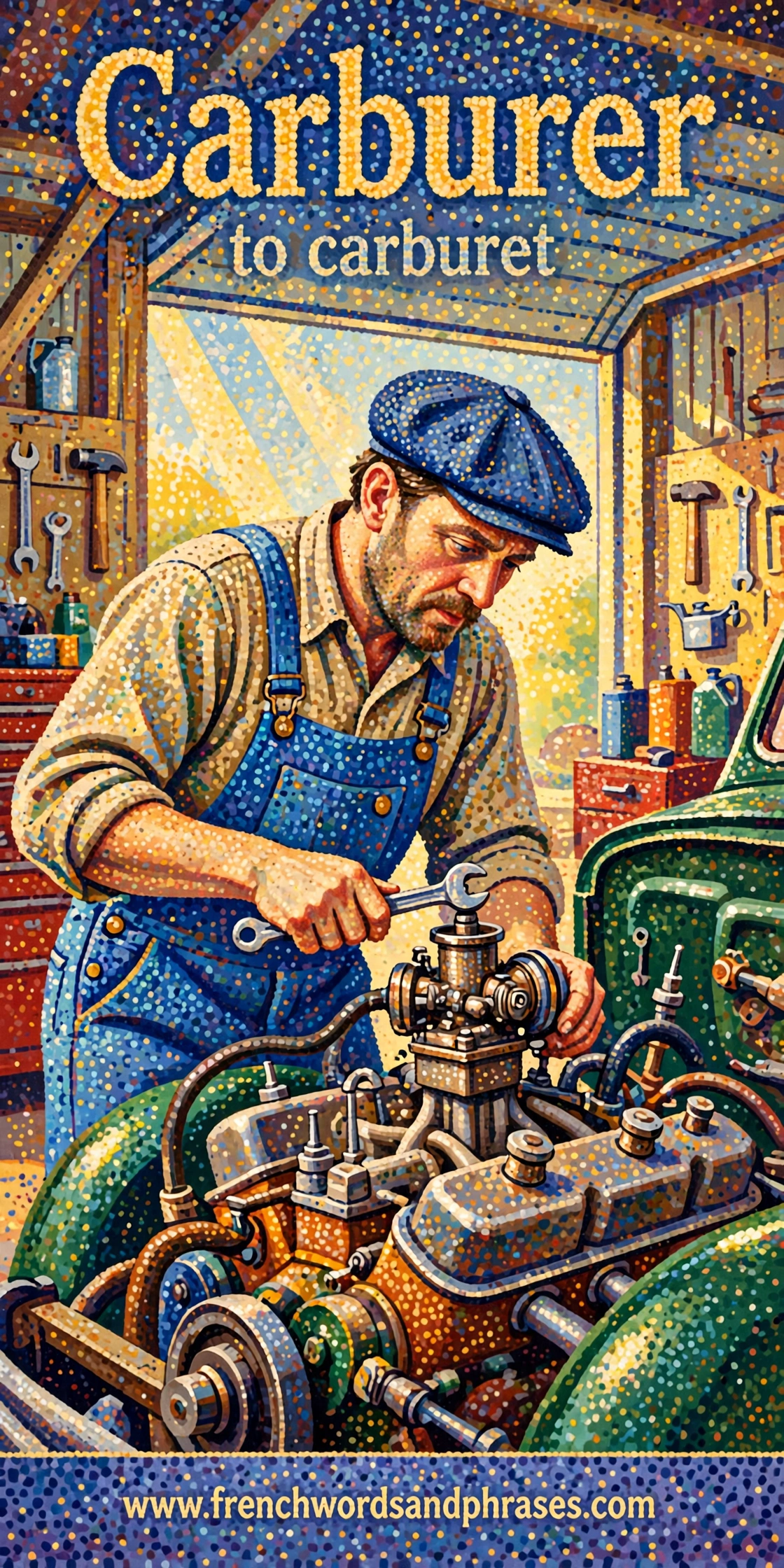
Carburer means to carburet — literally, to mix fuel with air in an engine — and, in familiar speech, to work flat out, to be firing on all cylinders.
An old engine coughing, catching, then roaring into life; an office worker on her third coffee finishing files at twice her usual speed — carburer covers both: the carburettor mixing its fuel, and the person who, figuratively, is running at full throttle.
In this guide, you’ll learn how to conjugate carburer in all the major French tenses and moods. Explore complete conjugation tables, French examples, English translations, and practice quizzes.
Understanding the French Verb Carburer
Carburer is a regular French verb belonging to the first group of verbs, those ending in-er.
It means to carburet, to work (fam.). In conversation you will almost always meet the familiar sense — praise for someone producing work at impressive speed, or an admission about what keeps you going (carburer au café, aux compliments). The literal engine sense survives in older mechanics’ vocabulary and in the noun le carburant, fuel, which every driver knows.
Verb classification: First group (-er)
Auxiliary verb: Avoir
Past participle: carburé
Present participle: carburant
English equivalents: To carburet; to work flat out, to be on fire (fam.); le moteur carbure bien — the engine is running well; carburer au café — to run on coffee (fam.); il carbure en ce moment — he is working at full throttle at the moment; carburer à plein régime — to work at full capacity.
One important detail: carburer has two lives. The literal sense — mixing air and fuel in a carburettor — is technical and slightly dated, since modern engines have injection instead. The familiar sense is the living one: il carbure means he is working flat out, thinking fast, performing at his peak; the fuel is often named with à — elle carbure au café, il carbure à l’adrénaline. The conjugation itself is a perfectly regular -er: je carbure, nous carburons, ils carburent, past participle carburé.
Experience the Word
Carburer is the verb of full throttle — engine or human, everything is mixing, burning and producing at maximum rate.
Imagine the last day before the holidays in a small office. Sophie has finished three reports, answered forty emails and booked the team’s travel, all before lunch. Her colleague stares: « Toi, tu carbures aujourd’hui ! » She just points at her empty coffee cup: she carbure au café, and the machine is empty.
No engine is in sight, yet everyone understands. She is running at full throttle — elle carbure.
How to Conjugate Carburer: Complete French Conjugation Guide
Let’s explore every major conjugation of carburer, beginning with the indicative mood.
How to Conjugate Carburer in the Indicative Mood
The indicative mood is used to express facts, observations, actions, and events.
How to Conjugate Carburer in the Present Tense (Présent)
Used for actions happening now, habitual actions, and general truths.
| Subject | Conjugation |
|---|---|
| je | carbure |
| tu | carbures |
| il / elle | carbure |
| nous | carburons |
| vous | carburez |
| ils / elles | carburent |
Example
En ce moment, il carbure et finit tout en avance.
At the moment, he is working flat out and finishing everything early.
Quick Quiz 1
Complete the sentence:
Nous ______ au café depuis ce matin.
Reveal the answer
carburons
Nous carburons au café depuis ce matin.
We have been running on coffee since this morning.
How to Conjugate Carburer in the Passé Composé
Used for completed actions in the past. Carburer takes the auxiliary verb avoir.
| Subject | Conjugation |
|---|---|
| j’ | ai carburé |
| tu | as carburé |
| il / elle | a carburé |
| nous | avons carburé |
| vous | avez carburé |
| ils / elles | ont carburé |
Example
Hier, l’équipe a carburé pour livrer le projet à temps.
Yesterday, the team worked flat out to deliver the project on time.
How to Conjugate Carburer in the Imparfait (Imperfect Tense)
Used for habitual past actions, descriptions, and ongoing situations in the past.
| Subject | Conjugation |
|---|---|
| je | carburais |
| tu | carburais |
| il / elle | carburait |
| nous | carburions |
| vous | carburiez |
| ils / elles | carburaient |
Example
Le vieux moteur carburait mal par temps froid.
The old engine used to carburet badly in cold weather.
Quick Quiz 2
Choose the correct form:
Yesterday, he worked flat out.
Hier, il ______ toute la journée. (a carburé / a carburer)
Reveal the answer
a carburé
Hier, il a carburé toute la journée.
The past participle of an -er verb ends in -é.
How to Conjugate Carburer in the Plus-que-parfait
Used to describe an action that had already been completed before another past event.
| Subject | Conjugation |
|---|---|
| j’ | avais carburé |
| tu | avais carburé |
| il / elle | avait carburé |
| nous | avions carburé |
| vous | aviez carburé |
| ils / elles | avaient carburé |
Example
Elle avait carburé au café toute la nuit avant l’examen.
She had run on coffee all night before the exam.
How to Conjugate Carburer in the Passé Simple
Primarily used in formal writing, literature, and historical narratives. It is rarely used in everyday conversation.
| Subject | Conjugation |
|---|---|
| je | carburai |
| tu | carburas |
| il / elle | carbura |
| nous | carburâmes |
| vous | carburâtes |
| ils / elles | carburèrent |
Example
Le moteur carbura enfin et la voiture démarra.
The engine finally carburetted properly and the car started.
How to Conjugate Carburer in the Passé Antérieur
A literary tense used to express an action completed immediately before another past action, generally in the passé simple.
| Subject | Conjugation |
|---|---|
| j’ | eus carburé |
| tu | eus carburé |
| il / elle | eut carburé |
| nous | eûmes carburé |
| vous | eûtes carburé |
| ils / elles | eurent carburé |
Example
Dès qu’il eut carburé une heure, le rapport fut presque fini.
As soon as he had worked flat out for an hour, the report was nearly finished.
How to Conjugate Carburer in the Future Tense (Futur Simple)
Used to describe actions that will take place in the future.
| Subject | Conjugation |
|---|---|
| je | carburerai |
| tu | carbureras |
| il / elle | carburera |
| nous | carburerons |
| vous | carburerez |
| ils / elles | carbureront |
Example
Demain, nous carburerons pour finir avant vendredi.
Tomorrow, we will work flat out to finish before Friday.
How to Conjugate Carburer in the Futur Antérieur (Future Perfect)
Used for an action that will have been completed before a particular point in the future.
| Subject | Conjugation |
|---|---|
| j’ | aurai carburé |
| tu | auras carburé |
| il / elle | aura carburé |
| nous | aurons carburé |
| vous | aurez carburé |
| ils / elles | auront carburé |
Example
À ce rythme, elle aura carburé toute la semaine sans pause.
At this rate, she will have worked flat out all week without a break.
How to Conjugate Carburer in the Near Future (Futur Proche)
Used to describe something that is going to happen soon. Formed with aller + infinitive.
| Subject | Conjugation |
|---|---|
| je | vais carburer |
| tu | vas carburer |
| il / elle | va carburer |
| nous | allons carburer |
| vous | allez carburer |
| ils / elles | vont carburer |
Example
Café en main, il va carburer toute la matinée.
Coffee in hand, he is going to work flat out all morning.
How to Conjugate Carburer in the Conditional Mood
The conditional mood expresses what would happen under certain circumstances. It is also frequently used to make polite requests or express wishes.
How to Conjugate Carburer in the Present Conditional
| Subject | Conjugation |
|---|---|
| je | carburerais |
| tu | carburerais |
| il / elle | carburerait |
| nous | carburerions |
| vous | carbureriez |
| ils / elles | carbureraient |
Example
Avec un café de plus, je carburerais jusqu’à minuit.
With one more coffee, I would keep going at full throttle until midnight.
How to Conjugate Carburer in the Past Conditional
| Subject | Conjugation |
|---|---|
| j’ | aurais carburé |
| tu | aurais carburé |
| il / elle | aurait carburé |
| nous | aurions carburé |
| vous | auriez carburé |
| ils / elles | auraient carburé |
Example
Sans cette panne, le moteur aurait carburé parfaitement.
Without that breakdown, the engine would have carburetted perfectly.
Carburer in the Literary Past Conditional Form
This less common literary form uses the imperfect subjunctive of avoir.
| Subject | Conjugation |
|---|---|
| j’ | eusse carburé |
| tu | eusses carburé |
| il / elle | eût carburé |
| nous | eussions carburé |
| vous | eussiez carburé |
| ils / elles | eussent carburé |
Example
Le vieux moteur eût carburé encore sans la gelée.
The old engine would have carburetted still without the frost.
How to Conjugate Carburer in the Subjunctive Mood
The subjunctive is used to express wishes, emotions, doubts, necessity, and uncertainty. It frequently follows expressions such as il faut que (it is necessary that) or bien que (although).
How to Conjugate Carburer in the Present Subjunctive
| Subject | Conjugation |
|---|---|
| que je | carbure |
| que tu | carbures |
| qu’il / qu’elle | carbure |
| que nous | carburions |
| que vous | carburiez |
| qu’ils / qu’elles | carburent |
Example
Il faut qu’elle carbure si elle veut finir à temps.
She has to work flat out if she wants to finish in time.
Quick Quiz 3
Complete the sentence using the subjunctive:
Il faut que tu ______ pour finir ce rapport.
Reveal the answer
carbures
Il faut que tu carbures pour finir ce rapport.
You have to work flat out to finish this report.
How to Conjugate Carburer in the Imperfect Subjunctive
A literary tense, rarely encountered in modern spoken French.
| Subject | Conjugation |
|---|---|
| que je | carburasse |
| que tu | carburasses |
| qu’il / qu’elle | carburât |
| que nous | carburassions |
| que vous | carburassiez |
| qu’ils / qu’elles | carburassent |
Example
Il travaillait comme si le moteur carburât sans fin.
He worked as if the engine would carburet for ever.
How to Conjugate Carburer in the Pluperfect Subjunctive
A literary construction used to express an action completed before another past action.
| Subject | Conjugation |
|---|---|
| que j’ | eusse carburé |
| que tu | eusses carburé |
| qu’il / qu’elle | eût carburé |
| que nous | eussions carburé |
| que vous | eussiez carburé |
| qu’ils / qu’elles | eussent carburé |
Example
On disait qu’il eût carburé au café pendant toute la session.
People said he had run on coffee throughout the session.
How to Conjugate Carburer in the Past Subjunctive
| Subject | Conjugation |
|---|---|
| que j’ | aie carburé |
| que tu | aies carburé |
| qu’il / qu’elle | ait carburé |
| que nous | ayons carburé |
| que vous | ayez carburé |
| qu’ils / qu’elles | aient carburé |
Example
Je suis impressionné qu’il ait carburé autant cette semaine.
I am impressed he worked flat out so much this week.
How to Conjugate Carburer in the Imperative
The imperative is used to give commands, instructions, invitations, or suggestions. Subject pronouns are omitted.
How to Conjugate Carburer in the Present Imperative
| Person | Conjugation |
|---|---|
| (tu) | carbure |
| (nous) | carburons |
| (vous) | carburez |
Example
Allez, carbure un peu, plus que deux dossiers !
Come on, get going at full throttle, only two files left!
Quick Quiz 4
How would you say Get going at full throttle, only two files left (tu form)?
Reveal the answer
Carbure, plus que deux dossiers !
French Participles of Carburer
Participles are verb forms that can be used in compound tenses and other grammatical constructions.
Present Participle of Carburer
carburant
En carburant au café, il a fini avant tout le monde.
Running on coffee, he finished before everyone else.
Past Participle of Carburer
carburé
Après avoir carburé toute la journée, elle mérite son repos.
After working flat out all day, she deserves her rest.
Carburer in Everyday French: Real-Life Examples
Now that you know the conjugations, let’s see how carburer appears in everyday French.
Example 1 — Present
Il carbure en ce moment, rien ne l’arrête.
He is working flat out at the moment, nothing stops him.
Example 2 — Passé composé
L’équipe a carburé pour finir à temps.
The team worked flat out to finish in time.
Example 3 — Imparfait
Le vieux moteur carburait mal l’hiver.
The old engine used to carburet badly in winter.
Example 4 — Future
Demain, nous carburerons dès l’aube.
Tomorrow, we will work flat out from dawn.
Example 5 — Conditional
Avec un café, je carburerais jusqu’à minuit.
With a coffee, I would keep going until midnight.
Example 6 — Imperative
Carburez, les amis, plus qu’un effort !
Full throttle, friends, one more effort!
Beyond Translation: The Meaning of Carburer
The word is a souvenir of the carburettor age: le carburant is fuel, and carburer was the engine’s own verb before speakers borrowed it for themselves.
The image is an engine at full revs.
Modern cars no longer carburet — they inject — yet the familiar sense thrives: to say quelqu’un carbure is to pay them the very French compliment of comparing them to a perfectly tuned machine.
How to Remember the French Verb Carburer
Remember it this way: Carburer is about a perfectly tuned engine — and the worker who matches it.
- Two lives: engines carburet (technical), people carburent = work flat out (fam.).
- Name the fuel with à: carburer au café, à l’adrénaline — to run on coffee, on adrenaline.
- Perfectly regular -er: je carbure, nous carburons, past participle carburé.
The key idea is a perfectly tuned engine — and the worker who matches it.
Test Your Knowledge of Carburer
Let’s see how much you’ve learned. Try answering these questions before revealing the answers.
Question 1
What does il carbure mean in familiar French?
Reveal the answer
He is working flat out, firing on all cylinders — not that he is an engine.
Question 2
How do you say She runs on coffee in French?
Reveal the answer
Elle carbure au café.
Question 3
Translate: The team worked flat out to finish in time.
Reveal the answer
L’équipe a carburé pour finir à temps.
Question 4
What is the past participle of carburer?
Reveal the answer
Carburé — a regular -er participle.
Question 5
Complete the sentence:
Il faut qu’elle ______ si elle veut finir à temps.
Reveal the answer
carbure
Il faut qu’elle carbure si elle veut finir à temps.
She has to work flat out if she wants to finish in time.
Your Final Challenge
Can You Use It?
How would you say this in French?
On delivery day, the whole team worked flat out from dawn, and the project left on time, like a well-tuned engine.
Reveal the answer
Le jour de la livraison, toute l’équipe carbura dès l’aube, et le projet partit à l’heure, comme un moteur bien réglé.
On delivery day, the whole team worked flat out from dawn, and the project left on time, like a well-tuned engine.
A little French. A little curiosity. A richer everyday life.
LEARN FRENCH ONE WORD AT A TIME




