A French Word to Live By
How to Conjugate Carbonater in French
/kaʁ.bɔ.na.te/
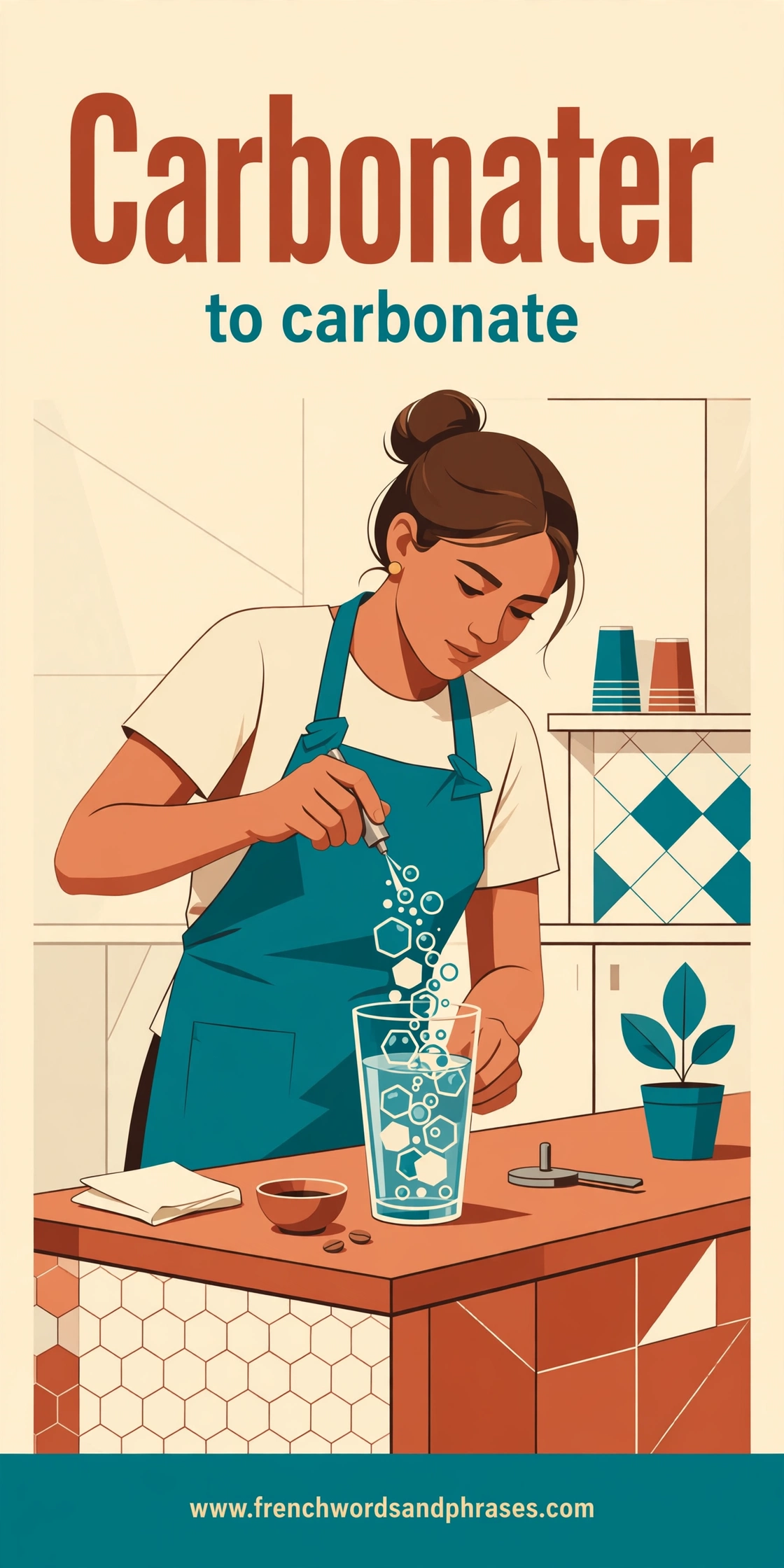
Carbonater means to carbonate — to charge a drink or a liquid with carbon dioxide, the gas that arrives as bubbles and leaves as sparkle.
A steel tank in a drinks factory, a clear liquid, and a hiss of gas forced in under pressure until the liquid itself fizzes — carbonater is the technical verb behind every sparkling drink: to load a liquid with carbon dioxide.
In this guide, you’ll learn how to conjugate carbonater in all the major French tenses and moods. Explore complete conjugation tables, French examples, English translations, and practice quizzes.
Understanding the French Verb Carbonater
Carbonater is a regular French verb belonging to the first group of verbs, those ending in-er.
It means to carbonate. You will meet it mostly in the drinks industry and in chemistry: factories carbonatent water, beer and soft drinks, and chemists use it for solutions absorbing carbon dioxide. In everyday speech French more often says gazéifier or simply describes the result — une eau gazeuse, une boisson pétillante.
Verb classification: First group (-er)
Auxiliary verb: Avoir
Past participle: carbonaté
Present participle: carbonatant
English equivalents: To carbonate; carbonater une boisson — to carbonate a drink; carbonater l’eau — to carbonate water; une boisson carbonatée — a carbonated drink; carbonater sous pression — to carbonate under pressure.
One important detail: carbonater is a modern technical verb built on le carbone and le gaz carbonique (carbon dioxide), and it conjugates without any surprise: je carbonate, nous carbonatons, ils carbonatent, past participle carbonaté. Do not confuse it with carboniser, to char — carbonater adds gas, carboniser adds fire.
Experience the Word
Carbonater is the hiss inside the bottle — gas persuaded, under pressure, to live inside a liquid.
Imagine the bottling line at a lemonade factory. Clear, flat lemonade runs into the tank; valves open, le gaz carbonique s’y dissout sous pression — on carbonate la limonade, and a second later the bottles sing with bubbles.
Still water went in; sparkling lemonade came out. The difference is one verb — carbonater.
How to Conjugate Carbonater: Complete French Conjugation Guide
Let’s explore every major conjugation of carbonater, beginning with the indicative mood.
How to Conjugate Carbonater in the Indicative Mood
The indicative mood is used to express facts, observations, actions, and events.
How to Conjugate Carbonater in the Present Tense (Présent)
Used for actions happening now, habitual actions, and general truths.
| Subject | Conjugation |
|---|---|
| je | carbonate |
| tu | carbonates |
| il / elle | carbonate |
| nous | carbonatons |
| vous | carbonatez |
| ils / elles | carbonatent |
Example
L’usine carbonate l’eau avant la mise en bouteille.
The factory carbonates the water before bottling.
Quick Quiz 1
Complete the sentence:
Nous ______ la limonade avant de la mettre en bouteille.
Reveal the answer
carbonatons
Nous carbonatons la limonade avant de la mettre en bouteille.
We carbonate the lemonade before bottling it.
How to Conjugate Carbonater in the Passé Composé
Used for completed actions in the past. Carbonater takes the auxiliary verb avoir.
| Subject | Conjugation |
|---|---|
| j’ | ai carbonaté |
| tu | as carbonaté |
| il / elle | a carbonaté |
| nous | avons carbonaté |
| vous | avez carbonaté |
| ils / elles | ont carbonaté |
Example
Ils ont carbonaté la limonade sous pression.
They carbonated the lemonade under pressure.
How to Conjugate Carbonater in the Imparfait (Imperfect Tense)
Used for habitual past actions, descriptions, and ongoing situations in the past.
| Subject | Conjugation |
|---|---|
| je | carbonatais |
| tu | carbonatais |
| il / elle | carbonatait |
| nous | carbonations |
| vous | carbonatiez |
| ils / elles | carbonataient |
Example
Autrefois, on carbonatait les boissons à la main.
In the old days, drinks were carbonated by hand.
Quick Quiz 2
Choose the correct form:
They have carbonated the beer.
Ils ______ la bière. (ont carbonaté / ont carbonater)
Reveal the answer
ont carbonaté
Ils ont carbonaté la bière.
The past participle of an -er verb ends in -é.
How to Conjugate Carbonater in the Plus-que-parfait
Used to describe an action that had already been completed before another past event.
| Subject | Conjugation |
|---|---|
| j’ | avais carbonaté |
| tu | avais carbonaté |
| il / elle | avait carbonaté |
| nous | avions carbonaté |
| vous | aviez carbonaté |
| ils / elles | avaient carbonaté |
Example
Le brasseur avait carbonaté la bière dans la cuve.
The brewer had carbonated the beer in the vat.
How to Conjugate Carbonater in the Passé Simple
Primarily used in formal writing, literature, and historical narratives. It is rarely used in everyday conversation.
| Subject | Conjugation |
|---|---|
| je | carbonatai |
| tu | carbonatas |
| il / elle | carbonata |
| nous | carbonatâmes |
| vous | carbonatâtes |
| ils / elles | carbonatèrent |
Example
La machine carbonata le liquide en quelques secondes.
The machine carbonated the liquid in a few seconds.
How to Conjugate Carbonater in the Passé Antérieur
A literary tense used to express an action completed immediately before another past action, generally in the passé simple.
| Subject | Conjugation |
|---|---|
| j’ | eus carbonaté |
| tu | eus carbonaté |
| il / elle | eut carbonaté |
| nous | eûmes carbonaté |
| vous | eûtes carbonaté |
| ils / elles | eurent carbonaté |
Example
Quand l’ouvrier eut carbonaté toute la cuvée, on ferma les bouteilles.
When the worker had carbonated the whole batch, the bottles were sealed.
How to Conjugate Carbonater in the Future Tense (Futur Simple)
Used to describe actions that will take place in the future.
| Subject | Conjugation |
|---|---|
| je | carbonaterai |
| tu | carbonateras |
| il / elle | carbonatera |
| nous | carbonaterons |
| vous | carbonaterez |
| ils / elles | carbonateront |
Example
Demain, nous carbonaterons une nouvelle série de boissons.
Tomorrow, we will carbonate a new series of drinks.
How to Conjugate Carbonater in the Futur Antérieur (Future Perfect)
Used for an action that will have been completed before a particular point in the future.
| Subject | Conjugation |
|---|---|
| j’ | aurai carbonaté |
| tu | auras carbonaté |
| il / elle | aura carbonaté |
| nous | aurons carbonaté |
| vous | aurez carbonaté |
| ils / elles | auront carbonaté |
Example
À midi, l’équipe aura carbonaté toutes les cuves.
By noon, the team will have carbonated all the vats.
How to Conjugate Carbonater in the Near Future (Futur Proche)
Used to describe something that is going to happen soon. Formed with aller + infinitive.
| Subject | Conjugation |
|---|---|
| je | vais carbonater |
| tu | vas carbonater |
| il / elle | va carbonater |
| nous | allons carbonater |
| vous | allez carbonater |
| ils / elles | vont carbonater |
Example
Cette machine va carbonater l’eau automatiquement.
This machine is going to carbonate the water automatically.
How to Conjugate Carbonater in the Conditional Mood
The conditional mood expresses what would happen under certain circumstances. It is also frequently used to make polite requests or express wishes.
How to Conjugate Carbonater in the Present Conditional
| Subject | Conjugation |
|---|---|
| je | carbonaterais |
| tu | carbonaterais |
| il / elle | carbonaterait |
| nous | carbonaterions |
| vous | carbonateriez |
| ils / elles | carbonateraient |
Example
Avec plus de pression, on carbonaterait davantage la boisson.
With more pressure, the drink would be carbonated more.
How to Conjugate Carbonater in the Past Conditional
| Subject | Conjugation |
|---|---|
| j’ | aurais carbonaté |
| tu | aurais carbonaté |
| il / elle | aurait carbonaté |
| nous | aurions carbonaté |
| vous | auriez carbonaté |
| ils / elles | auraient carbonaté |
Example
Sans la machine, ils n’auraient pas carbonaté la limonade.
Without the machine, they would not have carbonated the lemonade.
Carbonater in the Literary Past Conditional Form
This less common literary form uses the imperfect subjunctive of avoir.
| Subject | Conjugation |
|---|---|
| j’ | eusse carbonaté |
| tu | eusses carbonaté |
| il / elle | eût carbonaté |
| nous | eussions carbonaté |
| vous | eussiez carbonaté |
| ils / elles | eussent carbonaté |
Example
Le gaz eût carbonaté l’eau plus vite sous pression.
The gas would have carbonated the water faster under pressure.
How to Conjugate Carbonater in the Subjunctive Mood
The subjunctive is used to express wishes, emotions, doubts, necessity, and uncertainty. It frequently follows expressions such as il faut que (it is necessary that) or bien que (although).
How to Conjugate Carbonater in the Present Subjunctive
| Subject | Conjugation |
|---|---|
| que je | carbonate |
| que tu | carbonates |
| qu’il / qu’elle | carbonate |
| que nous | carbonations |
| que vous | carbonatiez |
| qu’ils / qu’elles | carbonatent |
Example
Il faut que l’on carbonate la boisson avant l’embouteillage.
The drink must be carbonated before bottling.
Quick Quiz 3
Complete the sentence using the subjunctive:
Il faut que vous ______ l’eau avant midi.
Reveal the answer
carbonatiez
Il faut que vous carbonatiez l’eau avant midi.
You must carbonate the water before noon.
How to Conjugate Carbonater in the Imperfect Subjunctive
A literary tense, rarely encountered in modern spoken French.
| Subject | Conjugation |
|---|---|
| que je | carbonatasse |
| que tu | carbonatasses |
| qu’il / qu’elle | carbonatât |
| que nous | carbonatassions |
| que vous | carbonatassiez |
| qu’ils / qu’elles | carbonatassent |
Example
Le procédé exigeait qu’on carbonatât le liquide lentement.
The process required the liquid to be carbonated slowly.
How to Conjugate Carbonater in the Pluperfect Subjunctive
A literary construction used to express an action completed before another past action.
| Subject | Conjugation |
|---|---|
| que j’ | eusse carbonaté |
| que tu | eusses carbonaté |
| qu’il / qu’elle | eût carbonaté |
| que nous | eussions carbonaté |
| que vous | eussiez carbonaté |
| qu’ils / qu’elles | eussent carbonaté |
Example
On doutait que l’usine eût carbonaté la cuvée à temps.
People doubted the factory had carbonated the batch in time.
How to Conjugate Carbonater in the Past Subjunctive
| Subject | Conjugation |
|---|---|
| que j’ | aie carbonaté |
| que tu | aies carbonaté |
| qu’il / qu’elle | ait carbonaté |
| que nous | ayons carbonaté |
| que vous | ayez carbonaté |
| qu’ils / qu’elles | aient carbonaté |
Example
Je suis content qu’ils aient carbonaté l’eau correctement.
I am glad they carbonated the water properly.
How to Conjugate Carbonater in the Imperative
The imperative is used to give commands, instructions, invitations, or suggestions. Subject pronouns are omitted.
How to Conjugate Carbonater in the Present Imperative
| Person | Conjugation |
|---|---|
| (tu) | carbonate |
| (nous) | carbonatons |
| (vous) | carbonatez |
Example
Carbonatez l’eau, puis fermez les bouteilles aussitôt !
Carbonate the water, then seal the bottles at once!
Quick Quiz 4
How would you say Carbonate the water (tu form)?
Reveal the answer
Carbonate l’eau !
French Participles of Carbonater
Participles are verb forms that can be used in compound tenses and other grammatical constructions.
Present Participle of Carbonater
carbonatant
En carbonatant la bière, le brasseur contrôle sa mousse.
By carbonating the beer, the brewer controls its head.
Past Participle of Carbonater
carbonaté
Carbonatée sous pression, l’eau devient pétillante.
Carbonated under pressure, the water becomes sparkling.
Carbonater in Everyday French: Real-Life Examples
Now that you know the conjugations, let’s see how carbonater appears in everyday French.
Example 1 — Present
L’usine carbonate l’eau avant l’embouteillage.
The factory carbonates the water before bottling.
Example 2 — Passé composé
Ils ont carbonaté la limonade sous pression.
They carbonated the lemonade under pressure.
Example 3 — Imparfait
On carbonatait les boissons à la main autrefois.
Drinks used to be carbonated by hand.
Example 4 — Future
Nous carbonaterons une nouvelle cuvée demain.
We will carbonate a new batch tomorrow.
Example 5 — Conditional
Avec plus de pression, on carbonaterait mieux.
With more pressure, it would carbonate better.
Example 6 — Imperative
Carbonate l’eau, puis ferme les bouteilles !
Carbonate the water, then seal the bottles!
Beyond Translation: The Meaning of Carbonater
English carbonate and French carbonater are laboratory twins, both built on Latin carbo, charcoal — the element carbon hides in both the coal and the gas.
The image is gas dissolving under pressure.
Carbonater is the precise, technical word; the café customer asks for une eau gazeuse, but the factory that made it pétillante carbonatait l’eau long before it reached the table.
How to Remember the French Verb Carbonater
Remember it this way: Carbonater is about the hiss of gas forced into lemonade at the factory.
- Carbonater = to add the gas (bubbles in); carboniser = to add the fire (charring) — keep the twins apart.
- Perfectly regular -er: je carbonate, nous carbonatons, past participle carbonaté.
- Mostly technical: factories and chemists carbonatent; customers just order une boisson gazeuse.
The key idea is the hiss of gas forced into lemonade at the factory.
Test Your Knowledge of Carbonater
Let’s see how much you’ve learned. Try answering these questions before revealing the answers.
Question 1
What does carbonater add to a liquid?
Reveal the answer
Carbon dioxide — le gaz carbonique, dissolved under pressure to make it sparkle.
Question 2
How do you say The factory carbonates the water in French?
Reveal the answer
L’usine carbonate l’eau.
Question 3
Translate: They carbonated the lemonade under pressure.
Reveal the answer
Ils ont carbonaté la limonade sous pression.
Question 4
What is the past participle of carbonater?
Reveal the answer
Carbonaté — a regular -er participle.
Question 5
Complete the sentence:
Il faut que l’on ______ la boisson avant l’embouteillage.
Reveal the answer
carbonate
Il faut que l’on carbonate la boisson avant l’embouteillage.
The drink must be carbonated before bottling.
Your Final Challenge
Can You Use It?
How would you say this in French?
Under pressure, the gas carbonated the clear water, and the first bottle sparkled like a miniature firework.
Reveal the answer
Sous pression, le gaz carbonata l’eau claire, et la première bouteille pétailla comme un feu d’artifice miniature.
Under pressure, the gas carbonated the clear water, and the first bottle sparkled like a miniature firework.
A little French. A little curiosity. A richer everyday life.
LEARN FRENCH ONE WORD AT A TIME