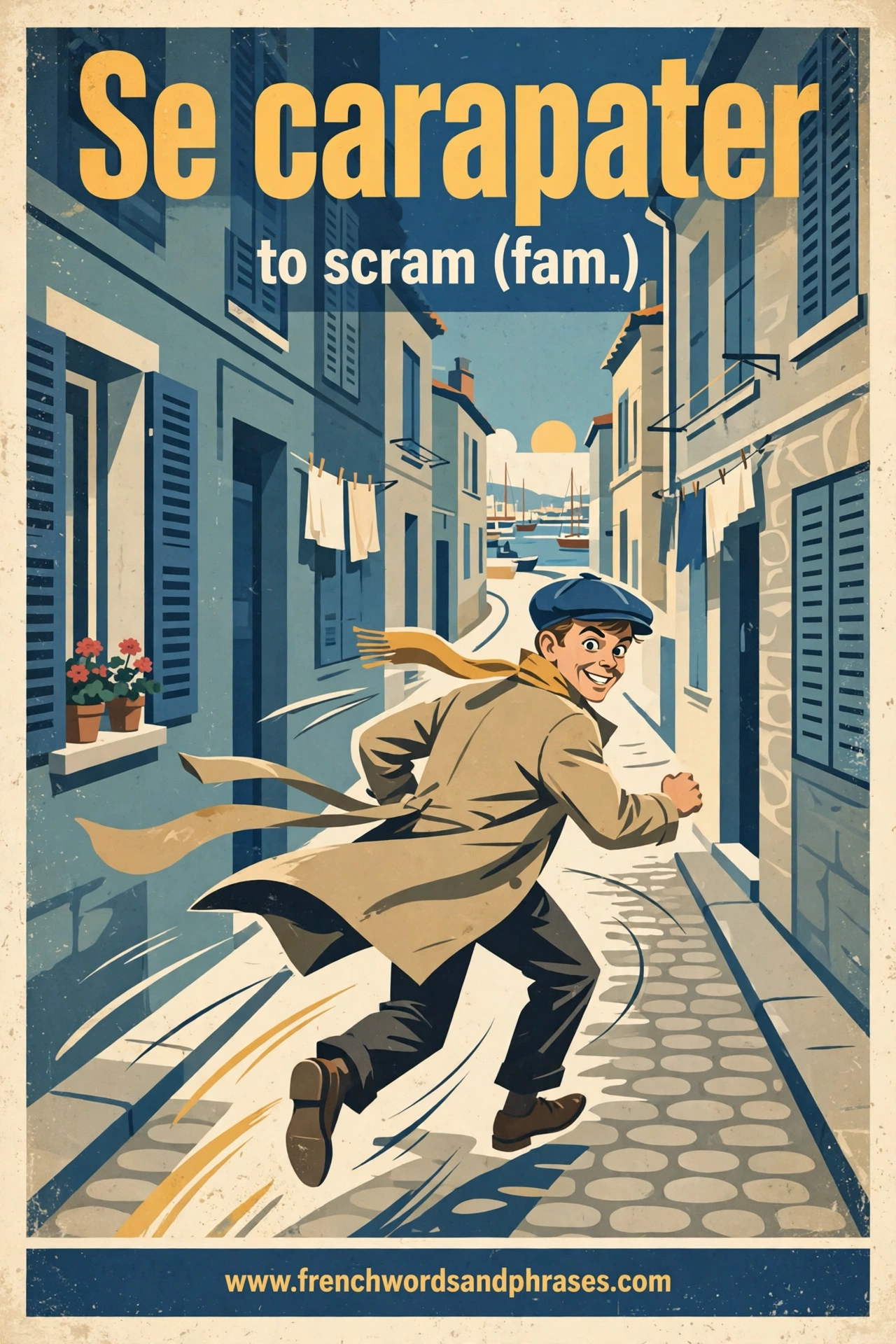
A French Word to Live By
How to Conjugate Se carapater in French
/sə ka.ʁa.pa.te/
Se carapater means to bolt, to scram — to make yourself scarce at high speed the moment trouble, work or the bill appears on the horizon (familiar).
The bell rings and the schoolboy is already over the fence; the waiter approaches with the bill and the table is mysteriously empty — se carapater is the cheerful, familiar verb of the quick getaway: to bolt, to scram, to vanish before anyone can stop you.
In this guide, you’ll learn how to conjugate se carapater in all the major French tenses and moods. Explore complete conjugation tables, French examples, English translations, and practice quizzes.
Understanding the French Verb Se carapater
Se carapater is a regular French verb belonging to the first group of verbs, those ending in-er.
It means to bolt, to scram (fam.). It always carries a smile: the person who se carapate is escaping something tedious, embarrassing or mildly dangerous — chores, questions, the bill, a boring guest — rather than fleeing real peril. Expect it in speech, comics and dialogue, often with en douce (quietly) or à toutes jambes (at full speed).
Verb classification: First group (-er), reflexive
Auxiliary verb: Être
Past participle: carapaté
Present participle: carapatant
English equivalents: To bolt, to scram, to make oneself scarce (fam.); se carapater en douce — to slip away quietly; se carapater dès que… — to bolt as soon as…; il s’est carapaté par la fenêtre — he scarpered out of the window; allez, on se carapate ! — come on, let’s scram!
One important detail: se carapater is familier — informal, playful French, the word of playgrounds and comedies, not of formal writing; in neutral French say s’enfuir or partir en vitesse. It exists only in the reflexive: there is no plain carapater. Being reflexive, it takes être in every compound tense and the past participle agrees with the subject: elle s’est carapatée, ils se sont carapatés. Underneath, the conjugation is a perfectly regular -er: je me carapate, nous nous carapatons.
Experience the Word
Se carapater is the verb of the strategic disappearance — gone before the trouble has even finished arriving.
Imagine the family lunch dragging into its fourth hour, and uncle Bernard reaching for the photo albums. Catching your eye, your cousin mouths one word — on se carapate ? — and by the time the albums open, vous vous êtes carapatés tous les deux, over the garden wall and free.
No farewells, no excuses. You have simply bolted — carapatés, in the friendliest sense of the word.
How to Conjugate Se carapater: Complete French Conjugation Guide
Let’s explore every major conjugation of se carapater, beginning with the indicative mood.
How to Conjugate Se carapater in the Indicative Mood
The indicative mood is used to express facts, observations, actions, and events.
How to Conjugate Se carapater in the Present Tense (Présent)
Used for actions happening now, habitual actions, and general truths.
| Subject | Conjugation |
|---|---|
| je | me carapate |
| tu | te carapates |
| il / elle | se carapate |
| nous | nous carapatons |
| vous | vous carapatez |
| ils / elles | se carapatent |
Example
Dès que la cloche sonne, les élèves se carapatent.
As soon as the bell rings, the pupils scram.
Quick Quiz 1
Complete the sentence:
Nous ______ dès que le surveillant tourne le dos.
Reveal the answer
nous carapatons
Nous nous carapatons dès que le surveillant tourne le dos.
We scram as soon as the supervisor turns his back.
How to Conjugate Se carapater in the Passé Composé
Used for completed actions in the past. Se carapater takes the auxiliary verb être.
| Subject | Conjugation |
|---|---|
| je | me suis carapaté / me suis carapatée |
| tu | t’es carapaté / t’es carapatée |
| il / elle | s’est carapaté / s’est carapatée |
| nous | nous sommes carapatés / nous sommes carapatées |
| vous | vous êtes carapatés / vous êtes carapatées / vous êtes carapaté / vous êtes carapatée |
| ils / elles | se sont carapatés / se sont carapatées |
Example
Il s’est carapaté avant l’arrivée du directeur.
He bolted before the headmaster arrived.
How to Conjugate Se carapater in the Imparfait (Imperfect Tense)
Used for habitual past actions, descriptions, and ongoing situations in the past.
| Subject | Conjugation |
|---|---|
| je | me carapatais |
| tu | te carapatais |
| il / elle | se carapatait |
| nous | nous carapations |
| vous | vous carapatiez |
| ils / elles | se carapataient |
Example
À la moindre corvée, il se carapatait en douce.
At the slightest chore, he would quietly slip away.
Quick Quiz 2
Choose the correct form:
She slipped away through the window.
Elle ______ par la fenêtre. (s’est carapatée / a carapaté)
Reveal the answer
s’est carapatée
Elle s’est carapatée par la fenêtre.
Reflexive verb: être, and the participle agrees.
How to Conjugate Se carapater in the Plus-que-parfait
Used to describe an action that had already been completed before another past event.
| Subject | Conjugation |
|---|---|
| je | m’étais carapaté / m’étais carapatée |
| tu | t’étais carapaté / t’étais carapatée |
| il / elle | s’était carapaté / s’était carapatée |
| nous | nous étions carapatés / nous étions carapatées |
| vous | vous étiez carapatés / vous étiez carapatées / vous étiez carapaté / vous étiez carapatée |
| ils / elles | s’étaient carapatés / s’étaient carapatées |
Example
Elle s’était carapatée par la fenêtre de la cuisine.
She had scarpered through the kitchen window.
How to Conjugate Se carapater in the Passé Simple
Primarily used in formal writing, literature, and historical narratives. It is rarely used in everyday conversation.
| Subject | Conjugation |
|---|---|
| je | me carapatai |
| tu | te carapatas |
| il / elle | se carapata |
| nous | nous carapatâmes |
| vous | vous carapatâtes |
| ils / elles | se carapatèrent |
Example
Voyant le chien du voisin, le chat se carapata sur le toit.
Seeing the neighbour’s dog, the cat bolted onto the roof.
How to Conjugate Se carapater in the Passé Antérieur
A literary tense used to express an action completed immediately before another past action, generally in the passé simple.
| Subject | Conjugation |
|---|---|
| je | me fus carapaté / me fus carapatée |
| tu | te fus carapaté / te fus carapatée |
| il / elle | se fut carapaté / se fut carapatée |
| nous | nous fûmes carapatés / nous fûmes carapatées |
| vous | vous fûtes carapatés / vous fûtes carapatées / vous fûtes carapaté / vous fûtes carapatée |
| ils / elles | se furent carapatés / se furent carapatées |
Example
Dès qu’ils se furent carapatés, la cour resta silencieuse.
As soon as they had scarpered, the yard fell silent.
How to Conjugate Se carapater in the Future Tense (Futur Simple)
Used to describe actions that will take place in the future.
| Subject | Conjugation |
|---|---|
| je | me carapaterai |
| tu | te carapateras |
| il / elle | se carapatera |
| nous | nous carapaterons |
| vous | vous carapaterez |
| ils / elles | se carapateront |
Example
Si le prof revient, on se carapatera par la porte de derrière.
If the teacher comes back, we will scram through the back door.
How to Conjugate Se carapater in the Futur Antérieur (Future Perfect)
Used for an action that will have been completed before a particular point in the future.
| Subject | Conjugation |
|---|---|
| je | me serai carapaté / me serai carapatée |
| tu | te seras carapaté / te seras carapatée |
| il / elle | se sera carapaté / se sera carapatée |
| nous | nous serons carapatés / nous serons carapatées |
| vous | vous serez carapatés / vous serez carapatées / vous serez carapaté / vous serez carapatée |
| ils / elles | se seront carapatés / se seront carapatées |
Example
À la fin du film, les enfants se seront carapatés depuis longtemps.
By the end of the film, the children will have bolted long ago.
How to Conjugate Se carapater in the Near Future (Futur Proche)
Used to describe something that is going to happen soon. Formed with aller + infinitive.
| Subject | Conjugation |
|---|---|
| je | vais me carapater |
| tu | vas te carapater |
| il / elle | va se carapater |
| nous | allons nous carapater |
| vous | allez vous carapater |
| ils / elles | vont se carapater |
Example
Chut, le surveillant arrive, on va se carapater !
Quiet, the supervisor is coming, we are going to scram!
How to Conjugate Se carapater in the Conditional Mood
The conditional mood expresses what would happen under certain circumstances. It is also frequently used to make polite requests or express wishes.
How to Conjugate Se carapater in the Present Conditional
| Subject | Conjugation |
|---|---|
| je | me carapaterais |
| tu | te carapaterais |
| il / elle | se carapaterait |
| nous | nous carapaterions |
| vous | vous carapateriez |
| ils / elles | se carapateraient |
Example
Sans la clôture, le lapin se carapaterait dans le jardin voisin.
Without the fence, the rabbit would bolt into the neighbour’s garden.
How to Conjugate Se carapater in the Past Conditional
| Subject | Conjugation |
|---|---|
| je | me serais carapaté / me serais carapatée |
| tu | te serais carapaté / te serais carapatée |
| il / elle | se serait carapaté / se serait carapatée |
| nous | nous serions carapatés / nous serions carapatées |
| vous | vous seriez carapatés / vous seriez carapatées / vous seriez carapaté / vous seriez carapatée |
| ils / elles | se seraient carapatés / se seraient carapatées |
Example
Elle se serait carapatée si elle avait vu la facture.
She would have scarpered if she had seen the bill.
Se carapater in the Literary Past Conditional Form
This less common literary form uses the imperfect subjunctive of être.
| Subject | Conjugation |
|---|---|
| je | me fusse carapaté / me fusse carapatée |
| tu | te fusses carapaté / te fusses carapatée |
| il / elle | se fût carapaté / se fût carapatée |
| nous | nous fussions carapatés / nous fussions carapatées |
| vous | vous fussiez carapatés / vous fussiez carapatées / vous fussiez carapaté / vous fussiez carapatée |
| ils / elles | se fussent carapatés / se fussent carapatées |
Example
Le chat se fût carapaté par la gouttière sans ce bruit.
The cat would have bolted up the drainpipe without that noise.
How to Conjugate Se carapater in the Subjunctive Mood
The subjunctive is used to express wishes, emotions, doubts, necessity, and uncertainty. It frequently follows expressions such as il faut que (it is necessary that) or bien que (although).
How to Conjugate Se carapater in the Present Subjunctive
| Subject | Conjugation |
|---|---|
| que je | me carapate |
| que tu | te carapates |
| qu’il / qu’elle | se carapate |
| que nous | nous carapations |
| que vous | vous carapatiez |
| qu’ils / qu’elles | se carapatent |
Example
Il est temps que vous vous carapatiez avant la pluie.
It is time you scarpered before the rain.
Quick Quiz 3
Complete the sentence using the subjunctive:
Il est temps que les enfants ______ avant la pluie.
Reveal the answer
se carapatent
Il est temps que les enfants se carapatent avant la pluie.
It is time the children scarpered before the rain.
How to Conjugate Se carapater in the Imperfect Subjunctive
A literary tense, rarely encountered in modern spoken French.
| Subject | Conjugation |
|---|---|
| que je | me carapatasse |
| que tu | te carapatasses |
| qu’il / qu’elle | se carapatât |
| que nous | nous carapatassions |
| que vous | vous carapatassiez |
| qu’ils / qu’elles | se carapatassent |
Example
Il ferma la porte comme s’il craignait que le chat se carapatât.
He shut the door as if he feared the cat might bolt.
How to Conjugate Se carapater in the Pluperfect Subjunctive
A literary construction used to express an action completed before another past action.
| Subject | Conjugation |
|---|---|
| que je | me fusse carapaté / me fusse carapatée |
| que tu | te fusses carapaté / te fusses carapatée |
| qu’il / qu’elle | se fût carapaté / se fût carapatée |
| que nous | nous fussions carapatés / nous fussions carapatées |
| que vous | vous fussiez carapatés / vous fussiez carapatées / vous fussiez carapaté / vous fussiez carapatée |
| qu’ils / qu’elles | se fussent carapatés / se fussent carapatées |
Example
On racontait qu’ils se fussent carapatés avant minuit.
People said they had scarpered before midnight.
How to Conjugate Se carapater in the Past Subjunctive
| Subject | Conjugation |
|---|---|
| que je | me sois carapaté / me sois carapatée |
| que tu | te sois carapaté / te sois carapatée |
| qu’il / qu’elle | se soit carapaté / se soit carapatée |
| que nous | nous soyons carapatés / nous soyons carapatées |
| que vous | vous soyez carapatés / vous soyez carapatées / vous soyez carapaté / vous soyez carapatée |
| qu’ils / qu’elles | se soient carapatés / se soient carapatées |
Example
Je suis sûr qu’il se soit carapaté dès la première question.
I am sure he bolted at the very first question.
How to Conjugate Se carapater in the Imperative
The imperative is used to give commands, instructions, invitations, or suggestions. Subject pronouns are omitted.
How to Conjugate Se carapater in the Present Imperative
| Person | Conjugation |
|---|---|
| (tu) | carapate-toi |
| (nous) | carapatons-nous |
| (vous) | carapatez-vous |
Example
Carapate-toi, le directeur arrive !
Scram, the headmaster is coming!
Quick Quiz 4
How would you say Scram, the boss is coming (tu form)?
Reveal the answer
Carapate-toi, le chef arrive !
French Participles of Se carapater
Participles are verb forms that can be used in compound tenses and other grammatical constructions.
Present Participle of Se carapater
carapatant
En se carapatant, il a renversé la chaise.
In bolting, he knocked over the chair.
Past Participle of Se carapater
carapaté
Carapaté dès la sonnerie, l’élève échappa à la corvée.
Having scarpered at the bell, the pupil escaped the chore.
Se carapater in Everyday French: Real-Life Examples
Now that you know the conjugations, let’s see how se carapater appears in everyday French.
Example 1 — Present
Dès la sonnerie, les élèves se carapatent.
As soon as the bell rings, the pupils scram.
Example 2 — Passé composé
Il s’est carapaté par la fenêtre.
He bolted through the window.
Example 3 — Imparfait
À la moindre corvée, elle se carapatait.
At the slightest chore, she would slip away.
Example 4 — Future
On se carapatera avant l’arrivée du chef.
We will scram before the boss arrives.
Example 5 — Conditional
Sans la clôture, le lapin se carapaterait.
Without the fence, the rabbit would bolt.
Example 6 — Imperative
Carapatez-vous, les enfants, voilà la pluie !
Scram, children, here comes the rain!
Beyond Translation: The Meaning of Se carapater
Nobody is quite sure where se carapater comes from — it surfaces in nineteenth-century slang, perhaps from the image of the tortoise (Spanish carapacho, a shell) pulling in its head and legs to disappear.
The image is a vanishing act.
Whatever its origin, modern French hears it as pure comedy: se carapater is never the escape of a tragedy, always the getaway of a schoolboy, a cat or a guest dodging the photo albums.
How to Remember the French Verb Se carapater
Remember it this way: Se carapater is about the schoolboy over the fence before the bell has finished.
- Familiar register: playgrounds and comedies — in neutral French, say s’enfuir or partir vite.
- Reflexive only, with être: elle s’est carapatée, ils se sont carapatés.
- Regular -er underneath: je me carapate, nous nous carapatons — the only trick is remembering the pronoun.
The key idea is the schoolboy over the fence before the bell has finished.
Test Your Knowledge of Se carapater
Let’s see how much you’ve learned. Try answering these questions before revealing the answers.
Question 1
What register is se carapater, and what is the neutral equivalent?
Reveal the answer
Familier — informal and playful; neutral French says s’enfuir or partir en vitesse.
Question 2
How do you say He bolted through the window in French?
Reveal the answer
Il s’est carapaté par la fenêtre.
Question 3
Translate: As soon as the bell rings, the pupils scram.
Reveal the answer
Dès que la cloche sonne, les élèves se carapatent.
Question 4
Which auxiliary does se carapater use?
Reveal the answer
Être — it is reflexive: elles se sont carapatées.
Question 5
Complete the sentence:
Il est temps que tu ______ avant l’arrivée du chef.
Reveal the answer
te carapates
Il est temps que tu te carapates avant l’arrivée du chef.
It is time you scarpered before the boss arrives.
Your Final Challenge
Can You Use It?
How would you say this in French?
Hardly had the bell rung than the pupils scattered and bolted like a flight of sparrows.
Reveal the answer
À peine la sonnerie eut-elle retenti que les élèves se carapatèrent comme une volée de moineaux.
Hardly had the bell rung than the pupils scattered and bolted like a flight of sparrows.
A little French. A little curiosity. A richer everyday life.
LEARN FRENCH ONE WORD AT A TIME