
A French Word to Live By
How to Conjugate Caponner in French
/ka.pɔ.ne/
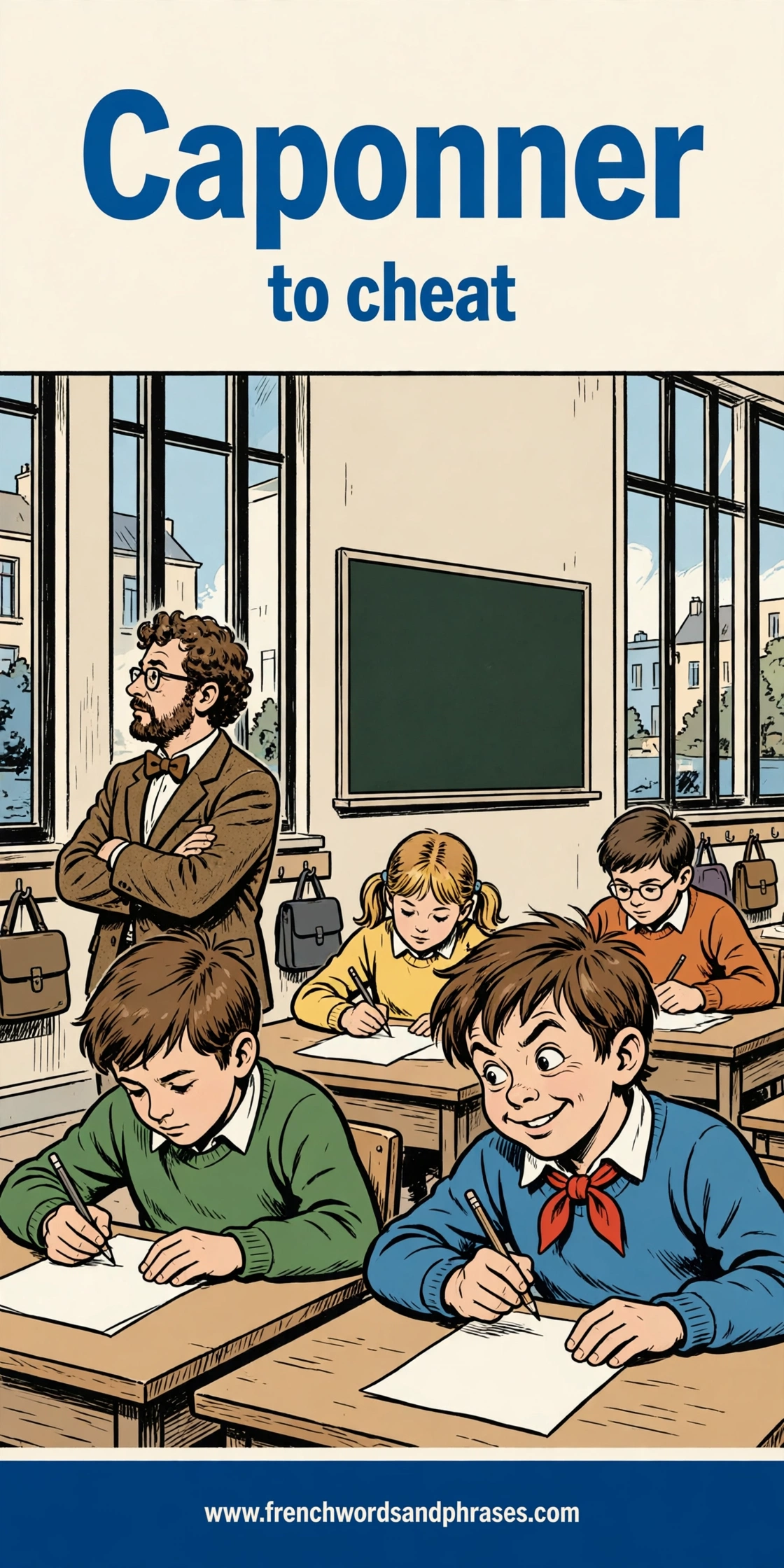
Caponner means to funk, to cheat — an old, familiar word for shirking out of cowardice and for sly, underhand cheating, from the schoolyard to the card table.
A schoolboy who vanishes when the fight starts, a card player with something up his sleeve — caponner is the old slang of the funk and the cheat: the one who will not face things squarely and wins, when he wins, crookedly.
In this guide, you’ll learn how to conjugate caponner in all the major French tenses and moods. Explore complete conjugation tables, French examples, English translations, and practice quizzes.
Understanding the French Verb Caponner
Caponner is a regular French verb belonging to the first group of verbs, those ending in-er.
It means to funk, to cheat. It carries both of the capon’s sins at once: cowardice (funking a challenge, slipping away from danger) and dishonesty (cheating at cards or in class). The tone is contemptuous but a little old-fashioned — calling someone un capon today sounds like a grandfather scolding.
Verb classification: First group (-er)
Auxiliary verb: Avoir
Past participle: caponné
Present participle: caponnant
English equivalents: To funk, to chicken out, to cheat (familiar); caponner au moment d’agir — to funk it at the moment of action; caponner aux cartes — to cheat at cards; caponner à l’école — to shirk and cheat at school; un élève qui caponne — a pupil who funks and cheats.
One important detail: caponner is built on le capon, the old word for a coward and a sneak — a capon in the chicken-yard sense, and in school slang the boy who tells tales and cheats. The verb is familier and somewhat dated: you will meet it in older novels and school stories rather than in today’s playground, where tricher and se dégonfler rule. Its conjugation is perfectly regular: je caponne, nous caponnons, ils caponnent, past participle caponné.
Experience the Word
Caponner is the verb of the shrinking cheat — too cowardly for the fair fight, too sly for the fair game.
Imagine a village school in 1920. When the big boys challenge the class to a snowball battle, Petit Louis slips home by the back lane — et aux examens, il caponne, copying from his neighbour with one eye on the master.
He never fights and never plays fair. He funks and cheats — il caponne, in the schoolyard’s oldest insult.
How to Conjugate Caponner: Complete French Conjugation Guide
Let’s explore every major conjugation of caponner, beginning with the indicative mood.
How to Conjugate Caponner in the Indicative Mood
The indicative mood is used to express facts, observations, actions, and events.
How to Conjugate Caponner in the Present Tense (Présent)
Used for actions happening now, habitual actions, and general truths.
| Subject | Conjugation |
|---|---|
| je | caponne |
| tu | caponnes |
| il / elle | caponne |
| nous | caponnons |
| vous | caponnez |
| ils / elles | caponnent |
Example
Il caponne dès que la situation devient dangereuse.
He funks it as soon as the situation turns dangerous.
Quick Quiz 1
Complete the sentence:
Nous ne ______ jamais, nous jouons honnêtement.
Reveal the answer
caponnons
Nous ne caponnons jamais, nous jouons honnêtement.
We never cheat, we play honestly.
How to Conjugate Caponner in the Passé Composé
Used for completed actions in the past. Caponner takes the auxiliary verb avoir.
| Subject | Conjugation |
|---|---|
| j’ | ai caponné |
| tu | as caponné |
| il / elle | a caponné |
| nous | avons caponné |
| vous | avez caponné |
| ils / elles | ont caponné |
Example
Tu as caponné aux cartes, tout le monde l’a vu.
You cheated at cards, everyone saw it.
How to Conjugate Caponner in the Imparfait (Imperfect Tense)
Used for habitual past actions, descriptions, and ongoing situations in the past.
| Subject | Conjugation |
|---|---|
| je | caponnais |
| tu | caponnais |
| il / elle | caponnait |
| nous | caponnions |
| vous | caponniez |
| ils / elles | caponnaient |
Example
À l’école, il caponnait toujours pendant les contrôles.
At school, he always used to cheat during tests.
Quick Quiz 2
Choose the correct form:
You cheated at cards.
Tu ______ aux cartes. (as caponné / es caponné)
Reveal the answer
as caponné
Tu as caponné aux cartes.
Caponner takes avoir.
How to Conjugate Caponner in the Plus-que-parfait
Used to describe an action that had already been completed before another past event.
| Subject | Conjugation |
|---|---|
| j’ | avais caponné |
| tu | avais caponné |
| il / elle | avait caponné |
| nous | avions caponné |
| vous | aviez caponné |
| ils / elles | avaient caponné |
Example
Il avait caponné si souvent que personne ne lui faisait confiance.
He had cheated so often that nobody trusted him.
How to Conjugate Caponner in the Passé Simple
Primarily used in formal writing, literature, and historical narratives. It is rarely used in everyday conversation.
| Subject | Conjugation |
|---|---|
| je | caponnai |
| tu | caponnas |
| il / elle | caponna |
| nous | caponnâmes |
| vous | caponnâtes |
| ils / elles | caponnèrent |
Example
Devant le danger, le soldat caponna et s’enfuit.
Faced with danger, the soldier funked it and fled.
How to Conjugate Caponner in the Passé Antérieur
A literary tense used to express an action completed immediately before another past action, generally in the passé simple.
| Subject | Conjugation |
|---|---|
| j’ | eus caponné |
| tu | eus caponné |
| il / elle | eut caponné |
| nous | eûmes caponné |
| vous | eûtes caponné |
| ils / elles | eurent caponné |
Example
Quand il eut caponné une fois de trop, ses camarades le rejetèrent.
When he had cheated once too often, his comrades cast him out.
How to Conjugate Caponner in the Future Tense (Futur Simple)
Used to describe actions that will take place in the future.
| Subject | Conjugation |
|---|---|
| je | caponnerai |
| tu | caponneras |
| il / elle | caponnera |
| nous | caponnerons |
| vous | caponnerez |
| ils / elles | caponneront |
Example
Si tu caponnes encore, personne ne jouera avec toi.
If you cheat again, nobody will play with you.
How to Conjugate Caponner in the Futur Antérieur (Future Perfect)
Used for an action that will have been completed before a particular point in the future.
| Subject | Conjugation |
|---|---|
| j’ | aurai caponné |
| tu | auras caponné |
| il / elle | aura caponné |
| nous | aurons caponné |
| vous | aurez caponné |
| ils / elles | auront caponné |
Example
À la fin de la partie, il aura caponné trois fois.
By the end of the game, he will have cheated three times.
How to Conjugate Caponner in the Near Future (Futur Proche)
Used to describe something that is going to happen soon. Formed with aller + infinitive.
| Subject | Conjugation |
|---|---|
| je | vais caponner |
| tu | vas caponner |
| il / elle | va caponner |
| nous | allons caponner |
| vous | allez caponner |
| ils / elles | vont caponner |
Example
Regarde-le, il va caponner dès que le maître tournera le dos.
Watch him, he is going to cheat as soon as the teacher turns his back.
How to Conjugate Caponner in the Conditional Mood
The conditional mood expresses what would happen under certain circumstances. It is also frequently used to make polite requests or express wishes.
How to Conjugate Caponner in the Present Conditional
| Subject | Conjugation |
|---|---|
| je | caponnerais |
| tu | caponnerais |
| il / elle | caponnerait |
| nous | caponnerions |
| vous | caponneriez |
| ils / elles | caponneraient |
Example
Sans surveillance, certains élèves caponneraient à chaque examen.
Without supervision, some pupils would cheat at every exam.
How to Conjugate Caponner in the Past Conditional
| Subject | Conjugation |
|---|---|
| j’ | aurais caponné |
| tu | aurais caponné |
| il / elle | aurait caponné |
| nous | aurions caponné |
| vous | auriez caponné |
| ils / elles | auraient caponné |
Example
Il n’aurait pas caponné si ses amis l’avaient encouragé.
He would not have funked it if his friends had encouraged him.
Caponner in the Literary Past Conditional Form
This less common literary form uses the imperfect subjunctive of avoir.
| Subject | Conjugation |
|---|---|
| j’ | eusse caponné |
| tu | eusses caponné |
| il / elle | eût caponné |
| nous | eussions caponné |
| vous | eussiez caponné |
| ils / elles | eussent caponné |
Example
Le lâche eût caponné devant le moindre péril.
The coward would have funked it at the least peril.
How to Conjugate Caponner in the Subjunctive Mood
The subjunctive is used to express wishes, emotions, doubts, necessity, and uncertainty. It frequently follows expressions such as il faut que (it is necessary that) or bien que (although).
How to Conjugate Caponner in the Present Subjunctive
| Subject | Conjugation |
|---|---|
| que je | caponne |
| que tu | caponnes |
| qu’il / qu’elle | caponne |
| que nous | caponnions |
| que vous | caponniez |
| qu’ils / qu’elles | caponnent |
Example
Je ne veux pas que tu caponnes pendant le match.
I do not want you to cheat during the match.
Quick Quiz 3
Complete the sentence using the subjunctive:
Je ne veux pas que vous ______ aux examens.
Reveal the answer
caponniez
Je ne veux pas que vous caponniez aux examens.
I do not want you to cheat in the exams.
How to Conjugate Caponner in the Imperfect Subjunctive
A literary tense, rarely encountered in modern spoken French.
| Subject | Conjugation |
|---|---|
| que je | caponnasse |
| que tu | caponnasses |
| qu’il / qu’elle | caponnât |
| que nous | caponnassions |
| que vous | caponnassiez |
| qu’ils / qu’elles | caponnassent |
Example
Le règlement punissait l’élève qui caponnât aux examens.
The rules punished any pupil who cheated in exams.
How to Conjugate Caponner in the Pluperfect Subjunctive
A literary construction used to express an action completed before another past action.
| Subject | Conjugation |
|---|---|
| que j’ | eusse caponné |
| que tu | eusses caponné |
| qu’il / qu’elle | eût caponné |
| que nous | eussions caponné |
| que vous | eussiez caponné |
| qu’ils / qu’elles | eussent caponné |
Example
On disait qu’il eût caponné même devant ses propres amis.
People said he had funked it even in front of his own friends.
How to Conjugate Caponner in the Past Subjunctive
| Subject | Conjugation |
|---|---|
| que j’ | aie caponné |
| que tu | aies caponné |
| qu’il / qu’elle | ait caponné |
| que nous | ayons caponné |
| que vous | ayez caponné |
| qu’ils / qu’elles | aient caponné |
Example
Je suis déçu que tu aies caponné aux cartes.
I am disappointed that you cheated at cards.
How to Conjugate Caponner in the Imperative
The imperative is used to give commands, instructions, invitations, or suggestions. Subject pronouns are omitted.
How to Conjugate Caponner in the Present Imperative
| Person | Conjugation |
|---|---|
| (tu) | caponne |
| (nous) | caponnons |
| (vous) | caponnez |
Example
Ne caponne pas, joue honnêtement !
Do not cheat, play honestly!
Quick Quiz 4
How would you say Do not cheat (tu form)?
Reveal the answer
Ne caponne pas !
French Participles of Caponner
Participles are verb forms that can be used in compound tenses and other grammatical constructions.
Present Participle of Caponner
caponnant
En caponnant, il a perdu l’estime de toute la classe.
By cheating, he lost the respect of the whole class.
Past Participle of Caponner
caponné
Il a caponné si souvent que son surnom est resté.
He cheated so often that the nickname stuck.
Caponner in Everyday French: Real-Life Examples
Now that you know the conjugations, let’s see how caponner appears in everyday French.
Example 1 — Present
Il caponne dès que la situation devient dangereuse.
He funks it as soon as the situation turns dangerous.
Example 2 — Passé composé
Tu as caponné aux cartes, tout le monde l’a vu.
You cheated at cards, everyone saw it.
Example 3 — Imparfait
À l’école, il caponnait pendant les contrôles.
At school, he used to cheat during tests.
Example 4 — Future
Si tu caponnes encore, personne ne jouera avec toi.
If you cheat again, nobody will play with you.
Example 5 — Conditional
Certains élèves caponneraient sans surveillance.
Some pupils would cheat without supervision.
Example 6 — Imperative
Ne caponne pas, joue honnêtement !
Do not cheat, play honestly!
Beyond Translation: The Meaning of Caponner
English to funk is the exact twin in tone — old school slang for shrinking from fear; French caponner adds the cheating that English keeps separate.
One word, both of the coward’s sins.
Behind it stands le capon, the castrated cockerel of the farmyard, long a symbol of the male who will neither fight nor play fair — the insult stings precisely because the picture is so unflattering.
How to Remember the French Verb Caponner
Remember it this way: Caponner is about the schoolboy who slips away from the fight and copies in the exam.
- Familier and a little dated: modern French prefers tricher (cheat) and se dégonfler (chicken out).
- Le capon is the coward-sneak behind the verb — funking and cheating in one word.
- Regular -er: je caponne, nous caponnons, past participle caponné.
The key idea is the schoolboy who slips away from the fight and copies in the exam.
Test Your Knowledge of Caponner
Let’s see how much you’ve learned. Try answering these questions before revealing the answers.
Question 1
What two sins does caponner combine?
Reveal the answer
Cowardice and cheating — funking a challenge, and playing crooked at cards or in class.
Question 2
How do you say He funks it as soon as it gets dangerous in French?
Reveal the answer
Il caponne dès que la situation devient dangereuse.
Question 3
Translate: You cheated at cards, everyone saw it.
Reveal the answer
Tu as caponné aux cartes, tout le monde l’a vu.
Question 4
What is the past participle of caponner?
Reveal the answer
Caponné.
Question 5
Complete the sentence:
Je ne veux pas que tu ______ pendant le match.
Reveal the answer
caponnes
Je ne veux pas que tu caponnes pendant le match.
I do not want you to cheat during the match.
Your Final Challenge
Can You Use It?
How would you say this in French?
Whoever cheats sometimes wins the game, but loses for ever his seat at the table of friends.
Reveal the answer
Qui caponne gagne parfois la partie, mais il perd pour toujours la place à la table des amis.
Whoever cheats sometimes wins the game, but loses for ever his seat at the table of friends.
A little French. A little curiosity. A richer everyday life.
LEARN FRENCH ONE WORD AT A TIME




