A French Word to Live By
How to Conjugate Capitaliser in French
/ka.pi.ta.li.ze/
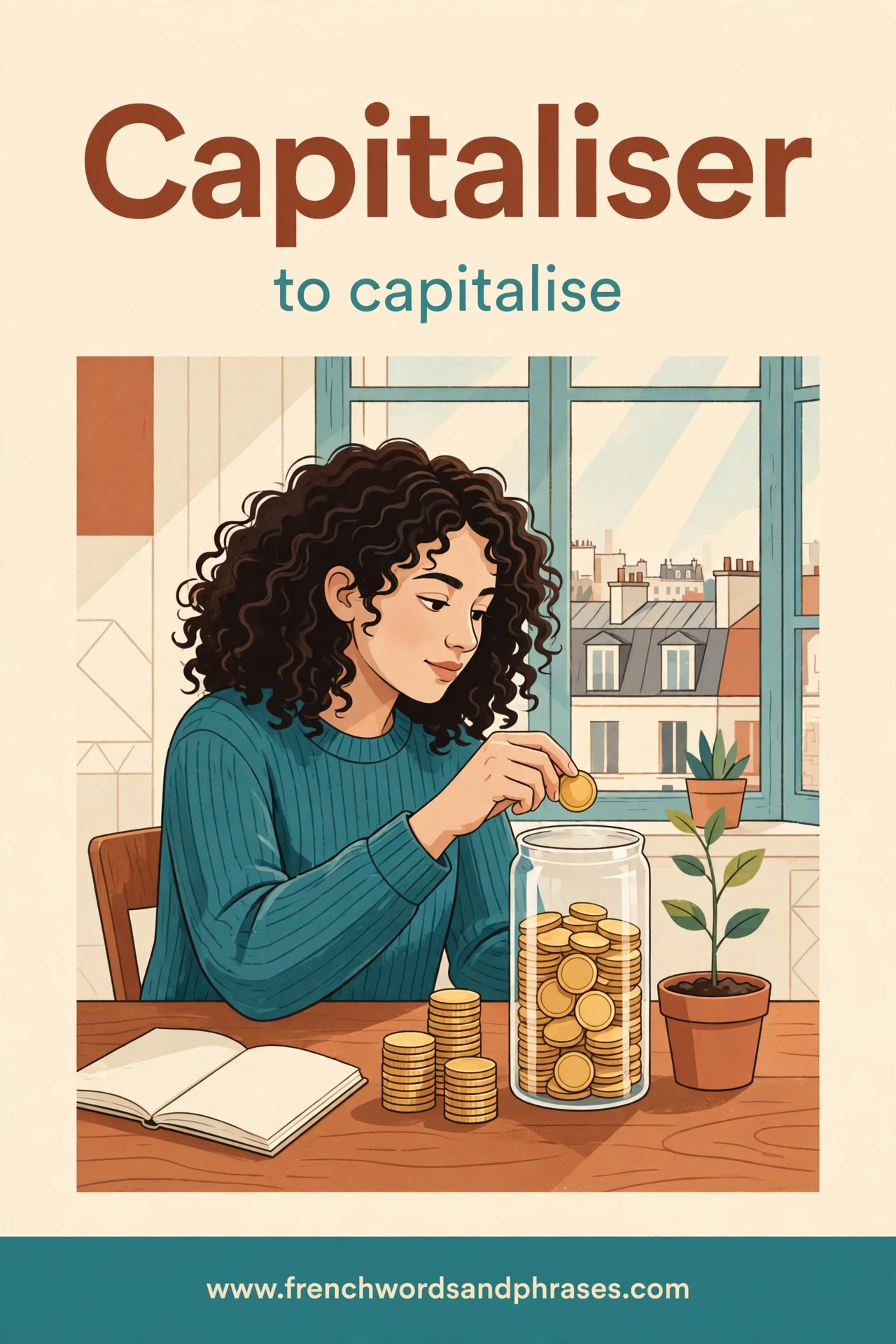
Capitaliser means to capitalise, to save — to turn income into capital, letting money pile up and work, franc by franc, year by year.
A careful saver watching a small account grow, a business ploughing its profits back into new machines — capitaliser is the verb of accumulation: nothing spent, everything added to the pile, until the pile itself starts earning.
In this guide, you’ll learn how to conjugate capitaliser in all the major French tenses and moods. Explore complete conjugation tables, French examples, English translations, and practice quizzes.
Understanding the French Verb Capitaliser
Capitaliser is a regular French verb belonging to the first group of verbs, those ending in-er.
It means to capitalise, to save. It is the standard verb of savings plans and balance sheets — capitaliser les intérêts is what compound interest does automatically — and a favourite of sports and business journalism in the figurative phrase capitaliser sur, to build on an advantage while it lasts.
Verb classification: First group (-er)
Auxiliary verb: Avoir
Past participle: capitalisé
Present participle: capitalisant
English equivalents: To capitalise, to save up, to build up capital; capitaliser les intérêts — to capitalise the interest; capitaliser pour sa retraite — to save for one’s retirement; capitaliser sur un succès — to capitalise on a success; une entreprise qui capitalise — a company that builds up its capital.
One important detail: capitaliser is a perfectly regular -er verb — je capitalise, nous capitalisons, ils capitalisent, past participle capitalisé — and its spelling holds no trap at all. The trap is in the senses: in finance it means turning earnings into capital or saving steadily (capitaliser pour sa retraite), in business French it means exploiting an advantage (capitaliser sur un succès), and in typography, capitaliser une lettre is to write it as a capital.
Experience the Word
Capitaliser is the verb of the growing pile — each small sum added, each interest payment kept, until patience itself becomes wealth.
Imagine a young baker who, every Friday for twenty years, puts the week’s small surplus into a separate account and never touches it. Les intérêts capitalisent, the sum swells quietly — and one morning the pile is big enough to buy the shop itself.
Nothing was won in a day. Everything was capitalised — saved, stacked, and left to grow.
How to Conjugate Capitaliser: Complete French Conjugation Guide
Let’s explore every major conjugation of capitaliser, beginning with the indicative mood.
How to Conjugate Capitaliser in the Indicative Mood
The indicative mood is used to express facts, observations, actions, and events.
How to Conjugate Capitaliser in the Present Tense (Présent)
Used for actions happening now, habitual actions, and general truths.
| Subject | Conjugation |
|---|---|
| je | capitalise |
| tu | capitalises |
| il / elle | capitalise |
| nous | capitalisons |
| vous | capitalisez |
| ils / elles | capitalisent |
Example
Elle capitalise ses intérêts au lieu de les dépenser.
She capitalises her interest instead of spending it.
Quick Quiz 1
Complete the sentence:
Nous ______ nos intérêts chaque année.
Reveal the answer
capitalisons
Nous capitalisons nos intérêts chaque année.
We capitalise our interest every year.
How to Conjugate Capitaliser in the Passé Composé
Used for completed actions in the past. Capitaliser takes the auxiliary verb avoir.
| Subject | Conjugation |
|---|---|
| j’ | ai capitalisé |
| tu | as capitalisé |
| il / elle | a capitalisé |
| nous | avons capitalisé |
| vous | avez capitalisé |
| ils / elles | ont capitalisé |
Example
Ils ont capitalisé pendant dix ans pour acheter la maison.
They saved up for ten years to buy the house.
How to Conjugate Capitaliser in the Imparfait (Imperfect Tense)
Used for habitual past actions, descriptions, and ongoing situations in the past.
| Subject | Conjugation |
|---|---|
| je | capitalisais |
| tu | capitalisais |
| il / elle | capitalisait |
| nous | capitalisions |
| vous | capitalisiez |
| ils / elles | capitalisaient |
Example
Mon grand-père capitalisait chaque mois une petite somme.
My grandfather used to save a small sum every month.
Quick Quiz 2
Choose the correct form:
They saved up for ten years.
Ils ______ pendant dix ans. (ont capitalisé / sont capitalisé)
Reveal the answer
ont capitalisé
Ils ont capitalisé pendant dix ans.
Capitaliser takes avoir.
How to Conjugate Capitaliser in the Plus-que-parfait
Used to describe an action that had already been completed before another past event.
| Subject | Conjugation |
|---|---|
| j’ | avais capitalisé |
| tu | avais capitalisé |
| il / elle | avait capitalisé |
| nous | avions capitalisé |
| vous | aviez capitalisé |
| ils / elles | avaient capitalisé |
Example
La société avait capitalisé ses bénéfices avant la crise.
The company had capitalised its profits before the crisis.
How to Conjugate Capitaliser in the Passé Simple
Primarily used in formal writing, literature, and historical narratives. It is rarely used in everyday conversation.
| Subject | Conjugation |
|---|---|
| je | capitalisai |
| tu | capitalisas |
| il / elle | capitalisa |
| nous | capitalisâmes |
| vous | capitalisâtes |
| ils / elles | capitalisèrent |
Example
Il capitalisa patiemment et acheta l’immeuble en 1960.
He saved patiently and bought the building in 1960.
How to Conjugate Capitaliser in the Passé Antérieur
A literary tense used to express an action completed immediately before another past action, generally in the passé simple.
| Subject | Conjugation |
|---|---|
| j’ | eus capitalisé |
| tu | eus capitalisé |
| il / elle | eut capitalisé |
| nous | eûmes capitalisé |
| vous | eûtes capitalisé |
| ils / elles | eurent capitalisé |
Example
Quand ils eurent capitalisé assez d’argent, ils ouvrirent leur boutique.
When they had saved enough money, they opened their shop.
How to Conjugate Capitaliser in the Future Tense (Futur Simple)
Used to describe actions that will take place in the future.
| Subject | Conjugation |
|---|---|
| je | capitaliserai |
| tu | capitaliseras |
| il / elle | capitalisera |
| nous | capitaliserons |
| vous | capitaliserez |
| ils / elles | capitaliseront |
Example
Vous capitaliserez davantage avec un meilleur taux.
You will build up more capital with a better rate.
How to Conjugate Capitaliser in the Futur Antérieur (Future Perfect)
Used for an action that will have been completed before a particular point in the future.
| Subject | Conjugation |
|---|---|
| j’ | aurai capitalisé |
| tu | auras capitalisé |
| il / elle | aura capitalisé |
| nous | aurons capitalisé |
| vous | aurez capitalisé |
| ils / elles | auront capitalisé |
Example
À sa retraite, elle aura capitalisé une belle somme.
By her retirement, she will have built up a fine sum.
How to Conjugate Capitaliser in the Near Future (Futur Proche)
Used to describe something that is going to happen soon. Formed with aller + infinitive.
| Subject | Conjugation |
|---|---|
| je | vais capitaliser |
| tu | vas capitaliser |
| il / elle | va capitaliser |
| nous | allons capitaliser |
| vous | allez capitaliser |
| ils / elles | vont capitaliser |
Example
Cette équipe va capitaliser sur sa victoire de dimanche.
This team is going to capitalise on its Sunday victory.
How to Conjugate Capitaliser in the Conditional Mood
The conditional mood expresses what would happen under certain circumstances. It is also frequently used to make polite requests or express wishes.
How to Conjugate Capitaliser in the Present Conditional
| Subject | Conjugation |
|---|---|
| je | capitaliserais |
| tu | capitaliserais |
| il / elle | capitaliserait |
| nous | capitaliserions |
| vous | capitaliseriez |
| ils / elles | capitaliseraient |
Example
Avec moins de dépenses, nous capitaliserions plus vite.
With fewer expenses, we would save up faster.
How to Conjugate Capitaliser in the Past Conditional
| Subject | Conjugation |
|---|---|
| j’ | aurais capitalisé |
| tu | aurais capitalisé |
| il / elle | aurait capitalisé |
| nous | aurions capitalisé |
| vous | auriez capitalisé |
| ils / elles | auraient capitalisé |
Example
Ils auraient capitalisé davantage sans la crise.
They would have built up more capital without the crisis.
Capitaliser in the Literary Past Conditional Form
This less common literary form uses the imperfect subjunctive of avoir.
| Subject | Conjugation |
|---|---|
| j’ | eusse capitalisé |
| tu | eusses capitalisé |
| il / elle | eût capitalisé |
| nous | eussions capitalisé |
| vous | eussiez capitalisé |
| ils / elles | eussent capitalisé |
Example
Il eût capitalisé ses gains au lieu de les jouer.
He would have capitalised his winnings instead of gambling them.
How to Conjugate Capitaliser in the Subjunctive Mood
The subjunctive is used to express wishes, emotions, doubts, necessity, and uncertainty. It frequently follows expressions such as il faut que (it is necessary that) or bien que (although).
How to Conjugate Capitaliser in the Present Subjunctive
| Subject | Conjugation |
|---|---|
| que je | capitalise |
| que tu | capitalises |
| qu’il / qu’elle | capitalise |
| que nous | capitalisions |
| que vous | capitalisiez |
| qu’ils / qu’elles | capitalisent |
Example
Il est sage qu’elle capitalise pour sa retraite.
It is wise that she saves for her retirement.
Quick Quiz 3
Complete the sentence using the subjunctive:
Il est sage que vous ______ pour votre retraite.
Reveal the answer
capitalisiez
Il est sage que vous capitalisiez pour votre retraite.
It is wise that you save for your retirement.
How to Conjugate Capitaliser in the Imperfect Subjunctive
A literary tense, rarely encountered in modern spoken French.
| Subject | Conjugation |
|---|---|
| que je | capitalisasse |
| que tu | capitalisasses |
| qu’il / qu’elle | capitalisât |
| que nous | capitalisassions |
| que vous | capitalisassiez |
| qu’ils / qu’elles | capitalisassent |
Example
Le banquier conseillait que les clients capitalisassent leurs intérêts.
The banker advised clients to capitalise their interest.
How to Conjugate Capitaliser in the Pluperfect Subjunctive
A literary construction used to express an action completed before another past action.
| Subject | Conjugation |
|---|---|
| que j’ | eusse capitalisé |
| que tu | eusses capitalisé |
| qu’il / qu’elle | eût capitalisé |
| que nous | eussions capitalisé |
| que vous | eussiez capitalisé |
| qu’ils / qu’elles | eussent capitalisé |
Example
On disait que la famille eût capitalisé une fortune en vingt ans.
People said the family had built up a fortune in twenty years.
How to Conjugate Capitaliser in the Past Subjunctive
| Subject | Conjugation | |
|---|---|---|
| que j’ | aie capitalisé | |
| que tu | aies capitalisé | |
| qu’il / qu’elle | ait capitalisé | |
| qu’r> | que nous | ayons capitalisé |
| que vous | ayez capitalisé | |
| qu’ils / qu’elles | aient capitalisé |
Example
Je suis content que tu aies capitalisé au lieu de tout dépenser.
I am glad you saved up instead of spending everything.
How to Conjugate Capitaliser in the Imperative
The imperative is used to give commands, instructions, invitations, or suggestions. Subject pronouns are omitted.
How to Conjugate Capitaliser in the Present Imperative
| Person | Conjugation |
|---|---|
| (tu) | capitalise |
| (nous) | capitalisons |
| (vous) | capitalisez |
Example
Capitalise tes intérêts, ne les dépense pas !
Capitalise your interest, do not spend it!
Quick Quiz 4
How would you say Capitalise your interest (tu form)?
Reveal the answer
Capitalise tes intérêts !
French Participles of Capitaliser
Participles are verb forms that can be used in compound tenses and other grammatical constructions.
Present Participle of Capitaliser
capitalisant
En capitalisant régulièrement, elle a doublé son épargne.
By saving regularly, she doubled her savings.
Past Participle of Capitaliser
capitalisé
Capitalisés pendant vingt ans, les intérêts ont payé la maison.
Capitalised over twenty years, the interest paid for the house.
Capitaliser in Everyday French: Real-Life Examples
Now that you know the conjugations, let’s see how capitaliser appears in everyday French.
Example 1 — Present
Elle capitalise ses intérêts au lieu de les dépenser.
She capitalises her interest instead of spending it.
Example 2 — Passé composé
Ils ont capitalisé dix ans pour acheter la maison.
They saved up for ten years to buy the house.
Example 3 — Imparfait
Mon grand-père capitalisait une petite somme chaque mois.
My grandfather used to save a small sum every month.
Example 4 — Future
Vous capitaliserez davantage avec un meilleur taux.
You will build up more capital with a better rate.
Example 5 — Conditional
Nous capitaliserions plus vite avec moins de dépenses.
We would save up faster with fewer expenses.
Example 6 — Imperative
Capitalise pour ta retraite dès maintenant !
Start saving for your retirement right now!
Beyond Translation: The Meaning of Capitaliser
English capitalise shares the finance sense, and both languages built the verb on capital — from Latin caput, the head: the head sum, the principal, as opposed to the interest it calves.
Compound interest is capitaliser working alone.
Every savings account that adds interest to principal is quietly conjugating this verb — capitaliser is the grammar of patience itself, written in money.
How to Remember the French Verb Capitaliser
Remember it this way: Capitaliser is about the small Friday surplus that one day buys the shop.
- Two scenes, one verb: the bank (capitaliser les intérêts) and the advantage (capitaliser sur un succès).
- Perfectly regular -er: je capitalise, nous capitalisons, capitalisé.
- Capital comes from caput, the head — capitaliser grows the head sum itself.
The key idea is the small Friday surplus that one day buys the shop.
Test Your Knowledge of Capitaliser
Let’s see how much you’ve learned. Try answering these questions before revealing the answers.
Question 1
What does capitaliser sur un succès mean?
Reveal the answer
To capitalise on a success — to build on an advantage while it lasts.
Question 2
How do you say She capitalises her interest in French?
Reveal the answer
Elle capitalise ses intérêts.
Question 3
Translate: They saved up for ten years to buy the house.
Reveal the answer
Ils ont capitalisé pendant dix ans pour acheter la maison.
Question 4
What is the past participle of capitaliser?
Reveal the answer
Capitalisé.
Question 5
Complete the sentence:
Il est sage qu’elle ______ pour sa retraite.
Reveal the answer
capitalise
Il est sage qu’elle capitalise pour sa retraite.
It is wise that she saves for her retirement.
Your Final Challenge
Can You Use It?
How would you say this in French?
Whoever saves with patience turns the small coins of Fridays into the house of their old age.
Reveal the answer
Qui capitalise avec patience transforme les petites pièces des vendredis en la maison de sa vieillesse.
Whoever saves with patience turns the small coins of Fridays into the house of their old age.
A little French. A little curiosity. A richer everyday life.
LEARN FRENCH ONE WORD AT A TIME