A French Word to Live By
How to Conjugate Canuler in French
/ka.ny.le/
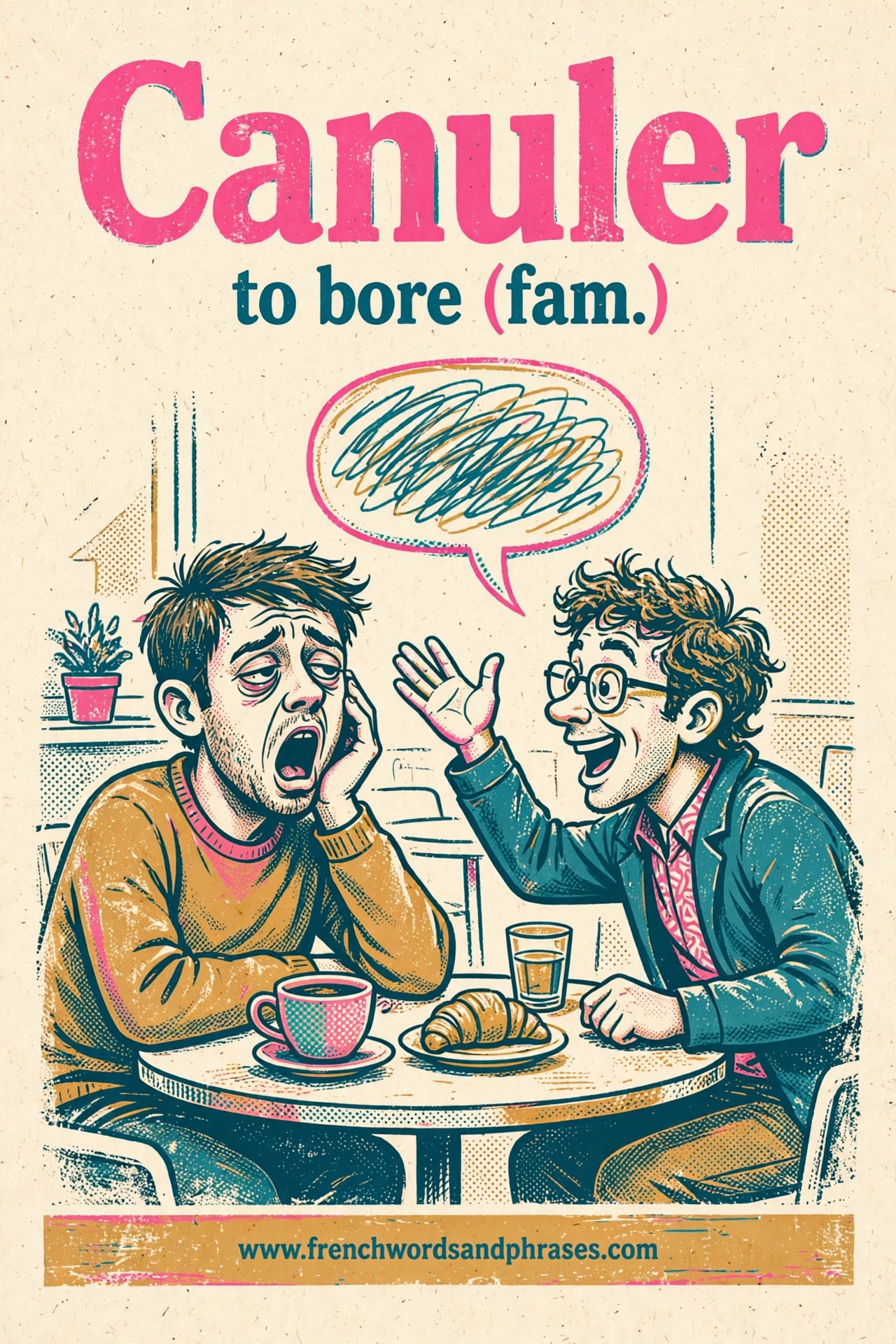
Canuler means to bore, to annoy (fam.) — to weary someone to distraction with talk, questions or company that simply will not stop.
A neighbour who has talked at you over the fence for forty minutes, a child asking the same question for the twentieth time — canuler is the familiar verb of cheerful exasperation: nothing terrible is happening, and that is exactly the problem.
In this guide, you’ll learn how to conjugate canuler in all the major French tenses and moods. Explore complete conjugation tables, French examples, English translations, and practice quizzes.
Understanding the French Verb Canuler
Canuler is a regular French verb belonging to the first group of verbs, those ending in-er.
It means to bore, to annoy (fam.). It is the verb of affectionate irritation — used of talkative neighbours, persistent children, dreary lecturers — and almost always in speech, with a smile or a sigh. What canule is rarely dangerous, merely endless: the bore at the party, the meeting that will not finish, the story told for the fifth time.
Verb classification: First group (-er)
Auxiliary verb: Avoir
Past participle: canulé
Present participle: canulant
English equivalents: To bore, to annoy, to pester (all familiar); canuler quelqu’un — to bore someone stiff; il me canule — he is boring me, he gets on my nerves; arrête de me canuler ! — stop pestering me!; un canulant — a bore, a pest (familiar).
One important detail: canuler is familier — informal, spoken French, warm or exasperated but never polite-print; the neutral verbs are ennuyer and importuner. Its origin is probably la canule, the little tube — the picture of something small, hollow and endlessly droning. The conjugation is perfectly regular: je canule, nous canulons, ils canulent, past participle canulé. The classic frame is personal: tu me canules, il nous canule — the victim comes first, as a pronoun, because the victim is the point.
Experience the Word
Canuler is the verb of the fortieth minute — nothing has gone wrong except that it is still going on.
Imagine a train journey across France. Your neighbour has described his garden, his grandchildren and his opinions on the weather; the train has four hours still to run — il vous canule, poliment, sans relâche, and you begin to study the corridor with deep and sudden interest.
He means no harm at all. He is simply boring you — il vous canule, familier et interminable.
How to Conjugate Canuler: Complete French Conjugation Guide
Let’s explore every major conjugation of canuler, beginning with the indicative mood.
How to Conjugate Canuler in the Indicative Mood
The indicative mood is used to express facts, observations, actions, and events.
How to Conjugate Canuler in the Present Tense (Présent)
Used for actions happening now, habitual actions, and general truths.
| Subject | Conjugation |
|---|---|
| je | canule |
| tu | canules |
| il / elle | canule |
| nous | canulons |
| vous | canulez |
| ils / elles | canulent |
Example
Le voisin me canule avec ses histoires de jardin.
The neighbour is boring me with his garden stories.
Quick Quiz 1
Complete the sentence:
Vous ______ tout le bureau avec vos plaintes.
Reveal the answer
canulez
Vous canulez tout le bureau avec vos plaintes.
You are boring the whole office with your complaints.
How to Conjugate Canuler in the Passé Composé
Used for completed actions in the past. Canuler takes the auxiliary verb avoir.
| Subject | Conjugation |
|---|---|
| j’ | ai canulé |
| tu | as canulé |
| il / elle | a canulé |
| nous | avons canulé |
| vous | avez canulé |
| ils / elles | ont canulé |
Example
Il nous a canulés pendant tout le trajet en train.
He bored us for the whole train journey.
How to Conjugate Canuler in the Imparfait (Imperfect Tense)
Used for habitual past actions, descriptions, and ongoing situations in the past.
| Subject | Conjugation |
|---|---|
| je | canulais |
| tu | canulais |
| il / elle | canulait |
| nous | canulions |
| vous | canuliez |
| ils / elles | canulaient |
Example
Autrefois, le vieux monsieur canulait tout le café avec ses souvenirs.
In the old days, the old gentleman used to bore the whole café with his memories.
Quick Quiz 2
Choose the correct form:
He bored us all evening.
Il ______ toute la soirée. (nous a canulés / nous est canulé)
Reveal the answer
nous a canulés
Il nous a canulés toute la soirée.
Canuler takes avoir.
How to Conjugate Canuler in the Plus-que-parfait
Used to describe an action that had already been completed before another past event.
| Subject | Conjugation |
|---|---|
| j’ | avais canulé |
| tu | avais canulé |
| il / elle | avait canulé |
| nous | avions canulé |
| vous | aviez canulé |
| ils / elles | avaient canulé |
Example
Elle m’avait canulé au téléphone avant même le dîner.
She had already bored me on the phone before dinner even started.
How to Conjugate Canuler in the Passé Simple
Primarily used in formal writing, literature, and historical narratives. It is rarely used in everyday conversation.
| Subject | Conjugation |
|---|---|
| je | canulai |
| tu | canulas |
| il / elle | canula |
| nous | canulâmes |
| vous | canulâtes |
| ils / elles | canulèrent |
Example
Le conférencier canula son auditoire pendant deux longues heures.
The lecturer bored his audience for two long hours.
How to Conjugate Canuler in the Passé Antérieur
A literary tense used to express an action completed immediately before another past action, generally in the passé simple.
| Subject | Conjugation |
|---|---|
| j’ | eus canulé |
| tu | eus canulé |
| il / elle | eut canulé |
| nous | eûmes canulé |
| vous | eûtes canulé |
| ils / elles | eurent canulé |
Example
Quand il eut canulé tous les invités, la soirée prit fin.
When he had bored all the guests, the evening came to an end.
How to Conjugate Canuler in the Future Tense (Futur Simple)
Used to describe actions that will take place in the future.
| Subject | Conjugation |
|---|---|
| je | canulerai |
| tu | canuleras |
| il / elle | canulera |
| nous | canulerons |
| vous | canulerez |
| ils / elles | canuleront |
Example
Si tu l’invites, il te canulera avec ses photos de vacances.
If you invite him, he will bore you with his holiday photos.
How to Conjugate Canuler in the Futur Antérieur (Future Perfect)
Used for an action that will have been completed before a particular point in the future.
| Subject | Conjugation |
|---|---|
| j’ | aurai canulé |
| tu | auras canulé |
| il / elle | aura canulé |
| nous | aurons canulé |
| vous | aurez canulé |
| ils / elles | auront canulé |
Example
À la fin du voyage, il aura canulé tout le wagon.
By the end of the journey, he will have bored the whole carriage.
How to Conjugate Canuler in the Near Future (Futur Proche)
Used to describe something that is going to happen soon. Formed with aller + infinitive.
| Subject | Conjugation |
|---|---|
| je | vais canuler |
| tu | vas canuler |
| il / elle | va canuler |
| nous | allons canuler |
| vous | allez canuler |
| ils / elles | vont canuler |
Example
Attention, le voisin va encore nous canuler ce soir.
Careful, the neighbour is going to bore us again tonight.
How to Conjugate Canuler in the Conditional Mood
The conditional mood expresses what would happen under certain circumstances. It is also frequently used to make polite requests or express wishes.
How to Conjugate Canuler in the Present Conditional
| Subject | Conjugation |
|---|---|
| je | canulerais |
| tu | canulerais |
| il / elle | canulerait |
| nous | canulerions |
| vous | canuleriez |
| ils / elles | canuleraient |
Example
Sans son monologue sur les trains, il ne canulerait personne.
Without his monologue about trains, he would not bore anyone.
How to Conjugate Canuler in the Past Conditional
| Subject | Conjugation |
|---|---|
| j’ | aurais canulé |
| tu | aurais canulé |
| il / elle | aurait canulé |
| nous | aurions canulé |
| vous | auriez canulé |
| ils / elles | auraient canulé |
Example
Tu m’aurais canulé moins longtemps avec une histoire plus courte.
You would have bored me for less time with a shorter story.
Canuler in the Literary Past Conditional Form
This less common literary form uses the imperfect subjunctive of avoir.
| Subject | Conjugation |
|---|---|
| j’ | eusse canulé |
| tu | eusses canulé |
| il / elle | eût canulé |
| nous | eussions canulé |
| vous | eussiez canulé |
| ils / elles | eussent canulé |
Example
Le bavard eût canulé la cour entière jusqu’à minuit.
The chatterbox would have bored the whole court until midnight.
How to Conjugate Canuler in the Subjunctive Mood
The subjunctive is used to express wishes, emotions, doubts, necessity, and uncertainty. It frequently follows expressions such as il faut que (it is necessary that) or bien que (although).
How to Conjugate Canuler in the Present Subjunctive
| Subject | Conjugation |
|---|---|
| que je | canule |
| que tu | canules |
| qu’il / qu’elle | canule |
| que nous | canulions |
| que vous | canuliez |
| qu’ils / qu’elles | canulent |
Example
Je ne veux pas que les enfants canulent leur grand-mère.
I do not want the children pestering their grandmother.
Quick Quiz 3
Complete the sentence using the subjunctive:
Je ne veux pas que tu ______ ta sœur avec tes questions.
Reveal the answer
canules
Je ne veux pas que tu canules ta sœur avec tes questions.
I do not want you pestering your sister with your questions.
How to Conjugate Canuler in the Imperfect Subjunctive
A literary tense, rarely encountered in modern spoken French.
| Subject | Conjugation |
|---|---|
| que je | canulasse |
| que tu | canulasses |
| qu’il / qu’elle | canulât |
| que nous | canulassions |
| que vous | canulassiez |
| qu’ils / qu’elles | canulassent |
Example
Il était dommage que le guide canulât les visiteurs.
It was a pity the guide bored the visitors.
How to Conjugate Canuler in the Pluperfect Subjunctive
A literary construction used to express an action completed before another past action.
| Subject | Conjugation |
|---|---|
| que j’ | eusse canulé |
| que tu | eusses canulé |
| qu’il / qu’elle | eût canulé |
| que nous | eussions canulé |
| que vous | eussiez canulé |
| qu’ils / qu’elles | eussent canulé |
Example
On plaisantait qu’il eût canulé même les statues du musée.
People joked that he had bored even the museum’s statues.
How to Conjugate Canuler in the Past Subjunctive
| Subject | Conjugation |
|---|---|
| que j’ | aie canulé |
| que tu | aies canulé |
| qu’il / qu’elle | ait canulé |
| que nous | ayons canulé |
| que vous | ayez canulé |
| qu’ils / qu’elles | aient canulé |
Example
Je suis sûr qu’il t’a canulé avec ses conseils.
I am sure he bored you with his advice.
How to Conjugate Canuler in the Imperative
The imperative is used to give commands, instructions, invitations, or suggestions. Subject pronouns are omitted.
How to Conjugate Canuler in the Present Imperative
| Person | Conjugation |
|---|---|
| (tu) | canule |
| (nous) | canulons |
| (vous) | canulez |
Example
Ne me canule plus avec tes questions, je travaille !
Stop pestering me with your questions, I am working!
Quick Quiz 4
How would you say Stop pestering me (tu form)?
Reveal the answer
Ne me canule plus !
French Participles of Canuler
Participles are verb forms that can be used in compound tenses and other grammatical constructions.
Present Participle of Canuler
canulant
En canulant ses collègues, il ne voit même pas qu’ils s’ennuient.
While boring his colleagues, he does not even notice they are bored.
Past Participle of Canuler
canulé
Canulé par trois heures de réunion, il s’est endormi sur sa chaise.
Bored stiff by three hours of meeting, he fell asleep on his chair.
Canuler in Everyday French: Real-Life Examples
Now that you know the conjugations, let’s see how canuler appears in everyday French.
Example 1 — Present
Le voisin me canule avec ses histoires.
The neighbour is boring me with his stories.
Example 2 — Passé composé
Il nous a canulés pendant tout le trajet.
He bored us for the whole journey.
Example 3 — Imparfait
Le vieux monsieur canulait tout le café.
The old gentleman used to bore the whole café.
Example 4 — Future
Il te canulera avec ses photos de vacances.
He will bore you with his holiday photos.
Example 5 — Conditional
Il ne canulerait personne sans son monologue.
He would not bore anyone without his monologue.
Example 6 — Imperative
Ne me canule plus, je travaille !
Stop pestering me, I am working!
Beyond Translation: The Meaning of Canuler
English bore drills a hole; French canuler probably whispers of la canule, the little tube — a thin, hollow, endless drone.
It is boredom as a sound, not a wound.
That is why canuler stays affectionate where ennuyer can be serious: one is ennuyé by bad news, but canulé by a talkative neighbour — and the neighbour, unlike the news, can be offered a coffee and gently escaped.
How to Remember the French Verb Canuler
Remember it this way: Canuler is about the neighbour still talking at minute forty.
- Register first: canuler is familier — ennuyer and importuner are the neutral verbs.
- The victim leads: tu me canules, il nous canule — the bored person comes first as a pronoun.
- Regular -er: je canule, nous canulons, past participle canulé.
The key idea is the neighbour still talking at minute forty.
Test Your Knowledge of Canuler
Let’s see how much you’ve learned. Try answering these questions before revealing the answers.
Question 1
What register is canuler, and what are its neutral equivalents?
Reveal the answer
Familier (informal) — neutral French says ennuyer or importuner.
Question 2
How do you say He bored us for the whole journey in French?
Reveal the answer
Il nous a canulés pendant tout le trajet.
Question 3
Translate: The neighbour is boring me with his stories.
Reveal the answer
Le voisin me canule avec ses histoires.
Question 4
What is the past participle of canuler?
Reveal the answer
Canulé.
Question 5
Complete the sentence:
Je ne veux pas que les enfants ______ leur grand-mère.
Reveal the answer
canulent
Je ne veux pas que les enfants canulent leur grand-mère.
I do not want the children pestering their grandmother.
Your Final Challenge
Can You Use It?
How would you say this in French?
He bores the whole carriage with his stories, and yet, when he falls silent, the quiet seems almost sad.
Reveal the answer
Il canule tout le wagon avec ses histoires, et pourtant, quand il se tait, le silence semble presque triste.
He bores the whole carriage with his stories, and yet, when he falls silent, the quiet seems almost sad.
A little French. A little curiosity. A richer everyday life.
LEARN FRENCH ONE WORD AT A TIME