
A French Word to Live By
How to Conjugate Cancaner in French
/kɑ̃.ka.ne/
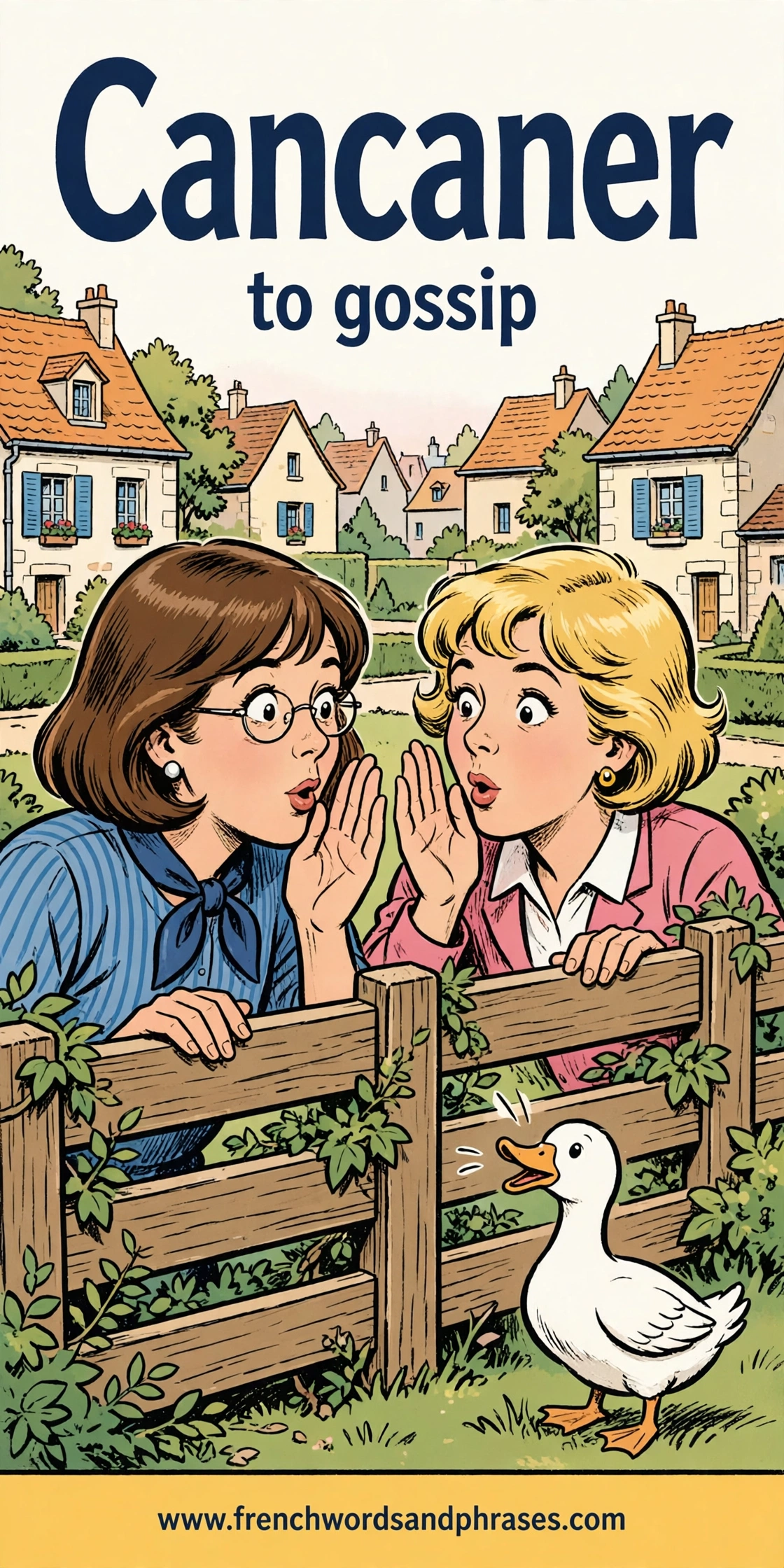
Cancaner means to gossip, to quack — to chatter away about other people’s business with the cheerful, ceaseless noise of ducks on a pond.
Neighbours leaning over a garden fence, colleagues round the coffee machine trading the latest news about the boss — cancaner is the verb of gleeful chatter about other people: half malice, half music, and never, ever silent for long.
In this guide, you’ll learn how to conjugate cancaner in all the major French tenses and moods. Explore complete conjugation tables, French examples, English translations, and practice quizzes.
Understanding the French Verb Cancaner
Cancaner is a regular French verb belonging to the first group of verbs, those ending in-er.
It means to gossip, to quack. Of people it always means malicious or idle gossip — spreading who said what about whom — and it carries a smile rather than real anger: the cancans of a village or an office are its small change of entertainment. Of ducks and geese it is the plain, literal quacking.
Verb classification: First group (-er)
Auxiliary verb: Avoir
Past participle: cancané
Present participle: cancanant
English equivalents: To gossip, to chatter, to quack; cancaner sur les voisins — to gossip about the neighbours; cancaner au bureau — to gossip at the office; les canards cancanent — the ducks are quacking; un village qui cancane — a village full of gossip.
One important detail: cancaner is an imitation of a sound — cancan is the quack of a duck, and the verb serves both masters: ducks cancanent on the pond, and people cancanent about their neighbours. It is perfectly regular: je cancane, nous cancanons, ils cancanent, past participle cancané. The noun un cancan is a piece of gossip — and, in quite another world, the famous high-kicking dance of the Moulin Rouge.
Experience the Word
Cancaner is the verb of the fence and the pond alike — a noise that travels from beak to beak and ear to ear.
Imagine a small village square at six in the evening. Two women meet by the fountain with their shopping bags; within a minute the whole week’s news has changed hands — qui a vendu sa maison, qui a rompu ses fiançailles — elles cancanent, delighted, while the ducks on the pond answer in kind.
Nothing is proved and nothing is decided. They have simply gossiped — cancané, happily, like ducks at sunset.
How to Conjugate Cancaner: Complete French Conjugation Guide
Let’s explore every major conjugation of cancaner, beginning with the indicative mood.
How to Conjugate Cancaner in the Indicative Mood
The indicative mood is used to express facts, observations, actions, and events.
How to Conjugate Cancaner in the Present Tense (Présent)
Used for actions happening now, habitual actions, and general truths.
| Subject | Conjugation |
|---|---|
| je | cancane |
| tu | cancanes |
| il / elle | cancane |
| nous | cancanons |
| vous | cancanez |
| ils / elles | cancanent |
Example
Les voisines cancanent sur le nouveau locataire.
The neighbours are gossiping about the new tenant.
Quick Quiz 1
Complete the sentence:
Nous ______ sur les voisins depuis une heure.
Reveal the answer
cancanons
Nous cancanons sur les voisins depuis une heure.
We have been gossiping about the neighbours for an hour.
How to Conjugate Cancaner in the Passé Composé
Used for completed actions in the past. Cancaner takes the auxiliary verb avoir.
| Subject | Conjugation |
|---|---|
| j’ | ai cancané |
| tu | as cancané |
| il / elle | a cancané |
| nous | avons cancané |
| vous | avez cancané |
| ils / elles | ont cancané |
Example
Elles ont cancané toute la soirée sur la famille du maire.
They gossiped all evening about the mayor’s family.
How to Conjugate Cancaner in the Imparfait (Imperfect Tense)
Used for habitual past actions, descriptions, and ongoing situations in the past.
| Subject | Conjugation |
|---|---|
| je | cancanais |
| tu | cancanais |
| il / elle | cancanait |
| nous | cancanions |
| vous | cancaniez |
| ils / elles | cancanaient |
Example
Au village, on cancanait beaucoup sur les amours de la boulangère.
In the village, people used to gossip a lot about the baker’s love affairs.
Quick Quiz 2
Choose the correct form:
They gossiped all evening.
Elles ______ toute la soirée. (ont cancané / sont cancanées)
Reveal the answer
ont cancané
Elles ont cancané toute la soirée.
Cancaner takes avoir.
How to Conjugate Cancaner in the Plus-que-parfait
Used to describe an action that had already been completed before another past event.
| Subject | Conjugation |
|---|---|
| j’ | avais cancané |
| tu | avais cancané |
| il / elle | avait cancané |
| nous | avions cancané |
| vous | aviez cancané |
| ils / elles | avaient cancané |
Example
Les commères avaient cancané sur son compte avant même son arrivée.
The gossips had chattered about her even before she arrived.
How to Conjugate Cancaner in the Passé Simple
Primarily used in formal writing, literature, and historical narratives. It is rarely used in everyday conversation.
| Subject | Conjugation |
|---|---|
| je | cancanai |
| tu | cancanas |
| il / elle | cancana |
| nous | cancanâmes |
| vous | cancanâtes |
| ils / elles | cancanèrent |
Example
La cour cancana sur le scandale pendant des semaines.
The court gossiped about the scandal for weeks.
How to Conjugate Cancaner in the Passé Antérieur
A literary tense used to express an action completed immediately before another past action, generally in the passé simple.
| Subject | Conjugation |
|---|---|
| j’ | eus cancané |
| tu | eus cancané |
| il / elle | eut cancané |
| nous | eûmes cancané |
| vous | eûtes cancané |
| ils / elles | eurent cancané |
Example
Quand elles eurent cancané une heure, elles rentrèrent dîner.
When they had gossiped for an hour, they went home for dinner.
How to Conjugate Cancaner in the Future Tense (Futur Simple)
Used to describe actions that will take place in the future.
| Subject | Conjugation |
|---|---|
| je | cancanerai |
| tu | cancaneras |
| il / elle | cancanera |
| nous | cancanerons |
| vous | cancanerez |
| ils / elles | cancaneront |
Example
Demain, tout le bureau cancanera sur la promotion de Julie.
Tomorrow, the whole office will gossip about Julie’s promotion.
How to Conjugate Cancaner in the Futur Antérieur (Future Perfect)
Used for an action that will have been completed before a particular point in the future.
| Subject | Conjugation |
|---|---|
| j’ | aurai cancané |
| tu | auras cancané |
| il / elle | aura cancané |
| nous | aurons cancané |
| vous | aurez cancané |
| ils / elles | auront cancané |
Example
À midi, les voisines auront cancané sur tout le quartier.
By noon, the neighbours will have gossiped about the whole street.
How to Conjugate Cancaner in the Near Future (Futur Proche)
Used to describe something that is going to happen soon. Formed with aller + infinitive.
| Subject | Conjugation |
|---|---|
| je | vais cancaner |
| tu | vas cancaner |
| il / elle | va cancaner |
| nous | allons cancaner |
| vous | allez cancaner |
| ils / elles | vont cancaner |
Example
Chut, elles vont cancaner sur nous si nous restons là.
Shh, they are going to gossip about us if we stay here.
How to Conjugate Cancaner in the Conditional Mood
The conditional mood expresses what would happen under certain circumstances. It is also frequently used to make polite requests or express wishes.
How to Conjugate Cancaner in the Present Conditional
| Subject | Conjugation |
|---|---|
| je | cancanerais |
| tu | cancanerais |
| il / elle | cancanerait |
| nous | cancanerions |
| vous | cancaneriez |
| ils / elles | cancaneraient |
Example
Sans la nouvelle du mariage, le village cancanerait sur autre chose.
Without the wedding news, the village would gossip about something else.
How to Conjugate Cancaner in the Past Conditional
| Subject | Conjugation |
|---|---|
| j’ | aurais cancané |
| tu | aurais cancané |
| il / elle | aurait cancané |
| nous | aurions cancané |
| vous | auriez cancané |
| ils / elles | auraient cancané |
Example
Elles auraient cancané davantage si elles avaient su la vérité.
They would have gossiped more if they had known the truth.
Cancaner in the Literary Past Conditional Form
This less common literary form uses the imperfect subjunctive of avoir.
| Subject | Conjugation |
|---|---|
| j’ | eusse cancané |
| tu | eusses cancané |
| il / elle | eût cancané |
| nous | eussions cancané |
| vous | eussiez cancané |
| ils / elles | eussent cancané |
Example
La cour eût cancané sur cette affaire jusqu’à l’hiver.
The court would have gossiped about that business until winter.
How to Conjugate Cancaner in the Subjunctive Mood
The subjunctive is used to express wishes, emotions, doubts, necessity, and uncertainty. It frequently follows expressions such as il faut que (it is necessary that) or bien que (although).
How to Conjugate Cancaner in the Present Subjunctive
| Subject | Conjugation |
|---|---|
| que je | cancane |
| que tu | cancanes |
| qu’il / qu’elle | cancane |
| que nous | cancanions |
| que vous | cancaniez |
| qu’ils / qu’elles | cancanent |
Example
Je déteste que les gens cancanent sur mes amis.
I hate people gossiping about my friends.
Quick Quiz 3
Complete the sentence using the subjunctive:
Je déteste que vous ______ sur les absents.
Reveal the answer
cancaniez
Je déteste que vous cancaniez sur les absents.
I hate you gossiping about absent people.
How to Conjugate Cancaner in the Imperfect Subjunctive
A literary tense, rarely encountered in modern spoken French.
| Subject | Conjugation |
|---|---|
| que je | cancanasse |
| que tu | cancanasses |
| qu’il / qu’elle | cancanât |
| que nous | cancanassions |
| que vous | cancanassiez |
| qu’ils / qu’elles | cancanassent |
Example
Il était inévitable que le village cancanât sur les nouveaux venus.
It was inevitable that the village would gossip about the newcomers.
How to Conjugate Cancaner in the Pluperfect Subjunctive
A literary construction used to express an action completed before another past action.
| Subject | Conjugation |
|---|---|
| que j’ | eusse cancané |
| que tu | eusses cancané |
| qu’il / qu’elle | eût cancané |
| que nous | eussions cancané |
| que vous | eussiez cancané |
| qu’ils / qu’elles | eussent cancané |
Example
On murmurait qu’elles eussent cancané même sur le curé.
People whispered that they had gossiped even about the priest.
How to Conjugate Cancaner in the Past Subjunctive
| Subject | Conjugation |
|---|---|
| que j’ | aie cancané |
| que tu | aies cancané |
| qu’il / qu’elle | ait cancané |
| que nous | ayons cancané |
| que vous | ayez cancané |
| qu’ils / qu’elles | aient cancané |
Example
Je suis sûr qu’on a cancané sur mon compte au bureau.
I am sure people have gossiped about me at the office.
How to Conjugate Cancaner in the Imperative
The imperative is used to give commands, instructions, invitations, or suggestions. Subject pronouns are omitted.
How to Conjugate Cancaner in the Present Imperative
| Person | Conjugation |
|---|---|
| (tu) | cancane |
| (nous) | cancanons |
| (vous) | cancanez |
Example
Ne cancanez pas sur les absents, c’est vilain !
Do not gossip about absent people, it is unkind!
Quick Quiz 4
How would you say Do not gossip about your friends (tu form)?
Reveal the answer
Ne cancane pas sur tes amies !
French Participles of Cancaner
Participles are verb forms that can be used in compound tenses and other grammatical constructions.
Present Participle of Cancaner
cancanant
En cancanant ainsi, vous finirez par fâcher tout le monde.
By gossiping like this, you will end up annoying everyone.
Past Participle of Cancaner
cancané
Cancané par tout le village, le pauvre homme a déménagé.
Gossiped about by the whole village, the poor man moved away.
Cancaner in Everyday French: Real-Life Examples
Now that you know the conjugations, let’s see how cancaner appears in everyday French.
Example 1 — Present
Les voisines cancanent sur le nouveau locataire.
The neighbours are gossiping about the new tenant.
Example 2 — Passé composé
Elles ont cancané toute la soirée.
They gossiped all evening.
Example 3 — Imparfait
Au village, on cancanait sur tout le monde.
In the village, people used to gossip about everyone.
Example 4 — Future
Tout le bureau cancanera sur cette promotion.
The whole office will gossip about this promotion.
Example 5 — Conditional
Le village cancanerait sur autre chose.
The village would gossip about something else.
Example 6 — Imperative
Ne cancane pas sur tes amies !
Do not gossip about your friends!
Beyond Translation: The Meaning of Cancaner
English gossip began as a word for a godparent; French cancaner began as a duck.
The French verb never lets you forget the noise.
To cancaner is to quack — and the same cancan that means a rumour also names the riotous dance of the Paris music halls: gossip and the can-can are cousins, both loud, both joyful, both slightly scandalous.
How to Remember the French Verb Cancaner
Remember it this way: Cancaner is about ducks on a pond, neighbours at a fence — same happy noise.
- Cancan is a duck’s quack: cancaner is to quack — about the neighbours.
- Un cancan is one piece of gossip; the verb is the whole pond at once.
- Regular -er: je cancane, nous cancanons, past participle cancané.
The key idea is ducks on a pond, neighbours at a fence — same happy noise.
Test Your Knowledge of Cancaner
Let’s see how much you’ve learned. Try answering these questions before revealing the answers.
Question 1
What sound is cancaner imitating?
Reveal the answer
A duck’s quack — cancan: the verb serves ducks literally and gossips figuratively.
Question 2
How do you say The neighbours are gossiping about the new tenant in French?
Reveal the answer
Les voisines cancanent sur le nouveau locataire.
Question 3
Translate: They gossiped all evening.
Reveal the answer
Elles ont cancané toute la soirée.
Question 4
What is the past participle of cancaner?
Reveal the answer
Cancané.
Question 5
Complete the sentence:
Je déteste que les gens ______ sur mes amis.
Reveal the answer
cancanent
Je déteste que les gens cancanent sur mes amis.
I hate people gossiping about my friends.
Your Final Challenge
Can You Use It?
How would you say this in French?
By the pond, the ducks are quacking, and in the village the neighbours are making exactly the same music.
Reveal the answer
Au bord de l’étang, les canards cancanent, et au village, les voisines font exactement la même musique.
By the pond, the ducks are quacking, and in the village the neighbours are making exactly the same music.
A little French. A little curiosity. A richer everyday life.
LEARN FRENCH ONE WORD AT A TIME




