
A French Word to Live By
How to Conjugate Calotter in French
/ka.lɔ.te/
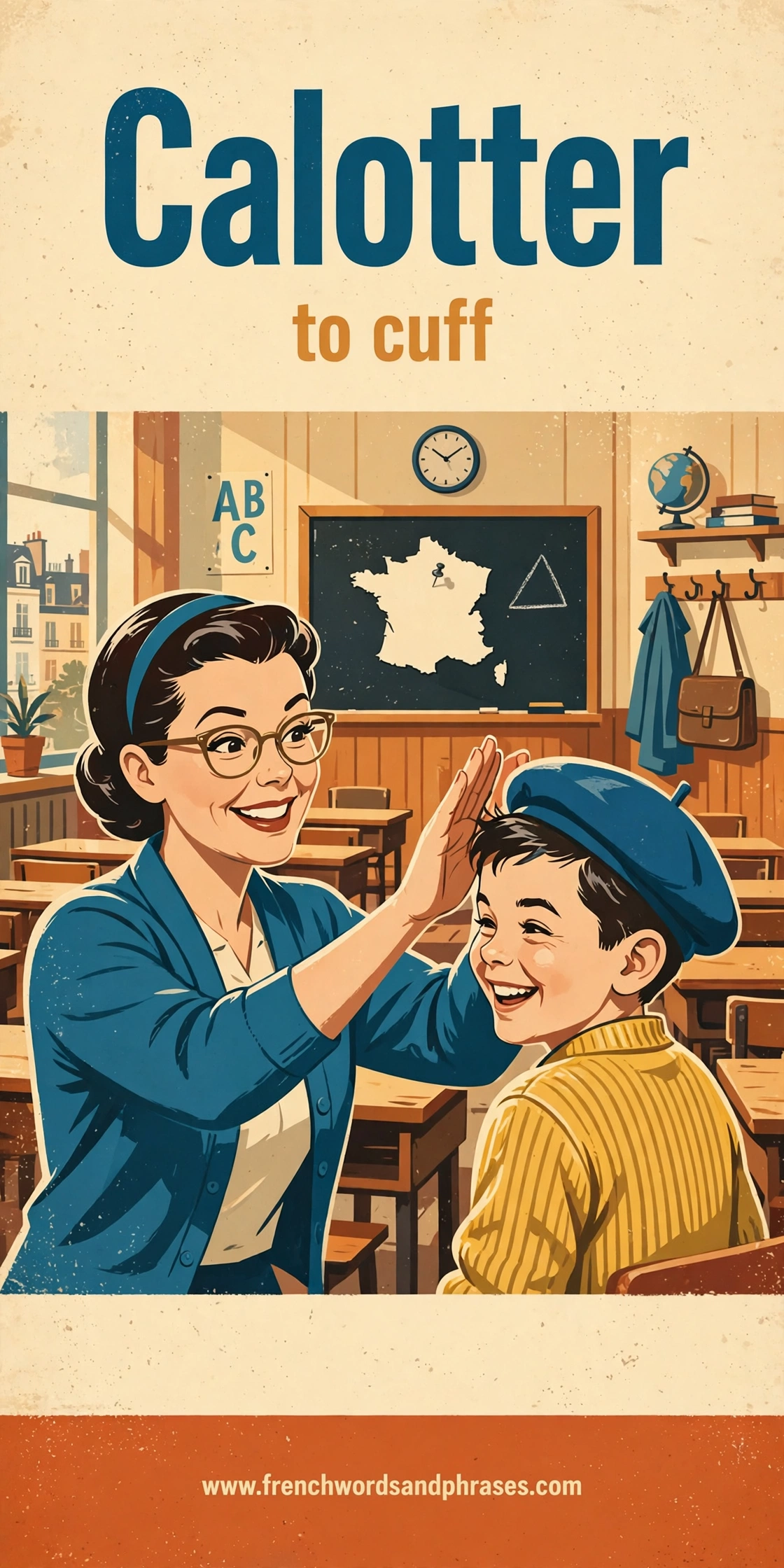
Calotter means to cuff — to give someone a slap, especially a sharp smack on the head or cheek, usually as a quick punishment.
A schoolboy caught whispering once too often, a kitten cuffed gently by its mother — calotter is the verb of the quick, stinging slap: une calotte, delivered on the spot.
In this guide, you’ll learn how to conjugate calotter in all the major French tenses and moods. Explore complete conjugation tables, French examples, English translations, and practice quizzes.
Understanding the French Verb Calotter
Calotter is a regular French verb belonging to the first group of verbs, those ending in-er.
It means to cuff. A calotte is a light, punishing slap — more humiliation than injury, traditionally given to children and rascals. In modern French the verb is somewhat old-fashioned and often half-humorous: one threatens to calotter far more often than one actually does it.
Verb classification: First group (-er)
Auxiliary verb: Avoir
Past participle: calotté
Present participle: calottant
English equivalents: To cuff, to slap, to give a smack; calotter un enfant — to cuff a child; recevoir une calotte — to get a slap; calotter un garnement — to smack a rascal; elle l’a calotté devant tout le monde — she slapped him in front of everyone.
One important detail: the double t is part of the stem and never changes — je calotte, nous calottons, ils calottent, past participle calotté. The verb is built on the noun une calotte, which means both a small skullcap and, in familiar French, a slap — the smack lands where the cap sits. The register is familiar, everyday French rather than formal prose.
Experience the Word
Calotter is the verb of the instant slap — short, sharp, and meant to teach a lesson rather than to wound.
Imagine a 1950s classroom, ink pens and wooden desks. Behind the teacher’s back, little Paul dips his neighbour’s braid in the inkwell for the third time. La maîtresse se retourne, traverse la classe — et le calotte devant tout le monde, sous les rires étouffés.
It hurt his pride far more than his cheek. He had been cuffed — calotté, once, in public, and he never touched the inkwell again.
How to Conjugate Calotter: Complete French Conjugation Guide
Let’s explore every major conjugation of calotter, beginning with the indicative mood.
How to Conjugate Calotter in the Indicative Mood
The indicative mood is used to express facts, observations, actions, and events.
How to Conjugate Calotter in the Present Tense (Présent)
Used for actions happening now, habitual actions, and general truths.
| Subject | Conjugation |
|---|---|
| je | calotte |
| tu | calottes |
| il / elle | calotte |
| nous | calottons |
| vous | calottez |
| ils / elles | calottent |
Example
La maîtresse calotte rarement ses élèves, mais elle menace souvent.
The teacher rarely cuffs her pupils, but she often threatens to.
Quick Quiz 1
Complete the sentence:
Nous ______ rarement les garnements.
Reveal the answer
calottons
Nous calottons rarement les garnements.
We rarely cuff rascals.
How to Conjugate Calotter in the Passé Composé
Used for completed actions in the past. Calotter takes the auxiliary verb avoir.
| Subject | Conjugation |
|---|---|
| j’ | ai calotté |
| tu | as calotté |
| il / elle | a calotté |
| nous | avons calotté |
| vous | avez calotté |
| ils / elles | ont calotté |
Example
Elle a calotté le garnement qui tirait les cheveux de sa sœur.
She cuffed the rascal who was pulling his sister’s hair.
How to Conjugate Calotter in the Imparfait (Imperfect Tense)
Used for habitual past actions, descriptions, and ongoing situations in the past.
| Subject | Conjugation |
|---|---|
| je | calottais |
| tu | calottais |
| il / elle | calottait |
| nous | calottions |
| vous | calottiez |
| ils / elles | calottaient |
Example
Autrefois, les maîtres calottaient les élèves désobéissants.
In the old days, teachers cuffed disobedient pupils.
Quick Quiz 2
Choose the correct form:
She cuffed the rascal.
Elle ______ le garnement. (a calotté / est calottée)
Reveal the answer
a calotté
Elle a calotté le garnement.
Calotter takes avoir.
How to Conjugate Calotter in the Plus-que-parfait
Used to describe an action that had already been completed before another past event.
| Subject | Conjugation |
|---|---|
| j’ | avais calotté |
| tu | avais calotté |
| il / elle | avait calotté |
| nous | avions calotté |
| vous | aviez calotté |
| ils / elles | avaient calotté |
Example
Le père avait calotté son fils avant de l’envoyer au lit.
The father had cuffed his son before sending him to bed.
How to Conjugate Calotter in the Passé Simple
Primarily used in formal writing, literature, and historical narratives. It is rarely used in everyday conversation.
| Subject | Conjugation |
|---|---|
| je | calottai |
| tu | calottas |
| il / elle | calotta |
| nous | calottâmes |
| vous | calottâtes |
| ils / elles | calottèrent |
Example
D’un geste sec, elle calotta le petit insolent.
With a sharp gesture, she cuffed the cheeky little boy.
How to Conjugate Calotter in the Passé Antérieur
A literary tense used to express an action completed immediately before another past action, generally in the passé simple.
| Subject | Conjugation |
|---|---|
| j’ | eus calotté |
| tu | eus calotté |
| il / elle | eut calotté |
| nous | eûmes calotté |
| vous | eûtes calotté |
| ils / elles | eurent calotté |
Example
Quand il eut calotté le chenapan, la classe redevint silencieuse.
When he had cuffed the young scamp, the class fell silent again.
How to Conjugate Calotter in the Future Tense (Futur Simple)
Used to describe actions that will take place in the future.
| Subject | Conjugation |
|---|---|
| je | calotterai |
| tu | calotteras |
| il / elle | calottera |
| nous | calotterons |
| vous | calotterez |
| ils / elles | calotteront |
Example
Si tu continues, je te calotterai devant tout le monde !
If you carry on, I shall cuff you in front of everyone!
How to Conjugate Calotter in the Futur Antérieur (Future Perfect)
Used for an action that will have been completed before a particular point in the future.
| Subject | Conjugation |
|---|---|
| j’ | aurai calotté |
| tu | auras calotté |
| il / elle | aura calotté |
| nous | aurons calotté |
| vous | aurez calotté |
| ils / elles | auront calotté |
Example
À la fin de la journée, elle aura calotté trois garnements.
By the end of the day, she will have cuffed three rascals.
How to Conjugate Calotter in the Near Future (Futur Proche)
Used to describe something that is going to happen soon. Formed with aller + infinitive.
| Subject | Conjugation |
|---|---|
| je | vais calotter |
| tu | vas calotter |
| il / elle | va calotter |
| nous | allons calotter |
| vous | allez calotter |
| ils / elles | vont calotter |
Example
Attention, elle va te calotter si tu ris encore.
Careful, she is going to cuff you if you laugh again.
How to Conjugate Calotter in the Conditional Mood
The conditional mood expresses what would happen under certain circumstances. It is also frequently used to make polite requests or express wishes.
How to Conjugate Calotter in the Present Conditional
| Subject | Conjugation |
|---|---|
| je | calotterais |
| tu | calotterais |
| il / elle | calotterait |
| nous | calotterions |
| vous | calotteriez |
| ils / elles | calotteraient |
Example
Je ne calotterais jamais un enfant, même désobéissant.
I would never cuff a child, even a disobedient one.
How to Conjugate Calotter in the Past Conditional
| Subject | Conjugation |
|---|---|
| j’ | aurais calotté |
| tu | aurais calotté |
| il / elle | aurait calotté |
| nous | aurions calotté |
| vous | auriez calotté |
| ils / elles | auraient calotté |
Example
Tu l’aurais calotté si tu avais vu la scène.
You would have cuffed him if you had seen the scene.
Calotter in the Literary Past Conditional Form
This less common literary form uses the imperfect subjunctive of avoir.
| Subject | Conjugation |
|---|---|
| j’ | eusse calotté |
| tu | eusses calotté |
| il / elle | eût calotté |
| nous | eussions calotté |
| vous | eussiez calotté |
| ils / elles | eussent calotté |
Example
Elle l’eût calotté sans la présence du directeur.
She would have cuffed him had the headmaster not been there.
How to Conjugate Calotter in the Subjunctive Mood
The subjunctive is used to express wishes, emotions, doubts, necessity, and uncertainty. It frequently follows expressions such as il faut que (it is necessary that) or bien que (although).
How to Conjugate Calotter in the Present Subjunctive
| Subject | Conjugation |
|---|---|
| que je | calotte |
| que tu | calottes |
| qu’il / qu’elle | calotte |
| que nous | calottions |
| que vous | calottiez |
| qu’ils / qu’elles | calottent |
Example
Je ne veux pas que tu calottes ton petit frère.
I do not want you cuffing your little brother.
Quick Quiz 3
Complete the sentence using the subjunctive:
Je ne veux pas que vous ______ les élèves.
Reveal the answer
calottiez
Je ne veux pas que vous calottiez les élèves.
I do not want you cuffing the pupils.
How to Conjugate Calotter in the Imperfect Subjunctive
A literary tense, rarely encountered in modern spoken French.
| Subject | Conjugation |
|---|---|
| que je | calottasse |
| que tu | calottasses |
| qu’il / qu’elle | calottât |
| que nous | calottassions |
| que vous | calottassiez |
| qu’ils / qu’elles | calottassent |
Example
Il fallait bien qu’elle calottât le chenapan pour avoir la paix.
She really had to cuff the scamp to get some peace.
How to Conjugate Calotter in the Pluperfect Subjunctive
A literary construction used to express an action completed before another past action.
| Subject | Conjugation |
|---|---|
| que j’ | eusse calotté |
| que tu | eusses calotté |
| qu’il / qu’elle | eût calotté |
| que nous | eussions calotté |
| que vous | eussiez calotté |
| qu’ils / qu’elles | eussent calotté |
Example
On racontait qu’il eût calotté l’insolent devant la classe.
People said he had cuffed the cheeky boy in front of the class.
How to Conjugate Calotter in the Past Subjunctive
| Subject | Conjugation |
|---|---|
| que j’ | aie calotté |
| que tu | aies calotté |
| qu’il / qu’elle | ait calotté |
| que nous | ayons calotté |
| que vous | ayez calotté |
| qu’ils / qu’elles | aient calotté |
Example
Je suis surpris qu’elle ait calotté un élève.
I am surprised she cuffed a pupil.
How to Conjugate Calotter in the Imperative
The imperative is used to give commands, instructions, invitations, or suggestions. Subject pronouns are omitted.
How to Conjugate Calotter in the Present Imperative
| Person | Conjugation |
|---|---|
| (tu) | calotte |
| (nous) | calottons |
| (vous) | calottez |
Example
Ne calotte pas ton frère, parle-lui !
Do not cuff your brother, talk to him!
Quick Quiz 4
How would you say Do not cuff your brother (tu form)?
Reveal the answer
Ne calotte pas ton frère !
French Participles of Calotter
Participles are verb forms that can be used in compound tenses and other grammatical constructions.
Present Participle of Calotter
calottant
En calottant le garnement, elle a fait rire toute la classe.
By cuffing the rascal, she made the whole class laugh.
Past Participle of Calotter
calotté
Calotté par sa grand-mère, le petit garçon a couru se cacher.
Cuffed by his grandmother, the little boy ran off to hide.
Calotter in Everyday French: Real-Life Examples
Now that you know the conjugations, let’s see how calotter appears in everyday French.
Example 1 — Present
Elle calotte rarement ses élèves.
She rarely cuffs her pupils.
Example 2 — Passé composé
Elle a calotté le garnement.
She cuffed the rascal.
Example 3 — Imparfait
Les maîtres calottaient les insolents.
Teachers used to cuff cheeky pupils.
Example 4 — Future
Je te calotterai si tu continues !
I shall cuff you if you carry on!
Example 5 — Conditional
Je ne calotterais jamais un enfant.
I would never cuff a child.
Example 6 — Imperative
Ne calotte pas ton frère !
Do not cuff your brother!
Beyond Translation: The Meaning of Calotter
English to cuff is a happy match — a cuff is a blow with the open hand, and French calotter is built on une calotte, the little cap that sits on the crown of the head.
The slap lands where the cap sits.
The same word calotte also names the skullcap of a priest and the ice cap of a pole — but when a grandmother raises her hand, there is no doubt which calotte she means.
How to Remember the French Verb Calotter
Remember it this way: Calotter is about a slap landing where the little cap sits.
- Double t in every form: je calotte, nous calottons, calotté.
- Une calotte is both a skullcap and a slap — the slap lands where the cap sits.
- Familiar register: a threat made ten times more often than it is carried out.
The key idea is a slap landing where the little cap sits.
Test Your Knowledge of Calotter
Let’s see how much you’ve learned. Try answering these questions before revealing the answers.
Question 1
What noun is calotter built on, and what are its two meanings?
Reveal the answer
Une calotte — a small skullcap, and, in familiar French, a slap.
Question 2
How do you say She cuffed the rascal in French?
Reveal the answer
Elle a calotté le garnement.
Question 3
Translate: I would never cuff a child.
Reveal the answer
Je ne calotterais jamais un enfant.
Question 4
What is the past participle of calotter?
Reveal the answer
Calotté.
Question 5
Complete the sentence:
Je ne veux pas que tu ______ ton petit frère.
Reveal the answer
calottes
Je ne veux pas que tu calottes ton petit frère.
I do not want you cuffing your little brother.
Your Final Challenge
Can You Use It?
How would you say this in French?
Cuffed just once in front of the whole class, little Paul kept a lifelong respect for inkwells.
Reveal the answer
Calotté une seule fois devant toute la classe, le petit Paul garda pour toujours le respect des encriers.
Cuffed just once in front of the whole class, little Paul kept a lifelong respect for inkwells.
A little French. A little curiosity. A richer everyday life.
LEARN FRENCH ONE WORD AT A TIME




