
A French Word to Live By
How to Conjugate Caillouter in French
/ka.ju.te/
Caillouter means to ballast, to gravel — to spread a path, a yard or a railway bed with small stones so that feet and wheels stop sinking into mud.
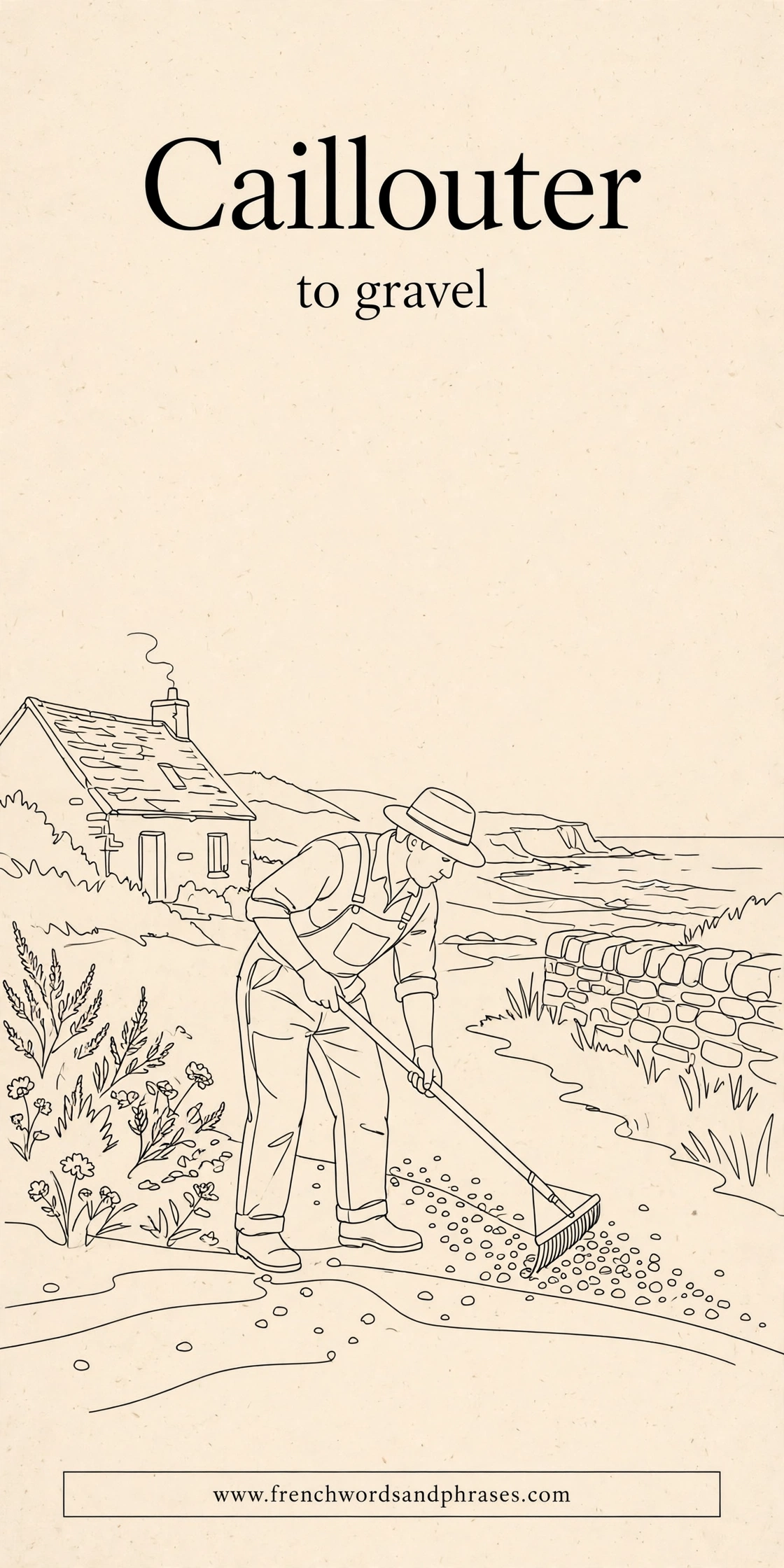
A wheelbarrow of gravel tipping onto a muddy farm track, shovels raking the stones level, boots crunching where yesterday they squelched — caillouter is the road-mender’s verb: the sound of a path being made walkable, one stone at a time.
In this guide, you’ll learn how to conjugate caillouter in all the major French tenses and moods. Explore complete conjugation tables, French examples, English translations, and practice quizzes.
Understanding the French Verb Caillouter
Caillouter is a regular French verb belonging to the first group of verbs, those ending in-er.
It means to ballast, to gravel. It belongs to farms, gardens, country lanes and railway yards — anywhere mud is the enemy and small stones are the cheap, eternal answer. An allée cailloutée crunches underfoot in French gardens exactly as a gravel drive does in English ones.
Verb classification: First group (-er)
Auxiliary verb: Avoir
Past participle: caillouté
Present participle: cailloutant
English equivalents: To gravel, to ballast, to metal a road; caillouter un chemin — to gravel a path; caillouter une allée — to gravel a drive; un sentier caillouté — a gravelled path; le cailloutage d’une cour — the gravelling of a yard.
One important detail: caillouter is simply un caillou, a pebble or small stone, turned into a verb — to caillouter a path is to pebble it. The double l and the ou belong to the stem and never change: je cailloute, nous cailloutons, past participle caillouté. In railway language the same stones are le ballast, and caillouter la voie is to ballast the track. A plain regular -er verb — the only trap is pronouncing the -ill- as a y sound, as in caillou itself.
Experience the Word
Caillouter is the verb of the crunch under the boot — the transformation of a muddy track into a path that sings when you walk on it.
Imagine a Burgundy farmyard after a wet October. The track to the barn is a soup of mud; the farmer backs his trailer up the lane and tips a load of river stones — puis, à la pelle et au râteau, il cailloute le chemin, and by evening the cart rolls where the boots used to sink.
No tarmac, no machinery. The path has simply been gravelled — caillouté, stone by honest stone.
How to Conjugate Caillouter: Complete French Conjugation Guide
Let’s explore every major conjugation of caillouter, beginning with the indicative mood.
How to Conjugate Caillouter in the Indicative Mood
The indicative mood is used to express facts, observations, actions, and events.
How to Conjugate Caillouter in the Present Tense (Présent)
Used for actions happening now, habitual actions, and general truths.
| Subject | Conjugation |
|---|---|
| je | cailloute |
| tu | cailloutes |
| il / elle | cailloute |
| nous | cailloutons |
| vous | cailloutez |
| ils / elles | cailloutent |
Example
Les ouvriers cailloutent l’allée du jardin.
The workmen are gravelling the garden path.
Quick Quiz 1
Complete the sentence:
Nous ______ la cour avant l’hiver.
Reveal the answer
cailloutons
Nous cailloutons la cour avant l’hiver.
We are gravelling the yard before winter.
How to Conjugate Caillouter in the Passé Composé
Used for completed actions in the past. Caillouter takes the auxiliary verb avoir.
| Subject | Conjugation |
|---|---|
| j’ | ai caillouté |
| tu | as caillouté |
| il / elle | a caillouté |
| nous | avons caillouté |
| vous | avez caillouté |
| ils / elles | ont caillouté |
Example
Nous avons caillouté le chemin avant l’hiver.
We gravelled the track before winter.
How to Conjugate Caillouter in the Imparfait (Imperfect Tense)
Used for habitual past actions, descriptions, and ongoing situations in the past.
| Subject | Conjugation |
|---|---|
| je | cailloutais |
| tu | cailloutais |
| il / elle | cailloutait |
| nous | cailloutions |
| vous | cailloutiez |
| ils / elles | cailloutaient |
Example
Autrefois, les cantonniers cailloutaient les routes à la main.
In the old days, roadmen used to gravel the roads by hand.
Quick Quiz 2
Choose the correct form:
We gravelled the track.
Nous ______ le chemin. (avons caillouté / sommes cailloutés)
Reveal the answer
avons caillouté
Nous avons caillouté le chemin.
Caillouter takes avoir.
How to Conjugate Caillouter in the Plus-que-parfait
Used to describe an action that had already been completed before another past event.
| Subject | Conjugation |
|---|---|
| j’ | avais caillouté |
| tu | avais caillouté |
| il / elle | avait caillouté |
| nous | avions caillouté |
| vous | aviez caillouté |
| ils / elles | avaient caillouté |
Example
Il avait caillouté la cour avant la saison des pluies.
He had gravelled the yard before the rainy season.
How to Conjugate Caillouter in the Passé Simple
Primarily used in formal writing, literature, and historical narratives. It is rarely used in everyday conversation.
| Subject | Conjugation |
|---|---|
| je | cailloutai |
| tu | cailloutas |
| il / elle | caillouta |
| nous | cailloutâmes |
| vous | cailloutâtes |
| ils / elles | cailloutèrent |
Example
La commune caillouta le sentier jusqu’à la chapelle.
The village gravelled the path up to the chapel.
How to Conjugate Caillouter in the Passé Antérieur
A literary tense used to express an action completed immediately before another past action, generally in the passé simple.
| Subject | Conjugation |
|---|---|
| j’ | eus caillouté |
| tu | eus caillouté |
| il / elle | eut caillouté |
| nous | eûmes caillouté |
| vous | eûtes caillouté |
| ils / elles | eurent caillouté |
Example
Quand ils eurent caillouté la piste, les camions purent passer.
When they had gravelled the track, the lorries could get through.
How to Conjugate Caillouter in the Future Tense (Futur Simple)
Used to describe actions that will take place in the future.
| Subject | Conjugation |
|---|---|
| je | caillouterai |
| tu | caillouteras |
| il / elle | cailloutera |
| nous | caillouterons |
| vous | caillouterez |
| ils / elles | caillouteront |
Example
Demain, nous caillouterons l’entrée du champ.
Tomorrow, we will gravel the entrance to the field.
How to Conjugate Caillouter in the Futur Antérieur (Future Perfect)
Used for an action that will have been completed before a particular point in the future.
| Subject | Conjugation |
|---|---|
| j’ | aurai caillouté |
| tu | auras caillouté |
| il / elle | aura caillouté |
| nous | aurons caillouté |
| vous | aurez caillouté |
| ils / elles | auront caillouté |
Example
Quand vous aurez caillouté l’allée, elle restera propre même sous la pluie.
Once you have gravelled the drive, it will stay clean even in the rain.
How to Conjugate Caillouter in the Near Future (Futur Proche)
Used to describe something that is going to happen soon. Formed with aller + infinitive.
| Subject | Conjugation |
|---|---|
| je | vais caillouter |
| tu | vas caillouter |
| il / elle | va caillouter |
| nous | allons caillouter |
| vous | allez caillouter |
| ils / elles | vont caillouter |
Example
Je vais caillouter le tour de la maison ce week-end.
I am going to gravel around the house this weekend.
How to Conjugate Caillouter in the Conditional Mood
The conditional mood expresses what would happen under certain circumstances. It is also frequently used to make polite requests or express wishes.
How to Conjugate Caillouter in the Present Conditional
| Subject | Conjugation |
|---|---|
| je | caillouterais |
| tu | caillouterais |
| il / elle | caillouterait |
| nous | caillouterions |
| vous | caillouteriez |
| ils / elles | caillouteraient |
Example
Le chemin caillouterait mieux avec des pierres plus fines.
The path would gravel better with finer stones.
How to Conjugate Caillouter in the Past Conditional
| Subject | Conjugation |
|---|---|
| j’ | aurais caillouté |
| tu | aurais caillouté |
| il / elle | aurait caillouté |
| nous | aurions caillouté |
| vous | auriez caillouté |
| ils / elles | auraient caillouté |
Example
Nous aurions caillouté la cour sans la panne du tracteur.
We would have gravelled the yard if the tractor had not broken down.
Caillouter in the Literary Past Conditional Form
This less common literary form uses the imperfect subjunctive of avoir.
| Subject | Conjugation |
|---|---|
| j’ | eusse caillouté |
| tu | eusses caillouté |
| il / elle | eût caillouté |
| nous | eussions caillouté |
| vous | eussiez caillouté |
| ils / elles | eussent caillouté |
Example
Les cantonniers eussent caillouté la route en une semaine.
The roadmen would have gravelled the road in a week.
How to Conjugate Caillouter in the Subjunctive Mood
The subjunctive is used to express wishes, emotions, doubts, necessity, and uncertainty. It frequently follows expressions such as il faut que (it is necessary that) or bien que (although).
How to Conjugate Caillouter in the Present Subjunctive
| Subject | Conjugation |
|---|---|
| que je | cailloute |
| que tu | cailloutes |
| qu’il / qu’elle | cailloute |
| que nous | cailloutions |
| que vous | cailloutiez |
| qu’ils / qu’elles | cailloutent |
Example
Il faut que la commune cailloute le sentier avant l’automne.
The village must gravel the path before autumn.
Quick Quiz 3
Complete the sentence using the subjunctive:
Il faut que vous ______ l’allée jusqu’au portail.
Reveal the answer
cailloutiez
Il faut que vous cailloutiez l’allée jusqu’au portail.
You must gravel the drive right up to the gate.
How to Conjugate Caillouter in the Imperfect Subjunctive
A literary tense, rarely encountered in modern spoken French.
| Subject | Conjugation |
|---|---|
| que je | cailloutasse |
| que tu | cailloutasses |
| qu’il / qu’elle | cailloutât |
| que nous | cailloutassions |
| que vous | cailloutassiez |
| qu’ils / qu’elles | cailloutassent |
Example
Je souhaitais qu’on cailloutât l’allée jusqu’au portail.
I wanted them to gravel the drive right up to the gate.
How to Conjugate Caillouter in the Pluperfect Subjunctive
A literary construction used to express an action completed before another past action.
| Subject | Conjugation |
|---|---|
| que j’ | eusse caillouté |
| que tu | eusses caillouté |
| qu’il / qu’elle | eût caillouté |
| que nous | eussions caillouté |
| que vous | eussiez caillouté |
| qu’ils / qu’elles | eussent caillouté |
Example
On racontait que les moines eussent caillouté le chemin de la chapelle.
People said the monks had gravelled the path to the chapel.
How to Conjugate Caillouter in the Past Subjunctive
| Subject | Conjugation |
|---|---|
| que j’ | aie caillouté |
| que tu | aies caillouté |
| qu’il / qu’elle | ait caillouté |
| que nous | ayons caillouté |
| que vous | ayez caillouté |
| qu’ils / qu’elles | aient caillouté |
Example
Je suis content que vous ayez caillouté l’entrée.
I am glad you gravelled the entrance.
How to Conjugate Caillouter in the Imperative
The imperative is used to give commands, instructions, invitations, or suggestions. Subject pronouns are omitted.
How to Conjugate Caillouter in the Present Imperative
| Person | Conjugation |
|---|---|
| (tu) | cailloute |
| (nous) | cailloutons |
| (vous) | cailloutez |
Example
Cailloute bien les bords du chemin !
Gravel the edges of the path properly!
Quick Quiz 4
How would you say Gravel the edges properly (tu form)?
Reveal the answer
Cailloute bien les bords !
French Participles of Caillouter
Participles are verb forms that can be used in compound tenses and other grammatical constructions.
Present Participle of Caillouter
cailloutant
En cailloutant la cour, ils ont retrouvé une vieille pièce.
While gravelling the yard, they found an old coin.
Past Participle of Caillouter
caillouté
Caillouté au printemps, le chemin est resté sec tout l’hiver.
Gravelled in spring, the path stayed dry all winter.
Caillouter in Everyday French: Real-Life Examples
Now that you know the conjugations, let’s see how caillouter appears in everyday French.
Example 1 — Present
Les ouvriers cailloutent l’allée.
The workmen are gravelling the path.
Example 2 — Passé composé
Nous avons caillouté le chemin.
We gravelled the track.
Example 3 — Imparfait
Les cantonniers cailloutaient les routes à la main.
The roadmen used to gravel the roads by hand.
Example 4 — Future
Nous caillouterons l’entrée demain.
We will gravel the entrance tomorrow.
Example 5 — Conditional
Le chemin caillouterait mieux avec des pierres fines.
The path would gravel better with fine stones.
Example 6 — Imperative
Cailloute bien les bords !
Gravel the edges properly!
Beyond Translation: The Meaning of Caillouter
English to gravel and to ballast divide the work; French caillouter does both with a child’s word — un caillou, the pebble every French schoolchild has in a pocket.
It is the pebble, promoted to a trade.
From garden paths to railway ballast, the principle never changes: small stones, spread thick, turn mud into music — the crunch of a well-caillouté path is one of the oldest sounds of the French countryside.
How to Remember the French Verb Caillouter
Remember it this way: Caillouter is about the wheelbarrow of pebbles tipping onto the muddy track.
- Un caillou is a pebble — caillouter a path is to pebble it, thoroughly.
- Railway French uses the same verb for ballast: caillouter la voie.
- Regular -er: je cailloute, nous cailloutons, past participle caillouté.
The key idea is the wheelbarrow of pebbles tipping onto the muddy track.
Test Your Knowledge of Caillouter
Let’s see how much you’ve learned. Try answering these questions before revealing the answers.
Question 1
What is un caillou?
Reveal the answer
A pebble, a small stone — caillouter is to cover a path with them.
Question 2
How do you say The workmen are gravelling the path in French?
Reveal the answer
Les ouvriers cailloutent l’allée.
Question 3
Translate: We gravelled the track before winter.
Reveal the answer
Nous avons caillouté le chemin avant l’hiver.
Question 4
What is the past participle of caillouter?
Reveal the answer
Caillouté — un sentier caillouté, a gravelled path.
Question 5
Complete the sentence:
Il faut que la commune ______ le sentier avant l’automne.
Reveal the answer
cailloute
Il faut que la commune cailloute le sentier avant l’automne.
The village must gravel the path before autumn.
Your Final Challenge
Can You Use It?
How would you say this in French?
They gravel the path stone by stone, and soon boots will sing where mud once reigned.
Reveal the answer
Ils cailloutent le chemin pierre à pierre, et bientôt les bottes chanteront où la boue régnait.
They gravel the path stone by stone, and soon boots will sing where mud once reigned.
A little French. A little curiosity. A richer everyday life.
LEARN FRENCH ONE WORD AT A TIME




