
A French Word to Live By
How to Conjugate Cafouiller in French
/ka.fu.je/
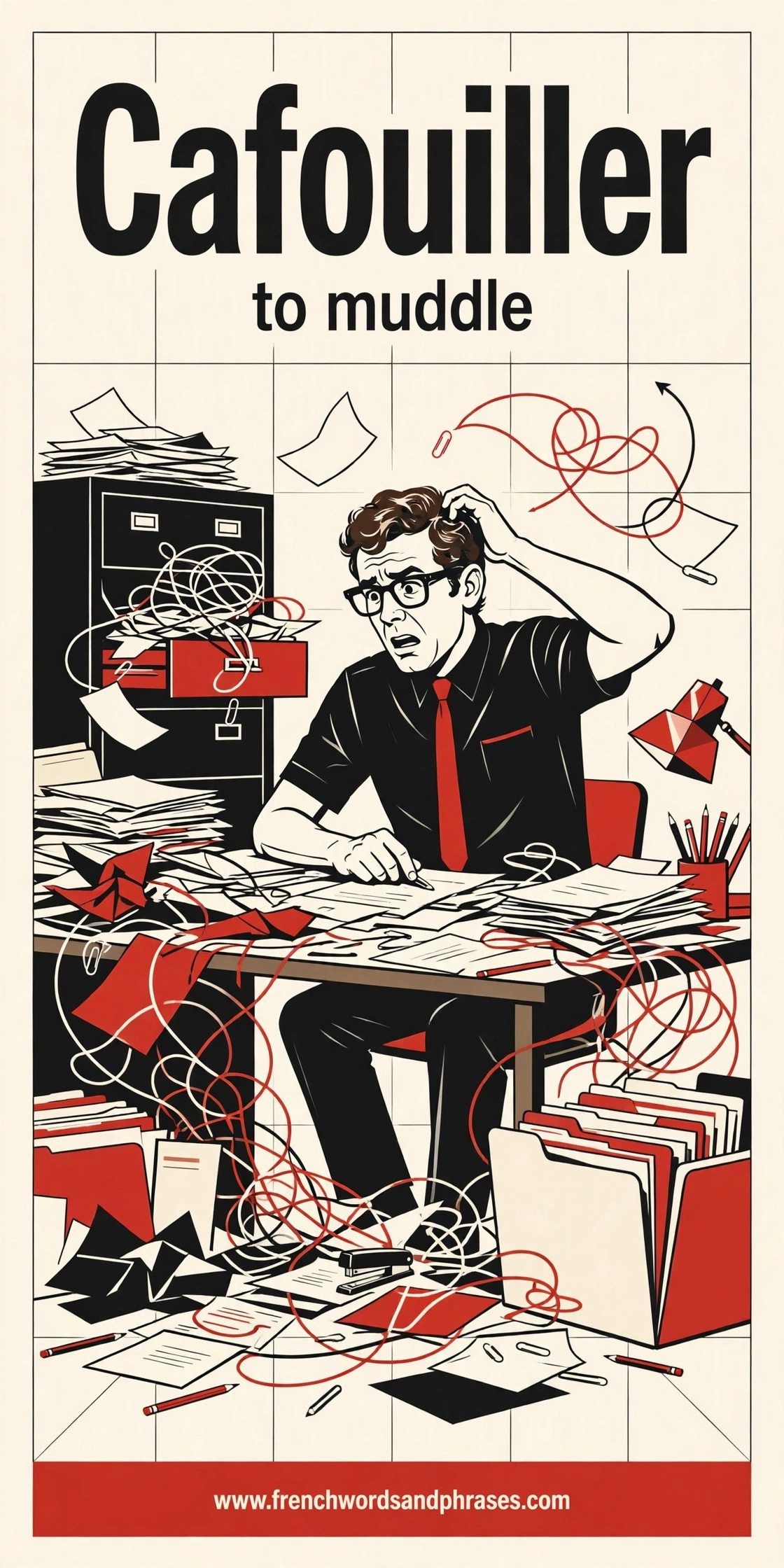
Cafouiller means to muddle, to flounder — to make a confused mess of a job, a speech or an explanation, losing the thread as you go.
A student blundering through an oral exam, a cook who has lost the recipe halfway through the sauce, a minister tangling his own figures at the microphone — cafouiller is the familiar verb of the muddle: plenty of movement, no progress.
In this guide, you’ll learn how to conjugate cafouiller in all the major French tenses and moods. Explore complete conjugation tables, French examples, English translations, and practice quizzes.
Understanding the French Verb Cafouiller
Cafouiller is a regular French verb belonging to the first group of verbs, those ending in-er.
It means to muddle, to flounder. It suits botched explanations, botched repairs and botched performances — work done in confusion rather than in bad faith. A machine or a plan can cafouiller too: quand tout cafouille, everything is going wrong at once, and nobody quite knows why.
Verb classification: First group (-er)
Auxiliary verb: Avoir
Past participle: cafouillé
Present participle: cafouillant
English equivalents: To muddle, to flounder, to make a mess of things (fam.); cafouiller dans ses explications — to get muddled in one’s explanations; cafouiller un travail — to bungle a job; tout cafouille — everything is going haywire; un beau cafouillage — a fine old muddle.
One important detail: cafouiller is familier — the spoken word for making a hash of something; in careful writing you would meet s’embrouiller or faire des erreurs. Its favourite construction is cafouiller dans: il cafouille dans ses papiers, elle cafouille dans sa présentation. The spelling is a plain regular -er pattern with a double l in the stem: je cafouille, nous cafouillons, past participle cafouillé — and the noun un cafouillage is just as common for the muddle itself.
Experience the Word
Cafouiller is the verb of the lost thread — hands busy, papers everywhere, and the one page you need nowhere to be found.
Imagine the morning of a village wedding. The best man has lost the rings, the cake is leaning, and the mayor is reading the wrong couple’s names. Tout le monde cafouille — everyone is floundering at once, in a panic of good intentions, until the grandmother takes charge.
Nothing was ruined. It had simply been muddled — cafouillé, thoroughly, by everyone at the same time.
How to Conjugate Cafouiller: Complete French Conjugation Guide
Let’s explore every major conjugation of cafouiller, beginning with the indicative mood.
How to Conjugate Cafouiller in the Indicative Mood
The indicative mood is used to express facts, observations, actions, and events.
How to Conjugate Cafouiller in the Present Tense (Présent)
Used for actions happening now, habitual actions, and general truths.
| Subject | Conjugation |
|---|---|
| je | cafouille |
| tu | cafouilles |
| il / elle | cafouille |
| nous | cafouillons |
| vous | cafouillez |
| ils / elles | cafouillent |
Example
Il cafouille dans ses explications depuis le début.
He has been floundering in his explanations from the start.
Quick Quiz 1
Complete the sentence:
Nous ______ dans nos papiers depuis une heure.
Reveal the answer
cafouillons
Nous cafouillons dans nos papiers depuis une heure.
We have been fumbling through our papers for an hour.
How to Conjugate Cafouiller in the Passé Composé
Used for completed actions in the past. Cafouiller takes the auxiliary verb avoir.
| Subject | Conjugation |
|---|---|
| j’ | ai cafouillé |
| tu | as cafouillé |
| il / elle | a cafouillé |
| nous | avons cafouillé |
| vous | avez cafouillé |
| ils / elles | ont cafouillé |
Example
Le réparateur a cafouillé et la machine marche encore moins bien.
The repairman made a mess of it and the machine works even worse.
How to Conjugate Cafouiller in the Imparfait (Imperfect Tense)
Used for habitual past actions, descriptions, and ongoing situations in the past.
| Subject | Conjugation |
|---|---|
| je | cafouillais |
| tu | cafouillais |
| il / elle | cafouillait |
| nous | cafouillions |
| vous | cafouilliez |
| ils / elles | cafouillaient |
Example
Pendant l’examen, elle cafouillait dès qu’on lui posait une question.
During the exam, she floundered whenever she was asked a question.
Quick Quiz 2
Choose the correct form:
She made a mess of the exercise.
Elle ______ l’exercice. (a cafouillé / est cafouillée)
Reveal the answer
a cafouillé
Elle a cafouillé l’exercice.
Cafouiller takes avoir.
How to Conjugate Cafouiller in the Plus-que-parfait
Used to describe an action that had already been completed before another past event.
| Subject | Conjugation |
|---|---|
| j’ | avais cafouillé |
| tu | avais cafouillé |
| il / elle | avait cafouillé |
| nous | avions cafouillé |
| vous | aviez cafouillé |
| ils / elles | avaient cafouillé |
Example
Ils avaient cafouillé le dossier avant mon arrivée.
They had made a muddle of the file before I arrived.
How to Conjugate Cafouiller in the Passé Simple
Primarily used in formal writing, literature, and historical narratives. It is rarely used in everyday conversation.
| Subject | Conjugation |
|---|---|
| je | cafouillai |
| tu | cafouillas |
| il / elle | cafouilla |
| nous | cafouillâmes |
| vous | cafouillâtes |
| ils / elles | cafouillèrent |
Example
Le ministre cafouilla dans ses chiffres devant les caméras.
The minister got muddled in his figures in front of the cameras.
How to Conjugate Cafouiller in the Passé Antérieur
A literary tense used to express an action completed immediately before another past action, generally in the passé simple.
| Subject | Conjugation |
|---|---|
| j’ | eus cafouillé |
| tu | eus cafouillé |
| il / elle | eut cafouillé |
| nous | eûmes cafouillé |
| vous | eûtes cafouillé |
| ils / elles | eurent cafouillé |
Example
Quand il eut cafouillé trois fois, le professeur l’arrêta.
When he had floundered three times, the teacher stopped him.
How to Conjugate Cafouiller in the Future Tense (Futur Simple)
Used to describe actions that will take place in the future.
| Subject | Conjugation |
|---|---|
| je | cafouillerai |
| tu | cafouilleras |
| il / elle | cafouillera |
| nous | cafouillerons |
| vous | cafouillerez |
| ils / elles | cafouilleront |
Example
Si tu ne prépares rien, tu cafouilleras comme la dernière fois.
If you prepare nothing, you will flounder like last time.
How to Conjugate Cafouiller in the Futur Antérieur (Future Perfect)
Used for an action that will have been completed before a particular point in the future.
| Subject | Conjugation |
|---|---|
| j’ | aurai cafouillé |
| tu | auras cafouillé |
| il / elle | aura cafouillé |
| nous | aurons cafouillé |
| vous | aurez cafouillé |
| ils / elles | auront cafouillé |
Example
À ce rythme, ils auront cafouillé tout le chantier avant midi.
At this rate, they will have made a mess of the whole site before noon.
How to Conjugate Cafouiller in the Near Future (Futur Proche)
Used to describe something that is going to happen soon. Formed with aller + infinitive.
| Subject | Conjugation |
|---|---|
| je | vais cafouiller |
| tu | vas cafouiller |
| il / elle | va cafouiller |
| nous | allons cafouiller |
| vous | allez cafouiller |
| ils / elles | vont cafouiller |
Example
Attention, ce montage va cafouiller si tu serres trop fort.
Careful, this assembly is going to go wrong if you tighten it too much.
How to Conjugate Cafouiller in the Conditional Mood
The conditional mood expresses what would happen under certain circumstances. It is also frequently used to make polite requests or express wishes.
How to Conjugate Cafouiller in the Present Conditional
| Subject | Conjugation |
|---|---|
| je | cafouillerais |
| tu | cafouillerais |
| il / elle | cafouillerait |
| nous | cafouillerions |
| vous | cafouilleriez |
| ils / elles | cafouilleraient |
Example
Sans ses notes, elle cafouillerait pendant toute la présentation.
Without her notes, she would flounder through the whole presentation.
How to Conjugate Cafouiller in the Past Conditional
| Subject | Conjugation |
|---|---|
| j’ | aurais cafouillé |
| tu | aurais cafouillé |
| il / elle | aurait cafouillé |
| nous | aurions cafouillé |
| vous | auriez cafouillé |
| ils / elles | auraient cafouillé |
Example
Tu aurais moins cafouillé avec un plan clair.
You would have muddled less with a clear plan.
Cafouiller in the Literary Past Conditional Form
This less common literary form uses the imperfect subjunctive of avoir.
| Subject | Conjugation |
|---|---|
| j’ | eusse cafouillé |
| tu | eusses cafouillé |
| il / elle | eût cafouillé |
| nous | eussions cafouillé |
| vous | eussiez cafouillé |
| ils / elles | eussent cafouillé |
Example
Le candidat eût cafouillé sans la question facile du jury.
The candidate would have floundered without the jury’s easy question.
How to Conjugate Cafouiller in the Subjunctive Mood
The subjunctive is used to express wishes, emotions, doubts, necessity, and uncertainty. It frequently follows expressions such as il faut que (it is necessary that) or bien que (although).
How to Conjugate Cafouiller in the Present Subjunctive
| Subject | Conjugation |
|---|---|
| que je | cafouille |
| que tu | cafouilles |
| qu’il / qu’elle | cafouille |
| que nous | cafouillions |
| que vous | cafouilliez |
| qu’ils / qu’elles | cafouillent |
Example
Je crains qu’il cafouille encore dans ses réponses.
I am afraid he will get muddled in his answers again.
Quick Quiz 3
Complete the sentence using the subjunctive:
Je crains que vous ______ dans vos réponses.
Reveal the answer
cafouilliez
Je crains que vous cafouilliez dans vos réponses.
I am afraid you will get muddled in your answers.
How to Conjugate Cafouiller in the Imperfect Subjunctive
A literary tense, rarely encountered in modern spoken French.
| Subject | Conjugation |
|---|---|
| que je | cafouillasse |
| que tu | cafouillasses |
| qu’il / qu’elle | cafouillât |
| que nous | cafouillassions |
| que vous | cafouillassiez |
| qu’ils / qu’elles | cafouillassent |
Example
On redoutait que le moteur cafouillât avant la côte.
They feared the engine might splutter and falter before the hill.
How to Conjugate Cafouiller in the Pluperfect Subjunctive
A literary construction used to express an action completed before another past action.
| Subject | Conjugation |
|---|---|
| que j’ | eusse cafouillé |
| que tu | eusses cafouillé |
| qu’il / qu’elle | eût cafouillé |
| que nous | eussions cafouillé |
| que vous | eussiez cafouillé |
| qu’ils / qu’elles | eussent cafouillé |
Example
On racontait que l’équipe eût cafouillé le chantier entier.
People said the team had made a mess of the whole site.
How to Conjugate Cafouiller in the Past Subjunctive
| Subject | Conjugation |
|---|---|
| que j’ | aie cafouillé |
| que tu | aies cafouillé |
| qu’il / qu’elle | ait cafouillé |
| que nous | ayons cafouillé |
| que vous | ayez cafouillé |
| qu’ils / qu’elles | aient cafouillé |
Example
Je suis étonné qu’elle ait cafouillé un exercice si simple.
I am surprised she made a mess of such a simple exercise.
How to Conjugate Cafouiller in the Imperative
The imperative is used to give commands, instructions, invitations, or suggestions. Subject pronouns are omitted.
How to Conjugate Cafouiller in the Present Imperative
| Person | Conjugation |
|---|---|
| (tu) | cafouille |
| (nous) | cafouillons |
| (vous) | cafouillez |
Example
Ne cafouille pas, reprends ton plan calmement !
Do not get muddled, go back to your plan calmly!
Quick Quiz 4
How would you say Do not get muddled (tu form)?
Reveal the answer
Ne cafouille pas !
French Participles of Cafouiller
Participles are verb forms that can be used in compound tenses and other grammatical constructions.
Present Participle of Cafouiller
cafouillant
En cafouillant dans ses papiers, il a perdu le contrat.
By fumbling through his papers, he lost the contract.
Past Participle of Cafouiller
cafouillé
Cafouillé du début à la fin, le discours n’a convaincu personne.
Muddled from start to finish, the speech convinced nobody.
Cafouiller in Everyday French: Real-Life Examples
Now that you know the conjugations, let’s see how cafouiller appears in everyday French.
Example 1 — Present
Il cafouille dans ses explications.
He is floundering in his explanations.
Example 2 — Passé composé
Le réparateur a cafouillé le moteur.
The repairman made a mess of the engine.
Example 3 — Imparfait
Elle cafouillait pendant tout l’examen.
She floundered through the whole exam.
Example 4 — Future
Tu cafouilleras si tu ne prépares rien.
You will flounder if you prepare nothing.
Example 5 — Conditional
Sans ses notes, elle cafouillerait.
Without her notes, she would flounder.
Example 6 — Imperative
Ne cafouille pas, respire et recommence !
Do not get muddled, breathe and start again!
Beyond Translation: The Meaning of Cafouiller
English to flounder is the closest cousin in spirit — both verbs picture someone splashing about without getting anywhere — but French cafouiller is strictly familier, the word of kitchens, classrooms and workshops.
Its noun is a small masterpiece: un cafouillage.
Say quel cafouillage ! of a botched meeting or a tangled administration, and every French listener pictures the same scene: too many hands, no plan, and the thread lost long ago.
How to Remember the French Verb Cafouiller
Remember it this way: Cafouiller is about the lost thread — busy hands, papers everywhere, no progress.
- Familier register: cafouiller is the spoken word for muddling a job — writing prefers s’embrouiller.
- Cafouiller dans quelque chose: il cafouille dans ses papiers, dans ses explications.
- Regular -er with a double-l stem: je cafouille, nous cafouillons, past participle cafouillé.
The key idea is the lost thread — busy hands, papers everywhere, no progress.
Test Your Knowledge of Cafouiller
Let’s see how much you’ve learned. Try answering these questions before revealing the answers.
Question 1
Which construction does cafouiller love?
Reveal the answer
Cafouiller dans — il cafouille dans ses papiers, elle cafouille dans sa présentation.
Question 2
How do you say He is floundering in his explanations in French?
Reveal the answer
Il cafouille dans ses explications.
Question 3
Translate: The repairman made a mess of the engine.
Reveal the answer
Le réparateur a cafouillé le moteur.
Question 4
What is the past participle of cafouiller?
Reveal the answer
Cafouillé — and un cafouillage is a muddle.
Question 5
Complete the sentence:
Je crains qu’il ______ encore dans ses réponses.
Reveal the answer
cafouille
Je crains qu’il cafouille encore dans ses réponses.
I am afraid he will get muddled in his answers again.
Your Final Challenge
Can You Use It?
How would you say this in French?
He flounders for a moment in his notes, then looks up and finally finds the right word.
Reveal the answer
Il cafouille un instant dans ses notes, puis relève la tête et trouve enfin le mot juste.
He flounders for a moment in his notes, then looks up and finally finds the right word.
A little French. A little curiosity. A richer everyday life.
LEARN FRENCH ONE WORD AT A TIME




