A French Word to Live By
How to Conjugate Cacaber in French
/ka.ka.be/
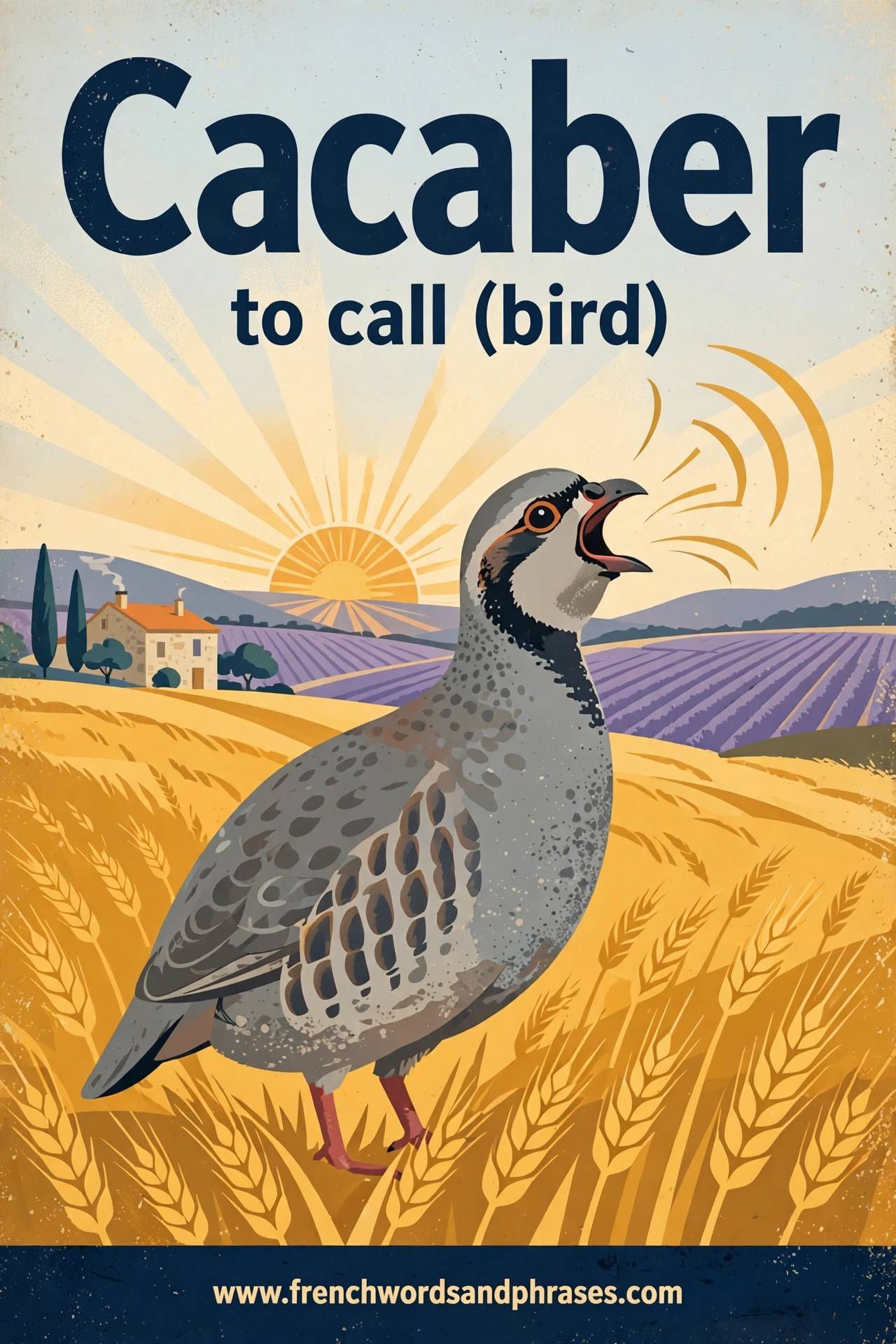
Cacaber means to call — the dry, rattling cry of the partridge, a sound-word for one very particular bird voice.
A red-legged partridge calling from the stubble at dawn — cacaber is one of French’s precise bird-verbs: every species, in the old hunting language, has its own verb for its own voice, and this one belongs to the partridge.
In this guide, you’ll learn how to conjugate cacaber in all the major French tenses and moods. Explore complete conjugation tables, French examples, English translations, and practice quizzes.
Understanding the French Verb Cacaber
Cacaber is a regular French verb belonging to the first group of verbs, those ending in-er.
It means to call (bird). You will meet it in hunting writing, nature guides and older country literature rather than in town conversation. It names the partridge’s call specifically — a short, harsh, repeated cry used to gather the covey — and using the right bird-verb is a point of honour among French hunters and ornithologists.
Verb classification: First group (-er)
Auxiliary verb: Avoir
Past participle: cacabé
Present participle: cacabant
English equivalents: To call (of a partridge); la perdrix cacabe — the partridge is calling; cacaber au lever du jour — to call at daybreak; le cri de la perdrix — the partridge’s call; on dit aussi que la caille cacabe — the quail, too, is said to cacaber.
One important detail: cacaber is an onomatopoeia — say it aloud, ca-ca-ber, and you hear the partridge’s dry rattle across the field. French hunting language is a whole dictionary of such bird-verbs, one per species, and cacaber is the partridge’s (the quail shares it in some regions). The verb is perfectly regular: la perdrix cacabe, nous entendons les perdrix qui cacabent.
Experience the Word
Cacaber is a sound before it is a word — the partridge’s rattle, written down as a verb.
Imagine a stubble field in September, just after dawn. Nothing moves, the mist is lifting — then, from the far hedge, a dry rattling cry: la perdrix cacabe, calling her covey together, and every hunter in the field freezes and listens.
You cannot see the bird at all. She has simply called — cacabé — and the whole field knows where she hides.
How to Conjugate Cacaber: Complete French Conjugation Guide
Let’s explore every major conjugation of cacaber, beginning with the indicative mood.
How to Conjugate Cacaber in the Indicative Mood
The indicative mood is used to express facts, observations, actions, and events.
How to Conjugate Cacaber in the Present Tense (Présent)
Used for actions happening now, habitual actions, and general truths.
| Subject | Conjugation |
|---|---|
| je | cacabe |
| tu | cacabes |
| il / elle | cacabe |
| nous | cacabons |
| vous | cacabez |
| ils / elles | cacabent |
Example
La perdrix cacabe dans le champ de blé.
The partridge is calling in the wheat field.
Quick Quiz 1
Complete the sentence:
Au loin, les perdrix ______ dans la brume.
Reveal the answer
cacabent
Au loin, les perdrix cacabent dans la brume.
In the distance, the partridges are calling in the mist.
How to Conjugate Cacaber in the Passé Composé
Used for completed actions in the past. Cacaber takes the auxiliary verb avoir.
| Subject | Conjugation |
|---|---|
| j’ | ai cacabé |
| tu | as cacabé |
| il / elle | a cacabé |
| nous | avons cacabé |
| vous | avez cacabé |
| ils / elles | ont cacabé |
Example
Les perdrix ont cacabé dès l’aube ce matin.
The partridges called from dawn this morning.
How to Conjugate Cacaber in the Imparfait (Imperfect Tense)
Used for habitual past actions, descriptions, and ongoing situations in the past.
| Subject | Conjugation |
|---|---|
| je | cacabais |
| tu | cacabais |
| il / elle | cacabait |
| nous | cacabions |
| vous | cacabiez |
| ils / elles | cacabaient |
Example
Autrefois, les perdrix cacabaient dans tous les champs du village.
In the old days, partridges used to call in every field around the village.
Quick Quiz 2
Choose the correct form:
The partridge called at dawn.
La perdrix ______ à l’aube. (a cacabé / est cacabée)
Reveal the answer
a cacabé
La perdrix a cacabé à l’aube.
Cacaber takes avoir.
How to Conjugate Cacaber in the Plus-que-parfait
Used to describe an action that had already been completed before another past event.
| Subject | Conjugation |
|---|---|
| j’ | avais cacabé |
| tu | avais cacabé |
| il / elle | avait cacabé |
| nous | avions cacabé |
| vous | aviez cacabé |
| ils / elles | avaient cacabé |
Example
La perdrix avait cacabé avant même le lever du soleil.
The partridge had called even before sunrise.
How to Conjugate Cacaber in the Passé Simple
Primarily used in formal writing, literature, and historical narratives. It is rarely used in everyday conversation.
| Subject | Conjugation |
|---|---|
| je | cacabai |
| tu | cacabas |
| il / elle | cacaba |
| nous | cacabâmes |
| vous | cacabâtes |
| ils / elles | cacabèrent |
Example
Au loin, une perdrix cacaba dans la brume.
In the distance, a partridge called in the mist.
How to Conjugate Cacaber in the Passé Antérieur
A literary tense used to express an action completed immediately before another past action, generally in the passé simple.
| Subject | Conjugation |
|---|---|
| j’ | eus cacabé |
| tu | eus cacabé |
| il / elle | eut cacabé |
| nous | eûmes cacabé |
| vous | eûtes cacabé |
| ils / elles | eurent cacabé |
Example
Quand la perdrix eut cacabé, la compagnie entière s’envola.
When the partridge had called, the whole covey flew off.
How to Conjugate Cacaber in the Future Tense (Futur Simple)
Used to describe actions that will take place in the future.
| Subject | Conjugation |
|---|---|
| je | cacaberai |
| tu | cacaberas |
| il / elle | cacabera |
| nous | cacaberons |
| vous | cacaberez |
| ils / elles | cacaberont |
Example
Demain matin, les perdrix cacaberont dans les chaumes.
Tomorrow morning, the partridges will call in the stubble.
How to Conjugate Cacaber in the Futur Antérieur (Future Perfect)
Used for an action that will have been completed before a particular point in the future.
| Subject | Conjugation |
|---|---|
| j’ | aurai cacabé |
| tu | auras cacabé |
| il / elle | aura cacabé |
| nous | aurons cacabé |
| vous | aurez cacabé |
| ils / elles | auront cacabé |
Example
À l’aube, la perdrix aura cacabé avant l’arrivée des chasseurs.
By dawn, the partridge will have called before the hunters arrive.
How to Conjugate Cacaber in the Near Future (Futur Proche)
Used to describe something that is going to happen soon. Formed with aller + infinitive.
| Subject | Conjugation |
|---|---|
| je | vais cacaber |
| tu | vas cacaber |
| il / elle | va cacaber |
| nous | allons cacaber |
| vous | allez cacaber |
| ils / elles | vont cacaber |
Example
Écoute, la perdrix va cacaber encore une fois.
Listen, the partridge is going to call once more.
How to Conjugate Cacaber in the Conditional Mood
The conditional mood expresses what would happen under certain circumstances. It is also frequently used to make polite requests or express wishes.
How to Conjugate Cacaber in the Present Conditional
| Subject | Conjugation |
|---|---|
| je | cacaberais |
| tu | cacaberais |
| il / elle | cacaberait |
| nous | cacaberions |
| vous | cacaberiez |
| ils / elles | cacaberaient |
Example
Sans le vent, on entendrait les perdrix cacaber de très loin.
Without the wind, you would hear the partridges calling from very far away.
How to Conjugate Cacaber in the Past Conditional
| Subject | Conjugation |
|---|---|
| j’ | aurais cacabé |
| tu | aurais cacabé |
| il / elle | aurait cacabé |
| nous | aurions cacabé |
| vous | auriez cacabé |
| ils / elles | auraient cacabé |
Example
La perdrix aurait cacabé si le chien ne l’avait pas effrayée.
The partridge would have called if the dog had not frightened it.
Cacaber in the Literary Past Conditional Form
This less common literary form uses the imperfect subjunctive of avoir.
| Subject | Conjugation |
|---|---|
| j’ | eusse cacabé |
| tu | eusses cacabé |
| il / elle | eût cacabé |
| nous | eussions cacabé |
| vous | eussiez cacabé |
| ils / elles | eussent cacabé |
Example
La perdrix eût cacabé dès la première lueur.
The partridge would have called at the first light.
How to Conjugate Cacaber in the Subjunctive Mood
The subjunctive is used to express wishes, emotions, doubts, necessity, and uncertainty. It frequently follows expressions such as il faut que (it is necessary that) or bien que (although).
How to Conjugate Cacaber in the Present Subjunctive
| Subject | Conjugation |
|---|---|
| que je | cacabe |
| que tu | cacabes |
| qu’il / qu’elle | cacabe |
| que nous | cacabions |
| que vous | cacabiez |
| qu’ils / qu’elles | cacabent |
Example
Il est rare que la perdrix cacabe en plein midi.
It is rare for the partridge to call in the middle of the day.
Quick Quiz 3
Complete the sentence using the subjunctive:
Je suis étonné que la perdrix ______ si près de nous.
Reveal the answer
ait cacabé
Je suis étonné que la perdrix ait cacabé si près de nous.
I am amazed the partridge called so close to us.
How to Conjugate Cacaber in the Imperfect Subjunctive
A literary tense, rarely encountered in modern spoken French.
| Subject | Conjugation |
|---|---|
| que je | cacabasse |
| que tu | cacabasses |
| qu’il / qu’elle | cacabât |
| que nous | cacabassions |
| que vous | cacabassiez |
| qu’ils / qu’elles | cacabassent |
Example
On attendait que la perdrix cacabât pour la repérer.
They were waiting for the partridge to call so they could locate it.
How to Conjugate Cacaber in the Pluperfect Subjunctive
A literary construction used to express an action completed before another past action.
| Subject | Conjugation |
|---|---|
| que j’ | eusse cacabé |
| que tu | eusses cacabé |
| qu’il / qu’elle | eût cacabé |
| que nous | eussions cacabé |
| que vous | eussiez cacabé |
| qu’ils / elles | eussent cacabé |
Example
On racontait que la perdrix eût cacabé trois fois avant l’envol.
People said the partridge had called three times before flying off.
How to Conjugate Cacaber in the Past Subjunctive
| Subject | Conjugation |
|---|---|
| que j’ | aie cacabé |
| que tu | aies cacabé |
| qu’il / qu’elle | ait cacabé |
| que nous | ayons cacabé |
| que vous | ayez cacabé |
| qu’ils / qu’elles | aient cacabé |
Example
Je suis étonné que la perdrix ait cacabé si près de nous.
I am amazed the partridge called so close to us.
How to Conjugate Cacaber in the Imperative
The imperative is used to give commands, instructions, invitations, or suggestions. Subject pronouns are omitted.
How to Conjugate Cacaber in the Present Imperative
| Person | Conjugation |
|---|---|
| (tu) | cacabe |
| (nous) | cacabons |
| (vous) | cacabez |
Example
Cacabe, petite perdrix, nous t’écoutons !
Call, little partridge, we are listening to you!
Quick Quiz 4
How would you say Call, little partridge (tu form)?
Reveal the answer
Cacabe, petite perdrix !
French Participles of Cacaber
Participles are verb forms that can be used in compound tenses and other grammatical constructions.
Present Participle of Cacaber
cacabant
En cacabant, la perdrix rassemble sa compagnie.
By calling, the partridge gathers its covey.
Past Participle of Cacaber
cacabé
Cacabé à l’aube, le cri de la perdrix a réveillé le chasseur.
Called at dawn, the partridge’s cry woke the hunter.
Cacaber in Everyday French: Real-Life Examples
Now that you know the conjugations, let’s see how cacaber appears in everyday French.
Example 1 — Present
La perdrix cacabe dans le champ.
The partridge is calling in the field.
Example 2 — Passé composé
Les perdrix ont cacabé dès l’aube.
The partridges called from dawn.
Example 3 — Imparfait
Les perdrix cacabaient dans tous les champs.
The partridges used to call in every field.
Example 4 — Future
Les perdrix cacaberont demain matin.
The partridges will call tomorrow morning.
Example 5 — Conditional
La perdrix cacaberait sans ce chien.
The partridge would call without that dog.
Example 6 — Imperative
Cacabe, petite perdrix !
Call, little partridge!
Beyond Translation: The Meaning of Cacaber
English gives the partridge a plain call; French cacaber is a portrait in sound — the word imitates the cry it names.
French has a bird-verb for almost every voice.
The goose cacarde, the hen caquette, the crow croasse — and the partridge cacabe. Learn the verb and you learn the sound, the bird and a little of the old hunting culture that listened so carefully.
How to Remember the French Verb Cacaber
Remember it this way: Cacaber is about the partridge’s dry rattle across a misty stubble field at dawn.
- An onomatopoeia: ca-ca-ber is the partridge’s dry rattle, written as a verb.
- One bird, one verb — the goose has cacarder, the partridge has cacaber.
- Regular -er: la perdrix cacabe, les perdrix cacabent, past participle cacabé.
The key idea is the partridge’s dry rattle across a misty stubble field at dawn.
Test Your Knowledge of Cacaber
Let’s see how much you’ve learned. Try answering these questions before revealing the answers.
Question 1
Which bird’s call does cacaber name?
Reveal the answer
The partridge’s — a dry, rattling cry for gathering the covey.
Question 2
How do you say The partridge is calling in the wheat field in French?
Reveal the answer
La perdrix cacabe dans le champ de blé.
Question 3
Translate: The partridges called from dawn this morning.
Reveal the answer
Les perdrix ont cacabé dès l’aube ce matin.
Question 4
What is the past participle of cacaber?
Reveal the answer
Cacabé.
Question 5
Complete the sentence:
Il est rare que la perdrix ______ en plein midi.
Reveal the answer
cacabe
Il est rare que la perdrix cacabe en plein midi.
It is rare for the partridge to call in the middle of the day.
Your Final Challenge
Can You Use It?
How would you say this in French?
At dawn, the partridge calls in the stubble, and the whole field seems to listen.
Reveal the answer
À l’aube, la perdrix cacabe dans les chaumes, et tout le champ semble écouter.
At dawn, the partridge calls in the stubble, and the whole field seems to listen.
A little French. A little curiosity. A richer everyday life.
LEARN FRENCH ONE WORD AT A TIME