A French Word to Live By
How to Conjugate Accoster in French
/a.kɔs.te/
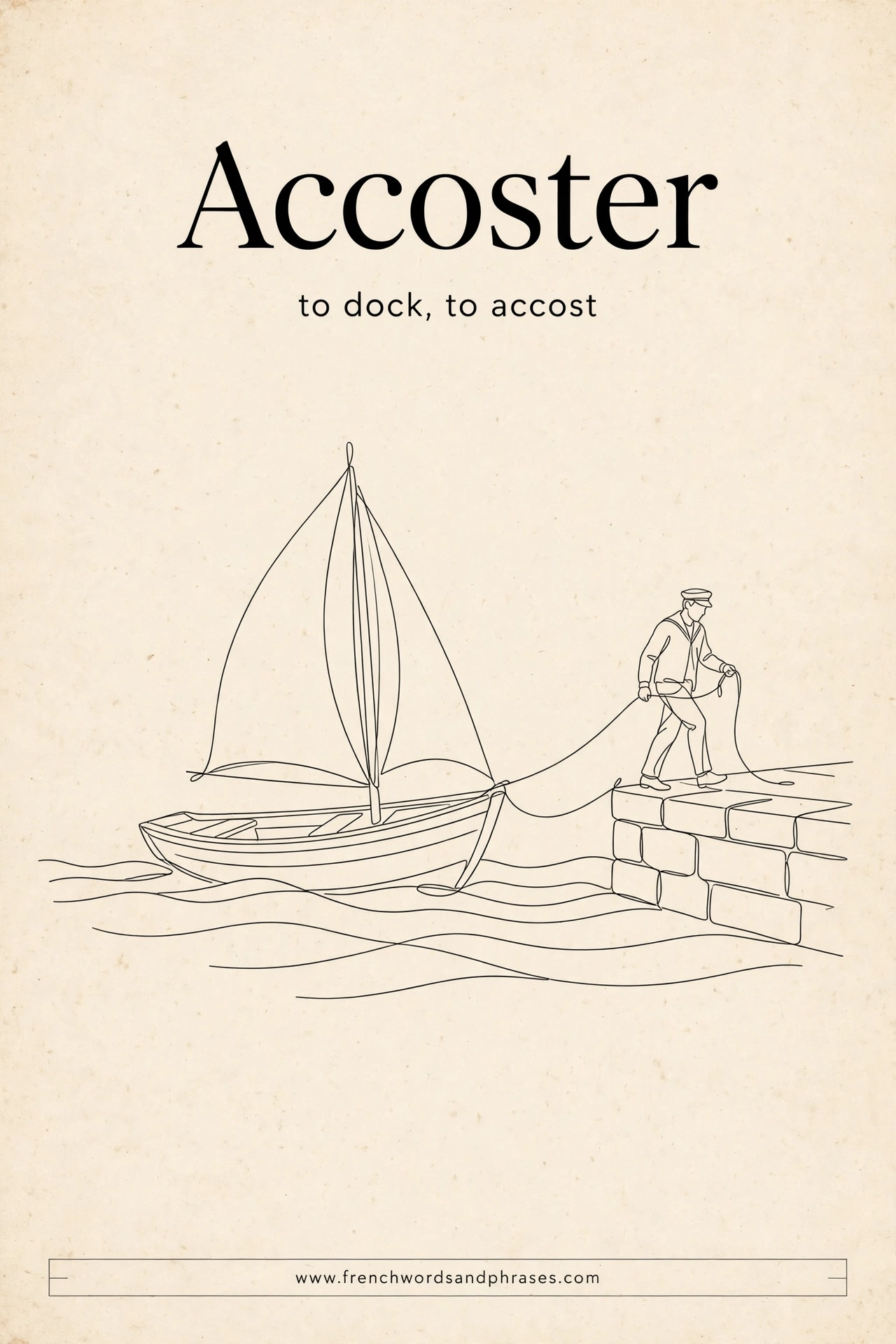
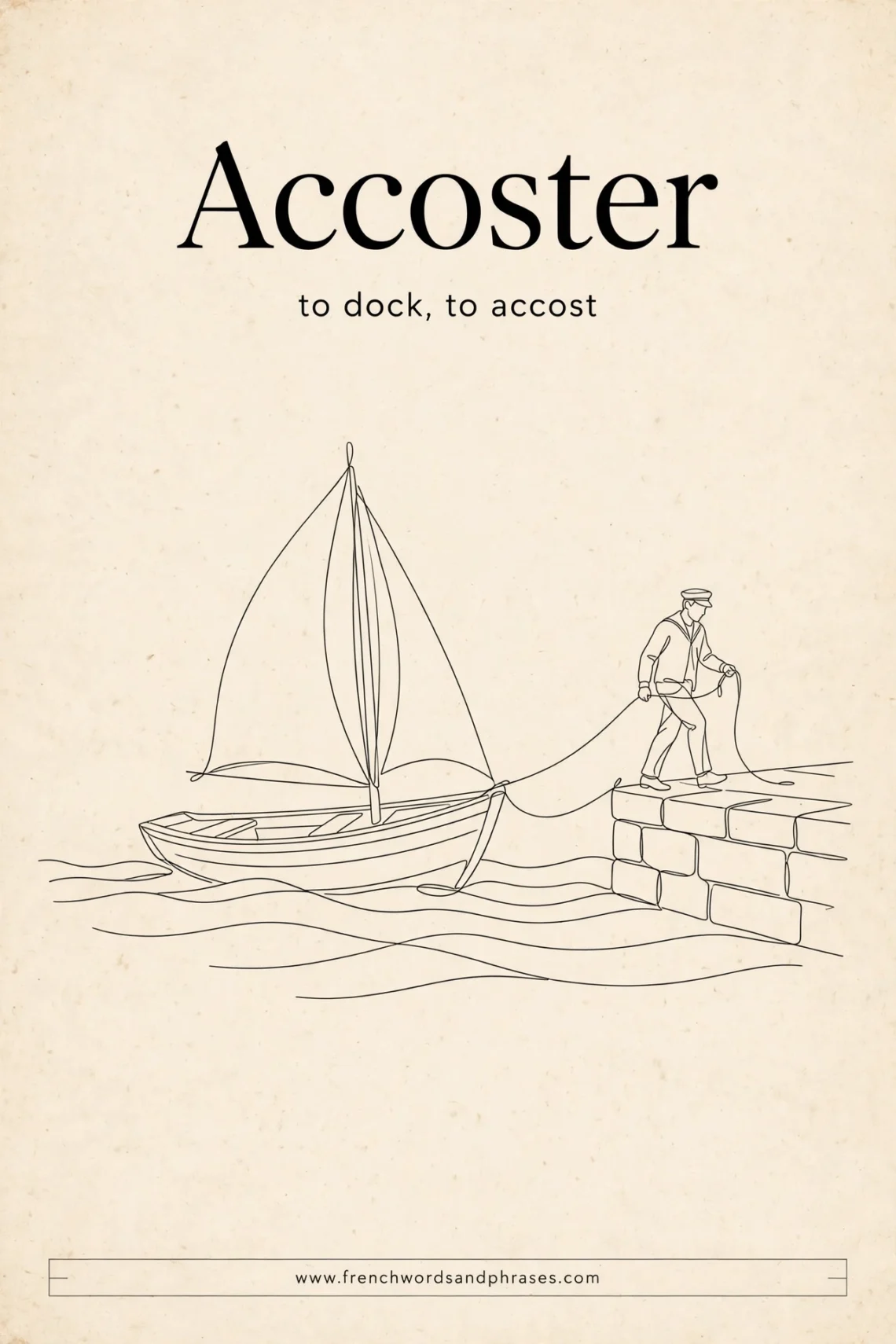
Accoster means to dock, to accost — a ship coming alongside the quay, or a stranger coming alongside you in the street to speak.
A ferry gliding the last few metres towards the quay at Calais, ropes ready — and, on that same quay, a stranger stepping up to a traveller to ask for a light. Accoster covers both arrivals: boats coming alongside land, and people coming alongside people, sometimes welcome, sometimes not.
In this guide, you’ll learn how to conjugate accoster in all the major French tenses and moods. Explore complete conjugation tables, French examples, English translations, and practice quizzes.
Understanding the French Verb Accoster
Accoster is a regular French verb belonging to the first group of verbs, those ending in-er.
It means to dock, to accost. Sailors use it for the precise moment a vessel touches her berth; everyone else meets it in the street sense, which usually carries a hint of boldness or nuisance — the person accosté did not ask to be approached. In harbour timetables it is neutral and technical: l’heure d’accostage, docking time.
Verb classification: First group (-er)
Auxiliary verb: Avoir
Past participle: accosté
Present participle: accostant
English equivalents: To dock, to come alongside, to accost, to approach; le navire accoste — the ship docks; accoster le quai — to come alongside the quay; accoster quelqu’un dans la rue — to accost someone in the street; se faire accoster — to get accosted, to be approached.
One important detail: accoster has two lives, and the harbour explains both. A ship accoste when it comes alongside the quay — le ferry accoste à huit heures — and a person accoste quelqu’un when they come alongside a stranger and start talking, often uninvited: un inconnu m’a accosté dans la rue. The verb is perfectly regular: j’accoste, nous accostons, past participle accosté. Note the word inside it: la côte, the coast — to accoster is to come up to the coast, or to someone’s side.
Experience the Word
Accoster is the verb of coming alongside — hull to quay, shoulder to shoulder — the moment the distance between two things closes.
Imagine the night ferry arriving at the island. The harbour lights double in the black water, the engines murmur down, and the great hull slides sideways the last metre until rubber fenders kiss the quay. On deck, a passenger watches — and beside him, unnoticed, a pickpocket is choosing his moment to accoster a tourist. Two accostages, one word.
The crossing is over. The ship has docked — elle a accosté — and the quay, with all its encounters, has begun.
How to Conjugate Accoster: Complete French Conjugation Guide
Let’s explore every major conjugation of accoster, beginning with the indicative mood.
How to Conjugate Accoster in the Indicative Mood
The indicative mood is used to express facts, observations, actions, and events.
How to Conjugate Accoster in the Present Tense (Présent)
Used for actions happening now, habitual actions, and general truths.
| Subject | Conjugation |
|---|---|
| je | accoste |
| tu | accostes |
| il / elle | accoste |
| nous | accostons |
| vous | accostez |
| ils / elles | accostent |
Example
Le navire accoste le quai avec précaution.
The ship comes alongside the quay with care.
Quick Quiz 1
Complete the sentence:
Nous ______ l’île vers midi.
Reveal the answer
accosterons
Nous accosterons l’île vers midi.
We will dock at the island around noon.
How to Conjugate Accoster in the Passé Composé
Used for completed actions in the past. Accoster takes the auxiliary verb avoir.
| Subject | Conjugation |
|---|---|
| j’ | ai accosté |
| tu | as accosté |
| il / elle | a accosté |
| nous | avons accosté |
| vous | avez accosté |
| ils / elles | ont accosté |
Example
Un inconnu m’a accosté dans la rue pour me demander l’heure.
A stranger accosted me in the street to ask me the time.
How to Conjugate Accoster in the Imparfait (Imperfect Tense)
Used for habitual past actions, descriptions, and ongoing situations in the past.
| Subject | Conjugation |
|---|---|
| je | accostais |
| tu | accostais |
| il / elle | accostait |
| nous | accostions |
| vous | accostiez |
| ils / elles | accostaient |
Example
Chaque matin, le bateau accostait l’île à huit heures.
Every morning, the boat docked at the island at eight o’clock.
Quick Quiz 2
Choose the correct form:
The boat docked without incident.
Le bateau ______ sans encombre. (a accosté / est accosté)
Reveal the answer
a accosté
Le bateau a accosté sans encombre.
Accoster takes avoir.
How to Conjugate Accoster in the Plus-que-parfait
Used to describe an action that had already been completed before another past event.
| Subject | Conjugation |
|---|---|
| j’ | avais accosté |
| tu | avais accosté |
| il / elle | avait accosté |
| nous | avions accosté |
| vous | aviez accosté |
| ils / elles | avaient accosté |
Example
Elle avait accosté le vendeur dès son arrivée au marché.
She had approached the seller as soon as she arrived at the market.
How to Conjugate Accoster in the Passé Simple
Primarily used in formal writing, literature, and historical narratives. It is rarely used in everyday conversation.
| Subject | Conjugation |
|---|---|
| je | accostai |
| tu | accostas |
| il / elle | accosta |
| nous | accostâmes |
| vous | accostâtes |
| ils / elles | accostèrent |
Example
La frégate accosta le port au lever du soleil.
The frigate docked at the port at sunrise.
How to Conjugate Accoster in the Passé Antérieur
A literary tense used to express an action completed immediately before another past action, generally in the passé simple.
| Subject | Conjugation |
|---|---|
| j’ | eus accosté |
| tu | eus accosté |
| il / elle | eut accosté |
| nous | eûmes accosté |
| vous | eûtes accosté |
| ils / elles | eurent accosté |
Example
Quand le navire eut accosté, les passagers descendirent.
When the ship had docked, the passengers went ashore.
How to Conjugate Accoster in the Future Tense (Futur Simple)
Used to describe actions that will take place in the future.
| Subject | Conjugation |
|---|---|
| je | accosterai |
| tu | accosteras |
| il / elle | accostera |
| nous | accosterons |
| vous | accosterez |
| ils / elles | accosteront |
Example
Nous accosterons l’île vers midi.
We will dock at the island around noon.
How to Conjugate Accoster in the Futur Antérieur (Future Perfect)
Used for an action that will have been completed before a particular point in the future.
| Subject | Conjugation |
|---|---|
| j’ | aurai accosté |
| tu | auras accosté |
| il / elle | aura accosté |
| nous | aurons accosté |
| vous | aurez accosté |
| ils / elles | auront accosté |
Example
Quand la vedette aura accosté, nous débarquerons les valises.
When the launch has docked, we will unload the suitcases.
How to Conjugate Accoster in the Near Future (Futur Proche)
Used to describe something that is going to happen soon. Formed with aller + infinitive.
| Subject | Conjugation |
|---|---|
| je | vais accoster |
| tu | vas accoster |
| il / elle | va accoster |
| nous | allons accoster |
| vous | allez accoster |
| ils / elles | vont accoster |
Example
Regarde, le voilier va accoster le ponton.
Look, the yacht is going to come alongside the pontoon.
How to Conjugate Accoster in the Conditional Mood
The conditional mood expresses what would happen under certain circumstances. It is also frequently used to make polite requests or express wishes.
How to Conjugate Accoster in the Present Conditional
| Subject | Conjugation |
|---|---|
| je | accosterais |
| tu | accosterais |
| il / elle | accosterait |
| nous | accosterions |
| vous | accosteriez |
| ils / elles | accosteraient |
Example
Avec moins de vent, le bateau accosterait plus facilement.
With less wind, the boat would dock more easily.
How to Conjugate Accoster in the Past Conditional
| Subject | Conjugation |
|---|---|
| j’ | aurais accosté |
| tu | aurais accosté |
| il / elle | aurait accosté |
| nous | aurions accosté |
| vous | auriez accosté |
| ils / elles | auraient accosté |
Example
Il ne m’aurait jamais accosté s’il n’avait pas été perdu.
He would never have accosted me if he had not been lost.
Accoster in the Literary Past Conditional Form
This less common literary form uses the imperfect subjunctive of avoir.
| Subject | Conjugation |
|---|---|
| j’ | eusse accosté |
| tu | eusses accosté |
| il / elle | eût accosté |
| nous | eussions accosté |
| vous | eussiez accosté |
| ils / elles | eussent accosté |
Example
Le navire eût accosté plus tôt sans la brume.
The ship would have docked earlier, were it not for the fog.
How to Conjugate Accoster in the Subjunctive Mood
The subjunctive is used to express wishes, emotions, doubts, necessity, and uncertainty. It frequently follows expressions such as il faut que (it is necessary that) or bien que (although).
How to Conjugate Accoster in the Present Subjunctive
| Subject | Conjugation |
|---|---|
| que je | accoste |
| que tu | accostes |
| qu’il / qu’elle | accoste |
| que nous | accostions |
| que vous | accostiez |
| qu’ils / qu’elles | accostent |
Example
Il faut que le pilote accoste en douceur.
The pilot must dock gently.
Quick Quiz 3
Complete the sentence using the subjunctive:
Il faut que vous ______ le quai en douceur.
Reveal the answer
accostiez
Il faut que vous accostiez le quai en douceur.
You must come alongside the quay gently.
How to Conjugate Accoster in the Imperfect Subjunctive
A literary tense, rarely encountered in modern spoken French.
| Subject | Conjugation |
|---|---|
| que je | accostasse |
| que tu | accostasses |
| qu’il / qu’elle | accostât |
| que nous | accostassions |
| que vous | accostassiez |
| qu’ils / qu’elles | accostassent |
Example
Le capitaine ordonna que le remorqueur accostât lentement.
The captain ordered the tug to come alongside slowly.
How to Conjugate Accoster in the Pluperfect Subjunctive
A literary construction used to express an action completed before another past action.
| Subject | Conjugation |
|---|---|
| que j’ | eusse accosté |
| que tu | eusses accosté |
| qu’il / qu’elle | eût accosté |
| que nous | eussions accosté |
| que vous | eussiez accosté |
| qu’ils / qu’elles | eussent accosté |
Example
On doutait qu’il eût accosté le bon quai dans le brouillard.
People doubted he had docked at the right quay in the fog.
How to Conjugate Accoster in the Past Subjunctive
| Subject | Conjugation |
|---|---|
| que j’ | aie accosté |
| que tu | aies accosté |
| qu’il / qu’elle | ait accosté |
| que nous | ayons accosté |
| que vous | ayez accosté |
| qu’ils / qu’elles | aient accosté |
Example
Je suis heureux que le bateau ait accosté sans encombre.
I am glad the boat docked without incident.
How to Conjugate Accoster in the Imperative
The imperative is used to give commands, instructions, invitations, or suggestions. Subject pronouns are omitted.
How to Conjugate Accoster in the Present Imperative
| Person | Conjugation |
|---|---|
| (tu) | accoste |
| (nous) | accostons |
| (vous) | accostez |
Example
Accoste doucement, le ponton est fragile !
Come alongside gently, the pontoon is fragile!
Quick Quiz 4
How would you say Dock gently (tu form)?
Reveal the answer
Accoste doucement !
French Participles of Accoster
Participles are verb forms that can be used in compound tenses and other grammatical constructions.
Present Participle of Accoster
accostant
En accostant le quai, le capitaine surveille le vent.
While docking at the quay, the captain watches the wind.
Past Participle of Accoster
accosté
Accosté par un inconnu, il a d’abord reculé.
Accosted by a stranger, he first stepped back.
Accoster in Everyday French: Real-Life Examples
Now that you know the conjugations, let’s see how accoster appears in everyday French.
Example 1 — Present
Le ferry accoste à huit heures précises.
The ferry docks at eight o’clock sharp.
Example 2 — Passé composé
Un inconnu m’a accosté près de la gare.
A stranger accosted me near the station.
Example 3 — Imparfait
Le bateau accostait l’île chaque matin.
The boat used to dock at the island every morning.
Example 4 — Future
Nous accosterons l’île vers midi.
We will dock at the island around noon.
Example 5 — Conditional
Avec moins de vent, le bateau accosterait facilement.
With less wind, the boat would dock easily.
Example 6 — Imperative
Accoste en douceur, sans heurter le quai !
Dock gently, without hitting the quay!
Beyond Translation: The Meaning of Accoster
English accost exists — and it kept only the street sense, the bold stranger — while French accoster kept the harbour too.
Both senses are the same picture: coming alongside.
Inside the word sits la côte, the coast: a ship accoste when it reaches the coast, and a stranger accoste you when he reaches your side. The noun l’accostage names the docking itself — you will see it on harbour signs long before you meet it in a novel.
How to Remember the French Verb Accoster
Remember it this way: Accoster is about the ferry sliding the last metre to the quay — and the stranger sliding up beside you.
- La côte is inside it: accoster = to come alongside the coast — a ship docking, or a stranger coming up to you.
- Two scenes, one verb: le ferry accoste (docks); un inconnu m’accoste (accosts me).
- Regular -er: j’accoste, nous accostons, past participle accosté.
The key idea is the ferry sliding the last metre to the quay — and the stranger sliding up beside you.
Test Your Knowledge of Accoster
Let’s see how much you’ve learned. Try answering these questions before revealing the answers.
Question 1
What are the two lives of the verb accoster?
Reveal the answer
Docking and accosting — a ship coming alongside the quay, and a person coming up to a stranger to speak.
Question 2
How do you say A stranger accosted me in the street in French?
Reveal the answer
Un inconnu m’a accosté dans la rue.
Question 3
Translate: Every morning, the boat docked at the island at eight o’clock.
Reveal the answer
Chaque matin, le bateau accostait l’île à huit heures.
Question 4
What is the past participle of accoster?
Reveal the answer
Accosté.
Question 5
Complete the sentence:
Il faut que le pilote ______ en douceur.
Reveal the answer
accoste
Il faut que le pilote accoste en douceur.
The pilot must dock gently.
Your Final Challenge
Can You Use It?
How would you say this in French?
The ferry docks slowly, and on the quay a sailor approaches the first passengers to show them the exit.
Reveal the answer
Le ferry accoste lentement, et sur le quai, un marin accoste les premiers passagers pour leur indiquer la sortie.
The ferry docks slowly, and on the quay a sailor approaches the first passengers to show them the exit.
A little French. A little curiosity. A richer everyday life.
LEARN FRENCH ONE WORD AT A TIME