
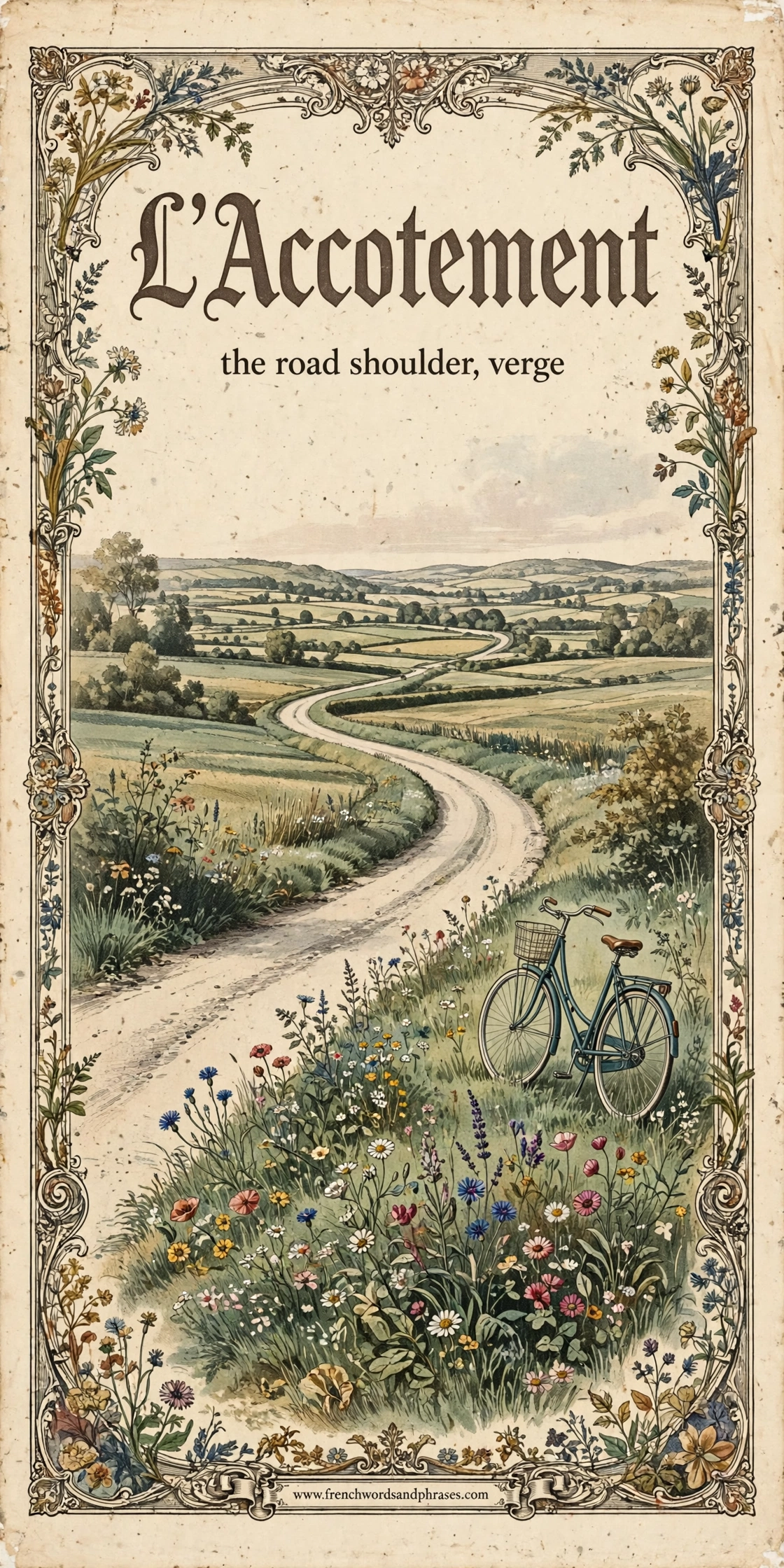
A French Word to Live By
Translate Accotement to English
/a.kɔt.mɑ̃/
L’accotement means the road shoulder, verge.
Night on a country road, rain on the windscreen, and suddenly a deer at the edge of the headlights — the driver brakes and swings the car onto the gravel strip at the road’s edge: l’accotement, the road shoulder, the narrow margin between the tarmac and the ditch.
In this guide, you’ll learn what accotement means in English, how to use it with its articles, how to form its plural, and how it appears in everyday French. Explore French examples, English translations, and practice quizzes.
Understanding the French Noun Accotement
Accotement is a masculine French noun, learned with its article: l’accotement, un accotement. It begins with a vowel, so the article melts into it: l’accotement. It comes from the old verb accoter, to prop or lean against — the accotement is the strip the road leans on, its supporting edge.
It means the shoulder of a road — the strip running along the edge of the carriageway, where a broken-down car pulls over, where cyclists ride and pedestrians walk when there is no pavement. French road signs divide it in two: un accotement stabilisé is the hardened, driveable shoulder, while un accotement non stabilisé is soft ground that can swallow a wheel. The word is also used for the side strip along a railway line or a canal.
Gender: Masculine — l’accotement
Definite article: l’ — l’accotement (the road shoulder), melted before the vowel
Indefinite article: un — un accotement (a road shoulder)
Plural: les accotements
Spelling note: from accoter, to prop against — the strip the road leans on
Register: road signs, the driving code, traffic news
English equivalents: The road shoulder, the verge.
The accotement is a word you will read more often than you say it: on the sign Accotement non stabilisé — soft shoulder, keep off. Everyday sentences are practical ones: s’arrêter sur l’accotement, to pull over onto the shoulder; rouler sur l’accotement, to drive on the shoulder — on a motorway, the hard shoulder proper is la bande d’arrêt d’urgence.
Experience the Word
Accotement is the road’s margin of forgiveness: a metre or two of gravel and grass between a mistake and the ditch.
Imagine the breakdown at midnight, the hazard lights blinking, the triangle placed on the gravel behind the car — everyone standing on l’accotement, in the thin safe strip the road keeps for its bad moments.
You have not just named a strip of gravel. You have named the road’s safety margin — l’accotement, the shoulder.
How to Use Accotement in French: Complete Guide
Let’s explore how accotement works in French, beginning with its articles — l’accotement, un accotement, s’arrêter sur l’accotement.
Accotement with the Definite Article (L’, Les)
Used for a specific shoulder — the one along this road, on this bend. The vowel opening makes le melt into l’.
| Form | French |
|---|---|
| Masculine singular | l’accotement |
| Plural | les accotements |
Example
L’accotement est étroit sur cette route de montagne.
The shoulder is narrow on this mountain road.
Accotement with the Indefinite Article (Un, Des)
Used for a shoulder in general — hardened or soft, safe or treacherous.
| Form | French |
|---|---|
| Masculine singular | un accotement |
| Plural | des accotements |
Example
Un accotement stabilisé permet de s’arrêter en sécurité.
A hard shoulder lets you stop safely.
Accotement in Everyday Phrases
Signs, breakdowns and soft ground — the accotement phrases of the road.
| Phrase | French |
|---|---|
| the shoulder of the road | l’accotement de la route |
| a soft shoulder | un accotement non stabilisé |
| a hard shoulder | un accotement stabilisé |
| to stop on the shoulder | s’arrêter sur l’accotement |
| along the shoulder | le long de l’accotement |
Example
Le panneau annonce un accotement non stabilisé.
The sign warns of a soft shoulder.
Quick Quiz 1
Complete the sentence:
______ accotement est couvert de gravier. (the)
Reveal the answer
L’
L’accotement est couvert de gravier.
The shoulder is covered with gravel — le melts into l’ before the vowel.
The Plural of Accotement
A regular plural in -s — both edges of the road, left and right.
| Number | French |
|---|---|
| Singular | l’accotement |
| Plural | les accotements |
Example
Les accotements sont fauchés au printemps.
The verges are mowed in spring.
Accotement with Possessive Adjectives (Mon, Ton, Son…)
Possessives agree with the noun: accotement is masculine, so mon, ton, son in the singular.
| Owner | French |
|---|---|
| my | mon accotement |
| your (tu) | ton accotement |
| his / her / its | son accotement |
| our | notre accotement |
| your (vous) | votre accotement |
| their | leur accotement |
Example
La route a perdu son accotement dans l’éboulement.
The road lost its shoulder in the landslide.
Quick Quiz 2
Complete the sentence:
La voiture a quitté la route et a fini sur ______ accotement. (its)
Reveal the answer
son
La voiture a quitté la route et a fini sur son accotement.
The car left the road and ended up on its shoulder — son, because accotement is masculine.
Accotement with Demonstrative Adjectives (Cet, Ces)
Used to point: cet accotement, this shoulder — cet, because a masculine noun before a vowel takes cet, not ce.
| Form | French |
|---|---|
| Masculine singular | cet accotement |
| Plural | ces accotements |
Example
Cet accotement est trop mou pour s’arrêter.
This shoulder is too soft to stop on.
Accotement with Adjectives
Adjectives agree with accotement — masculine singular: un accotement large, un accotement stabilisé.
| Adjective | With Accotement |
|---|---|
| stabilisé (hardened) | un accotement stabilisé |
| non stabilisé (soft, unstabilised) | un accotement non stabilisé |
| large (wide) | un accotement large |
| étroit (narrow) | un accotement étroit |
| herbeux (grassy) | un accotement herbeux |
Example
Un accotement étroit rend la route dangereuse.
A narrow shoulder makes the road dangerous.
Quick Quiz 3
Complete the sentence:
Un accotement ______ peut être dangereux sous la pluie. (unstabilised)
Reveal the answer
non stabilisé
Un accotement non stabilisé peut être dangereux sous la pluie.
A soft shoulder can be dangerous in the rain.
Everyday Expressions with Accotement
Pulling over, warning signs and grassy edges — the accotement phrases of driving life.
| Expression | In English |
|---|---|
| s’arrêter sur l’accotement | to pull over onto the shoulder |
| accotement non stabilisé | soft shoulder (road sign) |
| accotement stabilisé | hard shoulder |
| rouler sur l’accotement | to drive on the shoulder |
| le long de l’accotement | along the verge |
Example
En cas de panne, arrêtez-vous sur l’accotement.
If you break down, pull over onto the shoulder.
Words from the Same Family as Accotement
Carriageways, verges and emergency lanes — the words that travel with accotement.
| French | In English |
|---|---|
| accoter | to prop, to lean against |
| la chaussée | the carriageway, the road surface |
| la bande d’arrêt d’urgence | the hard shoulder (on motorways) |
| le bas-côté | the verge (an older synonym) |
| le fossé | the ditch |
Example
Entre la chaussée et le fossé, il y a l’accotement.
Between the carriageway and the ditch lies the shoulder.
Quick Quiz 4
What does the sign « Accotement non stabilisé » warn you about?
Reveal the answer
The shoulder is soft — the ground beside the road is not hardened; keep your wheels off it.
Sur un accotement non stabilisé, la voiture peut s’enliser.
On a soft shoulder, the car can get bogged down.
Accotement in Everyday French: Real-Life Examples
Now that you know the word, let’s see how accotement appears in everyday French.
Example 1 — The motorway
La voiture en panne attend sur l’accotement.
The broken-down car is waiting on the shoulder.
Example 2 — The sign
Attention, accotement non stabilisé sur deux kilomètres.
Careful, soft shoulder for two kilometres.
Example 3 — Cycling
Le cycliste roule prudemment sur l’accotement.
The cyclist rides carefully on the shoulder.
Example 4 — The breakdown
Il a garé sa voiture sur l’accotement et mis le triangle.
He parked his car on the shoulder and put out the warning triangle.
Example 5 — Night driving
Un cerf se tenait sur l’accotement, immobile.
A deer was standing on the verge, motionless.
Example 6 — Roadworks
Les ouvriers élargissent l’accotement cette semaine.
The workers are widening the shoulder this week.
Beyond Translation: The Meaning of Accotement
Accotement is a word from the paperwork of roads — the driving code, the sign-maker’s catalogue, the accident report — yet it names something every driver knows in the body: the narrow strip where you are no longer travelling but not yet safe. French divides it with bureaucratic tenderness into stabilisé and non stabilisé, the shoulder that will hold you and the shoulder that will betray you, and posts the difference on signs for strangers driving in the rain.
To say accotement is to know where the road ends and mercy begins.
It evokes hazard lights in the dark, the gravel under your shoes, and the thin grassy line between the journey and the ditch.
How to Remember the French Noun Accotement
Remember it this way: Accotement is the road shoulder — the strip at the road’s edge: l’accotement, s’arrêter sur l’accotement.
- Always masculine — l’accotement, un accotement, cet accotement.
- The sign pair — stabilisé holds you, non stabilisé swallows wheels.
- The picture — between la chaussée and le fossé, the ditch, lies l’accotement.
The key idea is l’accotement — the road shoulder, masculine; accotement non stabilisé = soft shoulder.
Test Your Knowledge of Accotement
Let’s see how much you’ve learned. Try answering these questions before revealing the answers.
Question 1
Is accotement masculine or feminine?
Reveal the answer
Masculine — l’accotement, un accotement (the article melts before the vowel).
Question 2
How do you say to pull over onto the shoulder?
Reveal the answer
S’arrêter sur l’accotement.
Question 3
Translate: The car stopped on the shoulder.
Reveal the answer
La voiture s’est arrêtée sur l’accotement.
Question 4
What is the difference between un accotement stabilisé and un accotement non stabilisé?
Reveal the answer
Hardened versus soft — the stabilisé is a firm, driveable shoulder; the non stabilisé is soft ground that can trap a wheel.
Question 5
Complete the sentence:
______ accotement est trop étroit pour les cyclistes. (this)
Reveal the answer
Cet
Cet accotement est trop étroit pour les cyclistes.
This shoulder is too narrow for cyclists — cet before a vowel.
Your Final Challenge
Can You Use It?
How would you say this in French?
“The car stopped on the shoulder.”
Reveal the answer
La voiture s’est arrêtée sur l’accotement.
The car stopped on the shoulder.
A little French. A little curiosity. A richer everyday life.
LEARN FRENCH ONE WORD AT A TIME




