A French Word to Live By
Translate Accent circonflexe to English
/ak.sɑ̃ siʁ.kɔ̃.flɛks/
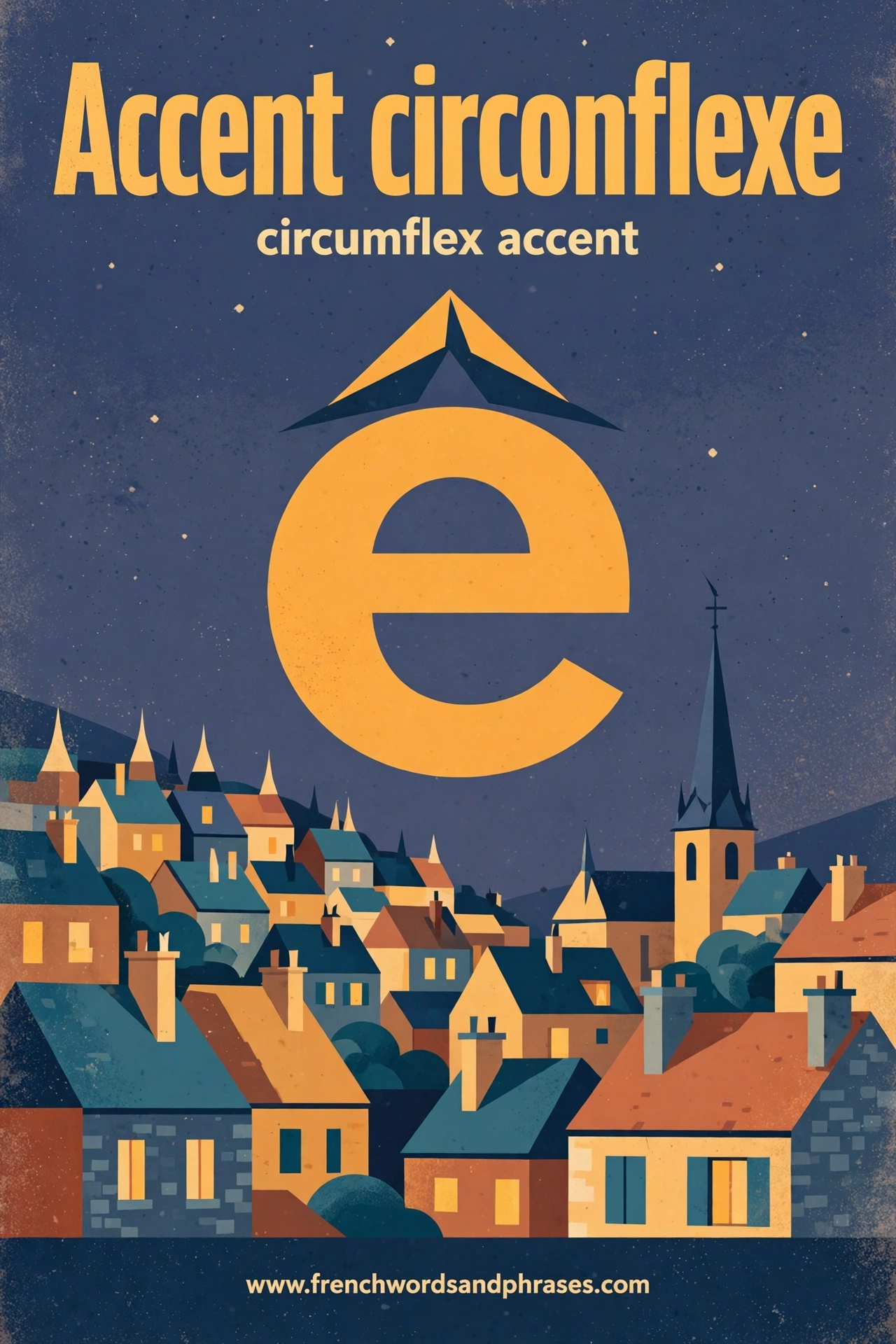
Accent circonflexe means circumflex accent — the little hat over a vowel, as in î and ô.
On the cottage door in Brittany, the painted sign reads « Hôtel » — and the o wears a tiny roof. The innkeeper’s granddaughter traces it with her finger and asks why the letter needs a hat. « Parce qu’il a froid, » jokes her grandfather — because it is cold. The real story is older and better: under that little roof hides a lost letter s.
Let’s explore how accent circonflexe works in French, beginning with the whole term on one card.
Understanding the French Phrase Accent circonflexe
Accent circonflexe is a French spelling term built from accent (a mark over a letter — a masculine noun) and circonflexe (circumflex, from Latin circumflexus, bent around). The mark is the little hat ( ˆ ) that can sit on any of the five vowels: â, ê, î, ô, û. It belongs to the same small family as the climbing accent aigu (é) and the falling accent grave (è) — but where they only dress the letter e, the circonflexe dresses them all.
It means the circumflex accent: the hat-shaped diacritic placed over a vowel. In French it does three jobs. It often marks a letter that history swallowed — usually an s: forêt was forest, hôpital was hospital, pâte was paste. It can stretch or darken the vowel’s sound: pâte against patte. And it separates twins that spelling would otherwise confuse: dû (owed) against du (of the), sûr (sure) against sur (on), mûr (ripe) against mur (wall).
Type: Spelling term — diacritic mark (accent + circonflexe)
Answers the need: Naming the circumflex in French — in spelling, dictations and the famous reform debates
Register: Neutral and educational — school, editing, language columns
Strength: Historical — the little hat is a tombstone for letters French lost
One important usage detail: since the spelling rectifications of 1990, the circonflexe is optional on i and u in many words — you may write coût or cout, paraître or paraitre — and both spellings are accepted. But it stays in verb endings (nous parlâmes) and wherever it prevents confusion: dû, sûr, mûr keep their hats in careful writing. On a, e and o it is not optional at all: âme, fête, hôpital.
Experience the Word
Accent circonflexe is the most loved and most argued-over mark in French — a tiny roof that newspapers have written editorials about.
Imagine the schoolboy who asks why forêt has a hat and his teacher opens the old book: the word once had an s, forest, like its English cousin still does. The s fell silent, then vanished — and French, polite to its dead, put a little monument over the place where it lay.
English lost this mark so long ago it has no everyday name for it. French children learn to call it le petit chapeau — the little hat — and the affection in the nickname is real.
How to Use Accent circonflexe in French: Complete Guide
Let’s explore how accent circonflexe works in French, beginning with the whole term on one card.
Accent circonflexe at a Glance
The Whole Term on One Card
Real meaning, literal picture, English twin and register — accent circonflexe in five lines.
| Point | Accent circonflexe |
|---|---|
| What it really means | the circumflex accent — the hat-shaped mark ( ˆ ) over a vowel |
| Word for word | bent-around accent — accent (mark) + circonflexe (circumflex) |
| English equivalent | circumflex accent |
| Register | educational and neutral — classrooms, spelling debates, editing |
| Use it for | spelling â ê î ô û, old letters, and twin words like dû/du |
Example
Le ô de hôtel porte un accent circonflexe.
The ô in hôtel carries a circumflex accent.
Word by Word: Building the Term
Two pieces — the mark and its bent shape — take them one by one.
| Word | Literal meaning | Its job in the term |
|---|---|---|
| accent | accent, mark | the diacritic itself — masculine: un accent |
| circonflexe | circumflex, bent around | the shape: a little roof bent over the vowel — the petit chapeau |
Example
On appelle l’accent circonflexe le petit chapeau.
The circumflex accent is called the little hat.
Quick Quiz 1
What letter is usually hiding under the circonflexe in forêt and hôpital?
Reveal the answer
An old s — forêt was forest, hôpital was hospital. The s fell silent and the hat took its place.
La forêt et l’hôpital ont perdu leur s.
Forêt and hôpital lost their s.
When You Meet It: The Spelling Moments
Accent circonflexe turns up at moments like these — wherever French words are spelled, debated or corrected.
| Situation | Example |
|---|---|
| A dictation | fête prend un accent circonflexe — fête takes a circumflex |
| A spelling debate | faut-il garder l’accent circonflexe ? — should we keep the circumflex? |
| A child’s question | pourquoi le o de hôtel a un chapeau ? — why does the o in hôtel have a hat? |
| A proofreader’s note | accent circonflexe sur le û de dû — circumflex on the û of dû |
| An old book | les accents circonflexes des vieux textes — the circumflexes of old texts |
Example
Pourquoi « forêt » porte un accent circonflexe ?
Why does “forêt” carry a circumflex accent?
Make It Yours: The Term in Its Frames
The term is fixed — the five vowels take turns under the hat.
| Form | French | In English |
|---|---|---|
| The mark | un accent circonflexe | a circumflex accent |
| On a | â — âme, pâté | â — soul, pâté |
| On e | ê — fête, forêt | ê — party, forest |
| On i and o | î, ô — île, hôtel | î, ô — island, hotel |
| On u | û — sûr, mûr, dû | û — sure, ripe, owed |
Example
Âme, fête, île, hôtel, sûr : les cinq voyelles portent le chapeau.
Âme, fête, île, hôtel, sûr: all five vowels wear the hat.
Quick Quiz 2
Which twin means ripe: mur or mûr?
Reveal the answer
Mûr — the circonflexe separates the twins: mûr is ripe, mur (no hat) is a wall.
Ce fruit est mûr, ce mur est haut.
This fruit is ripe, this wall is high.
Everyday Expressions: The Accent Shelf
Accent circonflexe slots into these frames — each one ready to use as it stands.
| Frame | In English |
|---|---|
| un accent circonflexe | a circumflex accent |
| le petit chapeau | the little hat — its affectionate nickname |
| un accent aigu | an acute accent — the climbing stroke |
| un accent grave | a grave accent — the falling stroke |
| la réforme de l’orthographe | the spelling reform |
Example
La réforme de l’orthographe a rendu certains accents circonflexes facultatifs.
The spelling reform made some circumflex accents optional.
Close Cousins: The Three Strokes of the Vowels
The circonflexe is the only mark that visits all five vowels — its cousins are specialists of the letter e.
| Expression | The difference |
|---|---|
| l’accent circonflexe (â ê î ô û) | the circumflex — the hat, on any vowel; history, length, and twin-splitting |
| l’accent aigu (é) | the acute accent — rising stroke, only on e: café |
| l’accent grave (è) | the grave accent — falling stroke, open e: père; also à, où |
| le tréma (ë, ï) | the diaeresis — two dots separating vowels: Noël, maïs |
| la cédille (ç) | the cedilla — the hook that softens c before a, o, u: garçon |
Example
L’accent aigu et l’accent grave habillent le e ; l’accent circonflexe habille toutes les voyelles.
The acute and grave accents dress the letter e; the circumflex dresses all the vowels.
Quick Quiz 3
Which cousin is a single climbing stroke — l’accent circonflexe or l’accent aigu?
Reveal the answer
L’accent aigu — one rising stroke on é. The circonflexe is a two-sided roof, up and down in a single mark.
Le café monte avec l’accent aigu, la fête se coiffe du circonflexe.
Café climbs with the acute accent, fête puts on the circumflex hat.
Accent circonflexe and Its Neighbours
The spelling shelf around the term — the vowels, the lost letters and the twins.
| French | In English |
|---|---|
| une voyelle | a vowel |
| un chapeau | a hat |
| un toit | a roof |
| jumeaux / jumelles | twins (words like dû and du) |
| l’orthographe | spelling |
Example
Le petit chapeau est un toit pour la voyelle.
The little hat is a roof for the vowel.
Watch Out: The Traps Around Accent circonflexe
The traps: hats removed where they still matter, hats added where they never were, and twins confused.
| Trap | The truth |
|---|---|
| dropping every hat since 1990 | the reform made î and û optional in many words — but dû, sûr, mûr and verb endings keep theirs |
| « un âccent circonflexe » | the word accent itself takes no hat: un accent circonflexe |
| confusing sûr and sur | sûr (with hat) is sure, certain; sur (no hat) is on, upon — the hat changes the word |
| thinking it is silent decoration | it can change the sound: pâte (paste, dough) is longer and darker than patte (paw) |
Example
Je suis sûr que le chat est sur le mur.
I am sure the cat is on the wall.
Quick Quiz 4
True or false: depuis 1990, on peut toujours écrire « cout » sans accent circonflexe — since 1990, you may write coût without the hat.
Reveal the answer
True — on i and u the hat became optional in most words: coût or cout, both are accepted. But â, ê, ô keep theirs, and so do dû, sûr and mûr.
Le coût — ou le cout — de la vie augmente.
The cost of living is rising.
Accent circonflexe in Everyday French: Real-Life Examples
Now that you know the word, let’s see how accent circonflexe appears in everyday French.
Example 1 — A dictation
Écrivez « fête » avec un accent circonflexe sur le e.
Write “fête” with a circumflex accent on the e.
Example 2 — A child’s question
Maman, pourquoi « hôtel » a un petit chapeau ?
Mum, why does “hôtel” have a little hat?
Example 3 — A spelling debate
Faut-il supprimer l’accent circonflexe ? Les journaux en parlent.
Should the circumflex accent be abolished? The newspapers are talking about it.
Example 4 — A twin lesson
« Dû » avec un accent circonflexe, « du » sans accent : attention !
“Dû” with a circumflex, “du” without: careful!
Example 5 — An old letter
Dans cette vieille lettre, tous les mots portent des accents circonflexes.
In this old letter, every word carries circumflex accents.
Example 6 — A proofreading note
Il manque un accent circonflexe dans « forêt ».
A circumflex accent is missing in “forêt”.
Beyond Translation: The Meaning of Accent circonflexe
No other spelling mark has a fan club. When the 1990 rectifications gently suggested that French might drop the circonflexe from i and u, the newspapers erupted, petitions circulated, and the little hat survived — bruised, optional in places, but loved. A nation that defends a diacritic is defending its memory: every hat is a grave-marker for a letter that died in the Middle Ages.
To say accent circonflexe is to put a roof over history — the s of forest and hospital sleeps underneath, and French refuses to leave it out in the rain.
Learn the hat and you learn to read French archaeologically: the modern word, and under its roof, the ghost of the old one.
How to Remember the French Phrase Accent circonflexe
Remember it this way: Accent circonflexe means circumflex accent — the little hat over a vowel, often the tombstone of a lost letter s.
- You call it by its nickname — le petit chapeau, the little hat over â, ê, î, ô, û.
- You look for the ghost — forêt, hôpital, fête : an old s sleeps under most hats.
- You respect the twins — dû is not du, sûr is not sur, mûr is not mur.
The key idea is accent circonflexe = circumflex accent — the little hat; often a lost s; dû/du, sûr/sur, mûr/mur.
Test Your Knowledge of Accent circonflexe
Let’s see how much you’ve learned. Try answering these questions before revealing the answers.
Question 1
What does accent circonflexe mean?
Reveal the answer
Circumflex accent — the hat-shaped diacritic ( ˆ ) over a vowel.
Question 2
What does the hat often replace?
Reveal the answer
A lost letter, usually s — forêt from forest, hôpital from hospital.
Question 3
Translate: The circumflex often replaces an old letter s.
Reveal the answer
L’accent circonflexe remplace souvent un ancien s.
Question 4
Which is ripe: mur or mûr?
Reveal the answer
Mûr — mur without the hat is a wall.
Question 5
Complete the sentence:
Le o de « hôtel » porte un ______ circonflexe. (accent)
Reveal the answer
accent
Le o de « hôtel » porte un accent circonflexe.
The o in “hôtel” carries a circumflex accent.
Your Final Challenge
Can You Use It?
How would you say this in French?
“The circumflex often replaces an old letter s.”
Reveal the answer
L’accent circonflexe remplace souvent un ancien s.
The circumflex often replaces an old letter s.
A little French. A little curiosity. A richer everyday life.
LEARN FRENCH ONE WORD AT A TIME