A French Word to Live By
Translate Accent aigu to English
/ak.sɑ̃ e.ɡy/
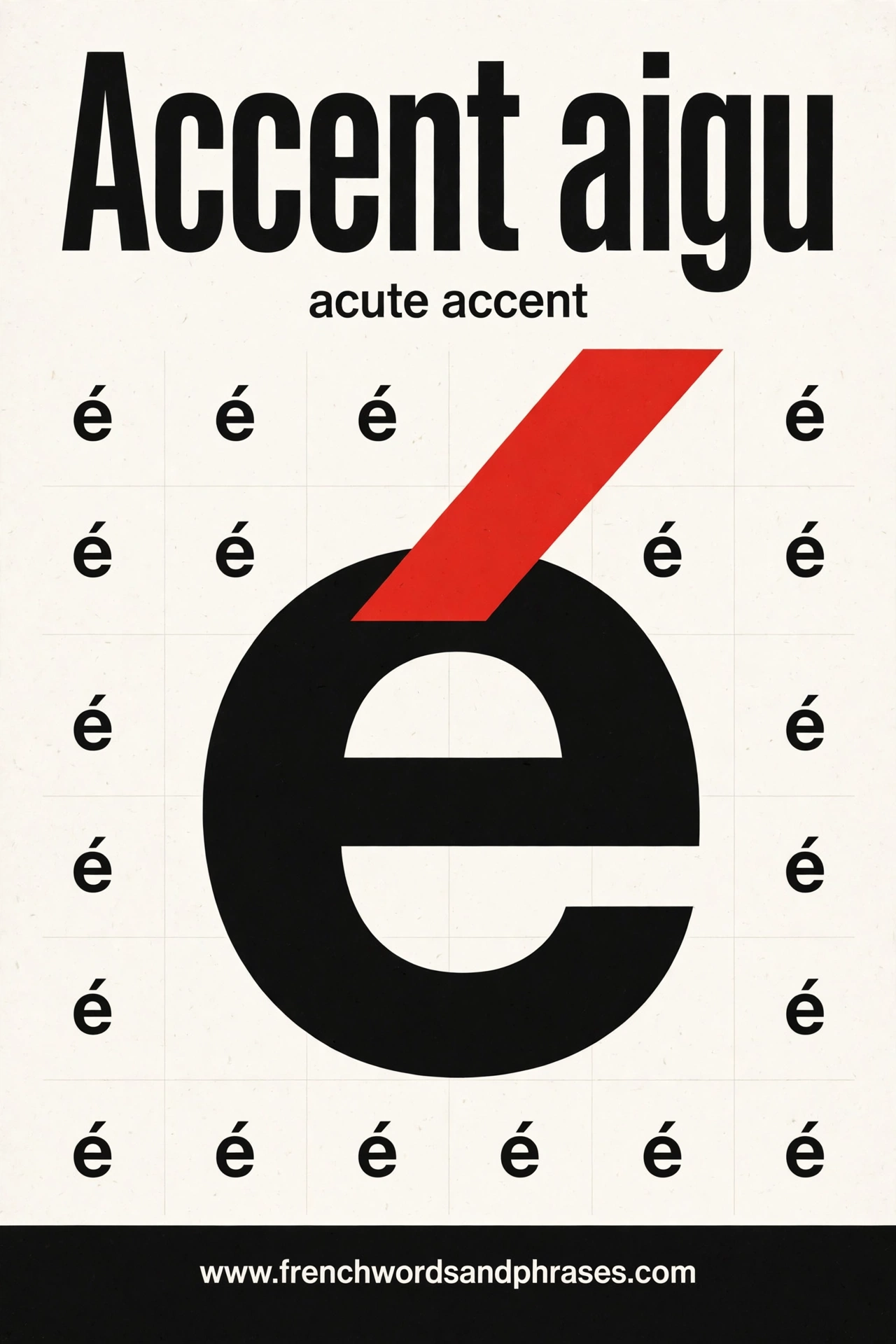
Accent aigu means acute accent — the rising stroke over a letter, as in é.
A classroom in Marseille, first week of school. The teacher writes two words on the board — thé and père — and draws the little strokes above the e’s with her chalk: one climbing, one falling. « Celui qui monte, c’est l’accent aigu. Il ferme le son : é. » Thirty children repeat the sound, and the tiny stroke has done its work.
Let’s explore how accent aigu works in French, beginning with the whole term on one card.
Understanding the French Phrase Accent aigu
Accent aigu is a French spelling term built from accent (a mark over a letter — a masculine noun) and aigu (acute, sharp — an adjective whose feminine is aiguë). The mark itself is the rising stroke ( ´ ) that leans to the right as it climbs. French spelling keeps a small family of these marks: the accent aigu, its mirror image the accent grave (è), and the little hat of the accent circonflexe (ê). The aigu belongs to one letter only: e.
It means the acute accent: the diacritic ( ´ ) placed over a letter in many writing systems. In French it lives exclusively on the letter e, making é, and it closes the sound — é sounds like the a in the English word late, tight and bright: café, été, école. Compare its falling twin, the accent grave, which opens the same letter into è, and the accent circonflexe, which stretches ê. Three strokes, three sounds, one letter e wearing them all.
Type: Spelling term — diacritic mark (accent + aigu)
Answers the need: Naming the acute accent in French — in dictations, classrooms and spelling questions
Register: Neutral and educational — school, editing, language learning
Strength: Exact — in French it means one mark, on one letter: é
One important usage detail: in French, the accent aigu is placed ONLY on the letter e — never on a, i, o or u (other languages are freer: Spanish writes á, í, ó). And aigu itself is an ordinary adjective meaning sharp or high-pitched: un angle aigu, an acute angle; une voix aiguë, a high-pitched voice — with a tréma on the feminine, aiguë, so the u is heard.
Experience the Word
Accent aigu is the smallest mountain in French spelling — one chalk stroke climbing a letter, and the sound climbs with it.
Imagine the dictation at ten in the morning, thirty pens hovering. The teacher pronounces the word café, and every child in the room must decide: does the last e wear the climbing stroke? Those who hear the bright, closed sound draw the accent aigu — and pass.
English names the mark in Latin, acute. French names it with an adjective you can see: aigu, sharp — the stroke is a little spear leaning into its climb.
How to Use Accent aigu in French: Complete Guide
Let’s explore how accent aigu works in French, beginning with the whole term on one card.
Accent aigu at a Glance
The Whole Term on One Card
Real meaning, literal picture, English twin and register — accent aigu in five lines.
| Point | Accent aigu |
|---|---|
| What it really means | the acute accent — the rising stroke ( ´ ) over a letter |
| Word for word | sharp accent — accent (mark) + aigu (sharp, acute) |
| English equivalent | acute accent |
| Register | educational and neutral — classrooms, dictations, proofreading |
| Use it for | spelling é, dictations, talking about French accents |
Example
Le é de café porte un accent aigu.
The é in café carries an acute accent.
Word by Word: Building the Term
Two pieces — the mark and its direction — take them one by one.
| Word | Literal meaning | Its job in the term |
|---|---|---|
| accent | accent, mark | the diacritic itself — masculine: un accent |
| aigu | sharp, acute | the shape and the sound: the stroke rises, sharp and closed — feminine aiguë |
Example
Un accent aigu monte de gauche à droite.
An acute accent rises from left to right.
Quick Quiz 1
On which letter does French place the accent aigu: a, e or o?
Reveal the answer
Only on e — é is the one and only home of the accent aigu in French spelling: café, école, été.
En français, l’accent aigu ne va que sur le e.
In French, the acute accent only goes on the letter e.
When You Meet It: The Spelling Moments
Accent aigu turns up at moments like these — wherever French words are written, dictated or corrected.
| Situation | Example |
|---|---|
| A dictation | café prend un accent aigu — café takes an acute accent |
| A spelling question | est-ce qu’il y a un accent aigu ? — is there an acute accent? |
| A child’s homework | mets un accent aigu sur le e — put an acute accent on the e |
| A proofreader’s note | accent aigu manquant — acute accent missing |
| A menu board | thé, café, écrits avec l’accent aigu — tea, coffee, written with the acute accent |
Example
N’oublie pas l’accent aigu sur le é de réponse.
Do not forget the acute accent on the é of réponse.
Make It Yours: The Term in Its Frames
The term is fixed — the letters wearing the mark do the moving.
| Form | French | In English |
|---|---|---|
| The mark | un accent aigu | an acute accent |
| Wearing it | un e accent aigu | an e with an acute accent |
| The result | é | é — e closed and bright |
| Putting it | mettre un accent aigu | to put an acute accent |
| Forgetting it | oublier l’accent aigu | to forget the acute accent |
Example
Elle met toujours un accent aigu sur les é.
She always puts an acute accent on the é’s.
Quick Quiz 2
Which word wears the accent aigu: père or café?
Reveal the answer
Café — its é climbs. Père wears the falling accent grave, è, and sounds open and wide.
Le café est chaud, mon père arrive.
The coffee is hot, my father is coming.
Everyday Expressions: The Accent Shelf
Accent aigu slots into these frames — each one ready to use as it stands.
| Frame | In English |
|---|---|
| un accent aigu | an acute accent |
| un accent grave | a grave accent — the falling twin |
| un accent circonflexe | a circumflex accent — the little hat |
| une dictée | a dictation |
| une faute d’orthographe | a spelling mistake |
Example
Confondre accent aigu et accent grave est une faute d’orthographe classique.
Confusing the acute accent and the grave accent is a classic spelling mistake.
Close Cousins: The Three Strokes of the Letter E
French gives the letter e three costumes — the aigu is the bright one; its cousins open and stretch the sound.
| Expression | The difference |
|---|---|
| l’accent aigu (é) | the acute accent — rising stroke, closed bright sound: café, été |
| l’accent grave (è) | the grave accent — falling stroke, open sound: père, très |
| l’accent circonflexe (ê) | the circumflex — the little hat, a long stretched sound: fête, forêt |
| le tréma (ë) | the diaeresis — two dots that separate two vowels: Noël, maïs |
| la cédille (ç) | the cedilla — the hook under c that softens it: français, garçon |
Example
É, è, ê : trois accents, trois sons pour la même lettre.
É, è, ê: three accents, three sounds for the same letter.
Quick Quiz 3
Which cousin wears a little hat — l’accent aigu or l’accent circonflexe?
Reveal the answer
L’accent circonflexe — the hat (â, ê, î, ô, û). The accent aigu is a single climbing stroke, no hat at all.
La fête porte un accent circonflexe, le café un accent aigu.
Fête carries a circumflex, café an acute accent.
Accent aigu and Its Neighbours
The spelling shelf around the term — the letters, the sounds and the classroom tools.
| French | In English |
|---|---|
| une lettre | a letter |
| une voyelle | a vowel |
| l’orthographe | spelling |
| une dictée | a dictation |
| un son fermé | a closed sound |
Example
L’orthographe française aime ses accents : aigu, grave, circonflexe.
French spelling loves its accents: acute, grave, circumflex.
Watch Out: The Traps Around Accent aigu
The traps: the wrong slope, the wrong letter, and an adjective with a double life.
| Trap | The truth |
|---|---|
| drawing it falling | the aigu climbs from low-left to high-right ( ´ ); the falling stroke ( ` ) is the grave |
| putting it on a or o in French | French reserves the aigu for e alone — á and ó belong to other languages |
| aigu = only the accent | aigu also means sharp and high-pitched: un couteau aigu, une voix aiguë |
| forgetting the tréma in aiguë | the feminine aiguë wears two dots so the u sounds: a-igu-ë |
Example
Une voix aiguë chante au-dessus de la mélodie.
A high-pitched voice sings above the melody.
Quick Quiz 4
True or false: en espagnol, l’accent aigu peut aller sur le a — in Spanish, the acute accent can go on the letter a.
Reveal the answer
True — Spanish writes á, é, í, ó, ú. French is the strict one: its aigu lives on e alone.
Le français est strict : l’accent aigu seulement sur le e.
French is strict: the acute accent only on the letter e.
Accent aigu in Everyday French: Real-Life Examples
Now that you know the word, let’s see how accent aigu appears in everyday French.
Example 1 — A dictation
Écrivez « café » avec un accent aigu sur le e.
Write “café” with an acute accent on the e.
Example 2 — A homework check
Tu as oublié l’accent aigu dans « école ».
You forgot the acute accent in “école”.
Example 3 — A spelling bee
Le mot « réponse » commence par un é avec accent aigu.
The word “réponse” begins with an é with an acute accent.
Example 4 — At the café
Sur l’ardoise, « thé » est écrit avec un accent aigu.
On the board, “thé” is written with an acute accent.
Example 5 — A teacher’s tip
Écoute le son fermé : c’est l’accent aigu.
Listen to the closed sound: it is the acute accent.
Example 6 — A proofreading note
Ajoute un accent aigu à « ete » pour écrire « été ».
Add an acute accent to “ete” to write “été” (summer).
Beyond Translation: The Meaning of Accent aigu
A language’s accents are its handwriting on the sound of speech. French keeps three strokes for a single letter and teaches every child to tell them apart by ear before the age of eight: the aigu climbing and closing, the grave falling and opening, the circonflexe stretching like a yawn.
To say accent aigu is to name a direction as much as a mark — up, sharp, closed: the sound rises because the stroke does.
And aigu is honest French: before it was a spelling term it was the word for a needle’s point and a soprano’s top note — sharp things, high things, things that pierce.
How to Remember the French Phrase Accent aigu
Remember it this way: Accent aigu means acute accent — the rising stroke that sits only on the letter e in French and closes its sound: é.
- You draw it climbing — l’accent aigu rises left to right; the falling one is its twin, the grave.
- You keep it on e — café, école, été : in French, é is its only home.
- You hear it closed — é is bright and tight, where è opens wide.
The key idea is accent aigu = acute accent — rising stroke, only on e in French: é.
Test Your Knowledge of Accent aigu
Let’s see how much you’ve learned. Try answering these questions before revealing the answers.
Question 1
What does accent aigu mean?
Reveal the answer
Acute accent — the rising diacritic stroke ( ´ ).
Question 2
On which letters does French use it?
Reveal the answer
Only on e — café, été, école. Other languages spread it wider; French does not.
Question 3
Translate: In French, the acute accent only goes on the letter e.
Reveal the answer
En français, l’accent aigu se met seulement sur la lettre e.
Question 4
What is the difference between é and è?
Reveal the answer
É wears the accent aigu and sounds closed; è wears the accent grave and sounds open — café against père.
Question 5
Complete the sentence:
Le é de « été » porte un accent ______. (acute)
Reveal the answer
aigu
Le é de « été » porte un accent aigu.
The é in “été” carries an acute accent.
Your Final Challenge
Can You Use It?
How would you say this in French?
“In French, the acute accent only goes on the letter e.”
Reveal the answer
En français, l’accent aigu se met seulement sur la lettre e.
In French, the acute accent only goes on the letter e.
A little French. A little curiosity. A richer everyday life.
LEARN FRENCH ONE WORD AT A TIME