
A French Word to Live By
Translate Accent grave to English
/ak.sɑ̃ ɡʁav/
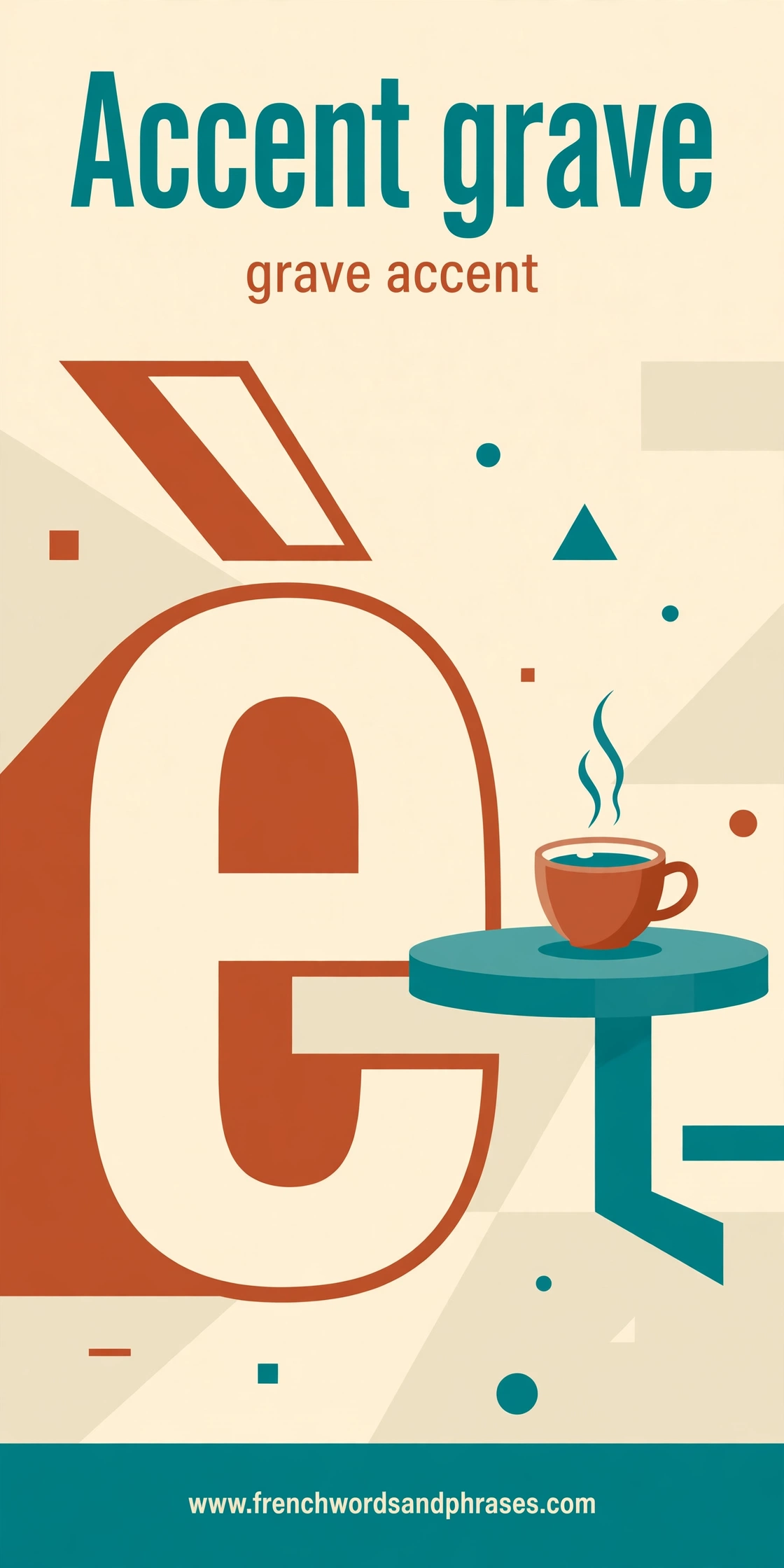
Accent grave means grave accent — the falling stroke over a letter, as in è.
The same classroom, the same two words on the board — thé and père. The teacher now draws the second stroke, the one that slides downhill over the e of père. « Celui qui descend, c’est l’accent grave. Il ouvre le son : è. » The children open their mouths wide for the sound, and the falling stroke has done its work.
Let’s explore how accent grave works in French, beginning with the whole term on one card.
Understanding the French Phrase Accent grave
Accent grave is a French spelling term built from accent (a mark over a letter — a masculine noun) and grave (grave, low, heavy — an adjective from Latin gravis, heavy). The mark is the falling stroke ( ` ) that leans downhill, the mirror image of the climbing accent aigu (é). Its third sibling, the accent circonflexe (ê), wears a hat instead of a slope. On the letter e, the grave opens the sound wide; on a and u it does a completely different job.
It means the grave accent: the diacritic ( ` ) placed over a vowel. On e it makes è, an open, broad sound: père, mère, très, après. On a and u it changes nothing you can hear — instead it separates twin words: à (to, at) against a (has), où (where) against ou (or), là (there) against la (the), déjà, çà et là. One small falling stroke, two trades: opening a sound, and telling twins apart.
Type: Spelling term — diacritic mark (accent + grave)
Answers the need: Naming the grave accent in French — in dictations, classrooms and spelling questions
Register: Neutral and educational — school, editing, language learning
Strength: Double — it opens the sound of è and it separates à/a, où/ou
One important usage detail: grave in this term is the adjective of weight and lowness (from Latin gravis) — the stroke falls like something heavy. It is the same word as in une voix grave, a deep voice, and un problème grave, a serious problem, but here it describes the slope of the mark, nothing sad. Note the slope itself: the grave falls from high-left to low-right ( ` ), exactly opposite to the aigu.
Experience the Word
Accent grave is the downhill stroke of French spelling — the mark that opens the mouth and, twice a day, saves a sentence from confusion.
Imagine the reader who meets the sentence « Où vas-tu ? » and the twin « Ou vas-tu ? » Only the little falling stroke on où stands between a question about place and a question about choice. The accent grave weighs almost nothing — and it carries the whole meaning.
English names the mark grave, borrowing the French word outright. French keeps the picture inside it: grave, heavy — the stroke slides down the letter the way a stone slides down a hill.
How to Use Accent grave in French: Complete Guide
Let’s explore how accent grave works in French, beginning with the whole term on one card.
Accent grave at a Glance
The Whole Term on One Card
Real meaning, literal picture, English twin and register — accent grave in five lines.
| Point | Accent grave |
|---|---|
| What it really means | the grave accent — the falling stroke ( ` ) over a vowel |
| Word for word | heavy accent — accent (mark) + grave (low, heavy, falling) |
| English equivalent | grave accent |
| Register | educational and neutral — classrooms, dictations, proofreading |
| Use it for | spelling è, and separating à/a, où/ou, là/la |
Example
Le è de père porte un accent grave.
The è in père carries a grave accent.
Word by Word: Building the Term
Two pieces — the mark and its downhill slope — take them one by one.
| Word | Literal meaning | Its job in the term |
|---|---|---|
| accent | accent, mark | the diacritic itself — masculine: un accent |
| grave | grave, low, heavy | the direction: the stroke falls, and on e the sound opens low and wide |
Example
Un accent grave descend de gauche à droite.
A grave accent falls from left to right.
Quick Quiz 1
Which stroke falls: l’accent aigu or l’accent grave?
Reveal the answer
L’accent grave — it slides downhill ( ` ). The aigu climbs ( ´ ). Grave like a stone, aigu like a spear.
Le è descend, le é monte.
The è falls, the é climbs.
When You Meet It: The Spelling Moments
Accent grave turns up at moments like these — wherever French words are written, dictated or untangled.
| Situation | Example |
|---|---|
| A dictation | père prend un accent grave — père takes a grave accent |
| A twin emergency | où avec un accent grave, sinon c’est « ou » — où with a grave accent, otherwise it is “or” |
| A spelling question | est-ce que « très » a un accent grave ? — does “très” have a grave accent? |
| A child’s homework | mets un accent grave sur le e de « mère » — put a grave accent on the e of “mère” |
| A place name | la ville de Saint-Étienne et ses accents graves — the town of Saint-Étienne and its grave accents |
Example
N’oublie pas l’accent grave dans « après ».
Do not forget the grave accent in “après”.
Make It Yours: The Term in Its Frames
The term is fixed — the three letters that wear the grave do the moving.
| Form | French | In English |
|---|---|---|
| The mark | un accent grave | a grave accent |
| On e (sound opens) | è — père, très, après | è — father, very, after |
| On a (twins split) | à — à Paris, déjà | à — in Paris, already |
| On u (twins split) | où — où vas-tu ? | où — where are you going? |
| Putting it | mettre un accent grave | to put a grave accent |
Example
Où a un accent grave, ou n’en a pas.
Où (where) has a grave accent, ou (or) does not.
Quick Quiz 2
Which twin asks about a place: ou or où?
Reveal the answer
Où — the grave accent makes it the question word “where”. Ou without the accent means “or”.
Où vas-tu, à Paris ou à Lyon ?
Where are you going, to Paris or to Lyon?
Everyday Expressions: The Accent Shelf
Accent grave slots into these frames — each one ready to use as it stands.
| Frame | In English |
|---|---|
| un accent grave | a grave accent |
| un accent aigu | an acute accent — the climbing twin |
| un accent circonflexe | a circumflex accent — the little hat |
| déjà | already — with its grave on the a |
| çà et là | here and there |
Example
« Déjà » et « où » portent un accent grave sur leur dernière voyelle.
“Déjà” and “où” carry a grave accent on their last vowel.
Close Cousins: The Three Strokes of the Vowels
The grave is the falling member of the family — its cousins climb and wear hats.
| Expression | The difference |
|---|---|
| l’accent grave (è, à, où) | the grave accent — falling stroke; opens e, separates à/a and où/ou |
| l’accent aigu (é) | the acute accent — rising stroke, closed sound, only on e: café |
| l’accent circonflexe (ê) | the circumflex — the little hat, on any vowel: fête |
| le tréma (ë) | the diaeresis — two dots separating vowels: Noël |
| la cédille (ç) | the cedilla — the hook under c: français, garçon |
Example
É monte, è descend, ê porte un chapeau.
É climbs, è falls, ê wears a hat.
Quick Quiz 3
On the letter e, what does the accent grave do to the sound — close it or open it?
Reveal the answer
It opens it — è is broad and open (père), where é with the aigu is tight and closed (café).
Le è de « très » est ouvert, le é de « thé » est fermé.
The è of “très” is open, the é of “thé” is closed.
Accent grave and Its Neighbours
The spelling shelf around the term — the twins, the letters and the classroom tools.
| French | In English |
|---|---|
| une voyelle | a vowel |
| un son ouvert | an open sound |
| jumeaux / jumelles | twins (à and a, où and ou) |
| une dictée | a dictation |
| l’orthographe | spelling |
Example
À et a sont des jumeaux que l’accent grave sépare.
À and a are twins that the grave accent separates.
Watch Out: The Traps Around Accent grave
The traps: the wrong slope, a missing grave that changes the word, and a sad meaning that is not there.
| Trap | The truth |
|---|---|
| drawing it climbing | the grave falls ( ` ); the climbing stroke ( ´ ) is the aigu — mirror images, different marks |
| « ou vas-tu ? » for “where are you going?” | without the grave, ou means or — the question collapses: où needs its accent |
| grave = sad or serious here | in this term grave means low and heavy, from Latin gravis — it describes the slope, not a mood |
| putting a grave on é’s territory | café, été take the aigu; père, très take the grave — the sound decides |
Example
Où est le café ? — Où demande un accent grave, café un accent aigu.
Where is the café? — Où needs a grave accent, café an acute one.
Quick Quiz 4
True or false: l’accent grave change le son du a dans « à Paris » — the grave accent changes the sound of a in “à Paris”.
Reveal the answer
False — à and a sound exactly alike. On a and u, the grave changes nothing you hear; it separates twins on the page. Only on e does it open the sound.
À Paris, on entend le même a qu’ailleurs.
In Paris, you hear the same a as anywhere else.
Accent grave in Everyday French: Real-Life Examples
Now that you know the word, let’s see how accent grave appears in everyday French.
Example 1 — A dictation
Écrivez « très » avec un accent grave sur le e.
Write “très” with a grave accent on the e.
Example 2 — A homework check
Tu as oublié l’accent grave dans « après ».
You forgot the grave accent in “après”.
Example 3 — A twin drill
« Où » prend un accent grave, « ou » n’en prend pas.
“Où” takes a grave accent, “ou” does not.
Example 4 — A family word
« Mère » et « père » portent tous les deux un accent grave.
“Mère” and “père” both carry a grave accent.
Example 5 — A teacher’s tip
Ouvre bien la bouche : c’est l’accent grave, è.
Open your mouth wide: it is the grave accent, è.
Example 6 — A text message
« Je suis déjà là » : deux accents graves dans une phrase.
“I am already there”: two grave accents in one sentence.
Beyond Translation: The Meaning of Accent grave
Of the three strokes of French, the grave is the diplomat. The aigu and the circonflexe work on sounds; the grave, on the letter e, opens the voice — but on a and u it abandons sound altogether and works purely on meaning, standing between à and a, où and ou like a referee between identical twins.
To say accent grave is to watch a single falling stroke do two kinds of work: opening a sound on e, and guarding a meaning on a and u.
And its name is a small Latin lesson: gravis, heavy — the stroke is the one that sinks, and French spelling has let it sink in the same direction for five hundred years.
How to Remember the French Phrase Accent grave
Remember it this way: Accent grave means grave accent — the falling stroke that opens the sound of è and separates the twins à/a and où/ou.
- You draw it falling — l’accent grave slides downhill; the climbing one is its twin, the aigu.
- You hear it open — père, mère, très : è is broad where é is tight.
- You trust it with twins — à is not a, où is not ou.
The key idea is accent grave = grave accent — falling stroke; è open sound; à/a, où/ou twins.
Test Your Knowledge of Accent grave
Let’s see how much you’ve learned. Try answering these questions before revealing the answers.
Question 1
What does accent grave mean?
Reveal the answer
Grave accent — the falling diacritic stroke ( ` ).
Question 2
What does it do on the letter e?
Reveal the answer
It opens the sound — è, broad and open: père, très, après.
Question 3
Translate: The grave accent opens the sound of the letter e.
Reveal the answer
L’accent grave ouvre le son de la lettre e.
Question 4
What does it do on a and u?
Reveal the answer
It separates twin words without changing the sound — à against a, où against ou.
Question 5
Complete the sentence:
Le è de « père » porte un accent ______. (grave)
Reveal the answer
grave
Le è de « père » porte un accent grave.
The è in “père” carries a grave accent.
Your Final Challenge
Can You Use It?
How would you say this in French?
“The grave accent opens the sound of the letter e.”
Reveal the answer
L’accent grave ouvre le son de la lettre e.
The grave accent opens the sound of the letter e.
A little French. A little curiosity. A richer everyday life.
LEARN FRENCH ONE WORD AT A TIME




