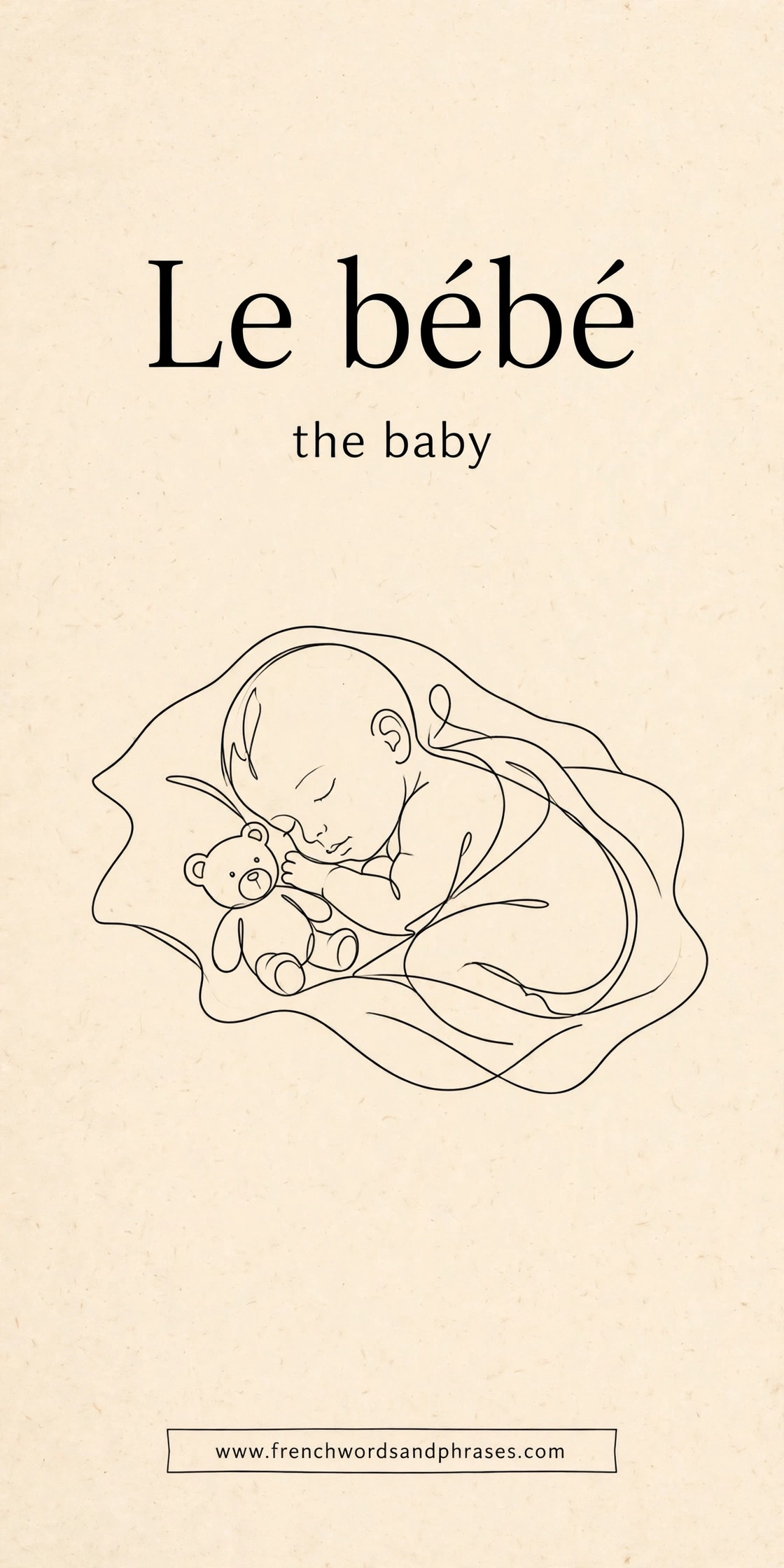
A French Word to Live By
Translate Bébé to English
/be.be/
Le bébé means the baby.
Three in the morning, a small cry from the next room, and the whole house is awake — le bébé, the baby, the smallest person and the loudest voice in the family.
In this guide, you’ll learn what bébé means in English, how to use it with its articles, how to form its plural, and how it appears in everyday French. Explore French examples, English translations, and practice quizzes.
Understanding the French Noun Bébé
Bébé is a masculine French noun, learned with its article: le bébé, un bébé. It wears two acute accents, two little climbing é’s — bé-bé, two bright syllables. It serves for boys and girls alike: un bébé, ce bébé, whatever the cradle holds.
It means the baby — a child in its first year or so of life, from the newborn in the maternity ward to the toddler taking first steps. French also lends the word to anything young and small: un bébé chat is a baby cat, a kitten, and un bébé requin a baby shark. Grown-ups who sulk are told, kindly or not, not to play the baby — faire le bébé.
Gender: Masculine — le bébé
Definite article: le — le bébé (the baby)
Indefinite article: un — un bébé (a baby)
Plural: les bébés
Spelling note: two acute accents: bé-bé, both é’s bright and open
For young animals too: un bébé chat (a kitten), un bébé chien (a puppy)
English equivalents: The baby.
Good news for learners: bébé does not change its article with the baby’s sex — a girl is still un bébé in everyday French. And when the baby is on its way, French announces it beautifully: un bébé en route, a baby on the way.
Experience the Word
Bébé is the sound of a house reorganised around one small person: bottles warming, lullabies at midnight, grandparents arriving with far too many presents.
Imagine the maternity ward window: a row of tiny wrapped bundles, and every family pressing close to find theirs — le bébé, already the centre of a world.
You have not just named an infant. You have met the word that turns adults into parents — le bébé, ruler of the house.
How to Use Bébé in French: Complete Guide
Let’s explore how bébé works in French, beginning with its articles — le bébé, un bébé, des bébés.
Bébé with the Definite Article (Le, Les)
Used for a specific baby — yours, the one in the pram.
| Form | French |
|---|---|
| Masculine singular | le bébé |
| Plural | les bébés |
Example
Le bébé dort enfin dans son berceau.
The baby is finally asleep in his cradle.
Bébé with the Indefinite Article (Un, Des)
Used for a baby in general — and for the happy announcement.
| Form | French |
|---|---|
| Masculine singular | un bébé |
| Plural | des bébés |
Example
Ils attendent un bébé pour le mois de mai.
They are expecting a baby in May.
Bébé with the Partitive and Quantities (Pour le bébé…)
Babies are measured in bottles, naps and spoonfuls — the quantities of the nursery.
| Quantity | French |
|---|---|
| a baby on the way | un bébé en route |
| a newborn baby | un bébé nouveau-né |
| a sleeping baby | un bébé endormi |
| a baby bottle | un biberon pour le bébé |
| two babies (twins) | deux bébés, des jumeaux |
Example
Elle prépare un biberon pour le bébé.
She is preparing a bottle for the baby.
Quick Quiz 1
Complete the sentence:
______ bébé pleure dans la chambre. (the)
Reveal the answer
Le
Le bébé pleure dans la chambre.
The baby is crying in the bedroom — bébé is masculine, so le.
The Plural of Bébé
Bébé adds an -s in the plural — les bébés, the whole row of the nursery.
| Number | French |
|---|---|
| Singular | le bébé |
| Plural | les bébés |
Example
Les bébés de la crèche font la sieste.
The nursery babies are having their nap.
Bébé with Possessive Adjectives (Mon, Ton, Son…)
Possessives agree with the noun: bébé is masculine, so mon, ton, son in the singular.
| Owner | French |
|---|---|
| my | mon bébé |
| your (tu) | ton bébé |
| his / her | son bébé |
| our | notre bébé |
| your (vous) | votre bébé |
| their | leur bébé |
Example
Mon bébé a fait ses premiers pas hier.
My baby took his first steps yesterday.
Quick Quiz 2
Complete the sentence:
Elle chante une chanson pour ______ bébé. (her)
Reveal the answer
son
Elle chante une chanson pour son bébé.
She sings a song for her baby — son, because bébé is masculine.
Bébé with Demonstrative Adjectives (Ce, Ces)
Used to point: ce bébé, this baby.
| Form | French |
|---|---|
| Masculine singular | ce bébé |
| Plural | ces bébés |
Example
Ce bébé sourit à tout le monde.
This baby smiles at everyone.
Bébé with Adjectives
Adjectives agree with bébé — masculine singular: un bébé sage, un petit bébé.
| Adjective | With Bébé |
|---|---|
| petit (small) | un petit bébé |
| sage (good, quiet) | un bébé sage |
| endormi (sleeping) | un bébé endormi |
| joyeux (happy) | un bébé joyeux |
| nouveau-né (newborn) | un bébé nouveau-né |
Example
C’est un bébé sage, il dort toute la nuit.
He is a good baby, he sleeps all night.
Quick Quiz 3
Complete the sentence:
Regarde ce ______ bébé dans son landau ! (small)
Reveal the answer
petit
Regarde ce petit bébé dans son landau !
Look at this small baby in his pram! — petit comes before the noun.
Everyday Expressions with Bébé
Announcements, kittens and sulking adults — the bébé phrases of daily life.
| Expression | In English |
|---|---|
| un bébé en route | a baby on the way |
| faire le bébé | to act like a baby, to sulk |
| un bébé chat | a kitten (a baby cat) |
| un bébé éprouvette | a test-tube baby |
| dormir comme un bébé | to sleep like a baby |
| un cadeau pour le bébé | a present for the baby |
Example
Après sa longue journée, il dort comme un bébé.
After his long day, he sleeps like a baby.
Words from the Same Family as Bébé
Cradles, bottles and lullabies — the words that travel with bébé.
| French | In English |
|---|---|
| le berceau | the cradle |
| le biberon | the baby’s bottle |
| la couche | the nappy, the diaper |
| la tétine | the dummy, the pacifier |
| la naissance | the birth |
Example
Le berceau du bébé est près de la fenêtre.
The baby’s cradle is near the window.
Quick Quiz 4
What does dormir comme un bébé mean?
Reveal the answer
To sleep like a baby — deeply and peacefully, all night long.
La maison est calme, tout le monde dort comme un bébé.
The house is quiet, everyone is sleeping like a baby.
Bébé in Everyday French: Real-Life Examples
Now that you know the word, let’s see how bébé appears in everyday French.
Example 1 — The announcement
Ils attendent un bébé pour le printemps.
They are expecting a baby in the spring.
Example 2 — Sleeping
Chut, le bébé dort dans la pièce à côté.
Shh, the baby is sleeping in the next room.
Example 3 — Feeding
Le bébé boit son biberon toutes les trois heures.
The baby drinks his bottle every three hours.
Example 4 — First steps
Regarde, le bébé marche tout seul !
Look, the baby is walking all by himself!
Example 5 — A kitten
Leur chatte a eu trois bébés chats.
Their cat has had three kittens.
Example 6 — Sulking
Arrête de faire le bébé et viens nous aider.
Stop acting like a baby and come and help us.
Beyond Translation: The Meaning of Bébé
Bébé is one of the friendliest words in French: two open syllables a baby itself could almost say, spelled with two acute accents like two little flags. English borrowed it half-way (baby is its cousin, not its translation — French bébé stayed proudly French). The word rules the house it enters: schedules, sleep and conversation all bend around le bébé.
To say bébé is to announce that the smallest person present is in charge.
It evokes the cradle and the first steps, the lullaby at three in the morning — the beginning of every family story.
How to Remember the French Noun Bébé
Remember it this way: Bébé is the baby — masculine for every baby, with two bright acute accents: le bébé, un bébé en route.
- Always masculine — le bébé, un bébé, mon bébé, for girls and boys alike.
- The announcement — un bébé en route, a baby on the way.
- The deep sleep — dormir comme un bébé, to sleep like a baby.
The key idea is le bébé — the baby, masculine, with two acute accents.
Test Your Knowledge of Bébé
Let’s see how much you’ve learned. Try answering these questions before revealing the answers.
Question 1
Is bébé masculine or feminine?
Reveal the answer
Masculine — le bébé, un bébé, for every baby.
Question 2
How do you announce a baby on the way?
Reveal the answer
Un bébé en route.
Question 3
Translate: The baby is sleeping.
Reveal the answer
Le bébé dort.
Question 4
What is un bébé chat?
Reveal the answer
A kitten — a baby cat; bébé lends itself to young animals.
Question 5
Complete the sentence:
Elle donne le biberon à ______ bébé. (her)
Reveal the answer
son
Elle donne le biberon à son bébé.
She gives the bottle to her baby.
Your Final Challenge
Can You Use It?
How would you say this in French?
“The baby sleeps in his cradle.”
Reveal the answer
Le bébé dort dans son berceau.
The baby sleeps in his cradle.
A little French. A little curiosity. A richer everyday life.
LEARN FRENCH ONE WORD AT A TIME