
A French Word to Live By
Translate Blessé to English
/ble.se/
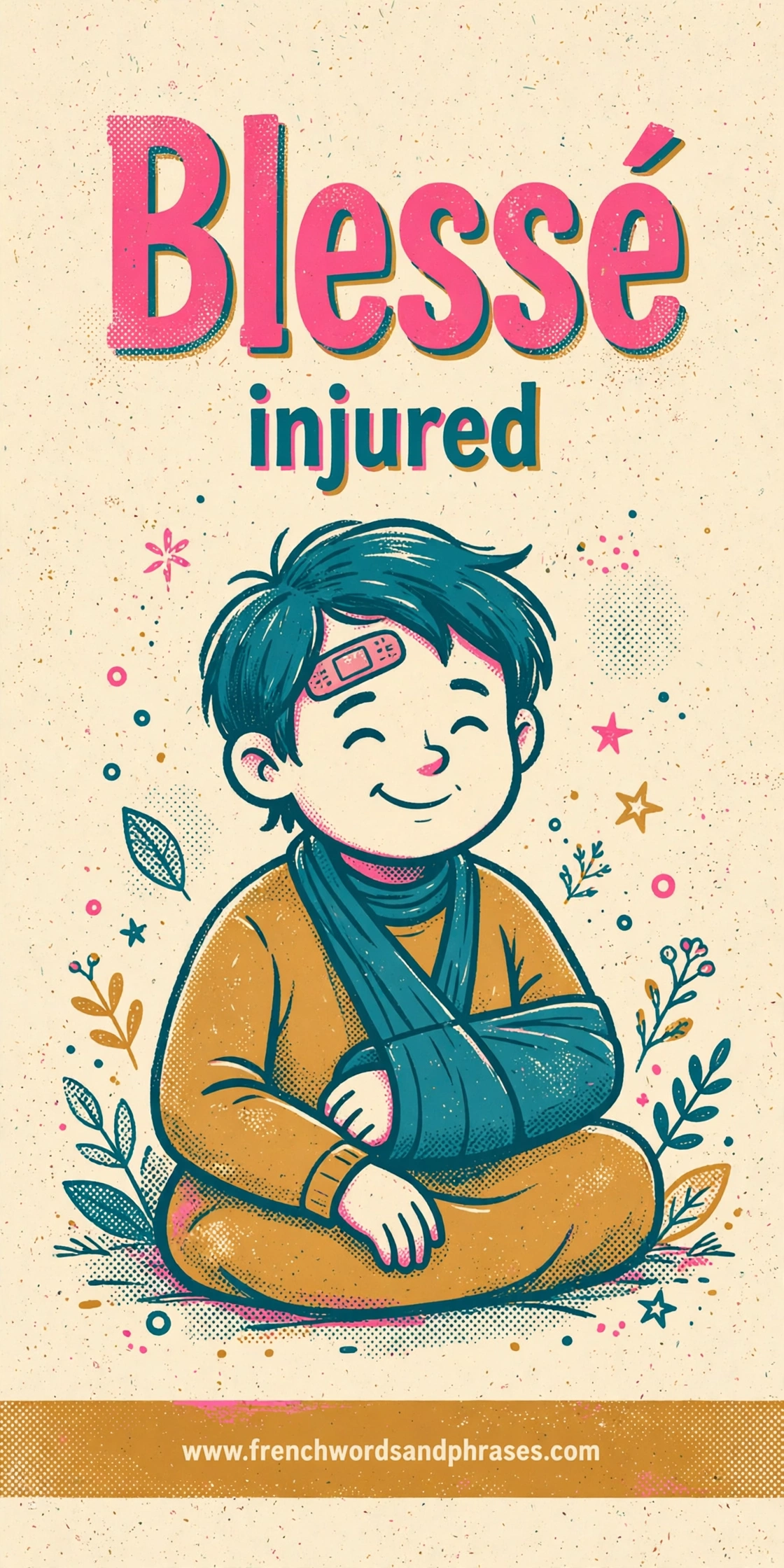
Blessé means injured.
A cyclist sits on the kerb after a fall, one knee scraped, the ambulance on its way. The medic kneels beside him and asks the only question that matters: « Vous êtes blessé ? » English speakers, beware — he is not asking whether the man feels blessed. He is asking whether he is hurt.
In this guide, you’ll learn what blessé means in English — and what it does NOT mean — how its feminine blessée is formed, where it stands in the sentence, and the hospital and sports vocabulary that travels with it. Explore French examples, English translations, and practice quizzes.
Understanding the French Adjective Blessé
Blessé is a French adjective of quality — and one of the great false friends of the language. It does NOT mean blessed. It means injured, hurt, wounded: someone who has been hurt in an accident, a fall or a fight. It is the past participle of the verb blesser (to injure, to wound) working as an adjective. Its feminine is blessée: un soldat blessé, une jambe blessée, des joueurs blessés. The French for blessed is a completely different word: béni.
It means injured — hurt in body, from a cut knee to a wounded soldier. Un blessé, used as a noun, is an injured person, a casualty: les blessés de l’accident, the injured of the accident. And blessé has a figurative life too: un amour-propre blessé is wounded pride, and a person easily offended is vite blessé — quickly hurt, in feelings this time.
Type: Adjective of quality — injury; also a noun (un blessé, an injured person)
Answers the question: What is he like? — injured, hurt, wounded
Changes form: Feminine adds -e — blessé / blessée; plurals blessés / blessées
English equivalents: Injured; hurt; wounded. NOT blessed — blessed is béni.
One important usage detail: blessé stands AFTER the noun — un joueur blessé, une jambe blessée. And the trap of traps: never translate English « blessed » by blessé. A blessed day, a blessed event, the Blessed Virgin — all of these are béni or bénit in French (un jour béni, la Vierge bénite). Blessé belongs to hospitals and battlefields, not to blessings.
Experience the Word
Blessé is the adjective of ambulances and bandages — the word on the medic’s lips and in every match report where a player limps off the pitch.
Imagine the tour de France on a mountain road: a rider touches a wheel, goes down, and sits in the dust holding his shoulder. The commentator’s voice drops: « Il est blessé. » Two words, and a million viewers understand that the race, for him, may be over.
You have not learned a word for good fortune. You have learned the word French uses when fortune fails — and the difference could matter in a hospital.
How to Use Blessé in French: Complete Guide
Let’s explore how blessé works in French, beginning with the whole word on one card.
Blessé at a Glance
Before the details, here is the whole word on one card.
The Whole Word on One Card
Meaning, type, position and forms — blessé in four lines.
| Point | Blessé |
|---|---|
| Meaning | injured, hurt, wounded — NOT blessed |
| Type | adjective of quality — injury (past participle of blesser) |
| Usual position | after the noun — un joueur blessé |
| Form | blessé / blessée — blessés / blessées in the plural |
Example
Le joueur blessé quitte le terrain.
The injured player leaves the pitch.
The Four Forms of Blessé
Blessé is a regular past-participle adjective: the feminine adds an e, the plurals add an s.
| Form | Blessé | Example |
|---|---|---|
| Masculine singular | blessé | un soldat blessé — a wounded soldier |
| Feminine singular | blessée | une femme blessée — an injured woman |
| Masculine plural | blessés | des passagers blessés — injured passengers |
| Feminine plural | blessées | des personnes blessées — injured people |
Example
Trois personnes blessées ont été emmenées à l’hôpital.
Three injured people were taken to hospital.
Quick Quiz 1
What is the feminine of blessé?
Reveal the answer
blessée
Une jambe blessée — the feminine adds an e.
An injured leg.
The Feminine of Blessé: Blessée
Blessée is not a separate word to learn later — it is half of this word’s life, and the hospital forms ask for it constantly.
| Situation | Example |
|---|---|
| Masculine | un cycliste blessé — an injured cyclist |
| Feminine | une cycliste blessée — identical but for the added e |
| Why | participle adjectives agree: the feminine adds -e |
| The plural | add s — des jambes blessées, injured legs |
Example
La conductrice, blessée au bras, attend les secours.
The driver, injured in the arm, waits for the emergency services.
Where Blessé Goes: After the Noun
Blessé follows the noun it describes, like most French adjectives, and it sits naturally after être.
| Pattern | Example |
|---|---|
| After the noun | un joueur blessé — an injured player |
| After être | elle est blessée — she is injured |
| With an adverb | un homme gravement blessé — a seriously injured man |
| Before the noun | un blessé joueur — not in everyday French |
Example
Il est légèrement blessé, rien de grave.
He is slightly injured, nothing serious.
Quick Quiz 2
How do you say ‘an injured player’ — un blessé joueur or un joueur blessé?
Reveal the answer
un joueur blessé
Blessé stands after the noun.
An injured player.
More Blessé: Comparing with Blessé
Blessé compares the regular way, with plus, moins and aussi — the language of hospital bulletins and match reports.
| Degree | Example |
|---|---|
| As injured as | aussi blessé que — as injured as |
| More injured | plus blessé — more seriously injured |
| Less injured | moins blessé — less injured |
| The most injured (masc.) | le plus blessé — le plus blessé des passagers |
| The most injured (fem.) | la plus blessée — la plus blessée des victimes |
Example
Le conducteur est plus blessé que son passager.
The driver is more seriously injured than his passenger.
Everyday Expressions with Blessé
Blessé lives in news bulletins, hospitals and sports pages — and, figuratively, wherever pride is wounded.
| Expression | In English |
|---|---|
| un blessé léger | a slightly injured person |
| un blessé grave | a seriously injured person |
| les blessés de guerre | the war wounded |
| un amour-propre blessé | wounded pride |
| être blessé dans son orgueil | to have one’s pride hurt |
| un animal blessé | an injured animal |
Example
L’accident a fait deux blessés légers.
The accident left two people slightly injured.
Quick Quiz 3
What does un amour-propre blessé mean?
Reveal the answer
Wounded pride
Un amour-propre blessé — here blessé is figurative: hurt feelings, not a hurt body.
Wounded pride.
Blessé and Its Neighbours
Blessé keeps company with the vocabulary of accidents and hospitals; across the fence stand its false friend béni and the gentler words for aches.
| French | In English |
|---|---|
| béni | blessed — the word blessé is NOT |
| blesser | to injure, to wound — the verb behind blessé |
| une blessure | a wound, an injury |
| un accidenté | an accident victim |
| souffrant | unwell, in pain — softer than blessé |
| indemne | unharmed, unscathed — the happy opposite |
Example
Par miracle, le pilote est indemne, mais son copilote est blessé.
By a miracle, the pilot is unharmed, but his co-pilot is injured.
Watch Out: The Traps Around Blessé
One trap towers over the rest: blessé looks like blessed and means the opposite side of fortune.
| Trap | The truth |
|---|---|
| Blessed | blessé means injured — blessed is béni: un enfant béni, a blessed child |
| The noun | un blessé is an injured person, a casualty — never a blessed one |
| Agreement | une femme blessée, des femmes blessées — the participle agrees like any adjective |
| Hurt feelings | blessé can be figurative — elle est blessée par tes paroles, she is hurt by your words |
Example
Elle se sent bénie par sa famille, pas blessée.
She feels blessed by her family, not injured.
Quick Quiz 4
How do you say ‘a blessed day’ in French?
Reveal the answer
un jour béni
Blessed is béni — blessé would mean an injured day, which makes no sense at all.
A blessed day.
Blessé in Everyday French: Real-Life Examples
Now that you know the word, let’s see how blessé appears in everyday French.
Example 1 — At the hospital
Le blessé arrive aux urgences.
The injured man arrives at A&E.
Example 2 — A match report
L’attaquant, blessé au genou, ne jouera pas dimanche.
The striker, injured in the knee, will not play on Sunday.
Example 3 — After a fall
Elle s’est relevée, blessée légèrement à la main.
She got up, slightly injured in the hand.
Example 4 — The news
L’incendie n’a fait aucun blessé.
The fire left no one injured.
Example 5 — Feelings
Il est blessé par cette remarque injuste.
He is hurt by that unfair remark.
Example 6 — An animal
Ils ont recueilli un chat blessé.
They took in an injured cat.
Beyond Translation: The Meaning of Blessé
English speakers meet blessé with a smile — it looks like an old friend, blessed. It is a trap laid by history: both words wandered far from their roots, and French blessé settled in the hospital while English blessed settled in the church. French keeps its true blessed safe in another word entirely, béni, from Latin benedictus.
Blessé is the adjective of the ambulance and the bandage: it means injured, and only injured.
Learn the pair together — blessé for the casualty ward, béni for the blessing — and the false friend loses its power over you forever.
How to Remember the French Adjective Blessé
Remember it this way: Blessé is the false friend in person — it means injured, never blessed, and its feminine blessée follows it everywhere.
- You banish the blessing — blessé veut dire injured ; blessed se dit béni.
- You learn the pair together — un joueur blessé, une joueuse blessée.
- You hear the hospital in it — un blessé est un casualty, pas un saint.
The key idea is blessé means injured, NOT blessed (blessed = béni); feminine blessée.
Test Your Knowledge of Blessé
Let’s see how much you’ve learned. Try answering these questions before revealing the answers.
Question 1
What does blessé mean?
Reveal the answer
Injured — hurt or wounded. It does NOT mean blessed.
Question 2
How do you say blessed in French?
Reveal the answer
Béni — un jour béni, a blessed day. Blessé would mean injured.
Question 3
Translate: an injured woman.
Reveal the answer
Une femme blessée.
Question 4
Complete the sentence:
Les passagers ______ ont été soignés sur place.
Reveal the answer
blessés
Les passagers blessés ont été soignés sur place.
The injured passengers were treated on the spot.
Question 5
How do you say ‘the war wounded’?
Reveal the answer
les blessés de guerre — blessé as a noun means an injured person, a casualty.
Your Final Challenge
Can You Use It?
How would you say this in French?
“The injured player leaves the pitch.”
Reveal the answer
Le joueur blessé quitte le terrain.
The injured player leaves the pitch.
A little French. A little curiosity. A richer everyday life.
LEARN FRENCH ONE WORD AT A TIME




