A French Word to Live By
Translate Problème to English
/pʁɔ.blɛm/
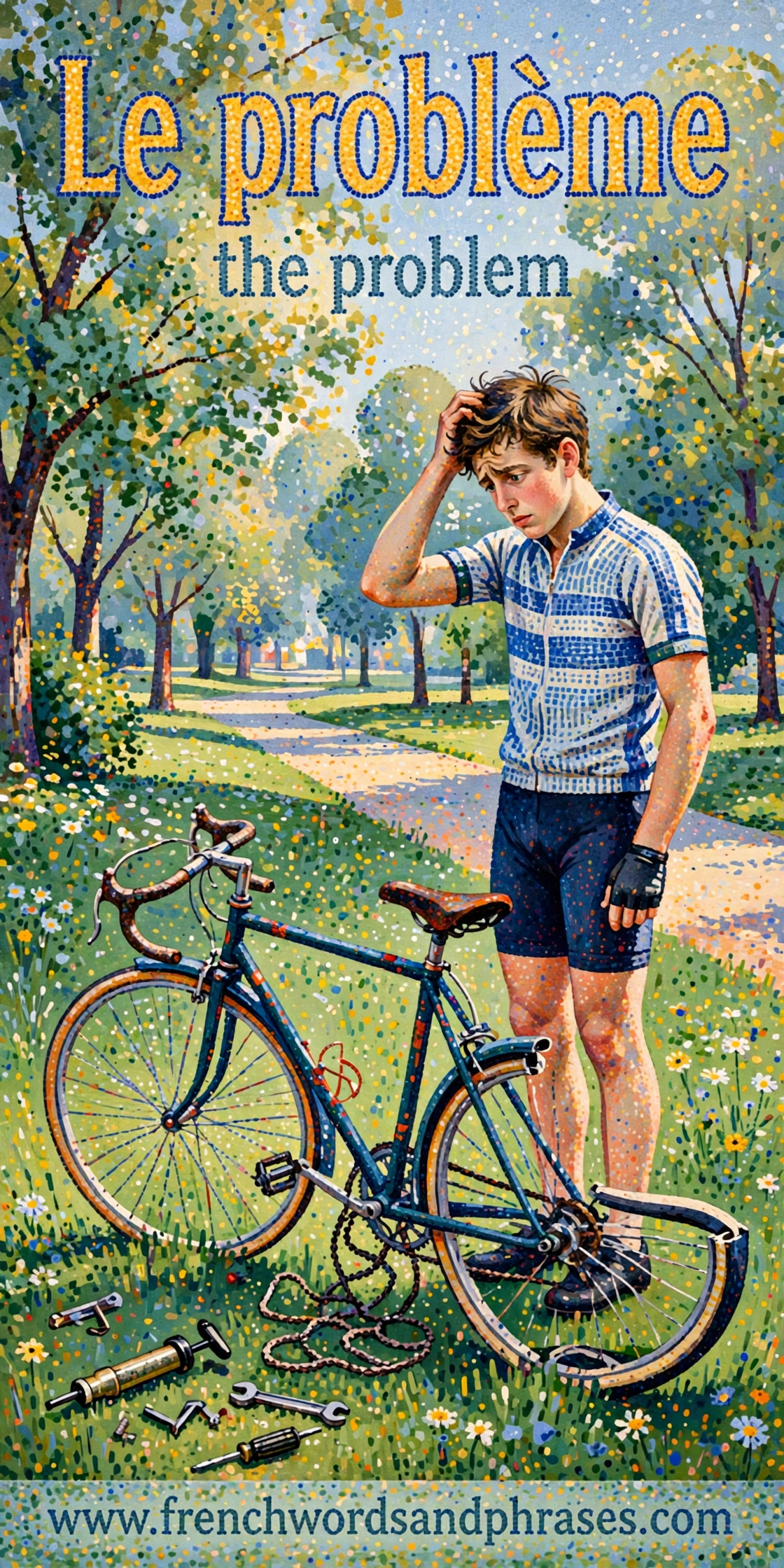
Le problème means the problem.
The train is late, the printer is blinking red, and the reservation has vanished from the system. Three different disasters, one same small word on everyone’s lips — le problème.
In this guide, you’ll learn what problème means in English, how to use it with its articles, how to form its plural, and how it appears in everyday French. Explore French examples, English translations, and practice quizzes.
Understanding the French Noun Problème
Problème is a masculine French noun — and that is its great trap, because it ends in -e, the letter learners associate with feminine nouns. Learn it with its article, always: le problème, un problème. It belongs to the -ème family — problème, poème, système, thème — and that whole family is masculine.
It means the problem — the difficulty, the snag, the thing that has gone wrong, from a maths exercise (un problème de maths) to a broken car. And it has a sunny side: inside the answer pas de problème, no problem, the word loses all its menace and becomes pure friendliness.
Gender: Masculine — le problème, despite the final -e
Definite article: le — le problème (the problem)
Indefinite article: un — un problème (a problem)
Plural: les problèmes
The -ème family: le poème, le système, le thème — all masculine
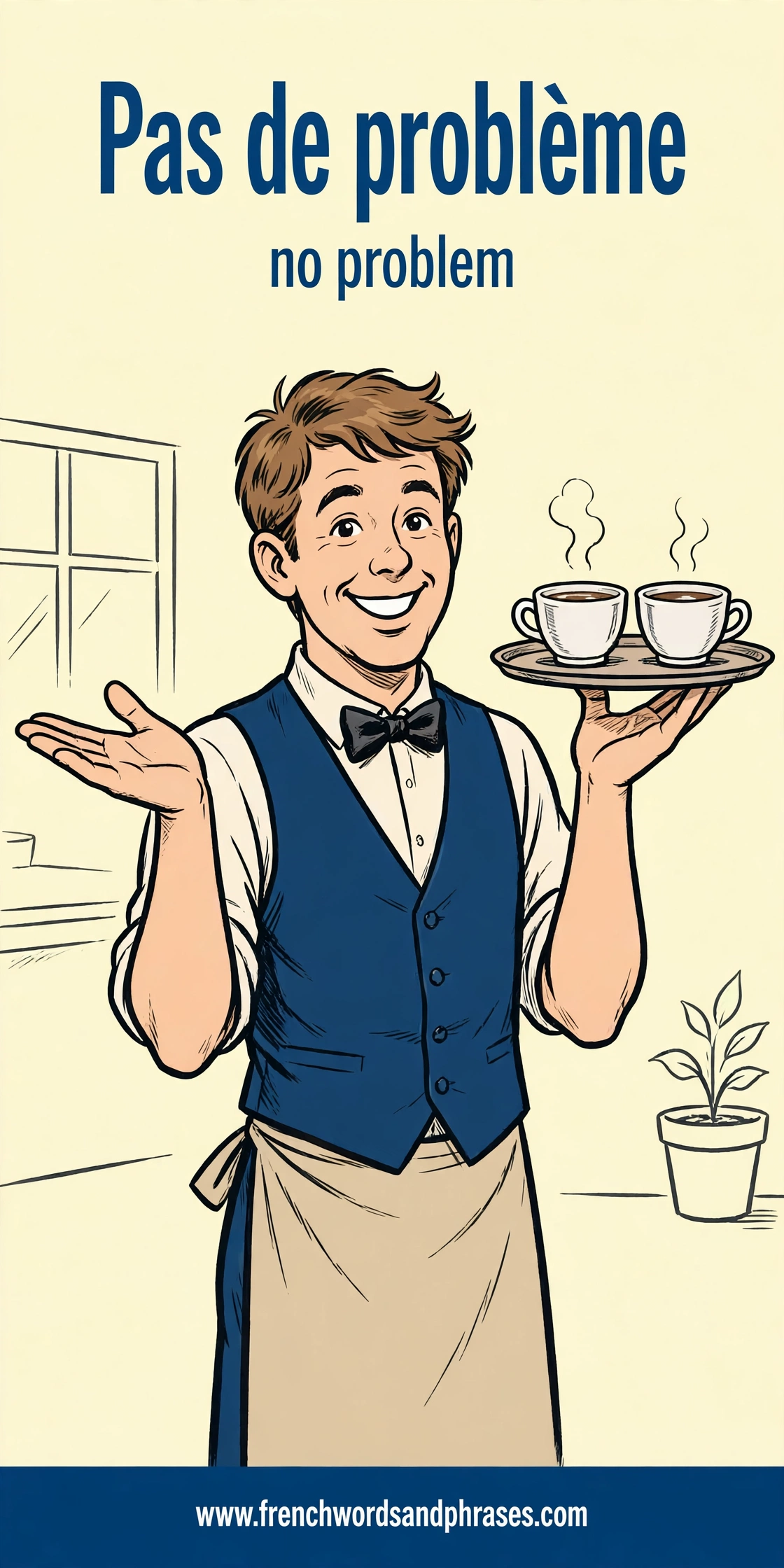
Famous answer: pas de problème — no problem
English equivalents: The problem.
Say it once, say it forever: problème is masculine. The final -e is a liar. It is le problème, un problème, ce problème, le problème est grave — never « la problème ». The safest anchor is its family: the Greek -ème words (problème, poème, système, thème, emblème) are masculine in French, every one of them.
Experience the Word
Problème is the most democratic word in French: the minister, the mechanic and the schoolchild all have one, and all say it the same way.
Imagine the classroom silence over un problème de maths — twenty pencils, twenty frowns — and then the one hand that rises, and the problem dissolves like sugar in coffee.
You have not just found a difficulty. You have named it — et un problème nommé est déjà à moitié résolu.
How to Use Problème in French: Complete Guide
Let’s explore how problème works in French, beginning with its articles — le problème, un problème, des problèmes — and one golden rule: masculine, always.
Problème with the Definite Article (Le, Les)
Used for a specific problem — the one everyone is talking about.
| Form | French |
|---|---|
| Masculine singular | le problème |
| Plural | les problèmes |
Example
Le problème, c’est que le train est en retard.
The problem is that the train is late.
Problème with the Indefinite Article (Un, Des)
Used for a problem in general — a new one, a small one, one more.
| Form | French |
|---|---|
| Masculine singular | un problème |
| Plural | des problèmes |
Example
Il y a un problème avec la réservation.
There is a problem with the booking.
Problème with the Partitive and Quantities (Un problème de…)
Problems are counted in halves, wholes and multitudes — here is problème in quantities.
| Quantity | French |
|---|---|
| a car problem | un problème de voiture |
| half of the problem | la moitié du problème |
| the whole problem | tout le problème |
| a lot of problems | beaucoup de problèmes |
| no problem | pas de problème |
Example
La moitié du problème est déjà résolue.
Half of the problem is already solved.
Quick Quiz 1
Complete the sentence:
______ problème est simple à résoudre. (The)
Reveal the answer
Le
Le problème est simple à résoudre.
The problem is simple to solve — le, because problème is masculine despite its -e.
The Plural of Problème
Problème adds a simple -s in the plural — les problèmes, which rarely travel alone.
| Number | French |
|---|---|
| Singular | le problème |
| Plural | les problèmes |
Example
Les problèmes arrivent rarement seuls.
Problems rarely come alone.
Problème with Possessive Adjectives (Mon, Ton, Son…)
Possessives agree with the noun: problème is masculine, so mon, ton, son.
| Owner | French |
|---|---|
| my | mon problème |
| your (tu) | ton problème |
| his / her | son problème |
| our | notre problème |
| your (vous) | votre problème |
| their | leur problème |
Example
Mon problème, c’est les maths.
My problem is maths.
Quick Quiz 2
Complete the sentence:
C’est ______ problème, pas le mien ! (your — vous form)
Reveal the answer
votre
C’est votre problème, pas le mien !
That’s your problem, not mine!
Problème with Demonstrative Adjectives (Ce, Ces)
Used to point: ce problème, this problem — the one giving you a headache.
| Form | French |
|---|---|
| Masculine singular | ce problème |
| Plural | ces problèmes |
Example
Ce problème me donne mal à la tête.
This problem is giving me a headache.
Problème with Adjectives
Adjectives agree with problème — masculine singular: un gros problème, un problème grave.
| Adjective | With Problème |
|---|---|
| gros (big) | un gros problème |
| petit (small) | un petit problème |
| grave (serious) | un problème grave |
| simple (simple) | un problème simple |
| compliqué (complicated) | un problème compliqué |
Example
Ce n’est pas un gros problème, ne t’inquiète pas.
It’s not a big problem, don’t worry.
Quick Quiz 3
Complete the sentence:
Pas ______ problème ! (of)
Reveal the answer
de
Pas de problème !
No problem! After pas, the article disappears and de takes its place.
Everyday Expressions with Problème
Having them, solving them and waving them away — the problème phrases of daily life.
| Expression | In English |
|---|---|
| avoir un problème | to have a problem |
| pas de problème | no problem |
| résoudre un problème | to solve a problem |
| un problème de maths | a maths problem |
| causer des problèmes | to cause problems, to cause trouble |
| le problème, c’est que… | the problem is that… |
Example
Elle résout le problème de maths en deux minutes.
She solves the maths problem in two minutes.
Words from the Same Family as Problème
Solutions, worries and the whole -ème team — the words that travel with problème.
| French | In English |
|---|---|
| problématique | problematic |
| la solution | the solution |
| résoudre | to solve |
| sans problème | without a problem, easily |
| le souci | the worry — pas de souci, no worries |
Example
Chaque problème a sa solution.
Every problem has its solution.
Quick Quiz 4
True or false: problème is feminine because it ends in -e.
Reveal the answer
False — problème is masculine.
On dit le problème, un problème, ce problème.
We say le problème, un problème, ce problème — the -ème family is masculine.
Problème in Everyday French: Real-Life Examples
Now that you know the word, let’s see how problème appears in everyday French.
Example 1 — At work
On a un petit problème avec l’imprimante.
We have a small problem with the printer.
Example 2 — Reassurance
Pas de problème, je m’en occupe.
No problem, I’ll take care of it.
Example 3 — Maths class
Qui peut résoudre ce problème ?
Who can solve this problem?
Example 4 — The car
Le garagiste a trouvé le problème.
The mechanic found the problem.
Example 5 — Honest talk
Le problème, c’est que je n’ai pas le temps.
The problem is that I don’t have time.
Example 6 — Solved
Bonne nouvelle : le problème est réglé !
Good news: the problem is sorted!
Beyond Translation: The Meaning of Problème
Problème’s finest hour is not a disaster but a smile: pas de problème, the friendliest answer in the language, where the problem is named only to be waved away. This noun page is that phrase’s home address. The word came from Greek problēma — something thrown in front of you, an obstacle on the path — and French has been stepping over it, solving it and joking about it ever since.
To say le problème is to put the obstacle into words — and words are the first tool for moving it.
It evokes the frown over the maths book, the mechanic under the bonnet, and the shrug that ends the story: pas de problème.
How to Remember the French Noun Problème
Remember it this way: Problème ends in -e but it is masculine: le problème, un problème. The whole -ème family plays for the masculine team.
- Masculine! — le problème, never « la problème ».
- The -ème team — problème, poème, système, thème.
- The friendly answer — pas de problème.
The key idea is le problème — masculine despite the -e.
Test Your Knowledge of Problème
Let’s see how much you’ve learned. Try answering these questions before revealing the answers.
Question 1
How do you say « the problem » in French?
Reveal the answer
Le problème.
Question 2
True or false: problème is feminine because it ends in -e.
Reveal the answer
False. Problème is masculine — le problème, un problème, like all the -ème words.
Question 3
Translate: No problem, I’ll do it.
Reveal the answer
Pas de problème, je le fais.
Question 4
Complete the sentence:
Elle a résolu ______ problème. (the)
Reveal the answer
le
Elle a résolu le problème.
She solved the problem.
Question 5
What does résoudre un problème mean?
Reveal the answer
To solve a problem — résoudre is the verb of solutions.
Your Final Challenge
Can You Use It?
How would you say this in French?
“The problem is solved.”
Reveal the answer
Le problème est résolu.
The problem is solved.
A little French. A little curiosity. A richer everyday life.
LEARN FRENCH ONE WORD AT A TIME