A French Word to Live By
Translate Pas de problème to English
/pa də pʁɔ.blɛm/
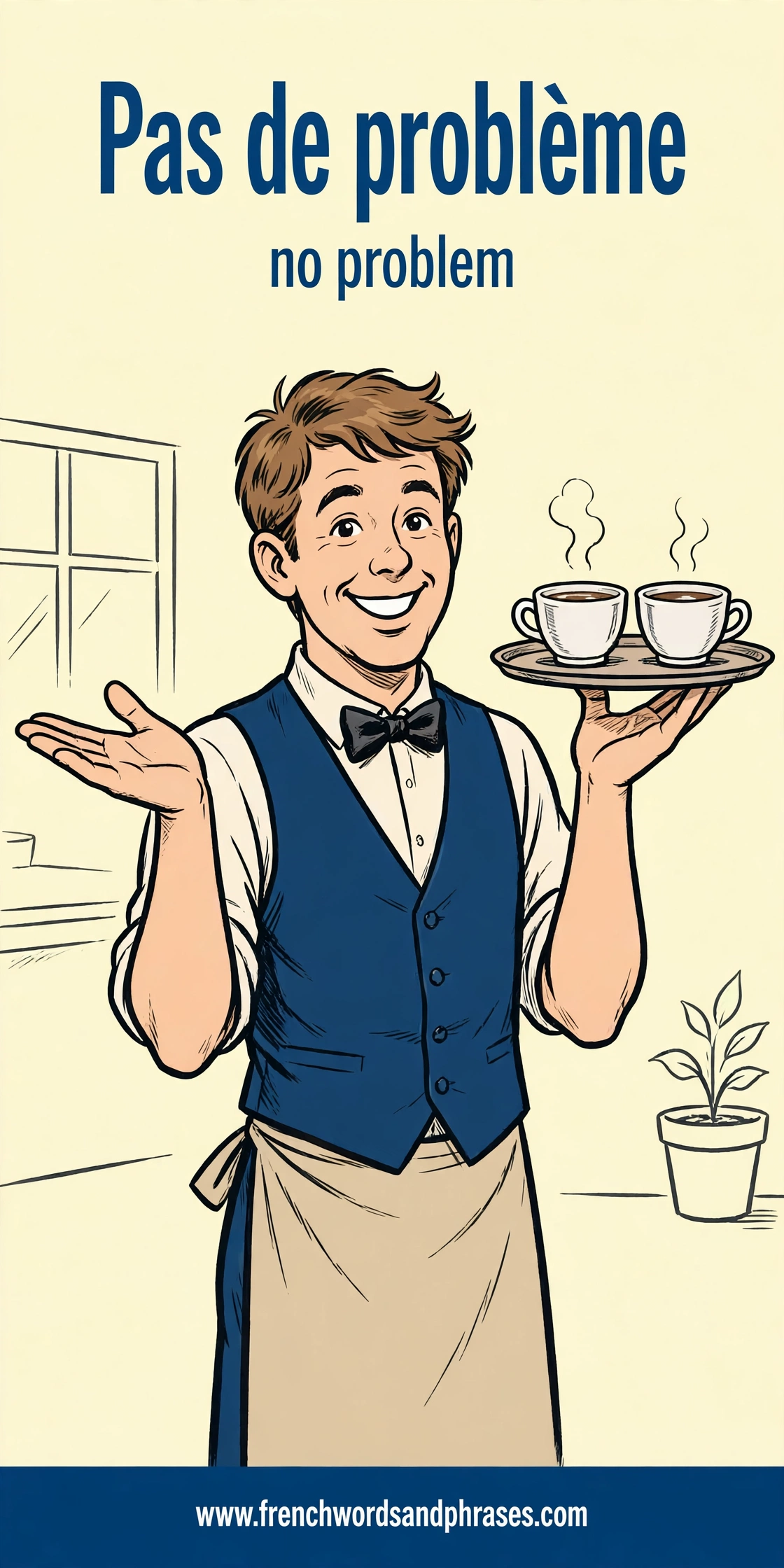
Pas de problème means no problem — the easy answer that waves a difficulty away.
The train is cancelled, the hotel is across town, and your friend is already apologising for the whole trip. You shrug, smile, and produce the three most relaxing words in French: « Pas de problème, on trouvera un bus. »
Let’s explore how pas de problème works in French, beginning with the whole phrase on one card.
Understanding the French Phrase Pas de problème
Pas de problème is a French everyday phrase built from pas (not — the everyday negative), de (of, a — the form the article takes after a negative) and problème (a problem — a masculine noun that has its own page on this site). It began life as the tail of a sentence — il n’y a pas de problème, there is no problem — and French now uses the tail on its own, as a complete answer.
It means no problem. It answers requests (— Tu peux venir à neuf heures ? — Pas de problème), it answers thanks (— Merci ! — Pas de problème), and it answers apologies (— Pardon pour le retard. — Pas de problème). Nothing is being denied about the world: the phrase simply promises that, whatever has happened, it will not become a difficulty between you and the speaker.
Type: Everyday phrase — reassurance (pas + de + problème)
Answers the need: Accepting a request, a thank-you or an apology with good grace
Register: Neutral to friendly — everywhere; the more relaxed twin is pas de souci
Strength: Reassuring — it closes the matter completely
One important usage detail: after pas, the article disappears into de — pas de problème, never « pas un problème » as the set phrase (ce n’est pas un problème exists, but it is a different, fuller sentence). The same de appears in pas de temps, pas de chance, pas de pain: no time, no luck, no bread. And for close friends, the even more relaxed pas de souci — no worries — does the same job.
Experience the Word
Pas de problème is the phrase of unflappable people — concierges, grandmothers, old friends — the ones who absorb a difficulty before it can grow.
Imagine the small hotel in the rain, the last room given away by mistake, the owner already on the phone to her cousin across the square: « Pas de problème, je vous trouve une chambre. » The crisis ends before it begins, killed by three words and a telephone.
English no problem spread around the world as a traveller’s phrase. In French it sits at home — pas de problème — the sound of a door being held open instead of closed.
How to Use Pas de problème in French: Complete Guide
Let’s explore how pas de problème works in French, beginning with the whole phrase on one card.
Pas de problème at a Glance
The Whole Phrase on One Card
Real meaning, literal picture, English twin and register — pas de problème in five lines.
| Point | Pas de problème |
|---|---|
| What it really means | no problem — of course, gladly, think nothing of it |
| Word for word | not a problem — the tail of il n’y a pas de problème |
| English equivalent | no problem / no worries / of course |
| Register | neutral to friendly — safe everywhere |
| Use it for | accepting requests, answering thanks, forgiving apologies |
Example
Tu peux passer demain ? — Pas de problème.
Can you come by tomorrow? — No problem.
>
Word by Word: Building the Reassurance
Three small pieces — take them one by one and the difficulty dissolves.
| Word | Literal meaning | Its job in the phrase |
|---|---|---|
| pas | not | the everyday negative — the ne of il n’y a pas has been dropped in speech |
| de | of, a | the article’s negative form: after pas, un and le become de |
| problème | problem | a masculine noun — le problème, despite its feminine-looking -e ending |
Example
Il n’y a pas de problème, tout est réglé.
There is no problem, everything is sorted.
Quick Quiz 1
Pas de problème is short for which full sentence?
Reveal the answer
Il n’y a pas de problème — there is no problem. Everyday French keeps the tail and lets the head go.
Il n’y a pas de problème, entrez.
There is no problem, come in.
When You Say It: The Three Doors
Pas de problème opens three doors — it accepts, it thanks back, and it forgives.
| Situation | Example |
|---|---|
| Accepting a request | tu peux m’aider ? — pas de problème — can you help me? — no problem |
| Answering thanks | merci pour tout ! — pas de problème — thanks for everything! — no problem |
| Forgiving an apology | pardon, je suis en retard — pas de problème — sorry, I am late — no problem |
| Reassuring | pas de problème, on a le temps — no problem, we have time |
| At work | pas de problème, je m’en occupe — no problem, I will deal with it |
Example
Pardon pour le bruit. — Pas de problème, vraiment.
Sorry about the noise. — No problem, really.
Make It Yours: The Pas de… Family
The frame pas de + noun is a small machine for saying no-there-is-none — problème is simply its friendliest product.
| Form | French | In English |
|---|---|---|
| No problem | pas de problème | no problem |
| No worries | pas de souci | no worries — the relaxed twin |
| No time | pas de temps | no time |
| No luck | pas de chance | no luck — also: what bad luck! |
| No question | pas de question | no question, no doubt about it |
Example
Pas de souci, je passe te prendre à huit heures.
No worries, I will pick you up at eight.
Quick Quiz 2
Which is the set phrase: pas de problème or pas un problème?
Reveal the answer
Pas de problème — after pas, the article becomes de. Ce n’est pas un problème exists as a full sentence, but the everyday answer is pas de problème.
— Merci ! — Pas de problème.
— Thanks! — No problem.
Everyday Expressions: Building on the Reassurance
Pas de problème slots into these everyday frames — each one ready to use as it stands.
| Frame | In English |
|---|---|
| pas de problème, je m’en occupe | no problem, I will take care of it |
| pas de problème pour demain | no problem for tomorrow — the arrangement stands |
| il n’y a pas de problème | there is no problem — the full form |
| pas de souci | no worries — the friendly twin |
| aucun problème | no problem at all — a touch more formal |
Example
Pas de problème pour demain, tout est prêt.
No problem for tomorrow, everything is ready.
Close Cousins: The Other Easy Answers
French has a whole shelf of easy answers — pas de problème is the all-rounder; its cousins specialise.
| Expression | The difference |
|---|---|
| pas de problème | no problem — accepts, thanks back, forgives |
| pas de souci | no worries — warmer and more relaxed, among friends |
| bien sûr | of course — pure agreement, for requests |
| avec plaisir | with pleasure — glad acceptance |
| ce n’est rien | it’s nothing — the modest answer to thanks and apologies |
Example
Tu peux venir ? — Bien sûr, avec plaisir, pas de problème.
Can you come? — Of course, with pleasure, no problem.
Quick Quiz 3
Which cousin is the most relaxed, for close friends — pas de problème or pas de souci?
Reveal the answer
Pas de souci — no worries. Pas de problème stays safe everywhere; pas de souci belongs to friends and family.
Pas de souci, on se voit demain.
No worries, see you tomorrow.
Pas de problème and Its Neighbours
The calm shelf around the phrase — the trouble and the people who dissolve it.
| French | In English |
|---|---|
| un souci | a worry, a concern |
| une difficulté | a difficulty |
| une solution | a solution |
| s’occuper de | to take care of |
| se débrouiller | to manage, to cope |
Example
Pas de souci : elle s’occupe de tout.
No worries: she is taking care of everything.
Watch Out: The Traps Around Pas de problème
The traps: the article that refuses to vanish, the masculine noun in disguise, and a tone that can sound too dry.
| Trap | The truth |
|---|---|
| « pas un problème » as the set phrase | the everyday answer is pas de problème — pas turns the article into de |
| problème treated as feminine | le problème, un problème — masculine, despite the -e ending |
| « pas problème » (de forgotten) | pas de problème — the de is obligatory |
| answering a formal apology too dryly | with a very formal excusez-moi, add warmth: pas de problème, je vous en prie |
Example
Le problème est réglé : pas de problème pour ce soir.
The problem is sorted: no problem for this evening.
Quick Quiz 4
True or false: problème is feminine because it ends in -e.
Reveal the answer
False — le problème is masculine, one of the famous exceptions among -e nouns.
Un problème, deux problèmes, pas de problème.
One problem, two problems, no problem.
Pas de problème in Everyday French: Real-Life Examples
Now that you know the word, let’s see how pas de problème appears in everyday French.
Example 1 — Accepting
Tu peux arriver plus tôt ? — Pas de problème.
Can you arrive earlier? — No problem.
Example 2 — Answering thanks
Merci pour la visite ! — Pas de problème, avec plaisir.
Thanks for the visit! — No problem, with pleasure.
Example 3 — An apology
Pardon, je suis en retard. — Pas de problème, entre.
Sorry, I am late. — No problem, come in.
Example 4 — At work
Pas de problème, je finis le rapport ce soir.
No problem, I will finish the report this evening.
Example 5 — Travel
Le train est annulé ? Pas de problème, il y a un bus.
The train is cancelled? No problem, there is a bus.
Example 6 — Among friends
Pas de souci, je t’attends ici.
No worries, I will wait for you here.
Beyond Translation: The Meaning of Pas de problème
Every language keeps a phrase for absorbing life’s small blows, and French keeps a particularly honest one: pas de problème does not pretend the difficulty never existed — it looks the problem in the eye, names it, and denies it a future.
To say pas de problème is to promise that this, whatever it is, will not become a wall between people.
Notice, too, the grammar of the shrug: the phrase is a fragment, a sentence with its head politely removed — il n’y a… — as if even the words refused to make a fuss.
How to Remember the French Phrase Pas de problème
Remember it this way: Pas de problème means no problem — the tail of il n’y a pas de problème, with pas turning the article into de.
- You drop the article into de — pas de problème, pas de temps, pas de chance.
- You open three doors with it — it accepts a request, answers thanks, and forgives an apology.
- You relax it for friends — pas de souci, no worries, the warmer twin.
The key idea is pas de problème means no problem — pas de + noun; relaxed twin pas de souci.
Test Your Knowledge of Pas de problème
Let’s see how much you’ve learned. Try answering these questions before revealing the answers.
Question 1
What does pas de problème mean?
Reveal the answer
No problem — of course, gladly, think nothing of it.
Question 2
Why de and not un in pas de problème?
Reveal the answer
After pas, the article becomes de — pas de problème, pas de temps, pas de pain.
Question 3
Translate: No worries, I will take care of it.
Reveal the answer
Pas de souci, je m’en occupe.
Question 4
Is problème masculine or feminine?
Reveal the answer
Masculine — le problème, despite the -e ending.
Question 5
Complete the sentence:
Merci pour ton aide ! — Pas ______ problème. (no problem)
Reveal the answer
de
Pas de problème.
No problem — the de never leaves the phrase.
Your Final Challenge
Can You Use It?
How would you say this in French?
“No problem, I will take care of it.”
Reveal the answer
Pas de problème, je m’en occupe.
No problem, I will take care of it.
A little French. A little curiosity. A richer everyday life.
LEARN FRENCH ONE WORD AT A TIME