How to Conjugate Patauger in French
/pa.to.ʒe/
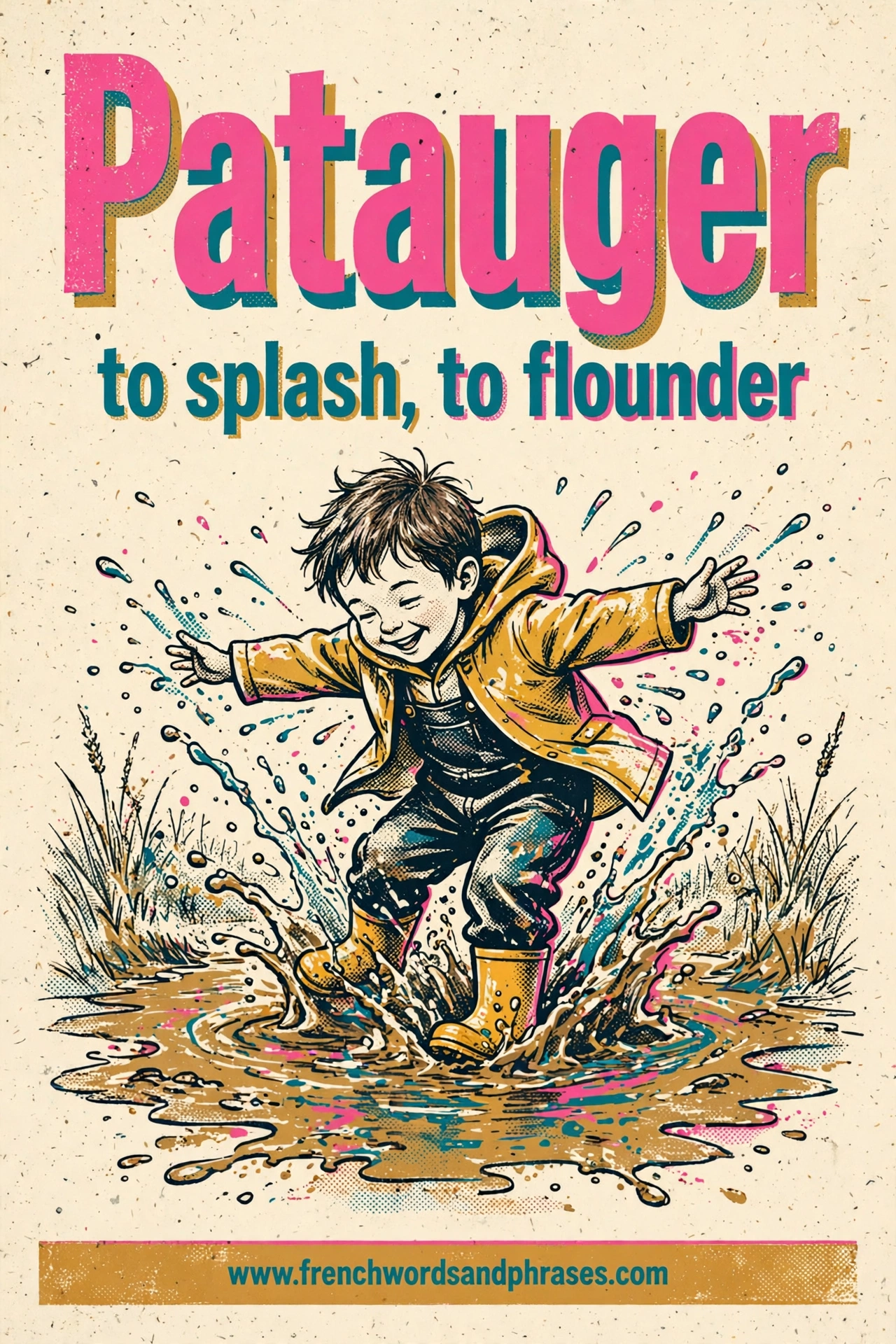
Patauger means to splash, to flounder — to wade clumsily through water or mud, and, figuratively, to struggle helplessly in a task.
A toddler in rubber boots discovers a puddle and stamps through it with solemn joy; a minister at a press conference loses his thread and flounders from phrase to phrase. Patauger is the verb of clumsy splashing — feet stuck in the mud, words stuck in the mud, nobody moving forward gracefully.
In this guide, you’ll learn how to conjugate patauger in all the major French tenses and moods. Explore complete conjugation tables, French examples, English translations, and practice quizzes.
Understanding the French Verb Patauger
Patauger is a regular French verb belonging to the first group of verbs, those ending in -er.
It means to splash, to flounder. It is a word of puddles, flooded fields and duck ponds — and of classrooms and meeting rooms, where one patauge in a maths problem, in English irregular verbs, or in a badly prepared speech. It is always a little comic and a little pitiful: the flounderer is trying, and that is what makes the picture.
Verb classification: First group (-er)
Auxiliary verb: Avoir
Past participle: pataugé
Present participle: pataugeant
English equivalents: To splash about, to wade, to flounder; patauger dans la boue — to flounder in the mud; patauger dans l’eau — to splash about in the water; patauger dans un problème — to flounder over a problem; patauger dans ses explications — to get bogged down in one’s explanations.
One important detail: patauger is a -ger verb, and the e is its flotation device — it stays wherever the ending begins with a or o, to keep the g soft: nous pataugeons, je pataugeais, en pataugeant, but je patauge, ils pataugent where the ending already protects the sound. The figurative sense takes the preposition dans: patauger dans la boue is literal, patauger dans ses explications is the same picture painted in words — splashing, stuck, and going nowhere.
Experience the Word
Patauger is the verb of effort without progress — splashing hard, sinking slightly, staying in the same puddle.
Imagine a schoolboy before the class, sent to the board for a problem he half understands. He writes, rubs out, writes again, murmurs — il patauge, the chalk squeaks, thirty classmates watch the mud deepen, and the answer is no closer than when he stood up.
He is not lazy and not lost at sea. He is floundering — il patauge — in full view, one splash at a time.
How to Conjugate Patauger: Complete French Conjugation Guide
Let’s explore every major conjugation of patauger, beginning with the indicative mood.
How to Conjugate Patauger in the Indicative Mood
The indicative mood is used to express facts, observations, actions, and events.
How to Conjugate Patauger in the Present Tense (Présent)
Used for actions happening now, habitual actions, and general truths.
| Subject | Conjugation |
|---|---|
| je | patauge |
| tu | patauges |
| il / elle | patauge |
| nous | pataugeons |
| vous | pataugez |
| ils / elles | pataugent |
Les enfants pataugent dans la flaque avec bonheur.
The children are splashing in the puddle with delight.
Complete the sentence:
Nous ______ dans la boue jusqu’à la ferme.
Reveal the answer
pataugeons
Nous pataugeons dans la boue jusqu’à la ferme.
We are floundering through the mud as far as the farm.
How to Conjugate Patauger in the Passé Composé
Used for completed actions in the past. Patauger takes the auxiliary verb avoir.
| Subject | Conjugation |
|---|---|
| j’ | ai pataugé |
| tu | as pataugé |
| il / elle | a pataugé |
| nous | avons pataugé |
| vous | avez pataugé |
| ils / elles | ont pataugé |
Nous avons pataugé dans la boue jusqu’à la ferme.
We floundered through the mud as far as the farm.
How to Conjugate Patauger in the Imparfait (Imperfect Tense)
Used for habitual past actions, descriptions, and ongoing situations in the past.
| Subject | Conjugation |
|---|---|
| je | pataugeais |
| tu | pataugeais |
| il / elle | pataugeait |
| nous | pataugions |
| vous | pataugiez |
| ils / elles | pataugeaient |
Les canards pataugeaient au bord de l’étang.
The ducks used to splash about at the edge of the pond.
Choose the correct form:
We floundered through the mud.
Nous ______ dans la boue. (avons pataugé / sommes pataugés)
Reveal the answer
avons pataugé
Nous avons pataugé dans la boue.
Patauger takes avoir.
How to Conjugate Patauger in the Plus-que-parfait
Used to describe an action that had already been completed before another past event.
| Subject | Conjugation |
|---|---|
| j’ | avais pataugé |
| tu | avais pataugé |
| il / elle | avait pataugé |
| nous | avions pataugé |
| vous | aviez pataugé |
| ils / elles | avaient pataugé |
Il avait pataugé dans ses explications pendant dix minutes.
He had floundered in his explanations for ten minutes.
How to Conjugate Patauger in the Passé Simple
Primarily used in formal writing, literature, and historical narratives. It is rarely used in everyday conversation.
| Subject | Conjugation |
|---|---|
| je | pataugeai |
| tu | pataugeas |
| il / elle | pataugea |
| nous | pataugeâmes |
| vous | pataugeâtes |
| ils / elles | pataugeèrent |
Le cheval pataugea dans le gué avant de traverser.
The horse splashed through the ford before crossing.
How to Conjugate Patauger in the Passé Antérieur
A literary tense used to express an action completed immediately before another past action, generally in the passé simple.
| Subject | Conjugation |
|---|---|
| j’ | eus pataugé |
| tu | eus pataugé |
| il / elle | eut pataugé |
| nous | eûmes pataugé |
| vous | eûtes pataugé |
| ils / elles | eurent pataugé |
Quand ils eurent pataugé une heure dans le marais, ils firent demi-tour.
When they had floundered for an hour in the marsh, they turned back.
How to Conjugate Patauger in the Future Tense (Futur Simple)
Used to describe actions that will take place in the future.
| Subject | Conjugation |
|---|---|
| je | pataugerai |
| tu | pataugeras |
| il / elle | pataugera |
| nous | pataugerons |
| vous | pataugerez |
| ils / elles | pataugeront |
Demain, les petits pataugeront dans la pataugeoire.
Tomorrow, the little ones will splash in the paddling pool.
How to Conjugate Patauger in the Futur Antérieur (Future Perfect)
Used for an action that will have been completed before a particular point in the future.
| Subject | Conjugation |
|---|---|
| j’ | aurai pataugé |
| tu | auras pataugé |
| il / elle | aura pataugé |
| nous | aurons pataugé |
| vous | aurez pataugé |
| ils / elles | auront pataugé |
À ce rythme, il aura pataugé dans ce dossier toute la semaine.
At this rate, he will have floundered over this file all week.
How to Conjugate Patauger in the Near Future (Futur Proche)
Used to describe something that is going to happen soon. Formed with aller + infinitive.
| Subject | Conjugation |
|---|---|
| je | vais patauger |
| tu | vas patauger |
| il / elle | va patauger |
| nous | allons patauger |
| vous | allez patauger |
| ils / elles | vont patauger |
Regarde les bottes : ils vont patauger dans la boue !
Look at the boots: they are going to splash in the mud!
How to Conjugate Patauger in the Conditional Mood
The conditional mood expresses what would happen under certain circumstances. It is also frequently used to make polite requests or express wishes.
How to Conjugate Patauger in the Present Conditional
| Subject | Conjugation |
|---|---|
| je | pataugerais |
| tu | pataugerais |
| il / elle | pataugerait |
| nous | pataugerions |
| vous | pataugeriez |
| ils / elles | pataugeraient |
Sans carte, nous pataugerions dans ce marais des heures.
Without a map, we would flounder in this marsh for hours.
How to Conjugate Patauger in the Past Conditional
| Subject | Conjugation |
|---|---|
| j’ | aurais pataugé |
| tu | aurais pataugé |
| il / elle | aurait pataugé |
| nous | aurions pataugé |
| vous | auriez pataugé |
| ils / elles | auraient pataugé |
Elle aurait moins pataugé avec quelques révisions.
She would have floundered less with a bit of revision.
Patauger in the Literary Past Conditional Form
This less common literary form uses the imperfect subjunctive of avoir.
| Subject | Conjugation |
|---|---|
| j’ | eusse pataugé |
| tu | eusses pataugé |
| il / elle | eût pataugé |
| nous | eussions pataugé |
| vous | eussiez pataugé |
| ils / elles | eussent pataugé |
Le ministre eût pataugé devant les caméras sans ses notes.
The minister would have floundered before the cameras without his notes.
How to Conjugate Patauger in the Subjunctive Mood
The subjunctive is used to express wishes, emotions, doubts, necessity, and uncertainty. It frequently follows expressions such as il faut que (it is necessary that) or bien que (although).
How to Conjugate Patauger in the Present Subjunctive
| Subject | Conjugation |
|---|---|
| que je | patauge |
| que tu | patauges |
| qu’il / qu’elle | patauge |
| que nous | pataugions |
| que vous | pataugiez |
| qu’ils / qu’elles | pataugent |
Il est drôle que les enfants pataugent si joyeusement.
It is funny that the children splash about so joyfully.
Complete the sentence using the subjunctive:
Je crains que vous ______ dans vos réponses.
Reveal the answer
pataugiez
Je crains que vous pataugiez dans vos réponses.
I fear you may flounder in your answers.
How to Conjugate Patauger in the Imperfect Subjunctive
A literary tense, rarely encountered in modern spoken French.
| Subject | Conjugation |
|---|---|
| que je | pataugasse |
| que tu | pataugasses |
| qu’il / qu’elle | pataugât |
| que nous | pataugassions |
| que vous | pataugassiez |
| qu’ils / qu’elles | pataugassent |
Je craignais qu’il pataugeât dans ses réponses.
I feared he would flounder in his answers.
How to Conjugate Patauger in the Pluperfect Subjunctive
A literary construction used to express an action completed before another past action.
| Subject | Conjugation |
|---|---|
| que j’ | eusse pataugé |
| que tu | eusses pataugé |
| qu’il / qu’elle | eût pataugé |
| que nous | eussions pataugé |
| que vous | eussiez pataugé |
| qu’ils / qu’elles | eussent pataugé |
On voyait bien qu’ils eussent pataugé dans le problème dès le début.
You could tell they had been floundering over the problem from the start.
How to Conjugate Patauger in the Past Subjunctive
| Subject | Conjugation |
|---|---|
| que j’ | aie pataugé |
| que tu | aies pataugé |
| qu’il / qu’elle | ait pataugé |
| que nous | ayons pataugé |
| que vous | ayez pataugé |
| qu’ils / qu’elles | aient pataugé |
Je suis content que tu n’aies pas pataugé à l’oral.
I am glad you did not flounder in the oral exam.
How to Conjugate Patauger in the Imperative
The imperative is used to give commands, instructions, invitations, or suggestions. Subject pronouns are omitted.
How to Conjugate Patauger in the Present Imperative
| Person | Conjugation |
|---|---|
| (tu) | patauge |
| (nous) | pataugeons |
| (vous) | pataugez |
Pataugez dans la flaque, les enfants, c’est l’été !
Splash in the puddle, children, it’s summer!
How would you say Splash in the puddle (tu form)?
Reveal the answer
Patauge dans la flaque !
French Participles of Patauger
Participles are verb forms that can be used in compound tenses and other grammatical constructions.
Present Participle of Patauger
pataugeant
En pataugeant dans le ruisseau, il a perdu une botte.
While splashing in the stream, he lost a boot.
Past Participle of Patauger
pataugé
Les bottes, pataugées toute la journée, séchaient près du feu.
The boots, splashed in all day, were drying by the fire.
Patauger in Everyday French: Real-Life Examples
Now that you know the conjugations, let’s see how patauger appears in everyday French.
Les enfants pataugent dans la flaque.
The children are splashing in the puddle.
Nous avons pataugé dans la boue.
We floundered through the mud.
Les canards pataugeaient au bord de l’étang.
The ducks used to splash at the edge of the pond.
Les petits pataugeront dans la pataugeoire.
The little ones will splash in the paddling pool.
Sans aide, il pataugerait dans ce problème.
Without help, he would flounder over this problem.
Patauge dans la flaque, c’est l’été !
Splash in the puddle, it’s summer!
Beyond Translation: The Meaning of Patauger
The word is almost certainly a sound before it is a word — pat- is the French noise of a foot in wet ground, the same family as patatras and the toddler’s pataugeoire, the paddling pool.
French keeps the puddle in the metaphor.
To say a student patauge dans ses conjugaisons is not to say he fails — it is to watch him splash: effort everywhere, progress nowhere, mud on everything. It is unkind only by a splash or two.
How to Remember the French Verb Patauger
Remember it this way: Patauger is about the toddler stamping solemnly through the puddle — and the minister doing the same in words.
- The -ger e is the flotation device: nous pataugeons, je pataugeais, en pataugeant — the e stays before a and o.
- Dans does both jobs: patauger dans la boue (real mud) and patauger dans un problème (mental mud).
- Regular -er endings otherwise: je patauge, ils pataugent, past participle pataugé.
The key idea is the toddler stamping solemnly through the puddle — and the minister doing the same in words.
Test Your Knowledge of Patauger
Let’s see how much you’ve learned. Try answering these questions before revealing the answers.
Why does nous pataugeons keep an e that je patauge does not need?
Reveal the answer
The -ger rule — the e keeps the g soft before a and o: nous pataugeons, je pataugeais; je patauge needs no help.
How do you say The children are splashing in the puddle in French?
Reveal the answer
Les enfants pataugent dans la flaque.
Translate: He floundered in his explanations.
Reveal the answer
Il a pataugé dans ses explications.
What is the past participle of patauger?
Reveal the answer
Pataugé.
Complete the sentence:
En ______ dans le ruisseau, il a perdu une botte.
Reveal the answer
pataugeant
En pataugeant dans le ruisseau, il a perdu une botte.
While splashing in the stream, he lost a boot.
Can You Use It?
How would you say this in French?
The child splashes in the puddle, and every splash is a victory over the mud.
Reveal the answer
L’enfant patauge dans la flaque, et chaque éclaboussure est une victoire sur la boue.
The child splashes in the puddle, and every splash is a victory over the mud.
LEARN FRENCH ONE WORD AT A TIME