How to Conjugate Pateliner in French
/pat.li.ne/
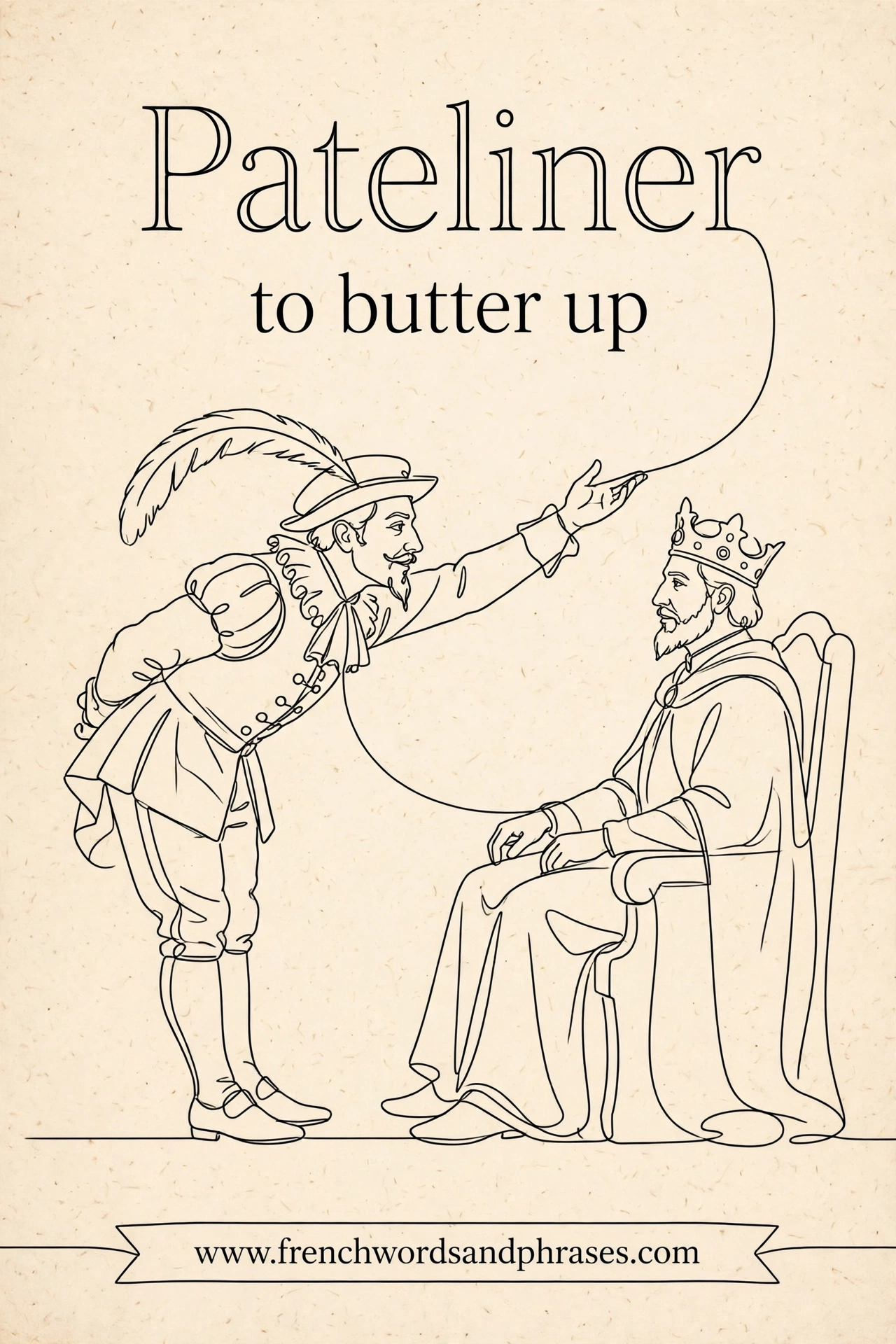
Pateliner means to butter up — to win someone over with soft, honeyed, insinuating flattery.
In the director’s office, a visitor lowers his voice, leans in, and begins: the project is brilliant, the leadership inspired, the future radiant. Pateliner is the old, sly verb of the wheedler — to butter someone up with words as soft and smooth as the flatterer’s hand.
In this guide, you’ll learn how to conjugate pateliner in all the major French tenses and moods. Explore complete conjugation tables, French examples, English translations, and practice quizzes.
Understanding the French Verb Pateliner
Pateliner is a regular French verb belonging to the first group of verbs, those ending in -er.
It means to butter up. It is used of courtiers, salesmen, pupils with a teacher and anyone angling for a favour: the manner matters more than the words — a soft voice, lowered eyes, endless agreement. You will meet it in novels and satire rather than in the office, where its blunter cousins do the daily work.
Verb classification: First group (-er)
Auxiliary verb: Avoir
Past participle: pateliné
Present participle: patelinant
English equivalents: To butter up, to wheedle, to soft-soap; pateliner le directeur — to butter up the boss; pateliner quelqu’un pour obtenir une faveur — to wheedle someone to get a favour; un ton patelin — a wheedling, unctuous tone; le patelinage — wheedling, soft soap.
One important detail: pateliner is an old-fashioned, slightly literary verb — modern French more often says flatter, amadouer or, bluntly, lécher les bottes — but pateliner keeps a flavour the others lack: the flattery is soft, patient and cat-like, from the family of patelin, wheedling, and Maître Pathelin, the smooth-talking lawyer of the medieval farce. The verb is a regular -er: je pateline, nous patelinons, ils patelinent, past participle pateliné. Its tone is never neutral — to say someone pateline is already to see through him.
Experience the Word
Pateliner is the verb of honeyed self-interest — flattery applied slowly, like butter on warm bread.
Imagine the clerk who needs a signature before noon. He does not argue; he pateline — the director’s last report was a model of clarity, his door is always open, his coffee, surely, is excellent — and by eleven the signature is on the page and nobody quite knows how it happened.
He has asked for nothing outright. He has buttered up — il a pateliné — and the butter did the asking.
How to Conjugate Pateliner: Complete French Conjugation Guide
Let’s explore every major conjugation of pateliner, beginning with the indicative mood.
How to Conjugate Pateliner in the Indicative Mood
The indicative mood is used to express facts, observations, actions, and events.
How to Conjugate Pateliner in the Present Tense (Présent)
Used for actions happening now, habitual actions, and general truths.
| Subject | Conjugation |
|---|---|
| je | pateline |
| tu | patelines |
| il / elle | pateline |
| nous | patelinons |
| vous | patelinez |
| ils / elles | patelinent |
Il pateline le directeur depuis ce matin.
He has been buttering up the director since this morning.
Complete the sentence:
Nous ______ le gardien pour entrer.
Reveal the answer
patelinons
Nous patelinons le gardien pour entrer.
We are buttering up the caretaker to get in.
How to Conjugate Pateliner in the Passé Composé
Used for completed actions in the past. Pateliner takes the auxiliary verb avoir.
| Subject | Conjugation |
|---|---|
| j’ | ai pateliné |
| tu | as pateliné |
| il / elle | a pateliné |
| nous | avons pateliné |
| vous | avez pateliné |
| ils / elles | ont pateliné |
Elle a pateliné le jury avec un sourire désarmant.
She wheedled the jury with a disarming smile.
How to Conjugate Pateliner in the Imparfait (Imperfect Tense)
Used for habitual past actions, descriptions, and ongoing situations in the past.
| Subject | Conjugation |
|---|---|
| je | patelinais |
| tu | patelinais |
| il / elle | patelinait |
| nous | patelinions |
| vous | pateliniez |
| ils / elles | patelinaient |
Le courtisan patelinait le ministre à chaque audience.
The courtier used to butter up the minister at every audience.
Choose the correct form:
She buttered up the teacher.
Elle ______ le professeur. (a pateliné / est patelinée)
Reveal the answer
a pateliné
Elle a pateliné le professeur.
Pateliner takes avoir.
How to Conjugate Pateliner in the Plus-que-parfait
Used to describe an action that had already been completed before another past event.
| Subject | Conjugation |
|---|---|
| j’ | avais pateliné |
| tu | avais pateliné |
| il / elle | avait pateliné |
| nous | avions pateliné |
| vous | aviez pateliné |
| ils / elles | avaient pateliné |
Il avait pateliné le notaire avant de parler d’héritage.
He had soft-soaped the notary before mentioning the inheritance.
How to Conjugate Pateliner in the Passé Simple
Primarily used in formal writing, literature, and historical narratives. It is rarely used in everyday conversation.
| Subject | Conjugation |
|---|---|
| je | patelinai |
| tu | patelinas |
| il / elle | patelina |
| nous | patelinâmes |
| vous | patelinâtes |
| ils / elles | patelinèrent |
Le vendeur patelina la cliente jusqu’à la signature.
The salesman wheedled the customer right up to the signature.
How to Conjugate Pateliner in the Passé Antérieur
A literary tense used to express an action completed immediately before another past action, generally in the passé simple.
| Subject | Conjugation |
|---|---|
| j’ | eus pateliné |
| tu | eus pateliné |
| il / elle | eut pateliné |
| nous | eûmes pateliné |
| vous | eûtes pateliné |
| ils / elles | eurent pateliné |
Quand il eut pateliné le gardien, il entra sans ticket.
When he had buttered up the caretaker, he got in without a ticket.
How to Conjugate Pateliner in the Future Tense (Futur Simple)
Used to describe actions that will take place in the future.
| Subject | Conjugation |
|---|---|
| je | patelinerai |
| tu | patelineras |
| il / elle | patelinera |
| nous | patelinerons |
| vous | patelinerez |
| ils / elles | patelineront |
Demain, il patelinera le chef pour obtenir son vendredi.
Tomorrow, he will butter up the boss to get his Friday off.
How to Conjugate Pateliner in the Futur Antérieur (Future Perfect)
Used for an action that will have been completed before a particular point in the future.
| Subject | Conjugation |
|---|---|
| j’ | aurai pateliné |
| tu | auras pateliné |
| il / elle | aura pateliné |
| nous | aurons pateliné |
| vous | aurez pateliné |
| ils / elles | auront pateliné |
À midi, elle aura pateliné tout le comité.
By noon, she will have wheedled the whole committee.
How to Conjugate Pateliner in the Near Future (Futur Proche)
Used to describe something that is going to happen soon. Formed with aller + infinitive.
| Subject | Conjugation |
|---|---|
| je | vais pateliner |
| tu | vas pateliner |
| il / elle | va pateliner |
| nous | allons pateliner |
| vous | allez pateliner |
| ils / elles | vont pateliner |
Attention, il va te pateliner pour emprunter ta voiture.
Careful, he is going to butter you up to borrow your car.
How to Conjugate Pateliner in the Conditional Mood
The conditional mood expresses what would happen under certain circumstances. It is also frequently used to make polite requests or express wishes.
How to Conjugate Pateliner in the Present Conditional
| Subject | Conjugation |
|---|---|
| je | patelinerais |
| tu | patelinerais |
| il / elle | patelinerait |
| nous | patelinerions |
| vous | patelineriez |
| ils / elles | patelineraient |
Avec ce ton, il patelinerait un mur.
With that tone, he could butter up a wall.
How to Conjugate Pateliner in the Past Conditional
| Subject | Conjugation |
|---|---|
| j’ | aurais pateliné |
| tu | aurais pateliné |
| il / elle | aurait pateliné |
| nous | aurions pateliné |
| vous | auriez pateliné |
| ils / elles | auraient pateliné |
Elle aurait pateliné le directeur si elle l’avait trouvé de bonne humeur.
She would have buttered up the director if she had found him in a good mood.
Pateliner in the Literary Past Conditional Form
This less common literary form uses the imperfect subjunctive of avoir.
| Subject | Conjugation |
|---|---|
| j’ | eusse pateliné |
| tu | eusses pateliné |
| il / elle | eût pateliné |
| nous | eussions pateliné |
| vous | eussiez pateliné |
| ils / elles | eussent pateliné |
Le courtisan eût pateliné le roi lui-même pour une charge.
The courtier would have wheedled the king himself for a post.
How to Conjugate Pateliner in the Subjunctive Mood
The subjunctive is used to express wishes, emotions, doubts, necessity, and uncertainty. It frequently follows expressions such as il faut que (it is necessary that) or bien que (although).
How to Conjugate Pateliner in the Present Subjunctive
| Subject | Conjugation |
|---|---|
| que je | pateline |
| que tu | patelines |
| qu’il / qu’elle | pateline |
| que nous | patelinions |
| que vous | pateliniez |
| qu’ils / qu’elles | patelinent |
Il est évident qu’il pateline pour obtenir quelque chose.
It is obvious he is buttering people up to get something.
Complete the sentence using the subjunctive:
On voyait bien que vous ______ le chef avant la réunion.
Reveal the answer
pateliniez
On voyait bien que vous pateliniez le chef avant la réunion.
You could see you were buttering up the boss before the meeting.
How to Conjugate Pateliner in the Imperfect Subjunctive
A literary tense, rarely encountered in modern spoken French.
| Subject | Conjugation |
|---|---|
| que je | patelinasse |
| que tu | patelinasses |
| qu’il / qu’elle | patelinât |
| que nous | patelinassions |
| que vous | patelinassiez |
| qu’ils / qu’elles | patelinassent |
On voyait bien qu’il patelinât le chef avant la réunion.
You could see he was soft-soaping the boss before the meeting.
How to Conjugate Pateliner in the Pluperfect Subjunctive
A literary construction used to express an action completed before another past action.
| Subject | Conjugation |
|---|---|
| que j’ | eusse pateliné |
| que tu | eusses pateliné |
| qu’il / qu’elle | eût pateliné |
| que nous | eussions pateliné |
| que vous | eussiez pateliné |
| qu’ils / qu’elles | eussent pateliné |
On soupçonnait qu’il eût pateliné le jury entier.
People suspected he had wheedled the entire jury.
How to Conjugate Pateliner in the Past Subjunctive
| Subject | Conjugation |
|---|---|
| que j’ | aie pateliné |
| que tu | aies pateliné |
| qu’il / qu’elle | ait pateliné |
| que nous | ayons pateliné |
| que vous | ayez pateliné |
| qu’ils / qu’elles | aient pateliné |
Je suis sûr qu’elle a pateliné le professeur avant l’examen.
I am sure she buttered up the teacher before the exam.
How to Conjugate Pateliner in the Imperative
The imperative is used to give commands, instructions, invitations, or suggestions. Subject pronouns are omitted.
How to Conjugate Pateliner in the Present Imperative
| Person | Conjugation |
|---|---|
| (tu) | pateline |
| (nous) | patelinons |
| (vous) | patelinez |
Ne me pateline pas, dis-moi ce que tu veux !
Don’t butter me up, tell me what you want!
How would you say Don’t butter me up (tu form)?
Reveal the answer
Ne me pateline pas !
French Participles of Pateliner
Participles are verb forms that can be used in compound tenses and other grammatical constructions.
Present Participle of Pateliner
patelinant
En patelinant le gardien, il a gagné dix minutes.
By buttering up the caretaker, he gained ten minutes.
Past Participle of Pateliner
pateliné
Pateliné par son adjoint, le directeur a tout accordé.
Buttered up by his deputy, the director granted everything.
Pateliner in Everyday French: Real-Life Examples
Now that you know the conjugations, let’s see how pateliner appears in everyday French.
Il pateline le directeur depuis ce matin.
He has been buttering up the director since this morning.
Elle a pateliné le jury avec un sourire.
She wheedled the jury with a smile.
Le courtisan patelinait le ministre.
The courtier used to butter up the minister.
Il patelinera le chef pour son vendredi.
He will butter up the boss for his Friday off.
Avec ce ton, il patelinerait un mur.
With that tone, he could butter up a wall.
Ne me pateline pas, parle franchement !
Don’t butter me up, speak frankly!
Beyond Translation: The Meaning of Pateliner
Behind the verb stands a famous trickster: Maître Pathelin, hero of a fifteenth-century farce, the lawyer whose honeyed tongue talks a draper out of his cloth and then talks his way out of paying.
Pateliner is flattery with a technique.
The adjective patelin — unctuous, wheedling — survives in modern French even where the verb rests: un sourire patelin, un ton patelin. When you hear it, someone is being softened up, and everyone in the room knows it except, perhaps, the victim.
How to Remember the French Verb Pateliner
Remember it this way: Pateliner is about Maître Pathelin talking the draper out of his cloth with honeyed words.
- Remember Maître Pathelin, the farce’s smooth-talking lawyer — pateliner is his art: buttering up with a honeyed tongue.
- The tone is the tell: un ton patelin, un sourire patelin — soft, low and self-interested.
- Regular -er: je pateline, nous patelinons, past participle pateliné.
The key idea is Maître Pathelin talking the draper out of his cloth with honeyed words.
Test Your Knowledge of Pateliner
Let’s see how much you’ve learned. Try answering these questions before revealing the answers.
Who is the literary ancestor of pateliner?
Reveal the answer
Maître Pathelin — the smooth-talking lawyer of the medieval farce, whose wheedling gave French the adjective patelin.
How do you say He is buttering up the director in French?
Reveal the answer
Il pateline le directeur.
Translate: She wheedled the jury with a smile.
Reveal the answer
Elle a pateliné le jury avec un sourire.
What is the past participle of pateliner?
Reveal the answer
Pateliné.
Complete the sentence:
Il est évident qu’il ______ pour obtenir quelque chose.
Reveal the answer
pateline
Il est évident qu’il pateline pour obtenir quelque chose.
It is obvious he is buttering people up to get something.
Can You Use It?
How would you say this in French?
He butters up the director all morning, and by noon the signature is already on the page.
Reveal the answer
Il pateline le directeur depuis le matin, et à midi, la signature est déjà sur la page.
He butters up the director all morning, and by noon the signature is already on the page.
LEARN FRENCH ONE WORD AT A TIME