How to Conjugate Se parjurer in French
/sə paʁ.ʒy.ʁe/
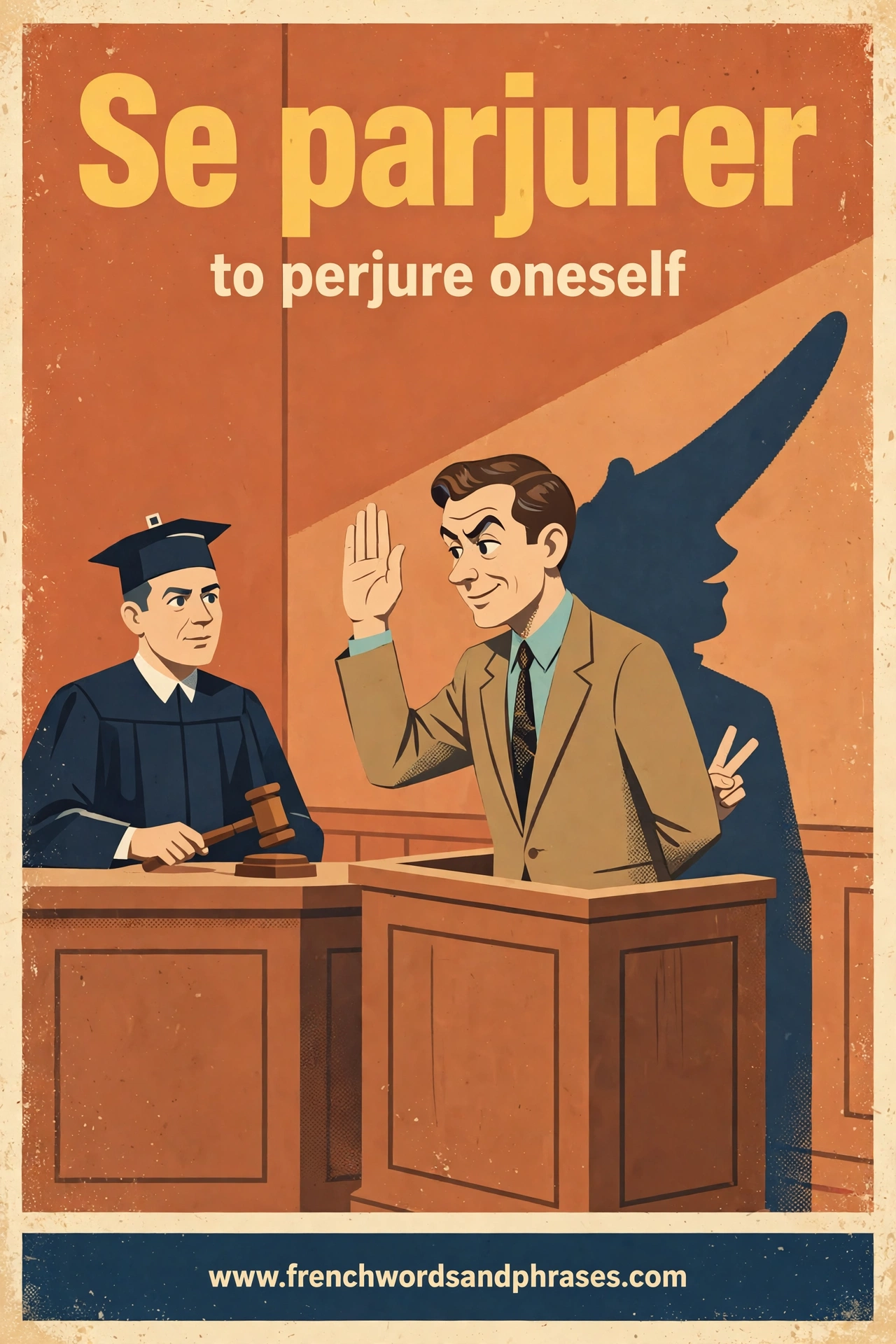
Se parjurer means to perjure oneself — to swear an oath in court and break it in the same breath: the hand raised, the truth abandoned.
A courtroom hush, a hand on the Bible, a witness who has already decided to lie: se parjurer is one of the gravest verbs in French — to commit perjury, to swear falsely under oath, trading your honour and possibly your freedom for one protected secret.
In this guide, you’ll learn how to conjugate se parjurer in all the major French tenses and moods. Explore complete conjugation tables, French examples, English translations, and practice quizzes.
Understanding the French Verb Se parjurer
Se parjurer is a regular French verb belonging to the first group of verbs, those ending in -er.
It means to perjure oneself. Se parjurer lives in courtrooms, oath ceremonies and moral drama. It is never casual: the verb implies a formal oath — devant le tribunal, sous serment — and a deliberate lie told beneath it. French law treats the act as a serious offence, and the verb carries that weight in literature, where a character who se parjure has usually crossed the story’s point of no return.
Verb classification: First group (-er), reflexive
Auxiliary verb: Être
Past participle: parjuré
Present participle: parjurant
English equivalents: To perjure oneself, to swear falsely; se parjurer devant le tribunal — to perjure oneself before the court; se parjurer sous serment — to perjure oneself under oath; se parjurer pour protéger quelqu’un — to perjure oneself to protect someone; un témoin qui se parjure — a witness who commits perjury.
One important detail: se parjurer exists only as a reflexive — there is no plain parjurer in modern French; one never ‘perjures’ anyone else. Being an essentially pronominal verb, its past participle agrees with the subject: il s’est parjuré, elle s’est parjurée, and compound tenses take être. The word names both the act and the crime: the noun is le parjure, perjury — and also, confusingly, the person who commits it. The conjugation is a regular -er underneath the solemnity: je me parjure, nous nous parjurons.
Experience the Word
Se parjurer is the verb of the raised hand and the lowered eyes — an oath kept in form and broken in fact.
Imagine a provincial assize court in 1910. The witness stands, raises his right hand, swears to tell the whole truth — and then, to save his brother, il se parjure, calmly, completely, watching the judges write down every false word as the clerk’s pen scratches on.
He had saved his brother. And lost, in one sentence — parjuré — the thing he swore on.
How to Conjugate Se parjurer: Complete French Conjugation Guide
Let’s explore every major conjugation of se parjurer, beginning with the indicative mood.
How to Conjugate Se parjurer in the Indicative Mood
The indicative mood is used to express facts, observations, actions, and events.
How to Conjugate Se parjurer in the Present Tense (Présent)
Used for actions happening now, habitual actions, and general truths.
| Subject | Conjugation |
|---|---|
| je | me parjure |
| tu | te parjures |
| il / elle | se parjure |
| nous | nous parjurons |
| vous | vous parjurez |
| ils / elles | se parjurent |
Le témoin se parjure pour protéger son frère.
The witness perjures himself to protect his brother.
Complete the sentence:
Nous ne nous ______ jamais, même sous la pression.
Reveal the answer
parjurerons
Nous ne nous parjurerons jamais, même sous la pression.
We will never perjure ourselves, even under pressure.
How to Conjugate Se parjurer in the Passé Composé
Used for completed actions in the past. Se parjurer takes the auxiliary verb être.
| Subject | Conjugation |
|---|---|
| je | me suis parjuré / me suis parjurée |
| tu | t’es parjuré / t’es parjurée |
| il / elle | s’est parjuré / s’est parjurée |
| nous | nous sommes parjurés / nous sommes parjurées |
| vous | vous êtes parjurés / vous êtes parjurées / vous êtes parjuré / vous êtes parjurée |
| ils / elles | se sont parjurés / se sont parjurées |
Elle s’est parjurée devant le tribunal.
She perjured herself before the court.
How to Conjugate Se parjurer in the Imparfait (Imperfect Tense)
Used for habitual past actions, descriptions, and ongoing situations in the past.
| Subject | Conjugation |
|---|---|
| je | me parjurais |
| tu | te parjurais |
| il / elle | se parjurait |
| nous | nous parjurions |
| vous | vous parjuriez |
| ils / elles | se parjuraient |
Il se parjurait sans rougir, serment après serment.
He perjured himself without blushing, oath after oath.
Choose the correct form:
She perjured herself.
Elle s’est ______. (parjurée / parjuré)
Reveal the answer
parjurée
Elle s’est parjurée.
Essentially pronominal verbs agree with the subject: parjurée.
How to Conjugate Se parjurer in the Plus-que-parfait
Used to describe an action that had already been completed before another past event.
| Subject | Conjugation |
|---|---|
| je | m’étais parjuré / m’étais parjurée |
| tu | t’étais parjuré / t’étais parjurée |
| il / elle | s’était parjuré / s’était parjurée |
| nous | nous étions parjurés / nous étions parjurées |
| vous | vous étiez parjurés / vous étiez parjurées / vous étiez parjuré / vous étiez parjurée |
| ils / elles | s’étaient parjurés / s’étaient parjurées |
Le ministre s’était parjuré bien avant le procès.
The minister had perjured himself long before the trial.
How to Conjugate Se parjurer in the Passé Simple
Primarily used in formal writing, literature, and historical narratives. It is rarely used in everyday conversation.
| Subject | Conjugation |
|---|---|
| je | me parjurai |
| tu | te parjuras |
| il / elle | se parjura |
| nous | nous parjurâmes |
| vous | vous parjurâtes |
| ils / elles | se parjurèrent |
Le faux témoin se parjura sous serment.
The false witness perjured himself under oath.
How to Conjugate Se parjurer in the Passé Antérieur
A literary tense used to express an action completed immediately before another past action, generally in the passé simple.
| Subject | Conjugation |
|---|---|
| je | me fus parjuré / me fus parjurée |
| tu | te fus parjuré / te fus parjurée |
| il / elle | se fut parjuré / se fut parjurée |
| nous | nous fûmes parjurés / nous fûmes parjurées |
| vous | vous fûtes parjurés / vous fûtes parjurées / vous fûtes parjuré / vous fûtes parjurée |
| ils / elles | se furent parjurés / se furent parjurées |
Quand il se fut parjuré, il baissa les yeux.
When he had perjured himself, he lowered his eyes.
How to Conjugate Se parjurer in the Future Tense (Futur Simple)
Used to describe actions that will take place in the future.
| Subject | Conjugation |
|---|---|
| je | me parjurerai |
| tu | te parjureras |
| il / elle | se parjurera |
| nous | nous parjurerons |
| vous | vous parjurerez |
| ils / elles | se parjureront |
Jamais je ne me parjurerai, même pour te sauver.
I will never perjure myself, even to save you.
How to Conjugate Se parjurer in the Futur Antérieur (Future Perfect)
Used for an action that will have been completed before a particular point in the future.
| Subject | Conjugation |
|---|---|
| je | me serai parjuré / me serai parjurée |
| tu | te seras parjuré / te seras parjurée |
| il / elle | se sera parjuré / se sera parjurée |
| nous | nous serons parjurés / nous serons parjurées |
| vous | vous serez parjurés / vous serez parjurées / vous serez parjuré / vous serez parjurée |
| ils / elles | se seront parjurés / se seront parjurées |
Quand il se sera parjuré, plus rien ne le sauvera.
Once he has perjured himself, nothing will save him.
How to Conjugate Se parjurer in the Near Future (Futur Proche)
Used to describe something that is going to happen soon. Formed with aller + infinitive.
| Subject | Conjugation |
|---|---|
| je | vais me parjurer |
| tu | vas te parjurer |
| il / elle | va se parjurer |
| nous | allons nous parjurer |
| vous | allez vous parjurer |
| ils / elles | vont se parjurer |
Prends garde, il va se parjurer pour s’en sortir.
Watch out, he is going to perjure himself to get out of this.
How to Conjugate Se parjurer in the Conditional Mood
The conditional mood expresses what would happen under certain circumstances. It is also frequently used to make polite requests or express wishes.
How to Conjugate Se parjurer in the Present Conditional
| Subject | Conjugation |
|---|---|
| je | me parjurerais |
| tu | te parjurerais |
| il / elle | se parjurerait |
| nous | nous parjurerions |
| vous | vous parjureriez |
| ils / elles | se parjureraient |
Pour de l’argent, il se parjurerait sans hésiter.
For money, he would perjure himself without hesitating.
How to Conjugate Se parjurer in the Past Conditional
| Subject | Conjugation |
|---|---|
| je | me serais parjuré / me serais parjurée |
| tu | te serais parjuré / te serais parjurée |
| il / elle | se serait parjuré / se serait parjurée |
| nous | nous serions parjurés / nous serions parjurées |
| vous | vous seriez parjurés / vous seriez parjurées / vous seriez parjuré / vous seriez parjurée |
| ils / elles | se seraient parjurés / se seraient parjurées |
Elle ne se serait jamais parjurée sans la menace.
She would never have perjured herself without the threat.
Se parjurer in the Literary Past Conditional Form
This less common literary form uses the imperfect subjunctive of être.
| Subject | Conjugation |
|---|---|
| je | me fusse parjuré / me fusse parjurée |
| tu | te fusses parjuré / te fusses parjurée |
| il / elle | se fût parjuré / se fût parjurée |
| nous | nous fussions parjurés / nous fussions parjurées |
| vous | vous fussiez parjurés / vous fussiez parjurées / vous fussiez parjuré / vous fussiez parjurée |
| ils / elles | se fussent parjurés / se fussent parjurées |
Il se fût parjuré, si la peur ne l’eût retenu.
He would have perjured himself, if fear had not held him back.
How to Conjugate Se parjurer in the Subjunctive Mood
The subjunctive is used to express wishes, emotions, doubts, necessity, and uncertainty. It frequently follows expressions such as il faut que (it is necessary that) or bien que (although).
How to Conjugate Se parjurer in the Present Subjunctive
| Subject | Conjugation |
|---|---|
| que je | me parjure |
| que tu | te parjures |
| qu’il / qu’elle | se parjure |
| que nous | nous parjurions |
| que vous | vous parjuriez |
| qu’ils / qu’elles | se parjurent |
Je refuse qu’il se parjure pour moi.
I refuse to let him perjure himself for me.
Complete the sentence using the subjunctive:
On craint que le témoin ne se ______.
Reveal the answer
parjure
On craint que le témoin ne se parjure.
People fear the witness will perjure himself.
How to Conjugate Se parjurer in the Imperfect Subjunctive
A literary tense, rarely encountered in modern spoken French.
| Subject | Conjugation |
|---|---|
| que je | me parjurasse |
| que tu | te parjurasses |
| qu’il / qu’elle | se parjurât |
| que nous | nous parjurassions |
| que vous | vous parjurassiez |
| qu’ils / qu’elles | se parjurassent |
On craignait que le témoin ne se parjurât.
People feared the witness would perjure himself.
How to Conjugate Se parjurer in the Pluperfect Subjunctive
A literary construction used to express an action completed before another past action.
| Subject | Conjugation |
|---|---|
| que je | me fusse parjuré / me fusse parjurée |
| que tu | te fusses parjuré / te fusses parjurée |
| qu’il / qu’elle | se fût parjuré / se fût parjurée |
| que nous | nous fussions parjurés / nous fussions parjurées |
| que vous | vous fussiez parjurés / vous fussiez parjurées / vous fussiez parjuré / vous fussiez parjurée |
| qu’ils / qu’elles | se fussent parjurés / se fussent parjurées |
On racontait qu’elle se fût parjurée pour sauver son fils.
People said she had perjured herself to save her son.
How to Conjugate Se parjurer in the Past Subjunctive
| Subject | Conjugation |
|---|---|
| que je | me sois parjuré / me sois parjurée |
| que tu | te sois parjuré / te sois parjurée |
| qu’il / qu’elle | se soit parjuré / se soit parjurée |
| que nous | nous soyons parjurés / nous soyons parjurées |
| que vous | vous soyez parjurés / vous soyez parjurées / vous soyez parjuré / vous soyez parjurée |
| qu’ils / qu’elles | se soient parjurés / se soient parjurées |
Il est grave qu’un officier se soit parjuré.
It is serious that an officer has perjured himself.
How to Conjugate Se parjurer in the Imperative
The imperative is used to give commands, instructions, invitations, or suggestions. Subject pronouns are omitted.
How to Conjugate Se parjurer in the Present Imperative
| Person | Conjugation |
|---|---|
| (tu) | parjure-toi |
| (nous) | parjurons-nous |
| (vous) | parjurez-vous |
Ne te parjure jamais, même sous la pression !
Never perjure yourself, even under pressure!
How would you say Never perjure yourself (tu form)?
Reveal the answer
Ne te parjure jamais !
French Participles of Se parjurer
Participles are verb forms that can be used in compound tenses and other grammatical constructions.
Present Participle of Se parjurer
parjurant
En se parjurant, il a perdu son honneur.
By perjuring himself, he lost his honour.
Past Participle of Se parjurer
parjuré
Parjuré devant tous, l’homme quitta la salle en silence.
Having perjured himself before everyone, the man left the room in silence.
Se parjurer in Everyday French: Real-Life Examples
Now that you know the conjugations, let’s see how se parjurer appears in everyday French.
Le témoin se parjure pour protéger son frère.
The witness perjures himself to protect his brother.
Elle s’est parjurée devant le tribunal.
She perjured herself before the court.
Il se parjurait sans rougir.
He perjured himself without blushing.
Je ne me parjurerai jamais.
I will never perjure myself.
Il se parjurerait pour de l’argent.
He would perjure himself for money.
Ne te parjure jamais !
Never perjure yourself!
Beyond Translation: The Meaning of Se parjurer
Se parjurer is Latin perjurare — to swear through and through, and therefore falsely: the prefix per- that strengthens pardonner into a total gift here poisons the oath into a total lie.
The noun le parjure does double duty.
It is both the crime, perjury, and the criminal, the perjurer — French lets the act and the man share one word, as if the lie and the liar had become the same thing.
How to Remember the French Verb Se parjurer
Remember it this way: Se parjurer is about a raised hand in a silent courtroom, and eyes that will not meet the judge’s.
- Reflexive only: there is no plain parjurer — one can only perjure oneself.
- The participle agrees: elle s’est parjurée; compound tenses take être.
- Its home ground is the oath: devant le tribunal, sous serment.
The key idea is a raised hand in a silent courtroom, and eyes that will not meet the judge’s.
Test Your Knowledge of Se parjurer
Let’s see how much you’ve learned. Try answering these questions before revealing the answers.
Does a non-reflexive parjurer exist in modern French?
Reveal the answer
No — the verb is reflexive only: se parjurer, to perjure oneself.
How do you say She perjured herself before the court in French?
Reveal the answer
Elle s’est parjurée devant le tribunal.
Translate: I will never perjure myself, even to save you.
Reveal the answer
Jamais je ne me parjurerai, même pour te sauver.
What is the past participle of se parjurer?
Reveal the answer
Parjuré — agreeing with the subject: parjuré, parjurée, parjurés, parjurées.
Complete the sentence:
Je refuse qu’il se ______ pour moi.
Reveal the answer
parjure
Je refuse qu’il se parjure pour moi.
I refuse to let him perjure himself for me.
Can You Use It?
How would you say this in French?
He perjured himself to save his brother, and the court wrote the lie down in official letters.
Reveal the answer
Il s’est parjuré pour sauver son frère, et le tribunal a écrit le mensonge en lettres officielles.
He perjured himself to save his brother, and the court wrote the lie down in official letters.
LEARN FRENCH ONE WORD AT A TIME