How to Conjugate Parier in French
/pa.ʁje/
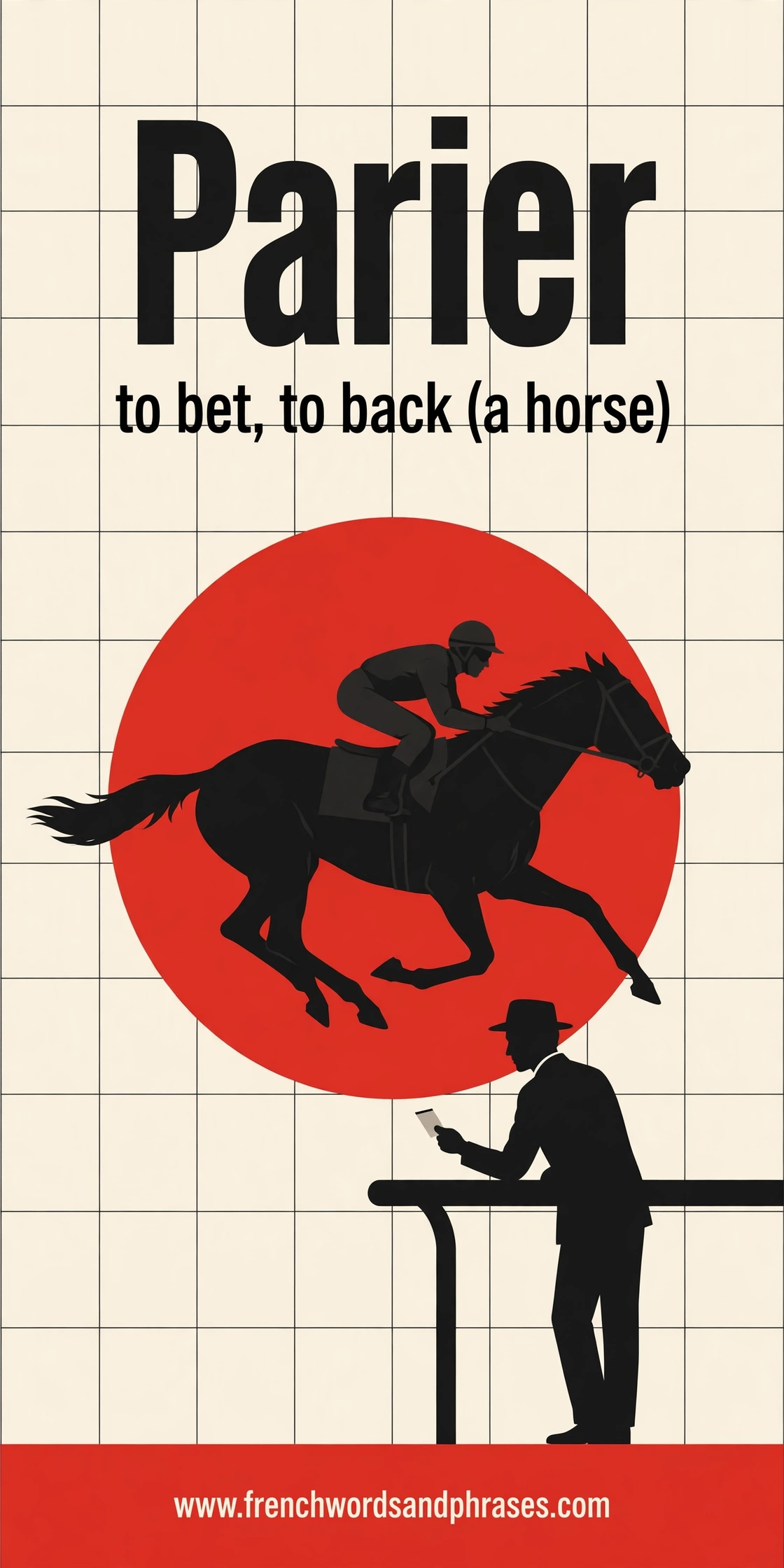
Parier means to bet, to back (a horse) — to put money, or just your certainty, on an outcome: a horse, a match, a number, tomorrow’s weather.
The roar of a racecourse as the favourite rounds the bend, a café argument settled with « je te parie que… », a gambler’s last coins on the number seven — parier is the verb of the wager: staking something you own on something you cannot know, and loving the stake as much as the prize.
In this guide, you’ll learn how to conjugate parier in all the major French tenses and moods. Explore complete conjugation tables, French examples, English translations, and practice quizzes.
Understanding the French Verb Parier
Parier is a regular French verb belonging to the first group of verbs, those ending in -er.
It means to bet, to back (a horse). Parier lives at the racecourse (parier sur un cheval, to back a horse), at the betting shop and in everyday bravado: je parie qu’il est en retard, I bet he is late. The figurative parier sur — parier sur l’avenir, to bet on the future — is how French talks about any hopeful investment of trust, time or money.
Verb classification: First group (-er)
Auxiliary verb: Avoir
Past participle: parié
Present participle: pariant
English equivalents: To bet, to back (a horse); parier sur un cheval — to bet on a horse, to back a horse; parier cent euros — to bet a hundred euros; parier que… — to bet that…; je parie qu’il va pleuvoir — I bet it is going to rain; parier sur le mauvais cheval — to back the wrong horse.
One important detail: parier is an -ier verb, and -ier verbs double the i where two vowel sounds collide: imperfect nous pariions, subjunctive que vous pariiez — two i’s in a row, and both are written. The rest is regular: je parie, tu paries, nous parions, past participle parié. Its constructions: parier sur for the horse or team you back, parier plus a sum for the stake, and the unbeatable everyday phrase je parie que… — I bet that…, no money required.
Experience the Word
Parier is certainty with its wallet open — the moment an opinion becomes a stake.
Imagine the racecourse at Longchamp on a bright Sunday. An old man in a flat cap studies the horses, folds his newspaper, and parie — as he has for forty years — on the black horse, number seven, « parce qu’il a l’œil honnête », because it has an honest eye. Logic has nothing to do with it; that is exactly what a bet is.
The horse may lose. But for one bright minute — parié — hope had a number on its back.
How to Conjugate Parier: Complete French Conjugation Guide
Let’s explore every major conjugation of parier, beginning with the indicative mood.
How to Conjugate Parier in the Indicative Mood
The indicative mood is used to express facts, observations, actions, and events.
How to Conjugate Parier in the Present Tense (Présent)
Used for actions happening now, habitual actions, and general truths.
| Subject | Conjugation |
|---|---|
| je | parie |
| tu | paries |
| il / elle | parie |
| nous | parions |
| vous | pariez |
| ils / elles | parient |
Il parie sur le cheval noir à chaque course.
He bets on the black horse at every race.
Complete the sentence:
Nous ______ sur le favori, cette fois.
Reveal the answer
parions
Nous parions sur le favori, cette fois.
We are betting on the favourite this time.
How to Conjugate Parier in the Passé Composé
Used for completed actions in the past. Parier takes the auxiliary verb avoir.
| Subject | Conjugation |
|---|---|
| j’ | ai parié |
| tu | as parié |
| il / elle | a parié |
| nous | avons parié |
| vous | avez parié |
| ils / elles | ont parié |
Elle a parié cent euros sur l’équipe de sa ville.
She bet a hundred euros on her town’s team.
How to Conjugate Parier in the Imparfait (Imperfect Tense)
Used for habitual past actions, descriptions, and ongoing situations in the past.
| Subject | Conjugation |
|---|---|
| je | pariais |
| tu | pariais |
| il / elle | pariait |
| nous | pariions |
| vous | pariiez |
| ils / elles | pariaient |
Autrefois, on pariait sur les combats de coqs.
In the old days, people bet on cockfights.
Choose the correct form:
We used to bet on cockfights.
Nous ______ sur les combats de coqs. (pariions / parions)
Reveal the answer
pariions
Nous pariions sur les combats de coqs.
The imperfect of an -ier verb doubles the i: pariions.
How to Conjugate Parier in the Plus-que-parfait
Used to describe an action that had already been completed before another past event.
| Subject | Conjugation |
|---|---|
| j’ | avais parié |
| tu | avais parié |
| il / elle | avait parié |
| nous | avions parié |
| vous | aviez parié |
| ils / elles | avaient parié |
Il avait parié sur le mauvais cheval et tout perdu.
He had bet on the wrong horse and lost everything.
How to Conjugate Parier in the Passé Simple
Primarily used in formal writing, literature, and historical narratives. It is rarely used in everyday conversation.
| Subject | Conjugation |
|---|---|
| je | pariai |
| tu | parias |
| il / elle | paria |
| nous | pariâmes |
| vous | pariâtes |
| ils / elles | parièrent |
Le joueur paria sa montre sur un coup de dés.
The gambler bet his watch on a throw of the dice.
How to Conjugate Parier in the Passé Antérieur
A literary tense used to express an action completed immediately before another past action, generally in the passé simple.
| Subject | Conjugation |
|---|---|
| j’ | eus parié |
| tu | eus parié |
| il / elle | eut parié |
| nous | eûmes parié |
| vous | eûtes parié |
| ils / elles | eurent parié |
Quand il eut parié sa fortune, le silence se fit autour de la table.
When he had bet his fortune, silence fell around the table.
How to Conjugate Parier in the Future Tense (Futur Simple)
Used to describe actions that will take place in the future.
| Subject | Conjugation |
|---|---|
| je | parierai |
| tu | parieras |
| il / elle | pariera |
| nous | parierons |
| vous | parierez |
| ils / elles | parieront |
Demain, je parierai sur le numéro sept.
Tomorrow, I will bet on number seven.
How to Conjugate Parier in the Futur Antérieur (Future Perfect)
Used for an action that will have been completed before a particular point in the future.
| Subject | Conjugation |
|---|---|
| j’ | aurai parié |
| tu | auras parié |
| il / elle | aura parié |
| nous | aurons parié |
| vous | aurez parié |
| ils / elles | auront parié |
À la fin de la course, il aura parié trois fois.
By the end of the race, he will have bet three times.
How to Conjugate Parier in the Near Future (Futur Proche)
Used to describe something that is going to happen soon. Formed with aller + infinitive.
| Subject | Conjugation |
|---|---|
| je | vais parier |
| tu | vas parier |
| il / elle | va parier |
| nous | allons parier |
| vous | allez parier |
| ils / elles | vont parier |
Attention, il va parier gros sur ce match.
Careful, he is going to bet big on this match.
How to Conjugate Parier in the Conditional Mood
The conditional mood expresses what would happen under certain circumstances. It is also frequently used to make polite requests or express wishes.
How to Conjugate Parier in the Present Conditional
| Subject | Conjugation |
|---|---|
| je | parierais |
| tu | parierais |
| il / elle | parierait |
| nous | parierions |
| vous | parieriez |
| ils / elles | parieraient |
À ta place, je parierais sur le favori.
In your place, I would bet on the favourite.
How to Conjugate Parier in the Past Conditional
| Subject | Conjugation |
|---|---|
| j’ | aurais parié |
| tu | aurais parié |
| il / elle | aurait parié |
| nous | aurions parié |
| vous | auriez parié |
| ils / elles | auraient parié |
Elle aurait parié sur lui si elle avait eu de l’argent.
She would have bet on him if she had had money.
Parier in the Literary Past Conditional Form
This less common literary form uses the imperfect subjunctive of avoir.
| Subject | Conjugation |
|---|---|
| j’ | eusse parié |
| tu | eusses parié |
| il / elle | eût parié |
| nous | eussions parié |
| vous | eussiez parié |
| ils / elles | eussent parié |
Il eût parié sa chemise sur ce cheval.
He would have bet his shirt on that horse.
How to Conjugate Parier in the Subjunctive Mood
The subjunctive is used to express wishes, emotions, doubts, necessity, and uncertainty. It frequently follows expressions such as il faut que (it is necessary that) or bien que (although).
How to Conjugate Parier in the Present Subjunctive
| Subject | Conjugation |
|---|---|
| que je | parie |
| que tu | paries |
| qu’il / qu’elle | parie |
| que nous | pariions |
| que vous | pariiez |
| qu’ils / qu’elles | parient |
Je ne veux pas que tu paries ton salaire.
I do not want you to bet your wages.
Complete the sentence using the subjunctive:
Je ne veux pas que vous ______ votre salaire.
Reveal the answer
pariiez
Je ne veux pas que vous pariiez votre salaire.
I do not want you to bet your wages.
How to Conjugate Parier in the Imperfect Subjunctive
A literary tense, rarely encountered in modern spoken French.
| Subject | Conjugation |
|---|---|
| que je | pariasse |
| que tu | pariasses |
| qu’il / qu’elle | pariât |
| que nous | pariassions |
| que vous | pariassiez |
| qu’ils / qu’elles | pariassent |
Son père défendait qu’il pariât aux courses.
His father forbade him to bet at the races.
How to Conjugate Parier in the Pluperfect Subjunctive
A literary construction used to express an action completed before another past action.
| Subject | Conjugation |
|---|---|
| que j’ | eusse parié |
| que tu | eusses parié |
| qu’il / qu’elle | eût parié |
| que nous | eussions parié |
| que vous | eussiez parié |
| qu’ils / qu’elles | eussent parié |
On disait qu’il eût parié sa maison sur un seul match.
People said he had bet his house on a single match.
How to Conjugate Parier in the Past Subjunctive
| Subject | Conjugation |
|---|---|
| que j’ | aie parié |
| que tu | aies parié |
| qu’il / qu’elle | ait parié |
| que nous | ayons parié |
| que vous | ayez parié |
| qu’ils / qu’elles | aient parié |
Je suis étonné qu’elle ait parié si juste.
I am amazed she bet so accurately.
How to Conjugate Parier in the Imperative
The imperative is used to give commands, instructions, invitations, or suggestions. Subject pronouns are omitted.
How to Conjugate Parier in the Present Imperative
| Person | Conjugation |
|---|---|
| (tu) | parie |
| (nous) | parions |
| (vous) | pariez |
Parie sur le sept, c’est ton jour de chance !
Bet on seven, it is your lucky day!
How would you say Bet on the black horse (tu form)?
Reveal the answer
Parie sur le cheval noir !
French Participles of Parier
Participles are verb forms that can be used in compound tenses and other grammatical constructions.
Present Participle of Parier
pariant
En pariant toujours sur le même cheval, il a fini ruiné.
By always betting on the same horse, he ended up ruined.
Past Participle of Parier
parié
Parié sur un coup de tête, l’argent fut perdu en une minute.
Bet on a whim, the money was lost in a minute.
Parier in Everyday French: Real-Life Examples
Now that you know the conjugations, let’s see how parier appears in everyday French.
Je parie qu’il va pleuvoir.
I bet it is going to rain.
Elle a parié cent euros sur son équipe.
She bet a hundred euros on her team.
On pariait sur les combats de coqs.
People bet on cockfights.
Je parierai sur le numéro sept.
I will bet on number seven.
Je parierais sur le favori, à ta place.
I would bet on the favourite, in your place.
Parie sur le cheval noir !
Bet on the black horse!
Beyond Translation: The Meaning of Parier
Parier descends from Latin par, equal — a bet, in the old Roman sense, was an equal stake laid by two parties, neither favoured.
French philosophy’s most famous bet is built on this verb.
Pascal’s wager — le pari de Pascal — argues that believing in God is the rational bet: parier is thus both the racecourse verb and the philosopher’s, the stake being, in one case, a hundred euros, and in the other, eternity.
How to Remember the French Verb Parier
Remember it this way: Parier is about an old man at Longchamp, betting on the black horse with the honest eye.
- -ier verb: watch the double i — nous pariions (imperfect), que vous pariiez (subjunctive).
- Parier sur for what you back, parier plus a sum for the stake, je parie que… for everyday certainty.
- Regular otherwise: je parie, nous parions, past participle parié.
The key idea is an old man at Longchamp, betting on the black horse with the honest eye.
Test Your Knowledge of Parier
Let’s see how much you’ve learned. Try answering these questions before revealing the answers.
Why does the imperfect read nous pariions, with two i’s?
Reveal the answer
Parier is an -ier verb — the stem’s i meets the ending’s i: nous pari-ions, que vous pari-iez.
How do you say She bet a hundred euros on her team in French?
Reveal the answer
Elle a parié cent euros sur son équipe.
Translate: In your place, I would bet on the favourite.
Reveal the answer
À ta place, je parierais sur le favori.
What is the past participle of parier?
Reveal the answer
Parié — regular: parié, pariée, pariés, pariées.
Complete the sentence:
Je ne veux pas que tu ______ ton salaire.
Reveal the answer
paries
Je ne veux pas que tu paries ton salaire.
I do not want you to bet your wages.
Can You Use It?
How would you say this in French?
He bets on the black horse, like his father before him, and hope gallops in the lead.
Reveal the answer
Il parie sur le cheval noir, comme son père avant lui, et l’espérance galope en tête.
He bets on the black horse, like his father before him, and hope gallops in the lead.
LEARN FRENCH ONE WORD AT A TIME