How to Conjugate Parlementer in French
/paʁ.lə.mɑ̃.te/
Parlementer means to parley — to talk, formally and at length, with the other side: flags of truce, delegations, and words used as the alternative to war.
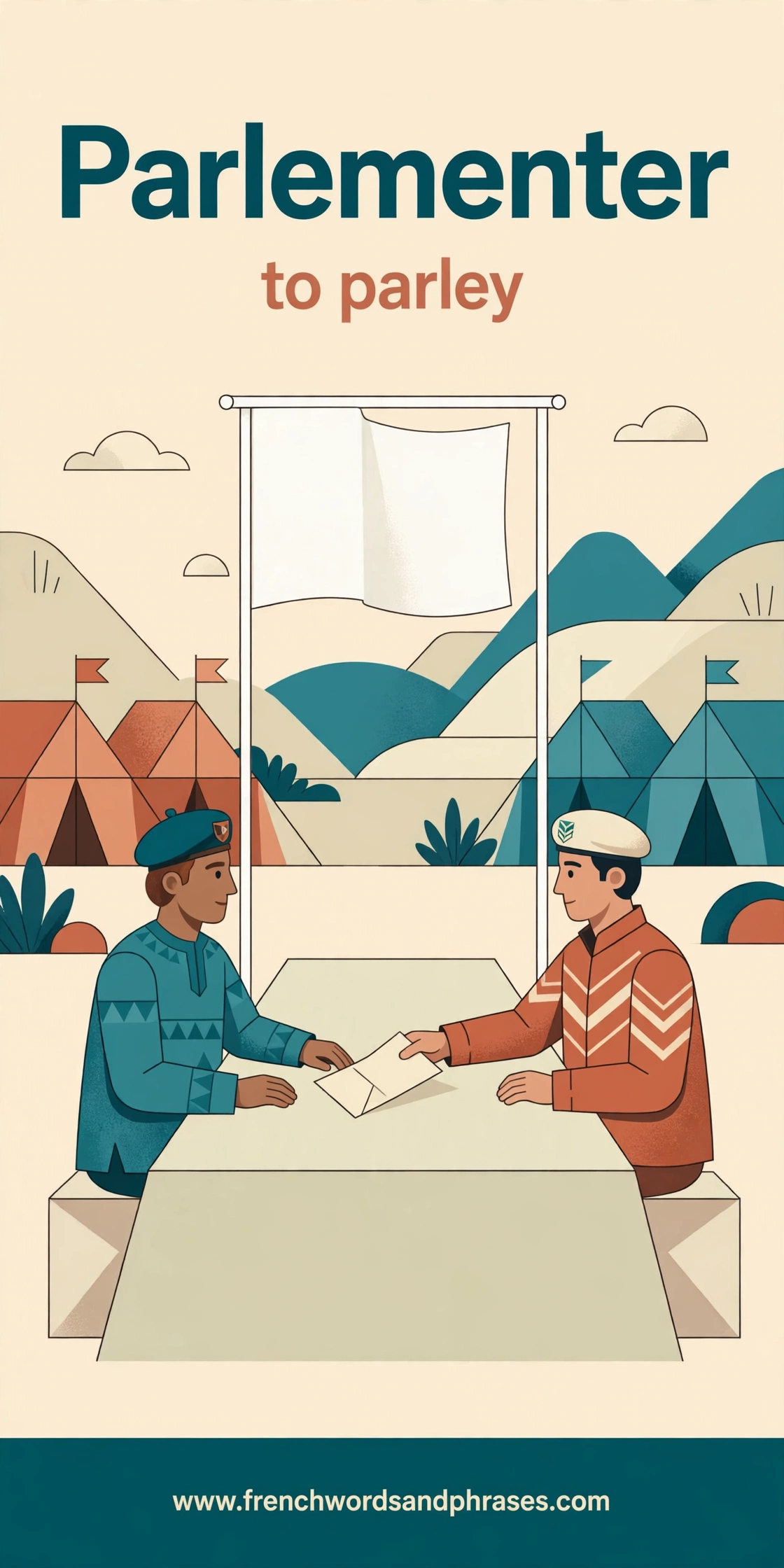
A white flag over a besieged gate, two delegations facing each other across a bare table, a union and a management locked in a room until midnight — parlementer is the verb of negotiation between opponents: long, formal, wary talk, where every sentence is weighed because the alternative to talking is fighting.
In this guide, you’ll learn how to conjugate parlementer in all the major French tenses and moods. Explore complete conjugation tables, French examples, English translations, and practice quizzes.
Understanding the French Verb Parlementer
Parlementer is a regular French verb belonging to the first group of verbs, those ending in -er.
It means to parley. Parlementer’s home is the space between conflict and agreement: sieges, strikes, hostage dramas, diplomatic crises. It implies opponents, formality and duration — one does not parlementer with a friend over coffee; that is discuter. The slight irony the word often carries (endless talk, little result) is centuries old and entirely intended.
Verb classification: First group (-er)
Auxiliary verb: Avoir
Past participle: parlementé
Present participle: parlementant
English equivalents: To parley, to negotiate; parlementer avec l’ennemi — to parley with the enemy; parlementer des heures — to talk for hours; venir parlementer — to come to parley; parlementer avant la trêve — to negotiate before the truce; ils parlementent depuis l’aube — they have been in talks since dawn.
One important detail: parlementer is built on parler, to talk — it is talking with a flag of truce in your hand. It takes avec for the other party — parlementer avec l’ennemi, avec la direction — and it is intransitive: one does not parlementer something. The conjugation is a regular -er — je parlemente, nous parlementons, past participle parlementé. In familiar modern use it can soften into ‘to have a long discussion, to haggle in words’ — often with a smile at how long the talking takes.
Experience the Word
Parlementer is war continued by conversation — slower, cheaper, and the only version where everybody goes home.
Imagine a besieged town in the seventeenth century. At dawn the gates open a crack and three men walk out under a white flag, unarmed, towards the enemy tents. All day they parlementent — terms, water, honour, time — and at dusk they walk back, and the town has won the only victory that matters: one more day.
No shot was fired. Only words — parlementé — had held the walls.
How to Conjugate Parlementer: Complete French Conjugation Guide
Let’s explore every major conjugation of parlementer, beginning with the indicative mood.
How to Conjugate Parlementer in the Indicative Mood
The indicative mood is used to express facts, observations, actions, and events.
How to Conjugate Parlementer in the Present Tense (Présent)
Used for actions happening now, habitual actions, and general truths.
| Subject | Conjugation |
|---|---|
| je | parlemente |
| tu | parlementes |
| il / elle | parlemente |
| nous | parlementons |
| vous | parlementez |
| ils / elles | parlementent |
Les délégués parlementent depuis l’aube sans résultat.
The delegates have been parleying since dawn without result.
Complete the sentence:
Nous ______ avec les assiégeants depuis l’aube.
Reveal the answer
parlementons
Nous parlementons avec les assiégeants depuis l’aube.
We have been parleying with the besiegers since dawn.
How to Conjugate Parlementer in the Passé Composé
Used for completed actions in the past. Parlementer takes the auxiliary verb avoir.
| Subject | Conjugation |
|---|---|
| j’ | ai parlementé |
| tu | as parlementé |
| il / elle | a parlementé |
| nous | avons parlementé |
| vous | avez parlementé |
| ils / elles | ont parlementé |
Ils ont parlementé trois jours avant de signer la trêve.
They parleyed for three days before signing the truce.
How to Conjugate Parlementer in the Imparfait (Imperfect Tense)
Used for habitual past actions, descriptions, and ongoing situations in the past.
| Subject | Conjugation |
|---|---|
| je | parlementais |
| tu | parlementais |
| il / elle | parlementait |
| nous | parlementions |
| vous | parlementiez |
| ils / elles | parlementaient |
Devant les portes de la ville, on parlementait des heures.
Before the city gates, people would parley for hours.
Choose the correct form:
They parleyed for three days.
Ils ont ______ trois jours. (parlementé / parlementer)
Reveal the answer
parlementé
Ils ont parlementé trois jours.
After avoir, the past participle parlementé completes the passé composé.
How to Conjugate Parlementer in the Plus-que-parfait
Used to describe an action that had already been completed before another past event.
| Subject | Conjugation |
|---|---|
| j’ | avais parlementé |
| tu | avais parlementé |
| il / elle | avait parlementé |
| nous | avions parlementé |
| vous | aviez parlementé |
| ils / elles | avaient parlementé |
Les chefs avaient parlementé toute la nuit quand l’accord tomba.
The leaders had been negotiating all night when the agreement came.
How to Conjugate Parlementer in the Passé Simple
Primarily used in formal writing, literature, and historical narratives. It is rarely used in everyday conversation.
| Subject | Conjugation |
|---|---|
| je | parlementai |
| tu | parlementas |
| il / elle | parlementa |
| nous | parlementâmes |
| vous | parlementâtes |
| ils / elles | parlementèrent |
L’ambassadeur parlementa longtemps avec les rebelles.
The ambassador parleyed at length with the rebels.
How to Conjugate Parlementer in the Passé Antérieur
A literary tense used to express an action completed immediately before another past action, generally in the passé simple.
| Subject | Conjugation |
|---|---|
| j’ | eus parlementé |
| tu | eus parlementé |
| il / elle | eut parlementé |
| nous | eûmes parlementé |
| vous | eûtes parlementé |
| ils / elles | eurent parlementé |
Quand ils eurent parlementé, les portes de la ville s’ouvrirent.
When they had parleyed, the city gates opened.
How to Conjugate Parlementer in the Future Tense (Futur Simple)
Used to describe actions that will take place in the future.
| Subject | Conjugation |
|---|---|
| je | parlementerai |
| tu | parlementeras |
| il / elle | parlementera |
| nous | parlementerons |
| vous | parlementerez |
| ils / elles | parlementeront |
Demain, les syndicats parlementeront avec la direction.
Tomorrow, the unions will negotiate with management.
How to Conjugate Parlementer in the Futur Antérieur (Future Perfect)
Used for an action that will have been completed before a particular point in the future.
| Subject | Conjugation |
|---|---|
| j’ | aurai parlementé |
| tu | auras parlementé |
| il / elle | aura parlementé |
| nous | aurons parlementé |
| vous | aurez parlementé |
| ils / elles | auront parlementé |
À minuit, ils auront parlementé dix heures de suite.
By midnight, they will have been parleying for ten hours straight.
How to Conjugate Parlementer in the Near Future (Futur Proche)
Used to describe something that is going to happen soon. Formed with aller + infinitive.
| Subject | Conjugation |
|---|---|
| je | vais parlementer |
| tu | vas parlementer |
| il / elle | va parlementer |
| nous | allons parlementer |
| vous | allez parlementer |
| ils / elles | vont parlementer |
Le capitaine va parlementer avec les assiégeants.
The captain is going to parley with the besiegers.
How to Conjugate Parlementer in the Conditional Mood
The conditional mood expresses what would happen under certain circumstances. It is also frequently used to make polite requests or express wishes.
How to Conjugate Parlementer in the Present Conditional
| Subject | Conjugation |
|---|---|
| je | parlementerais |
| tu | parlementerais |
| il / elle | parlementerait |
| nous | parlementerions |
| vous | parlementeriez |
| ils / elles | parlementeraient |
Sans l’interprète, nous parlementerions difficilement.
Without the interpreter, we would parley with difficulty.
How to Conjugate Parlementer in the Past Conditional
| Subject | Conjugation |
|---|---|
| j’ | aurais parlementé |
| tu | aurais parlementé |
| il / elle | aurait parlementé |
| nous | aurions parlementé |
| vous | auriez parlementé |
| ils / elles | auraient parlementé |
Ils auraient parlementé plus tôt si le messager était arrivé.
They would have parleyed sooner if the messenger had arrived.
Parlementer in the Literary Past Conditional Form
This less common literary form uses the imperfect subjunctive of avoir.
| Subject | Conjugation |
|---|---|
| j’ | eusse parlementé |
| tu | eusses parlementé |
| il / elle | eût parlementé |
| nous | eussions parlementé |
| vous | eussiez parlementé |
| ils / elles | eussent parlementé |
Il eût parlementé jusqu’au bout, si on l’eût écouté.
He would have parleyed to the very end, if he had been listened to.
How to Conjugate Parlementer in the Subjunctive Mood
The subjunctive is used to express wishes, emotions, doubts, necessity, and uncertainty. It frequently follows expressions such as il faut que (it is necessary that) or bien que (although).
How to Conjugate Parlementer in the Present Subjunctive
| Subject | Conjugation |
|---|---|
| que je | parlemente |
| que tu | parlementes |
| qu’il / qu’elle | parlemente |
| que nous | parlementions |
| que vous | parlementiez |
| qu’ils / qu’elles | parlementent |
Il faut que vous parlementiez avant toute attaque.
You must parley before any attack.
Complete the sentence using the subjunctive:
Le roi ordonne que tu ______ avec l’ennemi.
Reveal the answer
parlementes
Le roi ordonne que tu parlementes avec l’ennemi.
The king orders you to parley with the enemy.
How to Conjugate Parlementer in the Imperfect Subjunctive
A literary tense, rarely encountered in modern spoken French.
| Subject | Conjugation |
|---|---|
| que je | parlementasse |
| que tu | parlementasses |
| qu’il / qu’elle | parlementât |
| que nous | parlementassions |
| que vous | parlementassiez |
| qu’ils / qu’elles | parlementassent |
Le roi ordonna qu’on parlementât avec l’ennemi.
The king ordered that they parley with the enemy.
How to Conjugate Parlementer in the Pluperfect Subjunctive
A literary construction used to express an action completed before another past action.
| Subject | Conjugation |
|---|---|
| que j’ | eusse parlementé |
| que tu | eusses parlementé |
| qu’il / qu’elle | eût parlementé |
| que nous | eussions parlementé |
| que vous | eussiez parlementé |
| qu’ils / qu’elles | eussent parlementé |
On disait que les chefs eussent parlementé en secret.
People said the leaders had parleyed in secret.
How to Conjugate Parlementer in the Past Subjunctive
| Subject | Conjugation |
|---|---|
| que j’ | aie parlementé |
| que tu | aies parlementé |
| qu’il / qu’elle | ait parlementé |
| que nous | ayons parlementé |
| que vous | ayez parlementé |
| qu’ils / qu’elles | aient parlementé |
Je suis content qu’ils aient parlementé au lieu de se battre.
I am glad they parleyed instead of fighting.
How to Conjugate Parlementer in the Imperative
The imperative is used to give commands, instructions, invitations, or suggestions. Subject pronouns are omitted.
How to Conjugate Parlementer in the Present Imperative
| Person | Conjugation |
|---|---|
| (tu) | parlemente |
| (nous) | parlementons |
| (vous) | parlementez |
Parlemente encore un peu, la trêve est proche !
Parley a little longer, the truce is near!
How would you say Parley with them first (tu form)?
Reveal the answer
Parlemente d’abord avec eux !
French Participles of Parlementer
Participles are verb forms that can be used in compound tenses and other grammatical constructions.
Present Participle of Parlementer
parlementant
En parlementant, on gagne du temps et parfois la paix.
By parleying, one gains time and sometimes peace.
Past Participle of Parlementer
parlementé
Après avoir parlementé des heures, les deux camps se séparèrent.
After parleying for hours, the two camps parted.
Parlementer in Everyday French: Real-Life Examples
Now that you know the conjugations, let’s see how parlementer appears in everyday French.
Les délégués parlementent depuis l’aube.
The delegates have been parleying since dawn.
Ils ont parlementé trois jours.
They parleyed for three days.
On parlementait devant les portes de la ville.
People would parley before the city gates.
Les syndicats parlementeront avec la direction.
The unions will negotiate with management.
Nous parlementerions difficilement sans interprète.
We would parley with difficulty without an interpreter.
Parlemente encore un peu !
Parley a little longer!
Beyond Translation: The Meaning of Parlementer
Parlementer is parler dressed for diplomacy: from medieval parlement, a talking, a conference — the same word that gives English its parliament, the talking-place of the realm.
A parley is a parliament shrunk to two camps and a white flag.
The drum that summoned enemies to talk was called, in old armies, the chamade — and the talking it announced, parlementer, has outlived every siege it ever paused.
How to Remember the French Verb Parlementer
Remember it this way: Parlementer is about a white flag over the gate at dawn — talking as the alternative to war.
- Intransitive, with avec for the other side: parlementer avec l’ennemi.
- Opponents and formality: friends discuter; enemies parlementent.
- Regular -er: je parlemente, nous parlementons, past participle parlementé — from parler, to talk.
The key idea is a white flag over the gate at dawn — talking as the alternative to war.
Test Your Knowledge of Parlementer
Let’s see how much you’ve learned. Try answering these questions before revealing the answers.
Which preposition introduces the other party with parlementer?
Reveal the answer
Avec — parlementer avec l’ennemi, parlementer avec la direction.
How do you say They parleyed for three days before signing the truce in French?
Reveal the answer
Ils ont parlementé trois jours avant de signer la trêve.
Translate: Tomorrow, the unions will negotiate with management.
Reveal the answer
Demain, les syndicats parlementeront avec la direction.
What is the past participle of parlementer?
Reveal the answer
Parlementé — regular: parlementé, parlementée, parlementés, parlementées.
Complete the sentence:
Il faut que vous ______ avant toute attaque.
Reveal the answer
parlementiez
Il faut que vous parlementiez avant toute attaque.
You must parley before any attack.
Can You Use It?
How would you say this in French?
They have been parleying since dawn under the white flag, and every word won is one cannon shot fewer.
Reveal the answer
Ils parlementent depuis l’aube sous le drapeau blanc, et chaque mot gagné est un coup de canon en moins.
They have been parleying since dawn under the white flag, and every word won is one cannon shot fewer.
LEARN FRENCH ONE WORD AT A TIME