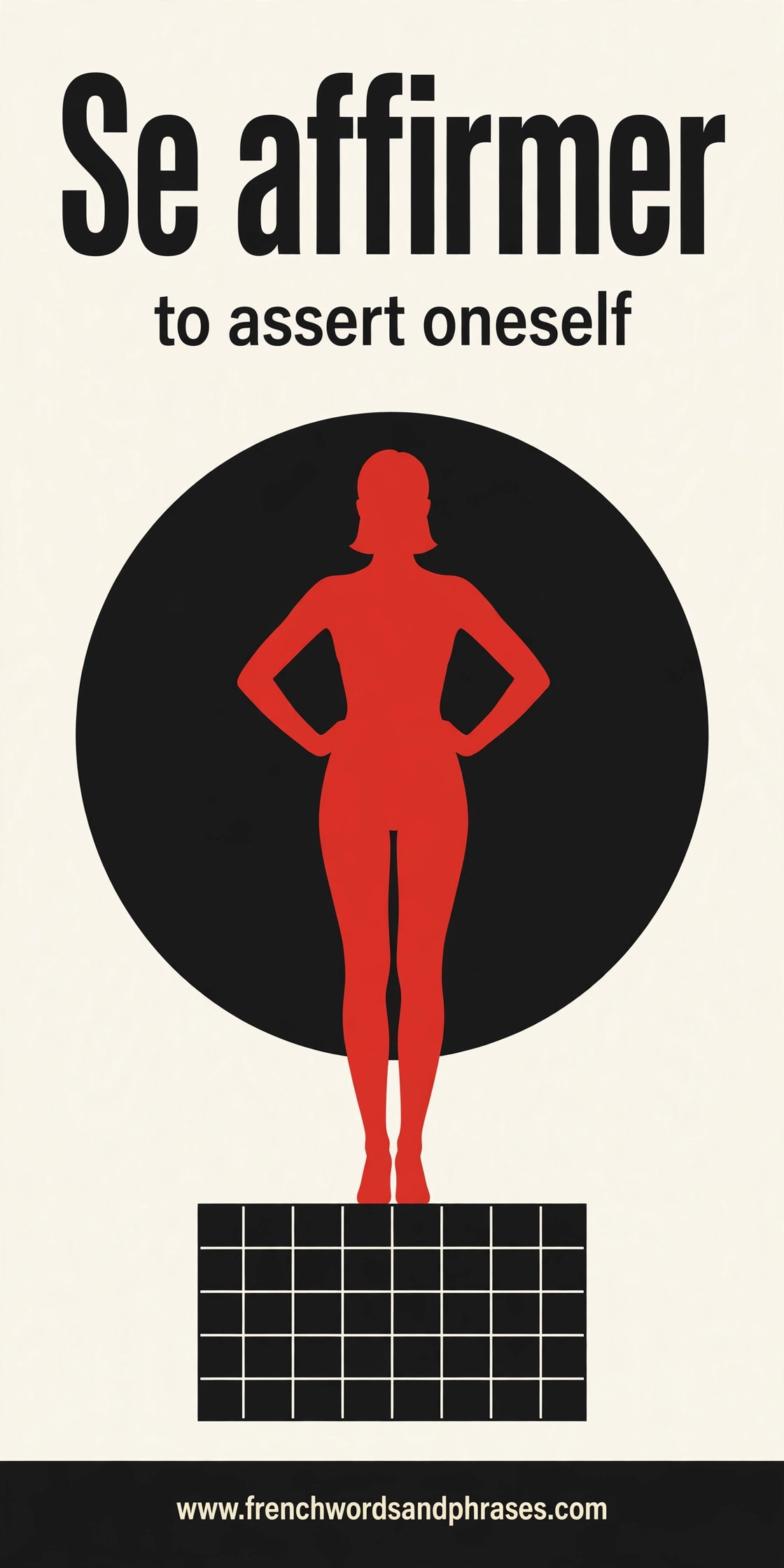
A French Word to Live By
How to Conjugate Se affirmer in French
/sa.fiʁ.me/
Se affirmer means to assert oneself — to stand up, speak up and take your place, so that nobody can pretend you are not there.
A shy apprentice speaking first at the meeting, a young artist signing her boldest canvas, a small nation holding its ground — se affirmer is the verb of self-assertion: the moment a person, a talent or an idea stops apologising and stands at its full height.
In this guide, you’ll learn how to conjugate se affirmer in all the major French tenses and moods. Explore complete conjugation tables, French examples, English translations, and practice quizzes.
Understanding the French Verb Se affirmer
Se affirmer is a regular French verb belonging to the first group of verbs, those ending in-er.
It means to assert oneself. It is commonly used of people finding their feet — shy employees, young artists, adolescents — and of things growing unmistakable: un style qui s’affirme, une tendance qui s’affirme, un talent qui s’affirme. L’affirmation de soi is the standard French term in psychology for assertiveness, the healthy middle ground between submission and aggression.
Verb classification: First group (-er), reflexive
Auxiliary verb: Être
Past participle: affirmé
Present participle: affirmant
English equivalents: To assert oneself, to make one’s mark; se affirmer au travail — to assert oneself at work; se affirmer comme un grand écrivain — to establish oneself as a great writer; une tendance qui s’affirme — a trend that is becoming established; l’affirmation de soi — self-assertion.
One important detail: se affirmer is the reflexive face of affirmer — where affirmer states a fact (il affirme que…, he states that…), se affirmer states yourself: your presence, your talent, your right to be counted. Its favourite companion is comme: elle s’est affirmée comme la meilleure joueuse de l’équipe. Being reflexive, it takes être in every compound tense and the participle agrees: elle s’est affirmée, ils se sont affirmés. The tu imperative tucks the pronoun behind the verb: affirme-toi !
Experience the Word
Se affirmer is the verb of standing at your full height — not shouting, not pushing, simply being undeniably there.
Imagine the youngest cook in a great kitchen, silent for two seasons, seasoning nothing without permission. This spring, during the panic of a full service, the head chef falters — and the young cook steps forward, calls the orders, saves the evening. Ce soir-là, il s’est affirmé: everyone in the kitchen, himself included, now knows who he is.
He has not boasted or fought. He has asserted himself — affirmé, established, become impossible to overlook.
How to Conjugate Se affirmer: Complete French Conjugation Guide
Let’s explore every major conjugation of se affirmer, beginning with the indicative mood.
How to Conjugate Se affirmer in the Indicative Mood
The indicative mood is used to express facts, observations, actions, and events.
How to Conjugate Se affirmer in the Present Tense (Présent)
Used for actions happening now, habitual actions, and general truths.
| Subject | Conjugation |
|---|---|
| je | m’affirme |
| tu | t’affirmes |
| il / elle | s’affirme |
| nous | nous affirmons |
| vous | vous affirmez |
| ils / elles | s’affirment |
Example
Elle s’affirme de plus en plus dans son travail.
She is asserting herself more and more in her work.
Quick Quiz 1
Complete the sentence:
Nous nous ______ dans notre métier.
Reveal the answer
affirmons
Nous nous affirmons dans notre métier.
We assert ourselves in our profession.
How to Conjugate Se affirmer in the Passé Composé
Used for completed actions in the past. Se affirmer takes the auxiliary verb être.
| Subject | Conjugation |
|---|---|
| je | me suis affirmé / me suis affirmée |
| tu | t’es affirmé / t’es affirmée |
| il / elle | s’est affirmé / s’est affirmée |
| nous | nous sommes affirmés / nous sommes affirmées |
| vous | vous êtes affirmés / vous êtes affirmées / vous êtes affirmé / vous êtes affirmée |
| ils / elles | se sont affirmés / se sont affirmées |
Example
Il s’est affirmé comme un grand chef.
He has established himself as a great chef.
How to Conjugate Se affirmer in the Imparfait (Imperfect Tense)
Used for habitual past actions, descriptions, and ongoing situations in the past.
| Subject | Conjugation |
|---|---|
| je | m’affirmais |
| tu | t’affirmais |
| il / elle | s’affirmait |
| nous | nous affirmions |
| vous | vous affirmiez |
| ils / elles | s’affirmaient |
Example
Son talent s’affirmait d’année en année.
His talent was asserting itself year by year.
Quick Quiz 2
Choose the correct form:
She has asserted herself at work.
Elle ______ au travail. (s’est affirmée / a affirmé)
Reveal the answer
s’est affirmée
Elle s’est affirmée au travail.
Se affirmer is reflexive, takes être, and the participle agrees: affirmée.
How to Conjugate Se affirmer in the Plus-que-parfait
Used to describe an action that had already been completed before another past event.
| Subject | Conjugation |
|---|---|
| je | m’étais affirmé / m’étais affirmée |
| tu | t’étais affirmé / t’étais affirmée |
| il / elle | s’était affirmé / s’était affirmée |
| nous | nous étions affirmés / nous étions affirmées |
| vous | vous étiez affirmés / vous étiez affirmées / vous étiez affirmé / vous étiez affirmée |
| ils / elles | s’étaient affirmés / s’étaient affirmées |
Example
Elle s’était affirmée avant même ses vingt ans.
She had asserted herself before she was even twenty.
How to Conjugate Se affirmer in the Passé Simple
Primarily used in formal writing, literature, and historical narratives. It is rarely used in everyday conversation.
| Subject | Conjugation |
|---|---|
| je | m’affirmai |
| tu | t’affirmas |
| il / elle | s’affirma |
| nous | nous affirmâmes |
| vous | vous affirmâtes |
| ils / elles | s’affirmèrent |
Example
Le jeune peintre s’affirma dès sa première exposition.
The young painter made his mark from his very first exhibition.
How to Conjugate Se affirmer in the Passé Antérieur
A literary tense used to express an action completed immediately before another past action, generally in the passé simple.
| Subject | Conjugation |
|---|---|
| je | me fus affirmé / me fus affirmée |
| tu | te fus affirmé / te fus affirmée |
| il / elle | se fut affirmé / se fut affirmée |
| nous | nous fûmes affirmés / nous fûmes affirmées |
| vous | vous fûtes affirmés / vous fûtes affirmées / vous fûtes affirmé / vous fûtes affirmée |
| ils / elles | se furent affirmés / se furent affirmées |
Example
Dès qu’elle se fut affirmée, les commandes arrivèrent.
As soon as she had established herself, the commissions arrived.
How to Conjugate Se affirmer in the Future Tense (Futur Simple)
Used to describe actions that will take place in the future.
| Subject | Conjugation |
|---|---|
| je | m’affirmerai |
| tu | t’affirmeras |
| il / elle | s’affirmera |
| nous | nous affirmerons |
| vous | vous affirmerez |
| ils / elles | s’affirmeront |
Example
Tu t’affirmeras avec l’expérience.
You will assert yourself with experience.
How to Conjugate Se affirmer in the Futur Antérieur (Future Perfect)
Used for an action that will have been completed before a particular point in the future.
| Subject | Conjugation |
|---|---|
| je | me serai affirmé / me serai affirmée |
| tu | te seras affirmé / te seras affirmée |
| il / elle | se sera affirmé / se sera affirmée |
| nous | nous serons affirmés / nous serons affirmées |
| vous | vous serez affirmés / vous serez affirmées / vous serez affirmé / vous serez affirmée |
| ils / elles | se seront affirmés / se seront affirmées |
Example
À trente ans, elle se sera affirmée dans son métier.
By thirty, she will have established herself in her profession.
How to Conjugate Se affirmer in the Near Future (Futur Proche)
Used to describe something that is going to happen soon. Formed with aller + infinitive.
| Subject | Conjugation |
|---|---|
| je | vais m’affirmer |
| tu | vas t’affirmer |
| il / elle | va s’affirmer |
| nous | allons nous affirmer |
| vous | allez vous affirmer |
| ils / elles | vont s’affirmer |
Example
Ce jeune joueur va s’affirmer cette saison.
This young player is going to make his mark this season.
How to Conjugate Se affirmer in the Conditional Mood
The conditional mood expresses what would happen under certain circumstances. It is also frequently used to make polite requests or express wishes.
How to Conjugate Se affirmer in the Present Conditional
| Subject | Conjugation |
|---|---|
| je | m’affirmerais |
| tu | t’affirmerais |
| il / elle | s’affirmerait |
| nous | nous affirmerions |
| vous | vous affirmeriez |
| ils / elles | s’affirmeraient |
Example
Avec plus de confiance, il s’affirmerait davantage.
With more confidence, he would assert himself more.
How to Conjugate Se affirmer in the Past Conditional
| Subject | Conjugation |
|---|---|
| je | me serais affirmé / me serais affirmée |
| tu | te serais affirmé / te serais affirmée |
| il / elle | se serait affirmé / se serait affirmée |
| nous | nous serions affirmés / nous serions affirmées |
| vous | vous seriez affirmés / vous seriez affirmées / vous seriez affirmé / vous seriez affirmée |
| ils / elles | se seraient affirmés / se seraient affirmées |
Example
Elle se serait affirmée plus tôt sans ce directeur.
She would have asserted herself earlier without that manager.
Se affirmer in the Literary Past Conditional Form
This less common literary form uses the imperfect subjunctive of être.
| Subject | Conjugation |
|---|---|
| je | me fusse affirmé / me fusse affirmée |
| tu | te fusses affirmé / te fusses affirmée |
| il / elle | se fût affirmé / se fût affirmée |
| nous | nous fussions affirmés / nous fussions affirmées |
| vous | vous fussiez affirmés / vous fussiez affinées / vous fussiez affirmé / vous fussiez affirmée |
| ils / elles | se fussent affirmés / se fussent affirmées |
Example
Il se fût affirmé sans l’ombre de son père.
He would have asserted himself without his father’s shadow.
How to Conjugate Se affirmer in the Subjunctive Mood
The subjunctive is used to express wishes, emotions, doubts, necessity, and uncertainty. It frequently follows expressions such as il faut que (it is necessary that) or bien que (although).
How to Conjugate Se affirmer in the Present Subjunctive
| Subject | Conjugation |
|---|---|
| que je | m’affirme |
| que tu | t’affirmes |
| qu’il / qu’elle | s’affirme |
| que nous | nous affirmions |
| que vous | vous affirmiez |
| qu’ils / qu’elles | s’affirment |
Example
Il est temps que tu t’affirmes un peu.
It is time you asserted yourself a little.
Quick Quiz 3
Complete the sentence using the subjunctive:
Il est temps que vous vous ______ un peu.
Reveal the answer
affirmiez
Il est temps que vous vous affirmiez un peu.
It is time you asserted yourselves a little.
How to Conjugate Se affirmer in the Imperfect Subjunctive
A literary tense, rarely encountered in modern spoken French.
| Subject | Conjugation |
|---|---|
| que je | m’affirmasse |
| que tu | t’affirmasses |
| qu’il / qu’elle | s’affirmât |
| que nous | nous affirmassions |
| que vous | vous affirmassiez |
| qu’ils / qu’elles | s’affirmassent |
Example
On attendait que le jeune chef s’affirmât enfin.
People were waiting for the young chef to assert himself at last.
How to Conjugate Se affirmer in the Pluperfect Subjunctive
A literary construction used to express an action completed before another past action.
| Subject | Conjugation |
|---|---|
| que je | me fusse affirmé / me fusse affirmée |
| que tu | te fusses affirmé / te fusses affirmée |
| qu’il / qu’elle | se fût affirmé / se fût affirmée |
| que nous | nous fussions affirmés / nous fussions affirmées |
| que vous | vous fussiez affirmés / vous fussiez affinées / vous fussiez affirmé / vous fussiez affirmée |
| qu’ils / qu’elles | se fussent affirmés / se fussent affirmées |
Example
On disait qu’elle se fût affirmée dès l’adolescence.
People said she had asserted herself from adolescence.
How to Conjugate Se affirmer in the Past Subjunctive
| Subject | Conjugation |
|---|---|
| que je | me sois affirmé / me sois affirmée |
| que tu | te sois affirmé / te sois affirmée |
| qu’il / qu’elle | se soit affirmé / se soit affirmée |
| que nous | nous soyons affirmés / nous soyons affirmées |
| que vous | vous soyez affirmés / vous soyez affirmées / vous soyez affirmé / vous soyez affirmée |
| qu’ils / qu’elles | se soient affirmés / se soient affirmées |
Example
Je suis fier qu’il se soit affirmé au travail.
I am proud he has asserted himself at work.
How to Conjugate Se affirmer in the Imperative
The imperative is used to give commands, instructions, invitations, or suggestions. Subject pronouns are omitted.
How to Conjugate Se affirmer in the Present Imperative
| Person | Conjugation |
|---|---|
| (tu) | affirme-toi |
| (nous) | affirmons-nous |
| (vous) | affirmez-vous |
Example
Affirme-toi, ne te laisse pas marcher sur les pieds !
Assert yourself, do not let people walk all over you!
Quick Quiz 4
How would you say Assert yourself (tu form)?
Reveal the answer
Affirme-toi !
French Participles of Se affirmer
Participles are verb forms that can be used in compound tenses and other grammatical constructions.
Present Participle of Se affirmer
affirmant
En s’affirmant, elle a gagné le respect de tous.
By asserting herself, she earned everyone’s respect.
Past Participle of Se affirmer
affirmé
Affirmée dans son art, la chanteuse ne doute plus.
Established in her art, the singer no longer doubts.
Se affirmer in Everyday French: Real-Life Examples
Now that you know the conjugations, let’s see how se affirmer appears in everyday French.
Example 1 — Present
Elle s’affirme dans son travail.
She is asserting herself in her work.
Example 2 — Passé composé
Il s’est affirmé comme un grand chef.
He has established himself as a great chef.
Example 3 — Imparfait
Son talent s’affirmait d’année en année.
His talent was asserting itself year by year.
Example 4 — Future
Tu t’affirmeras avec l’expérience.
You will assert yourself with experience.
Example 5 — Conditional
Il s’affirmerait davantage avec plus de confiance.
He would assert himself more with more confidence.
Example 6 — Imperative
Affirme-toi !
Assert yourself!
Beyond Translation: The Meaning of Se affirmer
English assert oneself is the exact translation, but French se affirmer ranges wider — all the way from a teenager finding her voice to a style becoming unmistakable.
Affirmer is to state; se affirmer is to stand.
The plain verb declares a fact to the world; the reflexive declares a person. French psychology borrowed the family name for its healthiest social skill: l’affirmation de soi, self-assertion — neither cringing nor crushing, just standing.
How to Remember the French Verb Se affirmer
Remember it this way: Se affirmer is about the young cook stepping forward in the middle of service.
- Affirmer states a fact; se affirmer states yourself — your presence, talent and place.
- Its partner is comme: se affirmer comme un grand écrivain, comme la meilleure joueuse.
- Always reflexive: être in compound tenses, participle agreeing — elle s’est affirmée.
The key idea is the young cook stepping forward in the middle of service.
Test Your Knowledge of Se affirmer
Let’s see how much you’ve learned. Try answering these questions before revealing the answers.
Question 1
What is the difference between affirmer and se affirmer?
Reveal the answer
Affirmer states a fact (il affirme que…); se affirmer asserts the person — presence, talent, place.
Question 2
How do you say He has established himself as a great chef in French?
Reveal the answer
Il s’est affirmé comme un grand chef.
Question 3
Translate: It is time you asserted yourself a little.
Reveal the answer
Il est temps que tu t’affirmes un peu.
Question 4
What is the past participle of se affirmer, and how does it agree?
Reveal the answer
Affirmé — agreeing with the subject: affirmée, affirmés, affirmées.
Question 5
Complete the sentence:
Je suis fier qu’il se ______ affirmé au travail.
Reveal the answer
soit
Je suis fier qu’il se soit affirmé au travail.
I am proud he has asserted himself at work.
Your Final Challenge
Can You Use It?
How would you say this in French?
To assert yourself is not to shout louder than the others, it is simply to remain standing.
Reveal the answer
S’affirmer n’est pas crier plus fort que les autres, c’est simplement rester debout.
To assert yourself is not to shout louder than the others, it is simply to remain standing.
A little French. A little curiosity. A richer everyday life.
LEARN FRENCH ONE WORD AT A TIME