A French Word to Live By
How to Conjugate Affleurer in French
/a.flœ.ʁe/
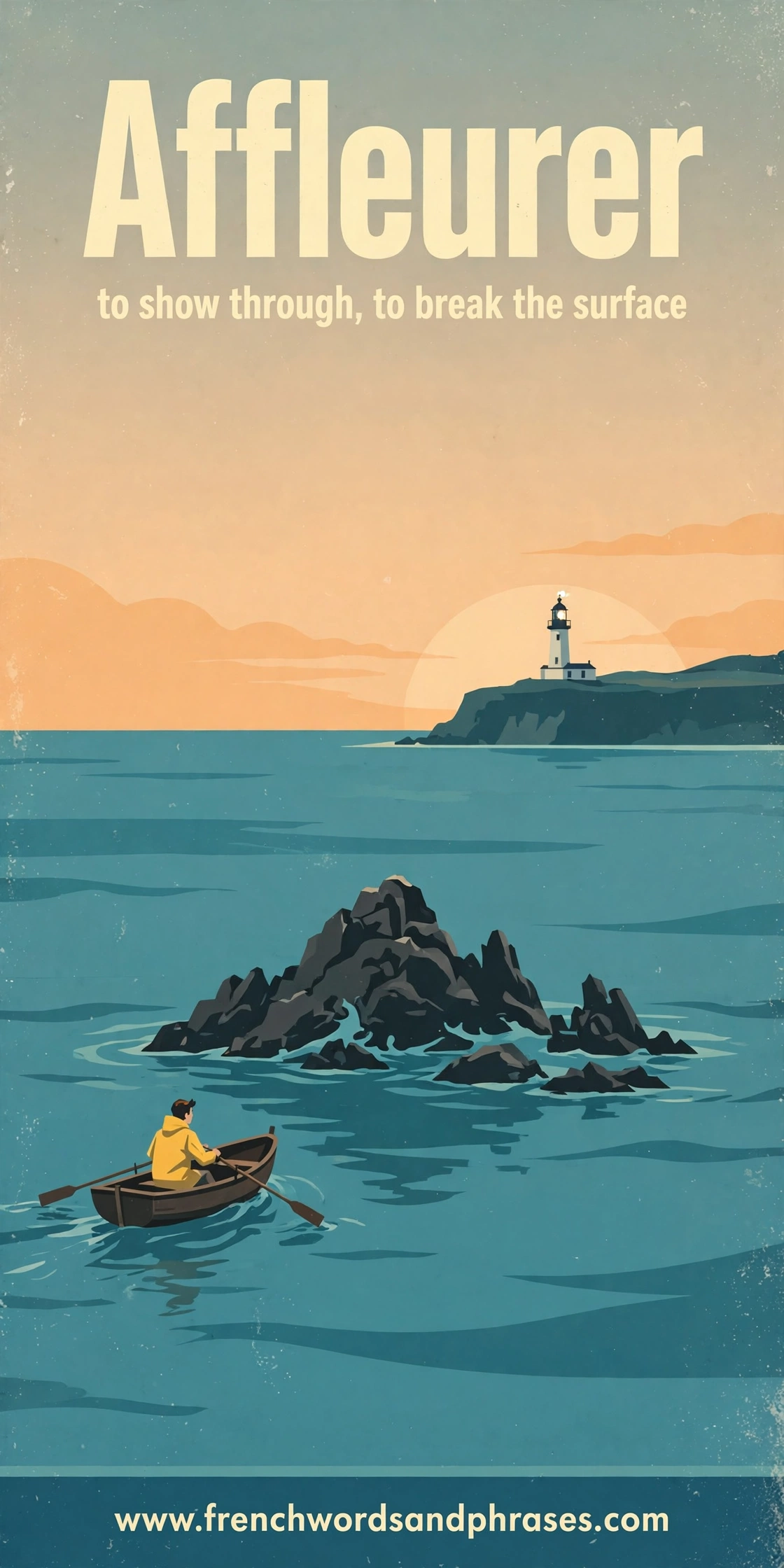
Affleurer means to show through, to break the surface — to rise exactly level with what covers you, and appear.
A vein of white rock crossing a ploughed field, the water of a well trembling at the brim, a smile that reaches the lips and stops — affleurer is the verb of the surface line: whatever rises to it, touches it, and shows itself without ever spilling over.
In this guide, you’ll learn how to conjugate affleurer in all the major French tenses and moods. Explore complete conjugation tables, French examples, English translations, and practice quizzes.
Understanding the French Verb Affleurer
Affleurer is a regular French verb belonging to the first group of verbs, those ending in-er.
It means to show through, to break the surface. It is commonly used in geology for rock strata and veins that reach the surface — un affleurement is an outcrop, a technical noun every geology student meets — and in finer writing for water at the brim and for feelings that show without breaking through: un sourire affleure, une émotion affleure, des larmes affleurent.
Verb classification: First group (-er)
Auxiliary verb: Avoir
Past participle: affleuré
Present participle: affleurant
English equivalents: To show through, to break the surface, to lie flush; la roche affleure — the rock outcrops; l’eau affleure le bord — the water reaches the brim; un sourire affleure — a smile hovers, shows; à fleur de — flush with, level with the surface of.
One important detail: affleurer is built on à fleur de — at the flower, that is, at the very surface of something: à fleur d’eau, at water level; à fleur de peau, just under the skin. To affleurer is to come exactly to that line and show: rock showing through soil, water at the brim, emotion at the lips. It takes avoir, and it is intransitive — things affleurent, nobody affleure something in the common language of the surface (builders use it transitively for levelling, a separate trade sense). The verb is perfectly regular: il affleure, nous affleurons, ils affleurent.
Experience the Word
Affleurer is the verb of almost — everything in it rises, arrives at the surface, and stops exactly there, visible but contained.
Imagine walking a ploughed field after rain. Across the brown earth runs a pale ribbon where the limestone affleure — the buried rock of the hill, rising to meet the daylight. You are walking on a hidden mountain, and only here, at the surface line, does it confess that it exists.
The rock has not erupted or broken out. It has shown through — affleuré, level with the soil, quietly visible.
How to Conjugate Affleurer: Complete French Conjugation Guide
Let’s explore every major conjugation of affleurer, beginning with the indicative mood.
How to Conjugate Affleurer in the Indicative Mood
The indicative mood is used to express facts, observations, actions, and events.
How to Conjugate Affleurer in the Present Tense (Présent)
Used for actions happening now, habitual actions, and general truths.
| Subject | Conjugation |
|---|---|
| je | affleure |
| tu | affleures |
| il / elle | affleure |
| nous | affleurons |
| vous | affleurez |
| ils / elles | affleurent |
Example
La roche affleure au milieu du champ.
The rock breaks the surface in the middle of the field.
Quick Quiz 1
Complete the sentence:
Les rochers ______ à marée basse.
Reveal the answer
affleurent
Les rochers affleurent à marée basse.
The rocks break the surface at low tide.
How to Conjugate Affleurer in the Passé Composé
Used for completed actions in the past. Affleurer takes the auxiliary verb avoir.
| Subject | Conjugation |
|---|---|
| j’ | ai affleuré |
| tu | as affleuré |
| il / elle | a affleuré |
| nous | avons affleuré |
| vous | avez affleuré |
| ils / elles | ont affleuré |
Example
Un sourire a affleuré sur ses lèvres.
A smile hovered on her lips.
How to Conjugate Affleurer in the Imparfait (Imperfect Tense)
Used for habitual past actions, descriptions, and ongoing situations in the past.
| Subject | Conjugation |
|---|---|
| je | affleurais |
| tu | affleurais |
| il / elle | affleurait |
| nous | affleurions |
| vous | affleuriez |
| ils / elles | affleuraient |
Example
L’eau affleurait le bord du puits.
The water reached the brim of the well.
Quick Quiz 2
Choose the correct form:
The water reached the brim of the well.
L’eau ______ le bord du puits. (affleurait / affleurais)
Reveal the answer
affleurait
L’eau affleurait le bord du puits.
Third person singular, imperfect: affleurait.
How to Conjugate Affleurer in the Plus-que-parfait
Used to describe an action that had already been completed before another past event.
| Subject | Conjugation |
|---|---|
| j’ | avais affleuré |
| tu | avais affleuré |
| il / elle | avait affleuré |
| nous | avions affleuré |
| vous | aviez affleuré |
| ils / elles | avaient affleuré |
Example
La veine de marbre avait affleuré après les pluies.
The vein of marble had shown through after the rains.
How to Conjugate Affleurer in the Passé Simple
Primarily used in formal writing, literature, and historical narratives. It is rarely used in everyday conversation.
| Subject | Conjugation |
|---|---|
| je | affleurai |
| tu | affleuras |
| il / elle | affleura |
| nous | affleurâmes |
| vous | affleurâtes |
| ils / elles | affleurèrent |
Example
Les rochers affleurèrent à marée basse.
The rocks broke the surface at low tide.
How to Conjugate Affleurer in the Passé Antérieur
A literary tense used to express an action completed immediately before another past action, generally in the passé simple.
| Subject | Conjugation |
|---|---|
| j’ | eus affleuré |
| tu | eus affleuré |
| il / elle | eut affleuré |
| nous | eûmes affleuré |
| vous | eûtes affleuré |
| ils / elles | eurent affleuré |
Example
Quand la source eut affleuré, les bêtes vinrent boire.
When the spring had reached the surface, the animals came to drink.
How to Conjugate Affleurer in the Future Tense (Futur Simple)
Used to describe actions that will take place in the future.
| Subject | Conjugation |
|---|---|
| je | affleurerai |
| tu | affleureras |
| il / elle | affleurera |
| nous | affleurerons |
| vous | affleurerez |
| ils / elles | affleureront |
Example
À marée basse, les récifs affleureront.
At low tide, the reefs will break the surface.
How to Conjugate Affleurer in the Futur Antérieur (Future Perfect)
Used for an action that will have been completed before a particular point in the future.
| Subject | Conjugation |
|---|---|
| j’ | aurai affleuré |
| tu | auras affleuré |
| il / elle | aura affleuré |
| nous | aurons affleuré |
| vous | aurez affleuré |
| ils / elles | auront affleuré |
Example
Après la crue, la nappe aura affleuré partout.
After the flood, the water table will have reached the surface everywhere.
How to Conjugate Affleurer in the Near Future (Futur Proche)
Used to describe something that is going to happen soon. Formed with aller + infinitive.
| Subject | Conjugation |
|---|---|
| je | vais affleurer |
| tu | vas affleurer |
| il / elle | va affleurer |
| nous | allons affleurer |
| vous | allez affleurer |
| ils / elles | vont affleurer |
Example
Regarde, l’eau va affleurer le bord du bassin.
Look, the water is going to reach the edge of the basin.
How to Conjugate Affleurer in the Conditional Mood
The conditional mood expresses what would happen under certain circumstances. It is also frequently used to make polite requests or express wishes.
How to Conjugate Affleurer in the Present Conditional
| Subject | Conjugation |
|---|---|
| je | affleurerais |
| tu | affleurerais |
| il / elle | affleurerait |
| nous | affleurerions |
| vous | affleureriez |
| ils / elles | affleureraient |
Example
Sans la sécheresse, la source affleurerait ici.
Without the drought, the spring would reach the surface here.
How to Conjugate Affleurer in the Past Conditional
| Subject | Conjugation |
|---|---|
| j’ | aurais affleuré |
| tu | aurais affleuré |
| il / elle | aurait affleuré |
| nous | aurions affleuré |
| vous | auriez affleuré |
| ils / elles | auraient affleuré |
Example
Un sourire aurait affleuré sans sa timidité.
A smile would have shown, were it not for her shyness.
Affleurer in the Literary Past Conditional Form
This less common literary form uses the imperfect subjunctive of avoir.
| Subject | Conjugation |
|---|---|
| j’ | eusse affleuré |
| tu | eusses affleuré |
| il / elle | eût affleuré |
| nous | eussions affleuré |
| vous | eussiez affleuré |
| ils / elles | eussent affleuré |
Example
La roche eût affleuré sans cette couche de terre.
The rock would have shown through without this layer of earth.
How to Conjugate Affleurer in the Subjunctive Mood
The subjunctive is used to express wishes, emotions, doubts, necessity, and uncertainty. It frequently follows expressions such as il faut que (it is necessary that) or bien que (although).
How to Conjugate Affleurer in the Present Subjunctive
| Subject | Conjugation |
|---|---|
| que je | affleure |
| que tu | affleures |
| qu’il / qu’elle | affleure |
| que nous | affleurions |
| que vous | affleuriez |
| qu’ils / qu’elles | affleurent |
Example
Il est rare que la nappe affleure en été.
It is rare for the water table to reach the surface in summer.
Quick Quiz 3
Complete the sentence using the subjunctive:
Il est rare que la source ______ en été.
Reveal the answer
affleure
Il est rare que la source affleure en été.
It is rare for the spring to reach the surface in summer.
How to Conjugate Affleurer in the Imperfect Subjunctive
A literary tense, rarely encountered in modern spoken French.
| Subject | Conjugation |
|---|---|
| que je | affleurasse |
| que tu | affleurasses |
| qu’il / qu’elle | affleurât |
| que nous | affleurassions |
| que vous | affleurassiez |
| qu’ils / qu’elles | affleurassent |
Example
On voyait à peine que le récif affleurât.
You could barely see that the reef broke the surface.
How to Conjugate Affleurer in the Pluperfect Subjunctive
A literary construction used to express an action completed before another past action.
| Subject | Conjugation |
|---|---|
| que j’ | eusse affleuré |
| que tu | eusses affleuré |
| qu’il / qu’elle | eût affleuré |
| que nous | eussions affleuré |
| que vous | eussiez affleuré |
| qu’ils / qu’elles | eussent affleuré |
Example
On racontait que l’or eût affleuré dans ce ruisseau.
They said gold had shown at the surface in this stream.
How to Conjugate Affleurer in the Past Subjunctive
| Subject | Conjugation |
|---|---|
| que j’ | aie affleuré |
| que tu | aies affleuré |
| qu’il / qu’elle | ait affleuré |
| que nous | ayons affleuré |
| que vous | ayez affleuré |
| qu’ils / qu’elles | aient affleuré |
Example
Je suis étonné que l’eau ait affleuré si vite.
I am surprised the water reached the surface so quickly.
How to Conjugate Affleurer in the Imperative
The imperative is used to give commands, instructions, invitations, or suggestions. Subject pronouns are omitted.
How to Conjugate Affleurer in the Present Imperative
| Person | Conjugation |
|---|---|
| (tu) | affleure |
| (nous) | affleurons |
| (vous) | affleurez |
Example
Affleure, petit sourire, ne te cache plus !
Show yourself, little smile, hide no longer!
Quick Quiz 4
How would you say Show yourself, little smile (tu form)?
Reveal the answer
Affleure, petit sourire !
French Participles of Affleurer
Participles are verb forms that can be used in compound tenses and other grammatical constructions.
Present Participle of Affleurer
affleurant
En affleurant, la roche dessine une ligne blanche.
In breaking the surface, the rock draws a white line.
Past Participle of Affleurer
affleuré
Affleuré par endroits, le filon guide les chercheurs.
Showing through in places, the vein guides the prospectors.
Affleurer in Everyday French: Real-Life Examples
Now that you know the conjugations, let’s see how affleurer appears in everyday French.
Example 1 — Present
La roche affleure au milieu du champ.
The rock breaks the surface in the middle of the field.
Example 2 — Passé composé
Un sourire a affleuré sur ses lèvres.
A smile hovered on her lips.
Example 3 — Imparfait
L’eau affleurait le bord du puits.
The water reached the brim of the well.
Example 4 — Future
Les récifs affleureront à marée basse.
The reefs will break the surface at low tide.
Example 5 — Conditional
La source affleurerait ici sans la sécheresse.
The spring would reach the surface here without the drought.
Example 6 — Imperative
Affleure, petit sourire !
Show yourself, little smile!
Beyond Translation: The Meaning of Affleurer
English outcrop is the geologist’s word, but French affleurer keeps the flower in it — fleur, the surface bloom of a thing.
Everything that affleure is on the point of confessing.
Rock confesses the mountain, water confesses the spring, and a face confesses its feeling — un sourire qui affleure is a secret that has risen exactly as far as the lips, and no further.
How to Remember the French Verb Affleurer
Remember it this way: Affleurer is about the pale vein of rock showing through the ploughed field.
- Picture à fleur d’eau — at the flower of the water: affleurer is rising to that surface line and showing.
- Its three worlds: rock outcropping, water at the brim, and smiles and tears that show without spilling.
- Regular -er with avoir: il affleure, nous affleurons, past participle affleuré.
The key idea is the pale vein of rock showing through the ploughed field.
Test Your Knowledge of Affleurer
Let’s see how much you’ve learned. Try answering these questions before revealing the answers.
Question 1
What does à fleur de mean, and how does it explain affleurer?
Reveal the answer
À fleur de means flush with the surface of — to affleurer is to rise exactly to that surface and show through.
Question 2
How do you say The rock breaks the surface in the middle of the field in French?
Reveal the answer
La roche affleure au milieu du champ.
Question 3
Translate: A smile hovered on her lips.
Reveal the answer
Un sourire a affleuré sur ses lèvres.
Question 4
What is the past participle of affleurer?
Reveal the answer
Affleuré.
Question 5
Complete the sentence:
Il est rare que la nappe ______ en été.
Reveal the answer
affleure
Il est rare que la nappe affleure en été.
It is rare for the water table to reach the surface in summer.
Your Final Challenge
Can You Use It?
How would you say this in French?
A smile shows on her lips, and all her sadness becomes visible for a moment.
Reveal the answer
Un sourire affleure sur ses lèvres, et toute sa tristesse devient visible un instant.
A smile shows on her lips, and all her sadness becomes visible for a moment.
A little French. A little curiosity. A richer everyday life.
LEARN FRENCH ONE WORD AT A TIME