A French Word to Live By
How to Conjugate Affabuler in French
/a.fa.by.le/
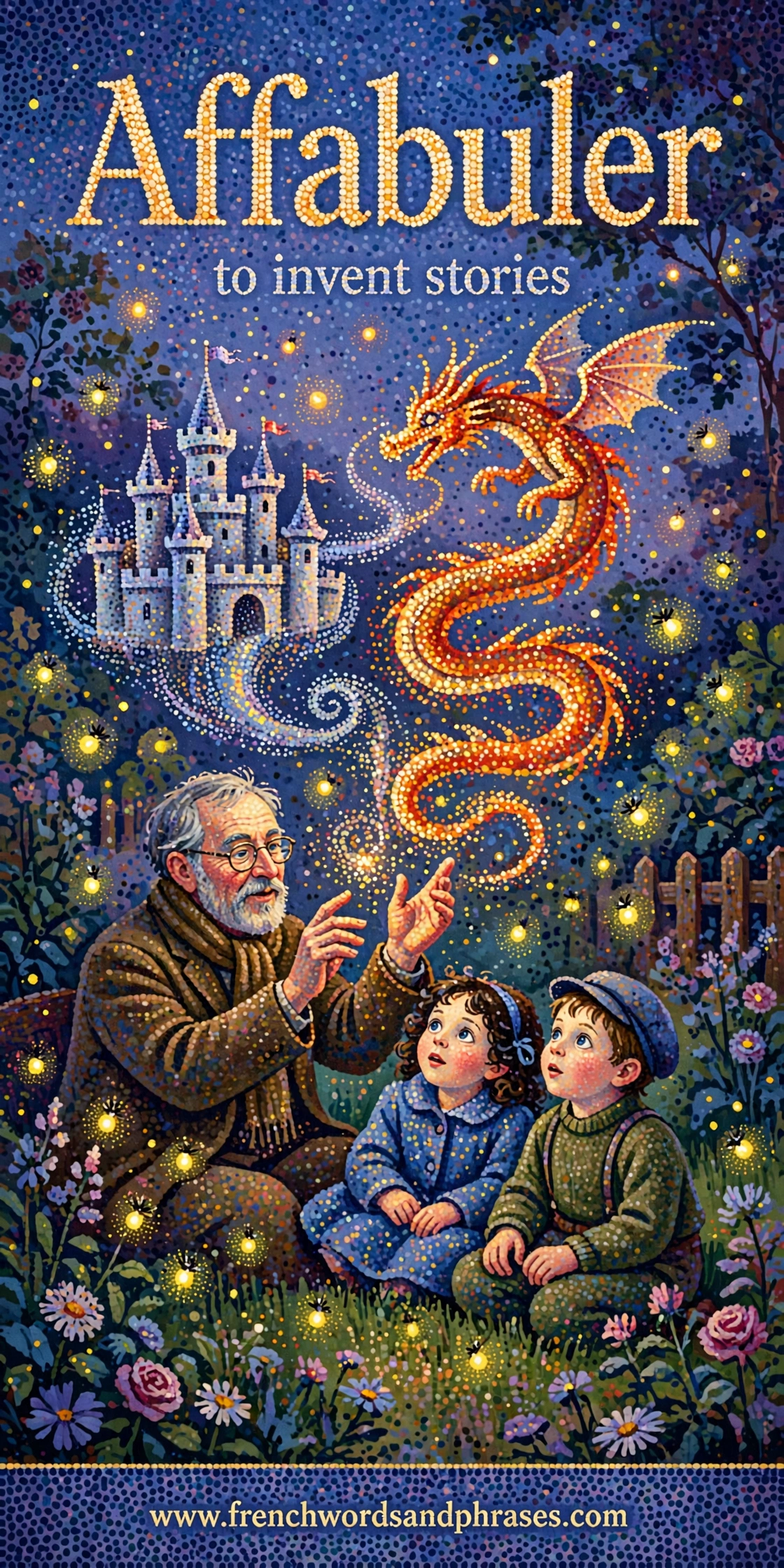
Affabuler means to invent stories — to dress up the bare facts in a plot, or to make the whole tale up out of whole cloth.
A fisherman whose fish grows at every retelling, a grandfather whose war gets braver each winter, a novelist building a world from a single overheard sentence — affabuler is the verb of turning events into stories, true or not.
In this guide, you’ll learn how to conjugate affabuler in all the major French tenses and moods. Explore complete conjugation tables, French examples, English translations, and practice quizzes.
Understanding the French Verb Affabuler
Affabuler is a regular French verb belonging to the first group of verbs, those ending in-er.
It means to invent stories. It is used of children inventing excuses, of witnesses embroidering testimony, of grandparents improving their memories, and — respectably — of novelists and playwrights constructing plots. The word always implies invention at work on raw material: pure lying is mentir; affabuler is lying with architecture.
Verb classification: First group (-er)
Auxiliary verb: Avoir
Past participle: affabulé
Present participle: affabulant
English equivalents: To invent stories, to make up tales; affabuler sur son passé — to spin yarns about one’s past; affabuler un récit — to fabricate a narrative; l’affabulation d’un roman — the plot construction of a novel; un enfant qui affabule — a child who makes things up.
One important detail: affabuler is a completely regular -er verb — j’affabule, nous affabulons, affabulé — with no spelling trap. Its interest is its double life: in everyday speech it means to make things up, with a whiff of the tall tale, while in literary language l’affabulation is a neutral, technical word for the way a novel’s plot is built. Context decides whether the storyteller is a craftsman or a fabulist.
Experience the Word
Affabuler is the verb of the improved past — facts go in at one end, and a story, with a beginning, a middle and a much bigger fish, comes out at the other.
Imagine a fisherman in a port café. The sardine he caught in June was this long; by August it needs both arms to describe; by Christmas it nearly sank the boat. Il affabule, everyone knows it, and nobody in the café would have it any other way.
The fish was real once. Now it is a story — affabulé — and better than the truth.
How to Conjugate Affabuler: Complete French Conjugation Guide
Let’s explore every major conjugation of affabuler, beginning with the indicative mood.
How to Conjugate Affabuler in the Indicative Mood
The indicative mood is used to express facts, observations, actions, and events.
How to Conjugate Affabuler in the Present Tense (Présent)
Used for actions happening now, habitual actions, and general truths.
| Subject | Conjugation |
|---|---|
| je | affabule |
| tu | affabules |
| il / elle | affabule |
| nous | affabulons |
| vous | affabulez |
| ils / elles | affabulent |
Example
Grand-père affabule dès qu’on lui demande son passé.
Grandfather invents stories as soon as anyone asks about his past.
Quick Quiz 1
Complete the sentence:
Grand-père ______ dès qu’on lui demande son passé.
Reveal the answer
affabule
Grand-père affabule dès qu’on lui demande son passé.
Grandfather invents stories as soon as anyone asks about his past.
How to Conjugate Affabuler in the Passé Composé
Used for completed actions in the past. Affabuler takes the auxiliary verb avoir.
| Subject | Conjugation |
|---|---|
| j’ | ai affabulé |
| tu | as affabulé |
| il / elle | a affabulé |
| nous | avons affabulé |
| vous | avez affabulé |
| ils / elles | ont affabulé |
Example
Il a affabulé toute son enfance pour impressionner les invités.
He made up his whole childhood to impress the guests.
How to Conjugate Affabuler in the Imparfait (Imperfect Tense)
Used for habitual past actions, descriptions, and ongoing situations in the past.
| Subject | Conjugation |
|---|---|
| je | affabulais |
| tu | affabulais |
| il / elle | affabulait |
| nous | affabulions |
| vous | affabuliez |
| ils / elles | affabulaient |
Example
Enfant, elle affabulait sans cesse pour éviter les punitions.
As a child, she was always making things up to avoid punishment.
Quick Quiz 2
Choose the correct form:
He made up his whole childhood.
Il ______ toute son enfance. (a affabulé / est affabulé)
Reveal the answer
a affabulé
Il a affabulé toute son enfance.
Affabuler is a plain verb with avoir: a affabulé.
How to Conjugate Affabuler in the Plus-que-parfait
Used to describe an action that had already been completed before another past event.
| Subject | Conjugation |
|---|---|
| j’ | avais affabulé |
| tu | avais affabulé |
| il / elle | avait affabulé |
| nous | avions affabulé |
| vous | aviez affabulé |
| ils / elles | avaient affabulé |
Example
Le témoin avait affabulé une partie de son récit.
The witness had invented part of his account.
How to Conjugate Affabuler in the Passé Simple
Primarily used in formal writing, literature, and historical narratives. It is rarely used in everyday conversation.
| Subject | Conjugation |
|---|---|
| je | affabulai |
| tu | affabulas |
| il / elle | affabula |
| nous | affabulâmes |
| vous | affabulâtes |
| ils / elles | affabulèrent |
Example
Le vieil homme affabula une jeunesse héroïque.
The old man spun a heroic youth for himself.
How to Conjugate Affabuler in the Passé Antérieur
A literary tense used to express an action completed immediately before another past action, generally in the passé simple.
| Subject | Conjugation |
|---|---|
| j’ | eus affabulé |
| tu | eus affabulé |
| il / elle | eut affabulé |
| nous | eûmes affabulé |
| vous | eûtes affabulé |
| ils / elles | eurent affabulé |
Example
Quand il eut affabulé son histoire, les enfants applaudirent.
When he had finished inventing his story, the children applauded.
How to Conjugate Affabuler in the Future Tense (Futur Simple)
Used to describe actions that will take place in the future.
| Subject | Conjugation |
|---|---|
| je | affabulerai |
| tu | affabuleras |
| il / elle | affabulera |
| nous | affabulerons |
| vous | affabulerez |
| ils / elles | affabuleront |
Example
Demain, il affabulera encore sur sa fameuse pêche.
Tomorrow, he will spin more yarns about his famous fishing trip.
How to Conjugate Affabuler in the Futur Antérieur (Future Perfect)
Used for an action that will have been completed before a particular point in the future.
| Subject | Conjugation |
|---|---|
| j’ | aurai affabulé |
| tu | auras affabulé |
| il / elle | aura affabulé |
| nous | aurons affabulé |
| vous | aurez affabulé |
| ils / elles | auront affabulé |
Example
À la fin du repas, il aura affabulé trois exploits.
By the end of the meal, he will have invented three feats.
How to Conjugate Affabuler in the Near Future (Futur Proche)
Used to describe something that is going to happen soon. Formed with aller + infinitive.
| Subject | Conjugation |
|---|---|
| je | vais affabuler |
| tu | vas affabuler |
| il / elle | va affabuler |
| nous | allons affabuler |
| vous | allez affabuler |
| ils / elles | vont affabuler |
Example
Ne va pas affabuler devant le directeur !
Do not go making up stories in front of the director!
How to Conjugate Affabuler in the Conditional Mood
The conditional mood expresses what would happen under certain circumstances. It is also frequently used to make polite requests or express wishes.
How to Conjugate Affabuler in the Present Conditional
| Subject | Conjugation |
|---|---|
| je | affabulerais |
| tu | affabulerais |
| il / elle | affabulerait |
| nous | affabulerions |
| vous | affabuleriez |
| ils / elles | affabuleraient |
Example
Sans témoins, il affabulerait des exploits incroyables.
Without witnesses, he would invent incredible exploits.
How to Conjugate Affabuler in the Past Conditional
| Subject | Conjugation |
|---|---|
| j’ | aurais affabulé |
| tu | aurais affabulé |
| il / elle | aurait affabulé |
| nous | aurions affabulé |
| vous | auriez affabulé |
| ils / elles | auraient affabulé |
Example
Elle aurait affabulé une excuse si on l’avait interrogée.
She would have made up an excuse if she had been questioned.
Affabuler in the Literary Past Conditional Form
This less common literary form uses the imperfect subjunctive of avoir.
| Subject | Conjugation |
|---|---|
| j’ | eusse affabulé |
| tu | eusses affabulé |
| il / elle | eût affabulé |
| nous | eussions affabulé |
| vous | eussiez affabulé |
| ils / elles | eussent affabulé |
Example
Il eût affabulé sa vie entière pour une heure d’attention.
He would have invented his whole life for one hour of attention.
How to Conjugate Affabuler in the Subjunctive Mood
The subjunctive is used to express wishes, emotions, doubts, necessity, and uncertainty. It frequently follows expressions such as il faut que (it is necessary that) or bien que (although).
How to Conjugate Affabuler in the Present Subjunctive
| Subject | Conjugation |
|---|---|
| que je | affabule |
| que tu | affabules |
| qu’il / qu’elle | affabule |
| que nous | affabulions |
| que vous | affabuliez |
| qu’ils / qu’elles | affabulent |
Example
Je ne crois pas qu’il affabule, cette fois.
I do not think he is making it up, this time.
Quick Quiz 3
Complete the sentence using the subjunctive:
Je ne crois pas qu’il ______ cette fois.
Reveal the answer
affabule
Je ne crois pas qu’il affabule, cette fois.
I do not think he is making it up, this time.
How to Conjugate Affabuler in the Imperfect Subjunctive
A literary tense, rarely encountered in modern spoken French.
| Subject | Conjugation |
|---|---|
| que je | affabulasse |
| que tu | affabulasses |
| qu’il / qu’elle | affabulât |
| que nous | affabulassions |
| que vous | affabulassiez |
| qu’ils / qu’elles | affabulassent |
Example
Il parlait si bien qu’on oubliait qu’il affabulât.
He spoke so well that you forgot he was inventing.
How to Conjugate Affabuler in the Pluperfect Subjunctive
A literary construction used to express an action completed before another past action.
| Subject | Conjugation |
|---|---|
| que j’ | eusse affabulé |
| que tu | eusses affabulé |
| qu’il / qu’elle | eût affabulé |
| que nous | eussions affabulé |
| que vous | eussiez affabulé |
| qu’ils / qu’elles | eussent affabulé |
Example
On soupçonnait qu’elle eût affabulé son témoignage.
People suspected she had fabricated her testimony.
How to Conjugate Affabuler in the Past Subjunctive
| Subject | Conjugation |
|---|---|
| que j’ | aie affabulé |
| que tu | aies affabulé |
| qu’il / qu’elle | ait affabulé |
| que nous | ayons affabulé |
| que vous | ayez affabulé |
| qu’ils / qu’elles | aient affabulé |
Example
Il est évident qu’il a affabulé la moitié du récit.
It is obvious he invented half the story.
How to Conjugate Affabuler in the Imperative
The imperative is used to give commands, instructions, invitations, or suggestions. Subject pronouns are omitted.
How to Conjugate Affabuler in the Present Imperative
| Person | Conjugation |
|---|---|
| (tu) | affabule |
| (nous) | affabulons |
| (vous) | affabulez |
Example
N’affabule pas, raconte simplement ce que tu as vu !
Do not make things up, just tell what you saw!
Quick Quiz 4
How would you say Do not make things up (tu form)?
Reveal the answer
N’affabule pas !
French Participles of Affabuler
Participles are verb forms that can be used in compound tenses and other grammatical constructions.
Present Participle of Affabuler
affabulant
En affabulant son passé, il devint le héros du village.
By inventing stories about his past, he became the hero of the village.
Past Participle of Affabuler
affabulé
Affabulé par les témoins, le récit ne ressemblait plus aux faits.
Embellished by the witnesses, the account no longer resembled the facts.
Affabuler in Everyday French: Real-Life Examples
Now that you know the conjugations, let’s see how affabuler appears in everyday French.
Example 1 — Present
Grand-père affabule sur son passé.
Grandfather spins yarns about his past.
Example 2 — Passé composé
Il a affabulé toute son enfance.
He made up his whole childhood.
Example 3 — Imparfait
Elle affabulait pour éviter les punitions.
She used to make things up to avoid punishment.
Example 4 — Future
Il affabulera encore sur sa fameuse pêche.
He will spin more yarns about his famous fishing trip.
Example 5 — Conditional
Il affabulerait des exploits incroyables.
He would invent incredible exploits.
Example 6 — Imperative
N’affabule pas, raconte ce que tu as vu !
Do not make things up, tell what you saw!
Beyond Translation: The Meaning of Affabuler
Inside affabuler is la fable — the fable, the tale with animals and a moral, from Latin fabula, a story told.
The verb never quite loses the storyteller’s licence.
French psychologists use it of children whose invented tales are development, not deceit, and critics speak of l’affabulation of a novel as its plot-making machinery. Between the café liar and the novelist, the same verb stretches — invention is invention, only the contract with the listener changes.
How to Remember the French Verb Affabuler
Remember it this way: Affabuler is about the fisherman’s fish, growing at every retelling.
- Regular -er, no traps: j’affabule, nous affabulons, affabulé.
- Inside it is la fable: affabuler is to build a fable on top of the facts.
- Not plain lying — mentir is lying; affabuler is lying with architecture.
The key idea is the fisherman’s fish, growing at every retelling.
Test Your Knowledge of Affabuler
Let’s see how much you’ve learned. Try answering these questions before revealing the answers.
Question 1
What word hides inside affabuler?
Reveal the answer
La fable — affabuler is to build a fable, an invented story, on top of the facts.
Question 2
How do you say Grandfather invents stories about his past in French?
Reveal the answer
Grand-père affabule sur son passé.
Question 3
Translate: He made up his whole childhood.
Reveal the answer
Il a affabulé toute son enfance.
Question 4
What is the past participle of affabuler?
Reveal the answer
Affabulé — affabulée, affabulés, affabulées.
Question 5
Complete the sentence:
Je ne crois pas qu’il ______ cette fois.
Reveal the answer
affabule
Je ne crois pas qu’il affabule, cette fois.
I do not think he is making it up, this time.
Your Final Challenge
Can You Use It?
How would you say this in French?
The old fisherman spins his yarns at the café, and his fish grows with the years.
Reveal the answer
Le vieux pêcheur affabule au café, et son poisson grandit avec les années.
The old fisherman spins his yarns at the café, and his fish grows with the years.
A little French. A little curiosity. A richer everyday life.
LEARN FRENCH ONE WORD AT A TIME